
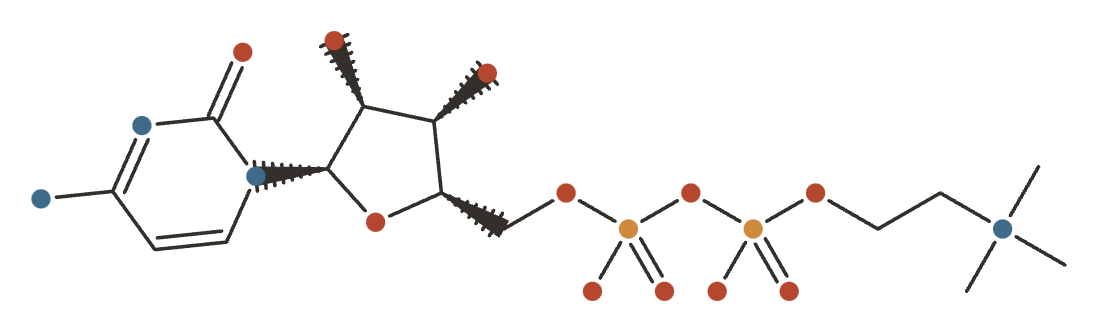
Citicoline (CDP-Choline)
A choline-donor nootropic with real placebo-controlled memory data in older adults — and two large negative trials that the marketing leaves out.

Citicoline (CDP-Choline) at a Glance
Citicoline is a naturally occurring choline–cytidine compound (cytidine-5′-diphosphocholine) — an intermediate in the body’s own synthesis of phosphatidylcholine, the main phospholipid of neuronal membranes. Taken orally it is hydrolysed in the gut and delivers two circulating substrates: choline, for acetylcholine and membrane synthesis, and cytidine, which humans convert to uridine.
It is not really a food compound. Citicoline exists intracellularly in trace amounts, so effectively all supplemental citicoline is manufactured by fermentation. It is also a licensed medicine for stroke and cognitive disorders in several countries, which is why it has a far larger trial record than most things in this class.
The framing that matters: citicoline’s clearest signals come from populations that are already impaired — age-associated memory decline, mild cognitive impairment, dementia. That is a deficit-correction pattern, not a general enhancement one. Bioavailability is not the limiting factor here; oral absorption is near-complete. The honest question is whether the effect generalises to healthy people, and the data there are thin.
The honest bottom line: genuine, modest, replicated-ish benefit in older adults with memory complaints — and two large, rigorous trials that were flatly negative, in acute stroke and traumatic brain injury. Most of the positive cognition trials are funded by the ingredient’s manufacturer.
What It’s Used For
Ranked by how well the evidence actually holds up:
- Age-related memory (AAMI/MCI) — the best-supported use, from two positive RCTs in older adults, both leaning on a pre-existing deficit.
- Dementia and vascular cognitive impairment — a Cochrane review and a meta-analysis find benefit, but rate the underlying studies poor quality.
- Glaucoma — a genuine registered RCT signal on vision-related quality of life; an adjunct, not a replacement for pressure control.
- Attention and psychomotor speed in healthy people — one small manufacturer-funded trial in adolescent males.
- Acute ischemic stroke — an early positive pooled analysis, then a definitive negative trial.
Be sceptical of the broad “focus, energy and mental clarity” marketing aimed at healthy young adults. It rests on one small manufacturer-funded study in adolescents plus mechanism — not on a replicated general-population trial. And note what gets omitted: ICTUS (n=2,298, acute stroke) and COBRIT (n=1,213, traumatic brain injury) were the two largest and most rigorous trials ever run on this compound, and both were negative.
How It Works
Citicoline is best understood not as a choline supplement but as a targeted substrate for one specific pathway.
When you swallow it, it splits. The choline arm feeds acetylcholine synthesis and membrane phospholipid production. The cytidine arm is converted to uridine, which becomes UTP — the other substrate the CDP-choline (Kennedy) pathway needs to build phosphatidylcholine. Supplying both halves of that pathway simultaneously is the actual rationale, and it is why citicoline is not interchangeable with a plain choline salt.
The arithmetic makes this clearer than any mechanism diagram. Citicoline is only about 21% choline by mass, so a 500 mg dose delivers roughly 107 mg of choline — less than a single egg yolk. If choline load were the point, citicoline would be an absurdly expensive way to get it. The value proposition has to rest on the cytidine/uridine arm and on delivering both substrates to the membrane-synthesis pathway together.
Preclinically it also raises dopamine and norepinephrine, restores Na⁺/K⁺-ATPase and mitochondrial ATPase activity under ischemia, and dampens phospholipase A₂-driven apoptosis — the basis for the neuroprotection claims that the large human trials then failed to confirm.
Pharmacology & Research
Citicoline (cytidine-5′-diphosphocholine, CDP-choline) is a cholinergic nootropic and a natural intermediate in the biosynthesis of phosphatidylcholine, the main phospholipid of neuronal membranes. Taken orally it is hydrolysed in the gut and delivers two circulating substrates — choline (for acetylcholine and membrane synthesis) and cytidine (converted to uridine, feeding the CDP-choline pathway) 7Reference 7ReviewCiticoline: pharmacological and clinical review, 2006 update — reviewView study →.
Its evidence posture is unusual for this supplement class: it has several genuine placebo-controlled human trials, but the clearest signals come from populations with age-associated memory decline, mild cognitive impairment or dementia — i.e. a repletion/deficit-correction effect — rather than from healthy young adults, and the strongest cognition trials are funded by the ingredient’s manufacturer. Bioavailability is not the limiting factor here (oral absorption is near-complete), so the honest question is whether the effect generalises beyond impaired populations, where the data are thin.
Support is an experimental score I’m building — a composite weighted by study type (human > animal > in vitro > review) and study volume. It’s a beta: a fast way to rank strength of evidence at a glance, not a validated metric. Each application links down to its write-up.
A Cochrane systematic review of CDP-choline for cognitive and behavioural disturbances in chronic cerebral disorders of the elderly found some short-term benefit on memory and behaviour, but flagged heterogeneity and limited evidence quality 9Reference 9Systematic reviewCytidinediphosphocholine (CDP-choline) for cognitive and behavioural disturbances associated with chronic cerebral disorders in the elderly — systematic review (2005 update)View study →. A 2023 systematic review and meta-analysis pooling seven studies in mild cognitive impairment, Alzheimer’s and post-stroke dementia reported consistently positive effects (standardised mean differences of 0.56 to 1.57 across sensitivity analyses) but rated the overall study quality poor, with significant risk of bias favouring the intervention 4Reference 4Meta-analysisIs citicoline effective in preventing and slowing down dementia? — systematic review and meta-analysisView study →.
Gap: the signal exists only in already-impaired populations and the underlying trials are small and low-quality with pro-intervention bias; this is treatment of a deficit, not prevention in healthy people.
Because citicoline supports neuronal membrane and retinal-ganglion-cell metabolism, it has been trialled as an add-on neuroprotectant in glaucoma. An international, multicentre, double-masked, placebo-controlled crossover RCT of 500 mg/day oral citicoline solution in open-angle glaucoma met its pre-specified primary outcome — improved vision-related quality of life (VFQ-25) versus placebo 5Reference 5RCTThe effect of citicoline oral solution on quality of life in patients with glaucoma — international randomised placebo-controlled crossover trialView study →.
Smaller trials have examined visual-field preservation, and this is now an active review area in ophthalmology.
Gap: benefits are reported on quality-of-life/functional scales rather than on hard structural endpoints (halting field loss), samples are modest, and citicoline is an adjunct to — not a replacement for — intraocular-pressure control.
The single controlled trial underpinning “focus” claims randomised 75 healthy adolescent males to citicoline (250 or 500 mg/day) or placebo for 28 days; the citicoline group showed improved attention (P=0.02) and psychomotor speed (P=0.03), with the higher weight-adjusted dose predicting better accuracy and lower impulsivity 3Reference 3RCTThe effect of citicoline supplementation on motor speed and attention in adolescent males — randomised controlled trialView study →. A supporting phosphorus-MRS study found citicoline raised frontal-lobe high-energy phosphate and membrane-phospholipid markers, offering a plausible bioenergetic mechanism 11Reference 11Citicoline enhances frontal lobe bioenergetics as measured by phosphorus magnetic resonance spectroscopyView study →.
Gap: this rests on one small, manufacturer-funded trial in adolescent males over 4 weeks; it has not been replicated in general healthy adults, so the broad young-adult “focus and energy” marketing outruns the evidence.
Citicoline is approved for stroke in some countries, and an early individual-patient-data pooling analysis of four oral-citicoline trials (n=1372 analysed) found higher complete recovery at 3 months (25.2% vs 20.2%; OR 1.33, 95% CI 1.10–1.62), best at 2000 mg/day 10Reference 10Oral citicoline in acute ischemic stroke — individual patient data pooling analysisView study →. However, the large, definitive ICTUS trial (n=2298) — designed to confirm this — found no benefit on 90-day global recovery (OR 1.03, 95% CI 0.86–1.25; P=0.364) and was stopped for futility 2Reference 2RCTCiticoline in the treatment of acute ischaemic stroke (ICTUS) — international randomised placebo-controlled trialView study →.
Gap: the well-powered confirmatory trial was negative, superseding the earlier positive pooled analysis; this application is essentially a well-evidenced null in the modern (thrombolysis/thrombectomy) era.
Mechanisms
| Target / pathway | Effect | Relevant to |
|---|---|---|
| Choline → acetylcholine synthesis | ↑ cholinergic tone | Attentionmemory |
| CDP-choline (Kennedy) pathway → phosphatidylcholine | ↑ neuronal membrane synthesis/turnover | Memoryneuroprotectionglaucoma |
| Cytidine → uridine / UTP | ↑ substrate for membrane phospholipid synthesis | Membrane repair |
| Dopamine & norepinephrine levels (animal) | ↑ (preclinical) | Attentionmood |
| Na⁺/K⁺-ATPase & mitochondrial ATPase | restored under ischemia (preclinical) | Strokeneuroprotection |
| Phospholipase A₂ activation / apoptosis | ↓ (preclinical) | Neuroprotection |
Pharmacokinetics
Oral citicoline is hydrolysed in the intestinal wall and absorbed as its two components; oral absorption is virtually complete, so oral bioavailability approaches that of the intravenous route 7Reference 7ReviewCiticoline: pharmacological and clinical review, 2006 update — reviewView study →. The liberated choline and cytidine (cytidine is converted to uridine in humans) enter the circulation, cross the blood–brain barrier, and are re-synthesised into CDP-choline and incorporated into membrane phospholipids 7Reference 7ReviewCiticoline: pharmacological and clinical review, 2006 update — reviewView study →. Plasma choline rises measurably after dosing 8Reference 8RCTCiticoline improves verbal memory in aging — randomised controlled trialView study →. Note that on a weight basis citicoline is only about 21% choline, so a 500 mg dose supplies roughly 107 mg of choline — less than an egg yolk — meaning much of its rationale rests on the cytidine/uridine arm and on membrane-pathway substrate delivery rather than on choline load alone.
Clinical trials
Citicoline has an unusually large trial record for a supplement because it is a licensed drug for stroke and cognitive disorders in several countries (developed by Grupo Ferrer and marketed as a nutraceutical, Cognizin, by Kyowa Hakko); much of the trial activity is manufacturer-sponsored, and the two largest independent-scale trials (ICTUS, COBRIT) were negative.
| Completed | Planned | Terminated | Preclinical |
|---|---|---|---|
| ~20+ | several(ophthalmology) | ICTUS stopped for futility | many |
Last checked: August 2026.
Dietary Sources
Citicoline is not consumed as such from food — it is an intracellular intermediate, present only in trace amounts in tissues, so effectively all supplemental citicoline is manufactured by fermentation. What food does supply is its rate-limiting building block, choline, plus the pyrimidine nucleosides that feed the cytidine/uridine arm.
| Food | Choline (approx.) |
|---|---|
| Beef liver (85 g) | ~350 mg |
| Egg (1 large, with yolk) | ~147 mg |
| Beef, chicken, fish (85 g) | ~70–100 mg |
| Soybeans (½ cup roasted) | ~107 mg |
| Cruciferous vegetables (broccoli, Brussels sprouts, ½ cup) | ~30–60 mg |
Choline is concentrated in the egg yolk and in organ and muscle meats; refining and low-egg or low-meat diets reduce intake. A 500 mg citicoline dose provides only ~107 mg of choline — less than a single egg — which is why citicoline is better understood as a targeted CDP-choline-pathway substrate than as a general choline source. See choline for the full dietary picture. (Food choline values per the NIH ODS choline fact sheet.)
Dosage
There is no RDA or Upper Limit for citicoline — it is a supplemented compound, not an essential nutrient. Reference values exist only for its choline component (choline AI: 550 mg/day men, 425 mg/day women; choline UL: 3,500 mg/day for adults).
- Studied supplemental ranges: 250–500 mg/day for general cognitive and attention use. The healthy-older-adult memory RCT used 500 mg/day 1Reference 1RCTCiticoline and memory function in healthy older adults — randomised controlled trialView study →; the adolescent attention trial used 250–500 mg/day 3Reference 3RCTThe effect of citicoline supplementation on motor speed and attention in adolescent males — randomised controlled trialView study →; verbal-memory and stroke trials used 1,000–2,000 mg/day 2,
8Reference 2RCTCiticoline in the treatment of acute ischaemic stroke (ICTUS) — international randomised placebo-controlled trialView study →Reference 8RCTCiticoline improves verbal memory in aging — randomised controlled trialView study → . Doses up to 2,000 mg/day have been used safely in trials. - Compound vs component weight: citicoline is ~21% choline by mass, so 500 mg citicoline ≈ 107 mg choline plus the cytidine/uridine fraction. Product labels list citicoline weight, not choline weight — do not add it to a choline UL calculation on a 1:1 basis.
- Timing: typically once or twice daily, and it can be split (e.g. 250 mg twice daily). It has no marked systemic cholinergic side effects, so timing with food is not critical.
These are doses studied in research, not a personal recommendation.
Safety
Citicoline was well tolerated across trials, including at 2,000 mg/day, with a safety profile similar to placebo in the large stroke and TBI trials.
- Well tolerated to 2,000 mg/day. Safety profile similar to placebo in ICTUS and COBRIT, the two largest trials 2,
6Reference 2RCTCiticoline in the treatment of acute ischaemic stroke (ICTUS) — international randomised placebo-controlled trialView study →Reference 6RCTEffect of citicoline on functional and cognitive status among patients with traumatic brain injury (COBRIT) — randomised controlled trialView study → . - No dose-limiting toxicity identified within the studied range, and no marked systemic cholinergic effects 7Reference 7ReviewCiticoline: pharmacological and clinical review, 2006 update — reviewView study →.
- Mild, transient side effects — GI upset, headache, occasionally insomnia or restlessness.
- May potentiate levodopa. Historically co-administered with L-DOPA in Parkinson’s disease; treat as a possible interaction.
- Theoretical interaction with cholinergic and anticholinergic drugs — it could add to or oppose their effect. No dedicated interaction trials exist.
- Long-term (>1 year) continuous-use data are limited.
Full Safety & Interactions Detail
The most commonly reported adverse effects are mild and transient: gastrointestinal upset (nausea, diarrhoea, abdominal discomfort), headache, and occasionally insomnia or restlessness. There is no clearly established dose-limiting toxicity within the studied range, and citicoline has no marked systemic cholinergic effects 7Reference 7ReviewCiticoline: pharmacological and clinical review, 2006 update — reviewView study →.
Interactions have not been formally studied in dedicated trials. On mechanistic grounds, because citicoline raises cholinergic substrate availability, caution is reasonable when combining it with cholinergic agents (such as the acetylcholinesterase inhibitor donepezil) or with anticholinergic drugs, where it could theoretically add to or oppose the drug’s effect. It has historically been co-administered with levodopa in Parkinson’s disease and may potentiate its effect, so anyone on levodopa should treat this as a possible interaction. Long-term continuous-use safety data beyond a year are limited.
Scope disclosure. Interactions assessed? Partially — no dedicated interaction trials exist; mechanistic cautions are noted for cholinergic/anticholinergic drugs and levodopa. Pregnancy/lactation assessed? Not established — no adequate human data. Upper limit established? No — doses to 2,000 mg/day were tolerated in trials, but absence of a UL does not imply unlimited intake is safe. Where citicoline was not studied for a given use, treat it as not established.
Avoid unless directed by a clinician. There are no adequate human safety data for supplemental citicoline in pregnancy or breastfeeding, and it has not been assessed for this use. Choline itself is important in pregnancy and is obtained through diet and prenatal nutrition under medical guidance — but that does not extend a safety endorsement to supplemental citicoline.
Related molecules: choline, the essential nutrient citicoline delivers; alpha-GPC, the other main high-bioavailability choline-donor nootropic and citicoline’s usual comparator; and phosphatidylcholine, the membrane phospholipid citicoline helps synthesise. Uridine and uridine monophosphate — the metabolites of citicoline’s cytidine arm — are often stacked for the same membrane-synthesis rationale, though neither has a page here yet.
References
- Nakazaki E, Mah E, Sanoshy K, Citrolo D, Watanabe F. (2021). Citicoline and memory function in healthy older adults — randomised controlled trial. The Journal of Nutrition. https://pubmed.ncbi.nlm.nih.gov/33978188/
- Dávalos A, et al. (2012). Citicoline in the treatment of acute ischaemic stroke (ICTUS) — international randomised placebo-controlled trial. The Lancet. https://pubmed.ncbi.nlm.nih.gov/22691567/
- McGlade E, et al. (2019). The effect of citicoline supplementation on motor speed and attention in adolescent males — randomised controlled trial. Journal of Attention Disorders. https://pubmed.ncbi.nlm.nih.gov/26179181/
- Bonvicini M, et al. (2023). Is citicoline effective in preventing and slowing down dementia? — systematic review and meta-analysis. Nutrients. https://pubmed.ncbi.nlm.nih.gov/36678257/
- Rossetti L, et al. (2023). The effect of citicoline oral solution on quality of life in patients with glaucoma — international randomised placebo-controlled crossover trial. Graefe’s Archive for Clinical and Experimental Ophthalmology. https://pubmed.ncbi.nlm.nih.gov/36639525/
- Zafonte RD, et al. (2012). Effect of citicoline on functional and cognitive status among patients with traumatic brain injury (COBRIT) — randomised controlled trial. JAMA. https://pubmed.ncbi.nlm.nih.gov/23168823/
- Secades JJ, Lorenzo JL. (2006). Citicoline: pharmacological and clinical review, 2006 update — review. Methods and Findings in Experimental and Clinical Pharmacology. https://pubmed.ncbi.nlm.nih.gov/17171187/
- Spiers PA, et al. (1996). Citicoline improves verbal memory in aging — randomised controlled trial. Archives of Neurology. https://pubmed.ncbi.nlm.nih.gov/8624220/
- Fioravanti M, Yanagi M. (2005). Cytidinediphosphocholine (CDP-choline) for cognitive and behavioural disturbances associated with chronic cerebral disorders in the elderly — systematic review (2005 update). Cochrane Database of Systematic Reviews. https://pubmed.ncbi.nlm.nih.gov/15846601/
- Dávalos A, et al. (2002). Oral citicoline in acute ischemic stroke — individual patient data pooling analysis. Stroke. https://pubmed.ncbi.nlm.nih.gov/12468781/
- Silveri MM, et al. (2008). Citicoline enhances frontal lobe bioenergetics as measured by phosphorus magnetic resonance spectroscopy. NMR in Biomedicine. https://pubmed.ncbi.nlm.nih.gov/18816480/
For half-lives, timing and stacking across the nootropics on this site, see the Nootropic Dosage Guide.



