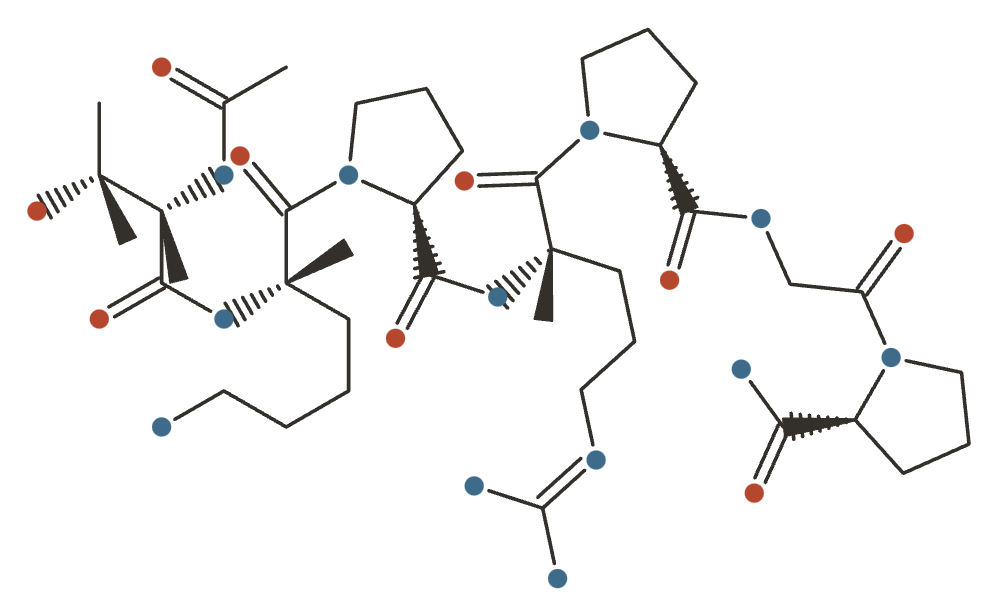
N-Acetyl Selank Amidate
An N-acetylated, C-amidated analogue of the Russian anxiolytic peptide Selank, with no published study of the analogue itself.

N-Acetyl Selank Amidate at a Glance
N-Acetyl Selank Amidate is Selank with acetyl and amide caps added at its termini, intended to resist the peptidases that clear the parent compound. Like its Semax counterpart it is sold as a research chemical with no published study of the analogue itself — the evidence cited for it belongs to Selank. It is unapproved everywhere, including Russia, where the parent peptide is registered.
History & Development
N-Acetyl Selank Amidate is Selank with acetyl and amide caps added. As with its sister analogue, no study of the modified molecule has been published.
| First described | Not established - no published study of the analogue exists |
| Discovered / synthesised by | Not established in the sources consulted for this section |
| Institution | Not established in the sources consulted for this section |
| Origin | Selank (Thr-Lys-Pro-Arg-Pro-Gly-Pro) acetylated at the N-terminus and amidated at the C-terminus - Ac-TKPRPGP-NH2 |
| Key patent | Not established in the sources consulted for this section |
| Assignee | Not established in the sources consulted for this section |
| Development status | Not a development programme - sold as a research chemical; never studied, never approved |
Discovery
The modification is the same one applied to Semax: block both termini to slow peptidase attack. The rationale is standard and the chemistry is straightforward.
Development & ownership
No development programme exists. There is no published pharmacokinetic, binding, animal or human study of this analogue.
The inherited-evidence problem is worse here than for the Semax analogue, for a reason specific to Selank. Selank is itself an extension of the endogenous tetrapeptide tuftsin, and it is rapidly trimmed in plasma to fragments - TKPRP, TKP, RP and GP - which are candidates for its activity. So Selank’s effects may belong substantially to its breakdown products.
An analogue engineered to resist breakdown could therefore produce less of what matters, not more. That is not a prediction, because nobody has measured it - it is the reason the “more stable is better” assumption cannot be carried across without evidence.
Selank’s own evidence base is also weaker than usually presented: no placebo-controlled trial of the parent compound exists in any indication.
How it reached the market
It reached consumers untested, sold as a stabilised or improved Selank at a premium over the parent - inheriting the clinical framing of a Russian registered medicine while being a different molecule about which nothing has been published.
What It's Used For
N-Acetyl Selank Amidate is a chemically end-capped analogue of Selank (Thr-Lys-Pro-Arg-Pro-Gly-Pro, TKPRPGP) — the Russian synthetic heptapeptide built by extending the immunomodulatory tetrapeptide tuftsin (TKPR) with a Pro-Gly-Pro tail 30Reference 30ReviewTuftsin — properties and analogs — reviewView study →.
The modification adds an acetyl group to the N-terminus and an amide to the C-terminus, a standard medicinal-chemistry maneuver for blunting exopeptidase attack. The single most important fact here is a negative one: no published study — human, animal, or in vitro — has ever administered or characterized N-Acetyl Selank Amidate. PubMed searches on the analogue’s name, its sequence forms (Ac-TKPRPGP, TKPRPGP-NH2), and every vendor synonym return zero primary results, and there is no registered trial of it in ClinicalTrials.gov, the EU-CTR, or the WHO ICTRP (verified July 2026). Every citation below describes the parent Selank, and even that literature is thin: a handful of small, open-label, unregistered Russian human studies on top of a mostly single-institute rodent program. Route is load-bearing for both molecules — Selank is a peptide, is oral-inactive, and was studied intranasally or by injection, so any oral product rests on an untested hope. The honest framing is that this is an unapproved research chemical whose entire marketed case is a structure–activity extrapolation from a drug it is not. For the parent peptide’s own (thin) evidence, see Selank; for its sister peptide from the same Moscow institute, see Semax.
Support is an experimental score I’m building — a composite weighted by study type (human > animal > in vitro > review) and study volume. It’s a beta: a fast way to rank strength of evidence at a glance, not a validated metric. Each application links down to its write-up.
Read every row with the same caveat: no percentage below describes N-Acetyl Selank Amidate. There is no direct evidence on the analogue to score. Each figure rates the parent Selank’s evidence for that use — the ceiling this analogue could at best inherit — and is capped well below the parent’s own reading because the transfer is untested and unmeasured. A low score here does not mean “tested and disappointing”; it means the molecule here has never been studied at all.
The only genuinely human signal in this whole area, and it belongs to parent Selank. Three Russian studies in patients: 62 patients with generalized anxiety disorder and neurasthenia, in which intranasal Selank (n=30) produced anxiolysis reported as comparable to the benzodiazepine medazepam (n=32) plus an additional anti-asthenic/activating effect, with blood enkephalinase activity tracking response 1Reference 1Efficacy and possible mechanisms of action of a new peptide anxiolytic selank in the therapy of generalized anxiety disorders and neurasthenia — human (open comparative, vs medazepam; parent Selank)View study →; 60 patients with anxiety disorders in which Selank matched phenazepam with a milder side-effect profile and anxiolysis persisting after dosing stopped 2Reference 2A comparison of the anxiolytic effect and tolerability of selank and phenazepam in the treatment of anxiety disorders — human (open comparative; parent Selank)View study →; and an add-on study reporting that Selank reduced benzodiazepine side-effects 3Reference 3Optimization of the treatment of anxiety disorders with selank — human (add-on study; parent Selank)View study →.
Mechanistic support is real but indirect: Selank inhibits plasma enkephalin-degrading enzymes, acting preferentially on carboxypeptidases and dicarboxypeptidases 4,
These human studies are small, open-label, single-region, unregistered in any international trial registry, and published in Russian — a genuine signal, not an approval-grade one.
Gap: No study of N-Acetyl Selank Amidate exists, so the analogue has no anxiety data of any kind — not a weak result, an absent one. The parent’s human data are also unreplicated outside Russia, and none of these trials tested the modified molecule.
Rodent-dominated, with a single human biomarker — all parent Selank. In rats, Selank (300 µg/kg) accelerated acquisition of a conditioned active-avoidance reflex, with the largest effect in animals that learned poorly to begin with and a time-course distinguishable from piracetam 11Reference 11AnimalThe optimizing action of the synthetic peptide Selank on a conditioned active avoidance reflex in rats — animal (rat; parent Selank)View study →, and it restored mnestic function after neurotoxic damage to the noradrenergic system 12Reference 12AnimalCompensatory effect of selank on the mnestic functions disturbed by neurotoxic damage of the noradrenergic system — animal (rat; parent Selank)View study →. Intranasal Selank raises BDNF expression in the rat hippocampus 14Reference 14AnimalIntranasal administration of the peptide Selank regulates BDNF expression in the rat hippocampus in vivo — animal (rat; parent Selank)View study →, and it protected against ethanol-induced memory impairment in rats while regulating hippocampal and prefrontal BDNF 13Reference 13AnimalSelank, peptide analogue of tuftsin, protects against ethanol-induced memory impairment by regulating BDNF in hippocampus and prefrontal cortex — animal (rat; parent Selank)View study →. The single human touchpoint is a resting-state fMRI study in healthy volunteers reporting that Selank shifted amygdala-related functional connectivity 15Reference 15Functional connectomic approach to studying Selank and Semax effects — human (resting-state fMRI, healthy volunteers; parent Selank)View study → — a brain-network readout, not a measured cognitive outcome. Route matters even within the parent’s own data: intranasal and intraperitoneal Selank produced different receptor-binding fingerprints in mice (intranasal shifting NMDA-site binding, intraperitoneal shifting GABA-site binding), which the authors attributed to route-specific pharmacokinetics and biotransformation 10Reference 10AnimalComparison of pharmacological effects of heptapeptide selank after intranasal and intraperitoneal administration to BALB/c and C57BL/6 mice — animal (mouse; parent Selank)View study →.
Gap: No human cognition-endpoint trial for Selank and nothing whatsoever for the analogue. The “focus / nootropic” marketing for N-Acetyl Selank Amidate rests on rodent data generated with a different molecule — and, per 10Reference 10AnimalComparison of pharmacological effects of heptapeptide selank after intranasal and intraperitoneal administration to BALB/c and C57BL/6 mice — animal (mouse; parent Selank)View study →, a different route.
Animal-only, and largely one research lineage — parent Selank. A single dose of Selank (0.3 mg/kg intraperitoneally) removed anxiety-like behavior and prevented mechanical allodynia during 48-hour alcohol withdrawal in alcohol-preferring rats, without changing alcohol intake 17Reference 17AnimalEfficacy of peptide anxiolytic selank during modeling of withdrawal syndrome in rats with stable alcoholic motivation — animal (rat; parent Selank)View study →. In rats, Selank attenuated the aversive signs of naloxone-precipitated morphine withdrawal 18Reference 18AnimalSelank, a peptide analog of tuftsin, attenuates aversive signs of morphine withdrawal in rats — animal (rat; parent Selank)View study →, and in DBA/2 mice it inhibited ethanol-induced hyperlocomotion and the development of behavioral sensitization, consistent with an endogenous-opioid mechanism 19Reference 19AnimalSelank inhibits ethanol-induced hyperlocomotion and manifestation of behavioral sensitization in DBA/2 mice — animal (mouse; parent Selank)View study → — a mechanism also supported by the naloxone-reversibility of some of Selank’s behavioral effects 7,
Gap: No human addiction or withdrawal study of Selank exists, and none of the analogue. Replication is within a narrow group of laboratories and a narrow species set.
Rodent and in-vitro, plus one small patient cytokine study — parent Selank. Reflecting its tuftsin origin 30Reference 30ReviewTuftsin — properties and analogs — reviewView study →, a single intraperitoneal dose of Selank changed the expression of 34 of 84 inflammation-related genes in mouse spleen, centring on Bcl6 and its target and corepressor genes — and, importantly for the stability question, two of Selank’s own fragments produced the same Bcl6 response 21Reference 21AnimalExpression of inflammation-related genes in mouse spleen under tuftsin analog Selank (Selank and two of its fragments) — animal (mouse; parent Selank)View study →. A follow-up mapped the time course of that response 22Reference 22AnimalThe temporary dynamics of inflammation-related gene expression under tuftsin analog Selank action — animal (mouse; parent Selank)View study →. Selank has also been reported to show antiviral activity against experimental influenza infection with interferon induction 23Reference 23In vitroAntiviral activity of the immunomodulator Selank in experimental influenza infection — in vitro / animal (parent Selank)View study →, and in patients with anxiety-asthenic disorders it shifted cytokine balance 20Reference 20Clinical trialImmunomodulatory effects of selank in patients with anxiety-asthenic disorders — human (small mechanistic cytokine study; parent Selank)View study → — a small mechanistic human study, not a clinical-endpoint trial.
Gap: No controlled human immune or antiviral outcome for Selank, and nothing at all for the analogue. Note also that the fragment result in 21Reference 21AnimalExpression of inflammation-related genes in mouse spleen under tuftsin analog Selank (Selank and two of its fragments) — animal (mouse; parent Selank)View study → is a warning for the central premise, not a supporting datapoint.
Rodent-only — parent Selank. In WAG/Rij rats, a genetic model of depression-like behavior, repeated high-dose Selank (1000–2000 µg/kg) reduced forced-swim immobility and anhedonia; low single doses (100–300 µg/kg) reduced immobility in BALB/c mice, but repeated or high doses did not 16Reference 16AnimalEffects of heptapeptide selank on genetically-based and situation-provoked symptoms of depression in WAG/Rij and Wistar rats and BALB/c mice — animal (rat, mouse; parent Selank; abstract states Selank completed third-phase clinical testing)View study → — a non-monotonic pattern worth noting rather than smoothing over. Monoamine work shows strain- and region-specific modulation of serotonin, dopamine and noradrenaline in mice 24Reference 24AnimalEffects of heptapeptide selank on the content of monoamines and their metabolites in the brain of BALB/c and C57Bl/6 mice — animal (mouse; parent Selank)View study →, and Selank normalized biogenic-amine disturbances after antenatal hypoxia in rats 25Reference 25AnimalSelank-induced normalizing effects on integrative brain activity and biogenic amine levels after antenatal hypoxia — animal (rat; parent Selank)View study →.
Gap: Animal models only for Selank, with an inconsistent dose–response, and nothing for the analogue. No human depression data for either molecule.
Mechanisms
| Target / pathway | Effect | Relevant to |
|---|---|---|
| Enkephalin-degrading enzymes | Inhibited, preferentially carboxypeptidases and dicarboxypeptidases → prolongs endogenous enkephalins 4, | Anxietyaddiction (parent) |
| GABA receptor complex | Positive allosteric modulation of [³H]GABA binding; blocks diazepam/olanzapine modulation in vitro; route-dependent binding shifts in vivo 9, | Anxiety (parent) |
| Endogenous opioid system | Modulated; several behavioral effects are naloxone-reversible 7, | Anxietywithdrawal (parent) |
| Monoamines (5-HT, dopamine, noradrenaline) | Region- and strain-specific modulation 24, | Moodcognition (parent) |
| BDNF expression (hippocampus, prefrontal cortex) | Increased after intranasal dosing 13, | Cognition (parent) |
| Inflammation gene networks (Bcl6), interferon | Altered expression; reproduced in part by Selank’s own fragments 21, | Immuneantiviral (parent) |
| Coagulation | Selank showed anticoagulant activity on thromboelastography, the most potent of three glyprolines tested — in vitro 28Reference 28In vitroAnticoagulant effects of arginine-containing peptides of the glyproline family (His-Phe-Arg-Trp-Pro-Gly-Pro and Thr-Lys-Pro-Arg-Pro-Gly-Pro) revealed by thromboelastography — in vitro (parent Selank)View study → | Unstudied clinically; a safety flagnot a use |
Not one row of this table has been measured for N-Acetyl Selank Amidate. Whether acetylating the N-terminus and amidating the C-terminus preserves, blunts, or redirects any of these actions is unknown. The tuftsin-derived N-terminus (TKPR) is the business end of the immunomodulatory lineage 30Reference 30ReviewTuftsin — properties and analogs — reviewView study →, and it is the end the acetyl group caps.
Pharmacokinetics
For the analogue: nothing exists. No absorption, distribution, half-life, metabolism, potency, or bioavailability figure has ever been measured for N-Acetyl Selank Amidate. Everything below is the parent’s, and is included because it is what the modification is aimed at.
Selank is oral-inactive — a peptide of this size is digested rather than absorbed — and was administered intranasally in the Russian clinical work or by injection in animals. Its degradation has been mapped directly: using uniformly tritium-labeled peptide, the major products of Selank breakdown in blood plasma were the pentapeptide TKPRP, tripeptide TKP, and dipeptides RP and GP, with brain pharmacokinetics studied after intranasal dosing 26Reference 26In vitroEvenly tritium-labeled peptides and their in vivo and in vitro biodegradation (Selank degradation to TKPRP, TKP, RP and GP; intranasal brain PK) — in vitro / animal (rat; parent Selank)View study →. That is exopeptidase trimming from both termini — precisely the process N-terminal acetylation and C-terminal amidation are designed to block, which is why the modification is chemically sensible. Two things complicate the “therefore it works better” conclusion. First, the parent already carries a stability feature: the Pro-Gly-Pro tail is there for exactly this reason, and the Russian glyproline literature argues these peptides are considerably more stable than regulatory peptides generally 27Reference 27ReviewNatural and hybrid (“chimeric”) stable regulatory glyproline peptides — review (Pro-Gly-Pro stability rationale)View study →. Second, Selank’s fragments are not inert — they reproduced part of its gene-expression signature in mouse spleen 21Reference 21AnimalExpression of inflammation-related genes in mouse spleen under tuftsin analog Selank (Selank and two of its fragments) — animal (mouse; parent Selank)View study → — so suppressing fragment generation may change the pharmacology rather than amplify it. This is mechanistic reasoning, explicitly not a finding, and it is untestable from the published record because the comparison has never been run.
It is worth naming the contrast with the sister compound: for Semax, the acetylated variant was actually taken into the laboratory and its proteolytic stability measured across biological media 33Reference 33In vitroStability of Semax acetyl to proteolysis in various biological media — in vitro (acetylated Semax, cited here only as the comparison that exists for the sister peptide and does not exist for Selank)View study →. No equivalent study exists for acetylated/amidated Selank. There is also no evidence that the modification confers oral activity, despite oral and sublingual products being sold under this name — the single most decision-relevant unknown here, because a compound that only works intranasally or injected makes every oral “take it for focus” claim inert regardless of the label.
Clinical & regulatory status
N-Acetyl Selank Amidate is an unapproved research chemical. It has no approval or filing with the FDA, EMA, TGA or PMDA, no drug label anywhere in the world, and no registered clinical trial of any phase — I searched ClinicalTrials.gov via the API in July 2026 and every “selank” hit is an unrelated false positive (high-altitude cognition, dyslexia tDCS, brivaracetam epilepsy, telephone psychotherapy); the EU-CTR and WHO ICTRP are likewise empty for Selank and its analogues. It is not a scheduled or controlled substance in the US, but that reflects obscurity, not a safety determination.
Parent Selank is likewise unapproved in the West. It is described in the Russian literature as having completed third-phase clinical testing as a selective anxiolytic 16Reference 16AnimalEffects of heptapeptide selank on genetically-based and situation-provoked symptoms of depression in WAG/Rij and Wistar rats and BALB/c mice — animal (rat, mouse; parent Selank; abstract states Selank completed third-phase clinical testing)View study → and is marketed in Russia as an intranasal preparation. That status is not a Western approval, it is not independently verifiable through English-language registries, and — decisively — it belongs to a chemically different molecule. A 2026 review of therapeutic peptides in orthopedics names selank among neuroactive peptides circulating without clinical-trial support 32Reference 32Clinical trialTherapeutic peptides in orthopaedics: applications, challenges, and future directions — review (names selank among neuroactive peptides lacking clinical trials)View study →, and a European official medicines control laboratory has published its identification of Selank in seized pharmaceutical preparations, noting it “[has] not completed any clinical trials” and is freely sold online as lyophilized powder and nasal spray 29Reference 29In vitroThe occurrence of putative cognitive enhancing research peptides in seized pharmaceutical preparations — in vitro (analytical; Selank and Semax identified in seized product)View study →.
| Completed | Ongoing | Terminated | Preclinical |
|---|---|---|---|
| 0for this analogue · ~3 small unregistered Russian human studies of parent Selank | 0 | 0 | 0for this analogue · dozens (parent Selank, rodent/in-vitro) |
Last checked: July 2026.
Sourcing, Route & Legal Status
Regulatory status. No marketing approval exists for N-Acetyl Selank Amidate from any regulator, and it is not a lawful dietary-supplement ingredient in the US, UK or EU. It is sold as a research chemical labeled “for research use only / not for human consumption,” which is the legally accurate frame for anyone acquiring it. Regulatory status does not transfer from the parent: Selank’s Russian registration gives this analogue no standing whatsoever, and the site’s Semax entry documents the same principle — a Russian marketing authorization is not a Western prescription status and does not flag this compound as a prescription drug here.
How it’s supplied & administered. Vials of lyophilized (freeze-dried) powder requiring user reconstitution with bacteriostatic or sterile water, plus pre-mixed nasal sprays and oral/sublingual “solutions.” The route logic inherited from the parent is the part worth holding onto: Selank has negligible oral bioavailability and was used intranasally or injected, so nasal and subcutaneous are the only routes with any mechanistic grounding at all — and even those are grounded in the parent’s data, not this molecule’s. Oral products are sold on the premise that the end-caps rescue gut survival; that premise has never been tested. Lyophilized peptide is stored cold; reconstituted material is unstable and time-limited.
Sourcing reality (this is a safety issue, not a footnote). This compound exists only in the unregulated research-peptide market, so there is no manufacturing oversight of identity, actual peptide content, correct sequence, or endotoxin load. This is not a hypothetical concern for the Selank family specifically: a Belgian official medicines control laboratory encountered two unknown suspicious preparations in 2017–2018 that turned out to contain Selank and Semax, and developed dedicated LC-MS/MS methodology precisely because these peptides are being sold online as injectables and nasal sprays 29Reference 29In vitroThe occurrence of putative cognitive enhancing research peptides in seized pharmaceutical preparations — in vitro (analytical; Selank and Semax identified in seized product)View study →. Verifying the identity of an analogue is harder still — a vendor selling plain Selank, or nothing at all, under the acetylated-amidated name would be difficult for a buyer to detect, and no independent assay of marketed N-Acetyl Selank Amidate product was located in this pass. Third-party certificates of analysis (independent HPLC identity/purity plus endotoxin testing) are a partial mitigation and can themselves be falsified. This page does not recommend, rank, or link any vendor.
Safety
There is no safety data on this analogue at all — no human study, no animal study, nothing has ever been administered. Its risks are unknown rather than low, and the parent molecule’s tolerability does not carry across to a compound engineered to last longer in the body.
- No safety data of any kind. No human or animal study has ever administered this molecule.
- Not assessed in pregnancy or breastfeeding. No reproductive data for the analogue or the parent — see the box below.
- Anticoagulant signal in the parent. Selank showed anticoagulant activity on thromboelastography in vitro.
- Theoretical interaction cautions. Parent Selank touches GABAergic, opioid and anticoagulant pathways; no formal interaction study exists.
- Gray-market product risk. Unverified identity, purity and sterility, plus endotoxin exposure from self-mixed sprays or injections.
Full Safety & Interactions Detail
There is no safety data on N-Acetyl Selank Amidate — none. No toxicology, no pharmacovigilance, no controlled human data, and no animal study, because no study has administered it. Its adverse-effect profile, dose-limiting toxicity and interaction risks are genuinely unknown, which is not the same as “well tolerated.” Everything below is drawn from the parent molecule or from route and class, and is labeled as such.
Parent-Selank tolerability (does not transfer). In the small Russian human anxiety studies, intranasal Selank was reported as generally well tolerated and specifically without the sedation, memory impairment, dependence or withdrawal characteristic of benzodiazepines 1,
Signals worth naming from the parent’s literature. Selank displayed anticoagulant activity on thromboelastography in vitro, the most potent of three glyprolines tested 28Reference 28In vitroAnticoagulant effects of arginine-containing peptides of the glyproline family (His-Phe-Arg-Trp-Pro-Gly-Pro and Thr-Lys-Pro-Arg-Pro-Gly-Pro) revealed by thromboelastography — in vitro (parent Selank)View study → — no clinical relevance has been established, but it is the kind of finding that would matter to anyone on anticoagulants and it is not something the marketing mentions. A rat study of hepatocyte function under restraint stress reported no adverse hepatic signal 31Reference 31AnimalEffect of Selank on functional state of rat hepatocytes under conditions of restraint stress — animal (rat; parent Selank)View study →. Neither of these is a human safety result.
Interactions (mechanism-based inference, not interaction studies). Selank modulates GABA binding and blocked the modulatory activity of diazepam and olanzapine in a radioligand assay 9Reference 9In vitroPeptide-based anxiolytics: the molecular aspects of heptapeptide Selank biological activity — in vitro (radioligand binding; parent Selank)View study →, and modulates the endogenous opioid system 7,
Route- and product-specific risks. With any reconstituted gray-market peptide: injection-site reactions, non-sterile technique, contamination and endotoxin exposure; nasal irritation and inconsistent dosing from self-mixed or compounded sprays; and dosing error from unverified vial concentration.
Who should avoid it. There is no established safe-use population, so the honest answer is everyone — but the specific flags are: anyone treating a real anxiety disorder, for whom substituting an unstudied research chemical for evaluated care is the actual harm here; anyone pregnant, breastfeeding or trying to conceive; children and adolescents; anyone on GABAergic, opioid, antipsychotic or anticoagulant medication; and anyone unwilling to self-administer a product of unverified identity and sterility.
Scope disclosure (honesty, not a claim):
- Human data? None for this analogue. Every human study cited here tested parent Selank — a different molecule — in small, unregistered, Russian-language trials.
- Animal data? None for this analogue either. This is unusual even among research peptides: there is no preclinical layer at all.
- Interactions assessed? No — none, for any drug class. The GABAergic/opioid/anticoagulant cautions are mechanism-based inference from the parent.
- Pregnancy/lactation assessed? No — no human or animal reproductive data located for either compound.
- Long-term safety established? No. Absence of reported harm reflects the total absence of study, not evidence of safety.
Never imply safety from silence. Where this compound has not been studied — which is everywhere — the correct statement is “not assessed,” not “safe.”
Not assessed / not established. No reproductive or lactation data exist for this analogue, and none in any rigorous form for parent Selank. Treat as contraindicated by default in pregnancy and breastfeeding.
Dosage
There is no established dose for N-Acetyl Selank Amidate, and none is recommended here. No study has ever administered this molecule, so there is no dose-finding data, no potency figure, no bioavailability estimate, and nothing from which a dose could be derived. Microgram and milligram figures circulate in vendor copy and forum posts; those are not dose data, they have no experimental basis, and reproducing them here would launder marketing as evidence — so they are not given.
For context only, and explicitly not as a substitute: the doses that exist in this literature belong to the parent. Selank was given intranasally in the Russian human anxiety studies 1,
References
- Zozulia AA, et al. (2008). Efficacy and possible mechanisms of action of a new peptide anxiolytic selank in the therapy of generalized anxiety disorders and neurasthenia — human (open comparative, vs medazepam; parent Selank). Zhurnal Nevrologii i Psikhiatrii imeni S.S. Korsakova. https://pubmed.ncbi.nlm.nih.gov/18454096/
- Medvedev VE, et al. (2014). A comparison of the anxiolytic effect and tolerability of selank and phenazepam in the treatment of anxiety disorders — human (open comparative; parent Selank). Zhurnal Nevrologii i Psikhiatrii imeni S.S. Korsakova. https://pubmed.ncbi.nlm.nih.gov/25176261/
- Medvedev VE, et al. (2015). Optimization of the treatment of anxiety disorders with selank — human (add-on study; parent Selank). Zhurnal Nevrologii i Psikhiatrii imeni S.S. Korsakova. https://pubmed.ncbi.nlm.nih.gov/26356395/
- Zozulya AA, et al. (2001). The inhibitory effect of Selank on enkephalin-degrading enzymes as a possible mechanism of its anxiolytic activity — in vitro / mechanistic (parent Selank). Bulletin of Experimental Biology and Medicine. https://pubmed.ncbi.nlm.nih.gov/11550013/
- Zolotarev YuA, et al. (2004). Leu-enkephalin homogeneously labeled with tritium in studying the Selank inhibiting effect on the enkephalin-degrading enzymes of human plasma — in vitro (parent Selank). Russian Journal of Bioorganic Chemistry (Bioorganicheskaia Khimiia). https://pubmed.ncbi.nlm.nih.gov/15344652/
- Sokolov OY, et al. (2002). Effects of Selank on behavioral reactions and activities of plasma enkephalin-degrading enzymes in mice — animal (mouse; parent Selank). Bulletin of Experimental Biology and Medicine. https://pubmed.ncbi.nlm.nih.gov/12432865/
- Meshavkin VK, et al. (2006). Naloxone-blocked depriming effect of anxiolytic selank on apomorphine-induced behavioral manifestations — animal (rodent; parent Selank). Bulletin of Experimental Biology and Medicine. https://pubmed.ncbi.nlm.nih.gov/17415472/
- Kozlovskiĭ II, et al. (2012). The role of the opioid system in the anti-anxiety effect of the peptide anxiolytic selank — animal (mouse; parent Selank). Eksperimental’naia i Klinicheskaia Farmakologiia. https://pubmed.ncbi.nlm.nih.gov/22550852/
- Vyunova TV, et al. (2018). Peptide-based anxiolytics: the molecular aspects of heptapeptide Selank biological activity — in vitro (radioligand binding; parent Selank). Protein and Peptide Letters. https://pubmed.ncbi.nlm.nih.gov/30255741/
- Vasil’eva EV, et al. (2016). Comparison of pharmacological effects of heptapeptide selank after intranasal and intraperitoneal administration to BALB/c and C57BL/6 mice — animal (mouse; parent Selank). Eksperimental’naia i Klinicheskaia Farmakologiia. https://pubmed.ncbi.nlm.nih.gov/29787664/
- Kozlovskii II, et al. (2003). The optimizing action of the synthetic peptide Selank on a conditioned active avoidance reflex in rats — animal (rat; parent Selank). Neuroscience and Behavioral Physiology. https://pubmed.ncbi.nlm.nih.gov/14552529/
- Kozlovskiĭ II, et al. (2008). Compensatory effect of selank on the mnestic functions disturbed by neurotoxic damage of the noradrenergic system — animal (rat; parent Selank). Eksperimental’naia i Klinicheskaia Farmakologiia. https://pubmed.ncbi.nlm.nih.gov/18488898/
- Kolik LG, et al. (2019). Selank, peptide analogue of tuftsin, protects against ethanol-induced memory impairment by regulating BDNF in hippocampus and prefrontal cortex — animal (rat; parent Selank). Bulletin of Experimental Biology and Medicine. https://pubmed.ncbi.nlm.nih.gov/31625062/
- Inozemtseva LS, et al. (2008). Intranasal administration of the peptide Selank regulates BDNF expression in the rat hippocampus in vivo — animal (rat; parent Selank). Doklady Biological Sciences. https://pubmed.ncbi.nlm.nih.gov/18841804/
- Panikratova YR, et al. (2020). Functional connectomic approach to studying Selank and Semax effects — human (resting-state fMRI, healthy volunteers; parent Selank). Doklady Biological Sciences. https://pubmed.ncbi.nlm.nih.gov/32342318/
- Sarkisova KIu, et al. (2008). Effects of heptapeptide selank on genetically-based and situation-provoked symptoms of depression in WAG/Rij and Wistar rats and BALB/c mice — animal (rat, mouse; parent Selank; abstract states Selank completed third-phase clinical testing). Zhurnal Vysshei Nervnoi Deiatelnosti. https://pubmed.ncbi.nlm.nih.gov/18661785/
- Kolik LG, et al. (2014). Efficacy of peptide anxiolytic selank during modeling of withdrawal syndrome in rats with stable alcoholic motivation — animal (rat; parent Selank). Bulletin of Experimental Biology and Medicine. https://pubmed.ncbi.nlm.nih.gov/24913576/
- Konstantinopolsky MA, et al. (2022). Selank, a peptide analog of tuftsin, attenuates aversive signs of morphine withdrawal in rats — animal (rat; parent Selank). Bulletin of Experimental Biology and Medicine. https://pubmed.ncbi.nlm.nih.gov/36322304/
- Kolik LG, et al. (2016). Selank inhibits ethanol-induced hyperlocomotion and manifestation of behavioral sensitization in DBA/2 mice — animal (mouse; parent Selank). Bulletin of Experimental Biology and Medicine. https://pubmed.ncbi.nlm.nih.gov/27878720/
- Uchakina ON, et al. (2008). Immunomodulatory effects of selank in patients with anxiety-asthenic disorders — human (small mechanistic cytokine study; parent Selank). Zhurnal Nevrologii i Psikhiatrii imeni S.S. Korsakova. https://pubmed.ncbi.nlm.nih.gov/18577961/
- Kolomin T, et al. (2011). Expression of inflammation-related genes in mouse spleen under tuftsin analog Selank (Selank and two of its fragments) — animal (mouse; parent Selank). Regulatory Peptides. https://pubmed.ncbi.nlm.nih.gov/21609736/
- Kolomin T, et al. (2014). The temporary dynamics of inflammation-related gene expression under tuftsin analog Selank action — animal (mouse; parent Selank). Molecular Immunology. https://pubmed.ncbi.nlm.nih.gov/24291245/
- Ershov FI, et al. (2009). Antiviral activity of the immunomodulator Selank in experimental influenza infection — in vitro / animal (parent Selank). Voprosy Virusologii. https://pubmed.ncbi.nlm.nih.gov/19882898/
- Narkevich VB, et al. (2008). Effects of heptapeptide selank on the content of monoamines and their metabolites in the brain of BALB/c and C57Bl/6 mice — animal (mouse; parent Selank). Eksperimental’naia i Klinicheskaia Farmakologiia. https://pubmed.ncbi.nlm.nih.gov/19093364/
- Semenova TP, et al. (2006). Selank-induced normalizing effects on integrative brain activity and biogenic amine levels after antenatal hypoxia — animal (rat; parent Selank). Rossiiskii Fiziologicheskii Zhurnal. https://pubmed.ncbi.nlm.nih.gov/17385425/
- Zolotarev YuA, et al. (2006). Evenly tritium-labeled peptides and their in vivo and in vitro biodegradation (Selank degradation to TKPRP, TKP, RP and GP; intranasal brain PK) — in vitro / animal (rat; parent Selank). Russian Journal of Bioorganic Chemistry (Bioorganicheskaia Khimiia). https://pubmed.ncbi.nlm.nih.gov/16637290/
- Ashmarin IP, et al. (2005). Natural and hybrid (“chimeric”) stable regulatory glyproline peptides — review (Pro-Gly-Pro stability rationale). Pathophysiology. https://pubmed.ncbi.nlm.nih.gov/15837162/
- Rogozinskaya EY, Lyapina MG (2017). Anticoagulant effects of arginine-containing peptides of the glyproline family (His-Phe-Arg-Trp-Pro-Gly-Pro and Thr-Lys-Pro-Arg-Pro-Gly-Pro) revealed by thromboelastography — in vitro (parent Selank). Bulletin of Experimental Biology and Medicine. https://pubmed.ncbi.nlm.nih.gov/29181670/
- Vanhee C, et al. (2020). The occurrence of putative cognitive enhancing research peptides in seized pharmaceutical preparations — in vitro (analytical; Selank and Semax identified in seized product). Drug Testing and Analysis. https://pubmed.ncbi.nlm.nih.gov/31667971/
- Siebert A, et al. (2017). Tuftsin — properties and analogs — review. Current Medicinal Chemistry. https://pubmed.ncbi.nlm.nih.gov/28745220/
- Fomenko EV, et al. (2017). Effect of Selank on functional state of rat hepatocytes under conditions of restraint stress — animal (rat; parent Selank). Bulletin of Experimental Biology and Medicine. https://pubmed.ncbi.nlm.nih.gov/28853100/
- Rahman OF, et al. (2026). Therapeutic peptides in orthopaedics: applications, challenges, and future directions — review (names selank among neuroactive peptides lacking clinical trials). Journal of the American Academy of Orthopaedic Surgeons. https://pubmed.ncbi.nlm.nih.gov/41490200/
- Shevchenko KV, et al. (2013). Stability of Semax acetyl to proteolysis in various biological media — in vitro (acetylated Semax, cited here only as the comparison that exists for the sister peptide and does not exist for Selank). Doklady Biological Sciences. https://pubmed.ncbi.nlm.nih.gov/23652441/
For half-lives, timing and stacking across the nootropics on this site, see the Nootropic Dosage Guide.