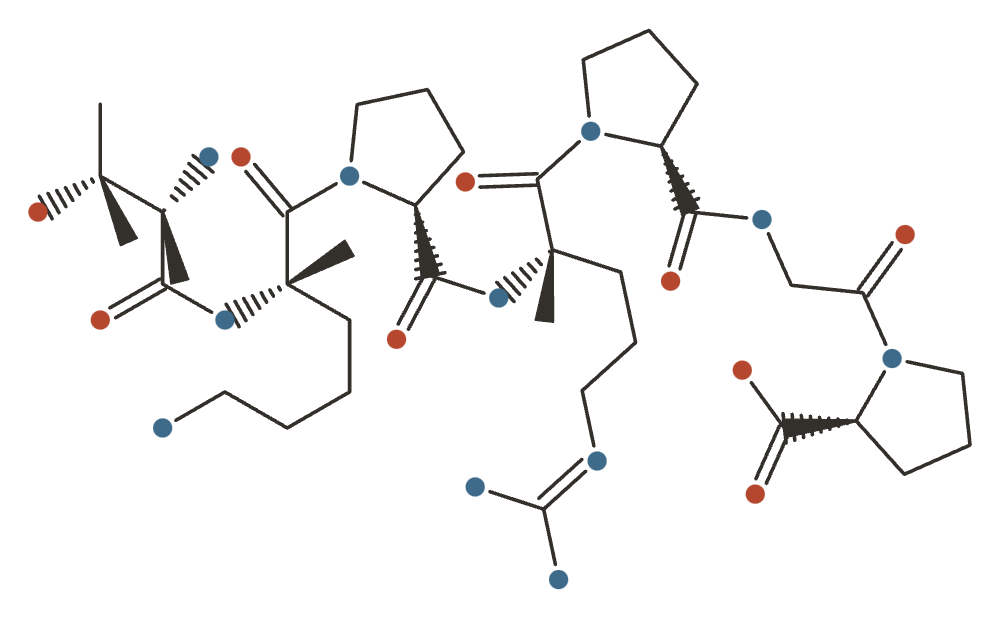
Selank
A synthetic heptapeptide extending the endogenous tetrapeptide tuftsin — registered in Russia as an intranasal anxiolytic, unapproved elsewhere.

Selank at a Glance
Selank is a synthetic heptapeptide built by extending tuftsin, an endogenous immunomodulatory tetrapeptide, with the same stabilising tail used in Semax. It is registered in Russia as an anxiolytic — intended to reduce anxiety without the sedation, dependence or withdrawal that benzodiazepines carry — and is unapproved elsewhere. Its mechanism runs partly through serotonin and partly through immune signalling, an unusual combination for an anxiolytic.
History & Development
Selank is the anxiolytic counterpart to semax - same design strategy, different parent molecule, and registered in Russia for anxiety.
| First described | Not established in the sources consulted for this section |
| Discovered / synthesised by | Not established in the sources consulted for this section |
| Institution | Not established in the sources consulted for this section |
| Origin | Synthetic heptapeptide extending the endogenous tetrapeptide tuftsin (Thr-Lys-Pro-Arg) with Pro-Gly-Pro |
| Key patent | Not established in the sources consulted for this section |
| Assignee | Not established in the sources consulted for this section |
| Development status | Registered prescription anxiolytic in Russia; unapproved in the US, UK, EU and Australia |
Discovery
Tuftsin is an endogenous tetrapeptide - a fragment of immunoglobulin heavy chain with immunomodulatory activity - and it also has central effects. Selank extends it with the same Pro-Gly-Pro tail used in semax, for the same reason: resisting exopeptidase degradation.
The parent molecule is a real interpretive problem for this compound. Because tuftsin has biological activity of its own and selank is trimmed back toward it in plasma, distinguishing selank’s effects from tuftsin’s requires studies designed to separate them - and the peptide’s rapid breakdown into TKPRP, TKP, RP and GP means the fragments are candidates for the activity too.
Development & ownership
Selank is registered in Russia as an intranasal anxiolytic, used at a 0.15% solution in microgram to low-milligram daily doses.
Its evidence base is its central limitation, and it is worth stating precisely: the human data are a handful of small Russian studies using active comparators with no placebo arm. Comparing a drug against another drug without a placebo can show non-inferiority; it cannot establish that either did better than nothing. No placebo-controlled trial of selank exists in any indication.
For a registered medicine that is an unusual position, and it is the honest ceiling on any claim made for it.
How it reached the market
Selank is prescription-only in Russia and an unapproved research chemical elsewhere. It is sold in the West as a nootropic and anti-anxiety nasal spray, on the strength of trials that never included a placebo group.
What It's Used For
Selank is a synthetic heptapeptide — Thr-Lys-Pro-Arg-Pro-Gly-Pro (TKPRPGP) — built at the Institute of Molecular Genetics of the Russian Academy of Sciences by taking the endogenous immunomodulatory tetrapeptide tuftsin (Thr-Lys-Pro-Arg) and attaching a C-terminal Pro-Gly-Pro tail to slow its proteolytic breakdown 47Reference 47ReviewTuftsin — properties and analogs — reviewView study →.
It is the sister compound of Semax, from the same institute and built on the same design principle. Selank is a registered medicine in Russia, sold there as an intranasal anxiolytic; it has never been approved by the FDA, EMA or TGA, and no trial of Selank is registered on ClinicalTrials.gov, the EU-CTR or the WHO ICTRP (verified July 2026). The whole evidence base sits under one structural constraint that shapes how everything below should be read: the human work is a small set of Russian-language, active-comparator studies with no placebo arm, mostly from the originating institute, and the rodent work is dominated by the same research lineage. Route is load-bearing — Selank is oral-inactive, and intranasal dosing is the only route with human data behind it. The honest frame is a peptide with a genuine, replicated mechanism, a real but thin and largely unverifiable human signal, and a marketing story (“as good as benzodiazepines, without the downsides”) that runs considerably ahead of both.
Support is an experimental score I’m building — a composite weighted by study type (human > animal > in vitro > review) and study volume. It’s a beta: a fast way to rank strength of evidence at a glance, not a validated metric. Each application links down to its write-up.
One caveat applies to every row. These scores are discounted for verifiability, not only for volume. The human literature is Russian-language and cannot be independently checked in English-language indexes — a limitation a Western regulator has now acted on for the sister compound, formally excluding the equivalent Russian Semax literature for want of a verified translation. A low score here generally means “not studied in humans,” not “tested and failed” — with one exception noted in row 1: the anxiety evidence has been tested, just never against placebo.
This is the only application with human data, and all of it is Russian. In 62 patients with generalized anxiety disorder and neurasthenia, intranasal Selank (n=30) was compared with the benzodiazepine medazepam (n=32); anxiolytic effects were reported as similar on Hamilton, Zung and CGI scales, with Selank additionally showing anti-asthenic and psychostimulant effects, and serum leu-enkephalin half-life — reduced at baseline in these patients — rising during treatment 1Reference 1Clinical trialEfficacy and possible mechanisms of action of a new peptide anxiolytic selank in the therapy of generalized anxiety disorders and neurasthenia (n=62; Selank n=30 vs medazepam n=32) — human (active-comparator clinical study, Russian-language)View study →. In 60 patients with phobic-anxiety and somatoform disorders, Selank was compared with phenazepam and reported to produce pronounced anxiolysis with a mild nootropic effect that persisted for a week after the last dose 2Reference 2Clinical trialA comparison of the anxiolytic effect and tolerability of selank and phenazepam in the treatment of anxiety disorders (n=60) — human (active-comparator clinical study, Russian-language)View study →. The third study is an add-on design rather than a comparison: 30 patients on phenazepam monotherapy versus 40 on phenazepam plus Selank, where the combination accelerated the response on HDRS and reduced phenazepam’s side-effects (attention and memory impairment, asthenia, sedation, sexual dysfunction, orthostatism) both during treatment and after tranquilizer withdrawal 3Reference 3Clinical trialOptimization of the treatment of anxiety disorders with selank (phenazepam monotherapy n=30 vs phenazepam + Selank n=40) — human (add-on clinical study, Russian-language)View study →.
Read the design, not the conclusion. None of these three reports randomization, blinding or allocation concealment in its English-language abstract; PubMed indexes two of them as randomized controlled trials, but that indexing cannot be checked against a full text that is only available in Russian. There is no placebo arm anywhere in this literature. Against an active comparator, without blinding, “comparable to a benzodiazepine” is not a strong claim — it is compatible with both drugs working and with neither working better than expectation.
Mechanistic support is real and independent of the clinical work. Selank inhibits enkephalin-degrading enzymes in human plasma and serum, acting preferentially on carboxypeptidases and dicarboxypeptidases 6,
Several of its behavioral effects are naloxone-reversible, implicating the endogenous opioid system 13,
In rodents the anxiolytic effect replicates, including in a rare largely non-Russian study: a Polish group, working with Selank under its development code TP-7, found sustained anxiolysis in high-emotional-reactivity rats over four weeks of daily dosing with no effect on body weight 24Reference 24AnimalInfluence of long-term treatment with tuftsin analogue TP-7 on the anxiety-phobic states and body weight (TP-7 is Selank; largely non-Russian group, Medical University of Lublin) — animal (rat, 4-week daily dosing)View study →.
A rat chronic-mild-stress study found Selank alone more effective than diazepam alone, but also — a nuance worth not smoothing over — that a course of either compound worsened some anxiety indicators in unstressed animals 25Reference 25AnimalPeptide Selank enhances the effect of diazepam in reducing anxiety in unpredictable chronic mild stress conditions in rats — animal (rat)View study →.
Gap: No placebo-controlled trial of any kind, no blinded trial verifiable in English, no Western or independently-conducted clinical study, and no registered trial in any international registry. Total documented human exposure across the anxiety literature is on the order of 130 patients.
Rodent- and primate-dominated, with a single human biomarker. In rats, Selank (300 µg/kg) accelerated acquisition of a conditioned active-avoidance reflex, with the largest effect in animals that learned poorly to begin with and a time-course distinguishable from piracetam 19Reference 19AnimalThe optimizing action of the synthetic peptide Selank on a conditioned active avoidance reflex in rats — animal (rat)View study →, and it restored mnestic function after neurotoxic damage to the noradrenergic system 20Reference 20AnimalCompensatory effect of selank on the mnestic functions disturbed by neurotoxic damage of the noradrenergic system — animal (rat)View study →. Intranasal Selank raises BDNF expression in the rat hippocampus 22Reference 22AnimalIntranasal administration of the peptide Selank regulates BDNF expression in the rat hippocampus in vivo — animal (rat)View study →, and it protected against ethanol-induced memory impairment in rats while regulating hippocampal and prefrontal BDNF 21Reference 21AnimalSelank, peptide analogue of tuftsin, protects against ethanol-induced memory impairment by regulating BDNF in hippocampus and prefrontal cortex — animal (rat)View study →. The most interesting non-rodent result is a monkey study: intranasal Selank produced long-lasting reduction of fear and aggression, increased orientational-exploratory activity, and compensated memory disturbance in experimentally neurotic animals, with effects the authors reported as independent of the type of neurotic disturbance — unlike the earlier ACTH(4-10) and thyroliberin work 23Reference 23Compensatory and antiamnestic effects of heptapeptide Selank in monkeys — animal (non-human primate, intranasal)View study →.
The human evidence is one study: a resting-state fMRI experiment in healthy volunteers reporting that Selank shifted amygdala-related functional connectivity 5Reference 5Functional connectomic approach to studying Selank and Semax effects — human (resting-state fMRI, healthy volunteers)View study →.
That is a brain-network readout in healthy people, not a measured cognitive outcome in anyone. Route matters even within the animal data: intranasal and intraperitoneal Selank produced different receptor-binding fingerprints in mice — intranasal shifting NMDA-site binding, intraperitoneal shifting GABA-site binding — which the authors attributed to route-specific pharmacokinetics and biotransformation 15Reference 15AnimalComparison of pharmacological effects of heptapeptide selank after intranasal and intraperitoneal administration to BALB/c and C57BL/6 mice — animal (mouse; route comparison)View study →.
A result obtained by injection does not automatically describe what a nasal spray does.
Gap: No human cognition-endpoint trial exists. The “focus / nootropic” marketing rests entirely on animal work, and per 15Reference 15AnimalComparison of pharmacological effects of heptapeptide selank after intranasal and intraperitoneal administration to BALB/c and C57BL/6 mice — animal (mouse; route comparison)View study → partly on a route that is not the route sold.
Mouse and in-vitro, plus one small patient cytokine study. This is the application closest to Selank’s tuftsin ancestry — tuftsin is itself an immunomodulatory peptide 47Reference 47ReviewTuftsin — properties and analogs — reviewView study →. A single intraperitoneal dose of Selank changed the expression of 34 of 84 inflammation-related genes in mouse spleen, centring on Bcl6 and its target and corepressor genes; two of Selank’s own degradation fragments produced the same Bcl6 response 31Reference 31AnimalExpression of inflammation-related genes in mouse spleen under tuftsin analog Selank — animal (mouse; Selank and two of its fragments)View study →, and a follow-up mapped the time course 32Reference 32AnimalThe temporary dynamics of inflammation-related gene expression under tuftsin analog Selank action — animal (mouse)View study →. Selank has been reported to show antiviral activity against experimental influenza infection with interferon induction 33Reference 33In vitroAntiviral activity of the immunomodulator Selank in experimental influenza infection — in vitro / animalView study →, and its structural fragments were separately reported to carry antiviral properties 34Reference 34In vitroAntiviral properties of structural fragments of the peptide Selank — in vitroView study → — the same fragment story that recurs throughout its pharmacology.
The single human touchpoint: in patients with anxiety-asthenic disorders, 14 days of Selank shifted the serum Th1/Th2 cytokine balance, and in vitro it suppressed IL-6 gene expression in peripheral blood cells from patients with depression but not from healthy controls 4Reference 4Clinical trialImmunomodulatory effects of selank in patients with anxiety-asthenic disorders — human (small mechanistic cytokine study) / in vitroView study →. That is a mechanistic study with a laboratory endpoint, not a clinical trial — nobody measured whether anyone got fewer infections.
Gap: No controlled human immune or antiviral outcome of any kind. The one human study measures cytokines, not illness.
Animal-only, and largely one research lineage. A single dose of Selank (0.3 mg/kg intraperitoneally) removed anxiety-like behavior and prevented mechanical allodynia during 48-hour alcohol withdrawal in alcohol-preferring rats — without changing alcohol intake 27Reference 27AnimalEfficacy of peptide anxiolytic selank during modeling of withdrawal syndrome in rats with stable alcoholic motivation — animal (rat)View study →, which is the honest limit of the finding. In rats, Selank attenuated the aversive signs of naloxone-precipitated morphine withdrawal 28Reference 28AnimalSelank, a peptide analog of tuftsin, attenuates aversive signs of morphine withdrawal in rats — animal (rat)View study →, and in DBA/2 mice it inhibited ethanol-induced hyperlocomotion and the development of behavioral sensitization 29Reference 29AnimalSelank inhibits ethanol-induced hyperlocomotion and manifestation of behavioral sensitization in DBA/2 mice — animal (mouse)View study →, consistent with the endogenous-opioid mechanism supported by the naloxone-reversibility work 13,
Gap: No human addiction or withdrawal study exists. Replication sits within a narrow group of laboratories and a narrow species set, and the alcohol result did not reduce drinking.
Rodent-only. In WAG/Rij rats, a genetic model of depression-like behavior, repeated high-dose Selank (1000–2000 µg/kg) reduced forced-swim immobility and anhedonia; low single doses (100–300 µg/kg) reduced immobility in BALB/c mice, but repeated or high doses did not 26Reference 26AnimalEffects of heptapeptide selank on genetically-based and situation-provoked symptoms of depression in WAG/Rij and Wistar rats and BALB/c mice (abstract states Selank completed third-phase clinical testing) — animal (rat, mouse)View study → — a non-monotonic dose–response worth stating rather than smoothing. Monoamine work shows strain- and region-specific modulation of serotonin, dopamine and noradrenaline in mice 16Reference 16AnimalEffects of heptapeptide selank on the content of monoamines and their metabolites in the brain of BALB/c and C57Bl/6 mice — animal (mouse)View study →, and Selank normalized biogenic-amine disturbances after antenatal hypoxia in rats 35Reference 35AnimalSelank-induced normalizing effects on integrative brain activity and biogenic amine levels after antenatal hypoxia — animal (rat)View study →. A serotonin study is also the cleanest published demonstration that Selank is not tuftsin: in serotonin-depleted rats, Selank enhanced brainstem 5-HT metabolism while tuftsin itself produced no such change and decreased it in neocortex 17Reference 17AnimalComparison of the effects of selank and tuftsin on the metabolism of serotonin in the brain of rats pretreated with PCPA (n=87 rats; Selank raised brainstem 5-HT metabolism, tuftsin did not) — animal (rat)View study →. In a 6-OHDA rat model of parkinsonism, Selank reduced anxiety-like behavior where Semax did not 30Reference 30AnimalPeptides Semax and Selank affect the behavior of rats with 6-OHDA-induced PD-like parkinsonism (Selank reduced anxiety; Semax did not change motor behaviour) — animal (rat)View study → — a small note on the two peptides not being interchangeable either.
Gap: Animal models only, with an inconsistent dose–response and no human depression data. The depression condition slug was deliberately not applied for that reason.
Rat models only, and an incidental finding rather than a marketed use. Selank and its in-vivo-formed metabolites reduced ulcer area across three experimental gastric-ulceration models in rats 36Reference 36AnimalSelank and its metabolites maintain homeostasis in the gastric mucosa (three experimental ulceration models) — animal (rat)View study →. This connects to a distribution finding: tritium-labeled Selank and Pro-Gly-Pro showed high affinity for gastric tissue by every route tested — intraperitoneal, intranasal, intragastric and intravenous — which the authors proposed as the reason glyprolines act on gastric mucosal homeostasis 38Reference 38AnimalA comparative analysis of distribution of glyprolines administered by various routes (Selank and PGP; intraperitoneal, intranasal, intragastric, intravenous — intranasal optimal for CNS) — animal (rat, PK)View study →. The result is coherent with the wider Russian glyproline literature, in which gastroprotection is a recurring class property 39Reference 39ReviewNatural and hybrid (“chimeric”) stable regulatory glyproline peptides — review (Pro-Gly-Pro stability rationale)View study →.
Gap: No human gastric study, no controlled ulcer-healing endpoint, and no evidence that intranasal dosing at anxiolytic amounts produces a gastric effect in people.
Mechanisms
| Target / pathway | Effect | Relevant to |
|---|---|---|
| Enkephalin-degrading enzymes | Inhibited, preferentially carboxypeptidases and dicarboxypeptidases → prolongs endogenous enkephalins 6, | Anxietyaddiction |
| GABA receptor complex | Positive allosteric modulation of [³H]GABA binding; blocks diazepam/olanzapine modulation in vitro; alters GABAergic gene expression 10, | Anxiety |
| Endogenous opioid system | Modulated; several behavioral effects are naloxone-reversible 13, | Anxietywithdrawal |
| Monoamines (5-HT, dopamine, noradrenaline) | Region- and strain-specific modulation; distinguishable from tuftsin’s effect 16, | Moodcognition |
| BDNF expression (hippocampus, prefrontal cortex) | Increased after intranasal dosing; broader hippocampal transcriptome shifts after single and course dosing 21, | Cognition |
| Inflammation gene networks (Bcl6), interferon | Altered expression; reproduced in part by Selank’s own fragments 31, | Immuneantiviral |
| Coagulation / hemostasis | Anticoagulant activity on thromboelastography — most potent of three glyprolines tested; appears in comparative glyproline anticoagulant analyses and in a hemostasis study in metabolic syndrome 40, | A safety flagnot a use |
| Cerebral hemodynamics | In anesthetized cats, intravenous Selank transiently lowered arterial pressure ~32% and raised cerebral blood flow ~24%, without changing heart or respiratory rate 18Reference 18Effects of the new peptide anxiolytic drug selank on the cardiovascular system functioning and respiration in cats — animal (cat, intravenous)View study → | Safety (route-dependent); not an indication |
Pharmacokinetics
Selank is oral-inactive — a peptide of this size is digested rather than absorbed — and the human clinical work used the intranasal route exclusively. Its degradation has been mapped directly with uniformly tritium-labeled peptide: the major breakdown products in blood plasma are the pentapeptide TKPRP, the tripeptide TKP, and the dipeptides RP and GP, with brain pharmacokinetics characterized after intranasal dosing 37Reference 37In vitroEvenly tritium-labeled peptides and their in vivo and in vitro biodegradation (Selank degradation to TKPRP, TKP, RP and GP; intranasal brain PK) — in vitro / animal (rat, PK)View study →. Exopeptidase trimming from both termini is therefore fast, and the parent’s plasma persistence is measured in minutes. The Pro-Gly-Pro tail exists specifically to slow that process, and the Russian glyproline literature argues these peptides are considerably more stable than regulatory peptides generally 39Reference 39ReviewNatural and hybrid (“chimeric”) stable regulatory glyproline peptides — review (Pro-Gly-Pro stability rationale)View study →.
The fragments are not inert, and this is pharmacologically load-bearing. Two of Selank’s own degradation products reproduced its Bcl6 gene-expression signature in mouse spleen 31Reference 31AnimalExpression of inflammation-related genes in mouse spleen under tuftsin analog Selank — animal (mouse; Selank and two of its fragments)View study →; its structural fragments carry antiviral activity in their own right 34Reference 34In vitroAntiviral properties of structural fragments of the peptide Selank — in vitroView study →; and its metabolites, not just the parent, protected the gastric mucosa 36Reference 36AnimalSelank and its metabolites maintain homeostasis in the gastric mucosa (three experimental ulceration models) — animal (rat)View study →. Whatever Selank does in vivo is plausibly done in part by what it becomes — the same pattern seen with Semax, whose activity may be substantially carried by its Pro-Gly-Pro metabolite.
A direct route comparison exists and is unusually informative. Tritium-labeled Selank and Pro-Gly-Pro were tracked through rat organs after intraperitoneal, intranasal, intragastric and intravenous administration; intranasal was optimal for CNS delivery, and all routes showed high affinity for gastric tissue 38Reference 38AnimalA comparative analysis of distribution of glyprolines administered by various routes (Selank and PGP; intraperitoneal, intranasal, intragastric, intravenous — intranasal optimal for CNS) — animal (rat, PK)View study →. Route also changes the pharmacodynamics, not just the exposure: intranasal and intraperitoneal Selank produced different receptor-binding profiles in mice (NMDA-site versus GABA-site shifts), which the authors attributed to route-specific biotransformation 15Reference 15AnimalComparison of pharmacological effects of heptapeptide selank after intranasal and intraperitoneal administration to BALB/c and C57BL/6 mice — animal (mouse; route comparison)View study →. No human pharmacokinetic study of Selank was located in this pass — no human half-life, no bioavailability figure, no absorption data by any route. Practical stability and reconstitution parameters for gray-market lyophilized product are not independently documented.
Clinical & regulatory status
Selank is a registered medicine in Russia, marketed as an intranasal preparation for anxiety and asthenic disorders. It is not approved by the FDA, EMA, TGA or PMDA, is not a lawful dietary-supplement ingredient in the US, UK or EU, and holds no drug label outside Russia. No trial of Selank is registered on ClinicalTrials.gov — every “selank” hit in the registry is an unrelated false positive (high-altitude cognition, dyslexia tDCS, brivaracetam epilepsy, telephone psychotherapy) — and the EU-CTR and WHO ICTRP are likewise empty (verified via the ClinicalTrials.gov v2 API, July 2026). The Russian literature states that Selank completed third-phase clinical testing as a selective anxiolytic 26Reference 26AnimalEffects of heptapeptide selank on genetically-based and situation-provoked symptoms of depression in WAG/Rij and Wistar rats and BALB/c mice (abstract states Selank completed third-phase clinical testing) — animal (rat, mouse)View study →; that claim appears in a paper abstract from the originating research program and is not independently verifiable through any international registry. A 2026 review of therapeutic peptides names selank among neuroactive peptides circulating without clinical-trial support 48Reference 48Clinical trialTherapeutic peptides in orthopaedics: applications, challenges, and future directions (names selank among neuroactive peptides lacking clinical trials) — reviewView study →, and a European official medicines control laboratory records that Selank “[has] not completed any clinical trials” while being freely sold online 46Reference 46In vitroThe occurrence of putative cognitive enhancing research peptides in seized pharmaceutical preparations (Selank and Semax identified in seized product by an official medicines control laboratory) — analytical / in vitroView study →.
The counts below reflect what is findable and verifiable in PubMed and English-language registries in this pass. The Russian-language clinical literature is larger; it is also, by the standard a Western regulator has now applied to the sister compound, not independently verifiable.
| Completed | Ongoing | Terminated | Preclinical |
|---|---|---|---|
| 3small unregistered Russian human studies (~130 patients, no placebo arm) + 2 human mechanistic studies | 0registered | 0 | ~100+(PubMed) |
Last checked: July 2026.
Sourcing, Route & Legal Status
Regulatory status — stated precisely, because the distinction is the whole point. Selank is a registered, prescription-status medicine in Russia. That is a true statement about Russia and carries no Western regulatory weight whatsoever. This site does not flag Selank as a prescription drug, and the reason is not editorial squeamishness: when FDA formally evaluated the sister peptide Semax for the section 503A Bulk Drug Substances List in 2026, it acknowledged the Russian registration as a bare fact of foreign marketing, gave it zero weight in its balancing of the criteria, and concluded against listing. The same logic applies here with the same force. Outside Russia, Selank is an unapproved research chemical, sold labeled “for research use only / not for human consumption,” which is the legally accurate frame for anyone acquiring it internationally. It is not a scheduled or controlled substance in the US, but “not scheduled” is not “approved” — marketing it for human use is unlawful in most Western jurisdictions.
The Russian-literature problem, named plainly. Selank was developed at the Institute of Molecular Genetics in Moscow, and essentially all of its clinical evidence is Russian-language work, much of it from the originating institute and its collaborators. These papers are indexed in PubMed with English abstracts; their full texts are not available in English. This is not a hedge — it is a limitation a regulator has acted on. FDA excluded the Russian-language clinical literature on Semax from its 2026 evaluation entirely, under 21 CFR 10.20(c)(2), because no verified English translation was available, and issued its effectiveness finding on the English-accessible references alone. Nothing here has laundered an unverifiable claim into a numbered citation: where a finding rests on a Russian abstract, the write-up says what the abstract says and stops there. Where the abstract does not state randomization, blinding, allocation or placebo control, they are not supplied.
Route — and the mismatch that matters. The route with human data is intranasal, as a solution (a 0.15% intranasal preparation is the commonly referenced Russian format). The gray market sells nasal spray and subcutaneous injection, plus oral and sublingual products. Three things follow. Oral and sublingual products cannot be assumed to deliver intact peptide and have no supporting data at all. Subcutaneous dosing has no human data whatsoever — it is an extrapolation from a peptide studied nasally, and the rodent work shows route changes the receptor-binding profile, not just the dose delivered 15,
How it’s supplied. Russian pharmaceutical Selank is an intranasal aqueous solution dosed in micrograms per application. Gray-market international material is typically lyophilized (freeze-dried) powder requiring user reconstitution with bacteriostatic or sterile water, plus pre-mixed nasal sprays. Lyophilized peptide is stored cold; reconstituted material is unstable and time-limited.
Sourcing reality (this is a safety issue, not a footnote). International Selank comes from unregulated vendors with no manufacturing oversight — no assurance of identity, actual peptide content, correct sequence, or absence of bacterial endotoxin. This is documented rather than hypothetical for this specific molecule: a Belgian official medicines control laboratory encountered unknown suspicious preparations in 2017–2018 that proved to contain Selank and Semax, and developed dedicated LC-MS/MS methodology precisely because these peptides are sold online as injectables and nasal sprays with no clinical-trial support behind them 46Reference 46In vitroThe occurrence of putative cognitive enhancing research peptides in seized pharmaceutical preparations (Selank and Semax identified in seized product by an official medicines control laboratory) — analytical / in vitroView study →. Because dosing is in micrograms and the product is self-reconstituted, small concentration errors and handling contamination carry real risk. Third-party certificates of analysis (independent HPLC identity/purity plus endotoxin testing) are the only partial mitigation, and can themselves be falsified. This page does not recommend, rank or link any vendor.
Analogues. A modified version, N-Acetyl Selank Amidate, is sold as a “more stable” derivative. No study of any kind — human, animal or in vitro — has ever administered that molecule; its entire case is a structure–activity extrapolation from the Selank data here, and its end-caps are specifically designed to block the fragment generation that Selank’s own pharmacology partly depends on 31,
Safety
Selank’s reputation for being well tolerated rests on roughly 130 patients in small Russian studies that were never designed as safety trials — and the clearest documented signal is anticoagulant activity, which makes bleeding risk, not sedation, the thing to watch.
- Anticoagulant activity is the clearest signal. A reason to avoid it on anticoagulant or antiplatelet drugs, or with a bleeding disorder.
- Not assessed in pregnancy or breastfeeding. No reproductive-toxicity data, and the one developmental study is not a null result — see the box below.
- Human safety data are minimal. Around 130 patients total, no placebo arm, no Western pharmacovigilance record.
- Open questions with GABAergic and opioid drugs. Selank blocked diazepam and olanzapine activity in a radioligand assay; no controlled interaction study exists.
- Delivery is the dominant practical risk. Nasal irritation, and for gray-market powder, contamination, endotoxin exposure and dosing error.
Full Safety & Interactions Detail
Overall posture. Documented human safety data are limited to the small Russian clinical literature, where intranasal Selank was reported as generally well tolerated and specifically without the sedation, memory impairment, dependence or withdrawal characteristic of benzodiazepines 1,
Signals worth naming. Anticoagulant activity is the clearest. Selank showed anticoagulant effects on thromboelastography and was the most potent of three glyprolines tested 40Reference 40In vitroAnticoagulant effects of arginine-containing peptides of the glyproline family (His-Phe-Arg-Trp-Pro-Gly-Pro and Thr-Lys-Pro-Arg-Pro-Gly-Pro) revealed by thromboelastography — in vitroView study →; it appears in a comparative analysis of the anticoagulant specificity of glyprolines, Semax and Selank 41Reference 41ReviewComparison of anticoagulant effects of regulatory proline-containing oligopeptides: specificity of glyprolines, semax and selank — review / animalView study →; and its effect on hemostasis parameters, lipid profile and blood glucose has been studied in an experimental metabolic-syndrome model 42Reference 42The influence of Selank on the parameters of the hemostasis system, lipid profile, and blood sugar level in the course of experimental metabolic syndrome — animalView study →. This is not a fringe finding, and it is reinforced from an unexpected direction: FDA’s 2026 evaluation of the sister peptide Semax treats the same class of antithrombotic/antiplatelet activity as a genuine bleeding risk, warning specifically about combination with other medications that increase bleeding risk. Neither compound has a documented clinical bleeding event, and no dose-response data exists for either. The correct posture is caution, not alarm — and it is a reason for anyone on anticoagulants or antiplatelet drugs, or with a bleeding disorder, to avoid it.
A developmental finding that must not be read as reassurance. A mouse embryonic-stem-cell study concluded that Selank and several related peptides “do not produce toxic effect during the embryonic and fetal period of life” — but the same study found that Selank reduced differentiation into GABAergic neurons by 61% relative to control 43Reference 43In vitroStudying the toxic effects of some biologically active peptides on the model of mouse embryonic stem cells (Selank reduced GABA+ neuronal differentiation by 61%) — in vitroView study →. An in-vitro cell model is not a reproductive-toxicity study in either direction, and a 61% shift in a neuronal lineage is not a null result. This is the only developmental data that exists.
Other findings. In anesthetized cats, intravenous Selank transiently reduced arterial pressure by ~32% and increased cerebral blood flow by ~24%, without affecting heart rate or respiration 18Reference 18Effects of the new peptide anxiolytic drug selank on the cardiovascular system functioning and respiration in cats — animal (cat, intravenous)View study → — an acute hemodynamic effect at a route and species remote from human use, but the only such measurement available. A rat study of hepatocyte function under restraint stress reported no adverse hepatic signal 45Reference 45AnimalEffect of Selank on functional state of rat hepatocytes under conditions of restraint stress — animal (rat)View study →. Neither is a human safety result.
Dose-limiting / route-specific risks. The dominant practical risks are delivery and product risks rather than classical drug toxicity: nasal-mucosa irritation from repeated intranasal dosing; for gray-market lyophilized product, contamination and sterility failure during reconstitution, endotoxin exposure, and dosing error from self-mixed concentrations. For subcutaneous use — a route with no human data at all — injection-site reactions and sterility risk apply on top of an untested route.
Interactions. No controlled human drug-interaction study exists for Selank. Mechanism-based cautions, labeled as inference: Selank modulates GABA binding and blocked the modulatory activity of diazepam and olanzapine in a radioligand assay 10Reference 10In vitroPeptide-based anxiolytics: the molecular aspects of heptapeptide Selank biological activity — in vitro (radioligand binding)View study →, and one clinical report deliberately combines it with a benzodiazepine 3Reference 3Clinical trialOptimization of the treatment of anxiety disorders with selank (phenazepam monotherapy n=30 vs phenazepam + Selank n=40) — human (add-on clinical study, Russian-language)View study → — so co-use with benzodiazepines, other GABAergic sedatives and antipsychotics is a genuine open question rather than a settled safe combination. It modulates the endogenous opioid system 13,
Who should avoid it. Anyone treating a diagnosed anxiety disorder, for whom substituting an unapproved research chemical for evaluated care is the actual harm; anyone pregnant, breastfeeding or trying to conceive; children and adolescents; anyone on anticoagulant, antiplatelet, benzodiazepine, antipsychotic or opioid medication; anyone with a bleeding disorder; and anyone unwilling to accept a product of unverified identity, purity and sterility. Because it is prescription-only where it is approved at all, self-administration outside medical supervision is off-label by definition.
Scope disclosure (honesty, not a claim):
- Human data? Minimal and structurally limited — three small Russian active-comparator anxiety studies (~130 patients total, no placebo arm anywhere), one small patient cytokine study, and one healthy-volunteer fMRI study. No blinded, placebo-controlled, or Western-conducted trial of any kind; no registered trial in any international registry.
- Human pharmacokinetics? None located. No human half-life, bioavailability, or absorption figure by any route.
- Interactions assessed? No. The GABAergic, opioid and anticoagulant cautions are mechanism-based inference plus one deliberate benzodiazepine co-administration study.
- Pregnancy/lactation assessed? No — no human or animal reproductive-toxicity data. One in-vitro stem-cell study only, with a non-null finding.
- Long-term safety established? No. Do not infer safety from the absence of reported harm — nobody has looked, in any Western system, at a population large enough to find anything.
Never imply safety from silence. Where Selank has not been studied — interactions, pregnancy, long-term use, subcutaneous dosing, gray-market product purity — the correct statement is “not assessed,” not “safe.”
Not assessed / not established. There are no human pregnancy or lactation data and no conventional animal reproductive-toxicity study. The only relevant work is the mouse embryonic-stem-cell study above 43Reference 43In vitroStudying the toxic effects of some biologically active peptides on the model of mouse embryonic stem cells (Selank reduced GABA+ neuronal differentiation by 61%) — in vitroView study →, which reported no cytotoxicity but a 61% reduction in GABAergic neuronal differentiation — a finding that argues for caution, not against it. Treat as contraindicated by default in pregnancy and breastfeeding.
Dosage
There is no established Western human dose for Selank, and none is recommended here. It is not an approved supplement or drug outside Russia, and every figure below is data reported for context, not a personal recommendation — do not read it as a protocol.
The human dosing that exists is intranasal. Russian pharmaceutical Selank is supplied as an intranasal solution (a 0.15% preparation is the commonly referenced format), dosed in micrograms per application across a course of days to weeks; the anxiety studies 1,
Two route points are decision-relevant. Oral and sublingual “Selank” products cannot be assumed to deliver intact peptide (see Pharmacokinetics) — any oral dose is pharmacologically questionable regardless of the number on the label. And subcutaneous Selank has no human dosing data at all; vendor injection protocols are extrapolated from a nasally-studied drug, and the animal data show the route changes the pharmacodynamic profile, not just the amount absorbed 15,
References
- Zozulia AA, et al. (2008). Efficacy and possible mechanisms of action of a new peptide anxiolytic selank in the therapy of generalized anxiety disorders and neurasthenia (n=62; Selank n=30 vs medazepam n=32) — human (active-comparator clinical study, Russian-language). Zhurnal Nevrologii i Psikhiatrii imeni S.S. Korsakova. https://pubmed.ncbi.nlm.nih.gov/18454096/
- Medvedev VE, et al. (2014). A comparison of the anxiolytic effect and tolerability of selank and phenazepam in the treatment of anxiety disorders (n=60) — human (active-comparator clinical study, Russian-language). Zhurnal Nevrologii i Psikhiatrii imeni S.S. Korsakova. https://pubmed.ncbi.nlm.nih.gov/25176261/
- Medvedev VE, et al. (2015). Optimization of the treatment of anxiety disorders with selank (phenazepam monotherapy n=30 vs phenazepam + Selank n=40) — human (add-on clinical study, Russian-language). Zhurnal Nevrologii i Psikhiatrii imeni S.S. Korsakova. https://pubmed.ncbi.nlm.nih.gov/26356395/
- Uchakina ON, et al. (2008). Immunomodulatory effects of selank in patients with anxiety-asthenic disorders — human (small mechanistic cytokine study) / in vitro. Zhurnal Nevrologii i Psikhiatrii imeni S.S. Korsakova. https://pubmed.ncbi.nlm.nih.gov/18577961/
- Panikratova YR, et al. (2020). Functional connectomic approach to studying Selank and Semax effects — human (resting-state fMRI, healthy volunteers). Doklady Biological Sciences. https://pubmed.ncbi.nlm.nih.gov/32342318/
- Zozulya AA, et al. (2001). The inhibitory effect of Selank on enkephalin-degrading enzymes as a possible mechanism of its anxiolytic activity — in vitro. Bulletin of Experimental Biology and Medicine. https://pubmed.ncbi.nlm.nih.gov/11550013/
- Kost NV, et al. (2001). Semax and selank inhibit the enkephalin-degrading enzymes from human serum — in vitro. Bioorganicheskaia Khimiia. https://pubmed.ncbi.nlm.nih.gov/11443939/
- Zolotarev YuA, et al. (2004). Leu-enkephalin homogeneously labeled with tritium in studying the Selank inhibiting effect on the enkephalin-degrading enzymes of human plasma — in vitro. Russian Journal of Bioorganic Chemistry (Bioorganicheskaia Khimiia). https://pubmed.ncbi.nlm.nih.gov/15344652/
- Sokolov OY, et al. (2002). Effects of Selank on behavioral reactions and activities of plasma enkephalin-degrading enzymes in mice with different phenotypes of emotional and stress reactions — animal (mouse). Bulletin of Experimental Biology and Medicine. https://pubmed.ncbi.nlm.nih.gov/12432865/
- Vyunova TV, et al. (2018). Peptide-based anxiolytics: the molecular aspects of heptapeptide Selank biological activity — in vitro (radioligand binding). Protein and Peptide Letters. https://pubmed.ncbi.nlm.nih.gov/30255741/
- Volkova A, et al. (2016). Selank administration affects the expression of some genes involved in GABAergic neurotransmission — animal (rat frontal cortex). Frontiers in Pharmacology. https://pubmed.ncbi.nlm.nih.gov/26924987/
- Filatova E, et al. (2017). GABA, Selank, and olanzapine affect the expression of genes involved in GABAergic neurotransmission in IMR-32 cells — in vitro (human neuroblastoma line). Frontiers in Pharmacology. https://pubmed.ncbi.nlm.nih.gov/28293190/
- Meshavkin VK, et al. (2006). Naloxone-blocked depriming effect of anxiolytic selank on apomorphine-induced behavioral manifestations — animal (rodent). Bulletin of Experimental Biology and Medicine. https://pubmed.ncbi.nlm.nih.gov/17415472/
- Kozlovskiĭ II, et al. (2012). The role of the opioid system in the anti-anxiety effect of the peptide anxiolytic selank — animal (mouse). Eksperimental’naia i Klinicheskaia Farmakologiia. https://pubmed.ncbi.nlm.nih.gov/22550852/
- Vasil’eva EV, et al. (2016). Comparison of pharmacological effects of heptapeptide selank after intranasal and intraperitoneal administration to BALB/c and C57BL/6 mice — animal (mouse; route comparison). Eksperimental’naia i Klinicheskaia Farmakologiia. https://pubmed.ncbi.nlm.nih.gov/29787664/
- Narkevich VB, et al. (2008). Effects of heptapeptide selank on the content of monoamines and their metabolites in the brain of BALB/c and C57Bl/6 mice — animal (mouse). Eksperimental’naia i Klinicheskaia Farmakologiia. https://pubmed.ncbi.nlm.nih.gov/19093364/
- Semenova TP, et al. (2009). Comparison of the effects of selank and tuftsin on the metabolism of serotonin in the brain of rats pretreated with PCPA (n=87 rats; Selank raised brainstem 5-HT metabolism, tuftsin did not) — animal (rat). Eksperimental’naia i Klinicheskaia Farmakologiia. https://pubmed.ncbi.nlm.nih.gov/19803361/
- Gan’shina TS, Kozlovskiĭ II (2005). Effects of the new peptide anxiolytic drug selank on the cardiovascular system functioning and respiration in cats — animal (cat, intravenous). Eksperimental’naia i Klinicheskaia Farmakologiia. https://pubmed.ncbi.nlm.nih.gov/16193654/
- Kozlovskii II, et al. (2003). The optimizing action of the synthetic peptide Selank on a conditioned active avoidance reflex in rats — animal (rat). Neuroscience and Behavioral Physiology. https://pubmed.ncbi.nlm.nih.gov/14552529/
- Kozlovskiĭ II, et al. (2008). Compensatory effect of selank on the mnestic functions disturbed by neurotoxic damage of the noradrenergic system — animal (rat). Eksperimental’naia i Klinicheskaia Farmakologiia. https://pubmed.ncbi.nlm.nih.gov/18488898/
- Kolik LG, et al. (2019). Selank, peptide analogue of tuftsin, protects against ethanol-induced memory impairment by regulating BDNF in hippocampus and prefrontal cortex — animal (rat). Bulletin of Experimental Biology and Medicine. https://pubmed.ncbi.nlm.nih.gov/31625062/
- Inozemtseva LS, et al. (2008). Intranasal administration of the peptide Selank regulates BDNF expression in the rat hippocampus in vivo — animal (rat). Doklady Biological Sciences. https://pubmed.ncbi.nlm.nih.gov/18841804/
- (2008). Compensatory and antiamnestic effects of heptapeptide Selank in monkeys — animal (non-human primate, intranasal). Zhurnal Evoliutsionnoi Biokhimii i Fiziologii. https://pubmed.ncbi.nlm.nih.gov/18727417/
- Czabak-Garbacz R, et al. (2006). Influence of long-term treatment with tuftsin analogue TP-7 on the anxiety-phobic states and body weight (TP-7 is Selank; largely non-Russian group, Medical University of Lublin) — animal (rat, 4-week daily dosing). Pharmacological Reports. https://pubmed.ncbi.nlm.nih.gov/16963804/
- Kasian A, et al. (2017). Peptide Selank enhances the effect of diazepam in reducing anxiety in unpredictable chronic mild stress conditions in rats — animal (rat). Behavioural Neurology. https://pubmed.ncbi.nlm.nih.gov/28280289/
- Sarkisova KIu, et al. (2008). Effects of heptapeptide selank on genetically-based and situation-provoked symptoms of depression in WAG/Rij and Wistar rats and BALB/c mice (abstract states Selank completed third-phase clinical testing) — animal (rat, mouse). Zhurnal Vysshei Nervnoi Deiatelnosti. https://pubmed.ncbi.nlm.nih.gov/18661785/
- Kolik LG, et al. (2014). Efficacy of peptide anxiolytic selank during modeling of withdrawal syndrome in rats with stable alcoholic motivation — animal (rat). Bulletin of Experimental Biology and Medicine. https://pubmed.ncbi.nlm.nih.gov/24913576/
- Konstantinopolsky MA, et al. (2022). Selank, a peptide analog of tuftsin, attenuates aversive signs of morphine withdrawal in rats — animal (rat). Bulletin of Experimental Biology and Medicine. https://pubmed.ncbi.nlm.nih.gov/36322304/
- Kolik LG, et al. (2016). Selank inhibits ethanol-induced hyperlocomotion and manifestation of behavioral sensitization in DBA/2 mice — animal (mouse). Bulletin of Experimental Biology and Medicine. https://pubmed.ncbi.nlm.nih.gov/27878720/
- Slominsky PA, et al. (2017). Peptides Semax and Selank affect the behavior of rats with 6-OHDA-induced PD-like parkinsonism (Selank reduced anxiety; Semax did not change motor behaviour) — animal (rat). Doklady Biological Sciences. https://pubmed.ncbi.nlm.nih.gov/28702721/
- Kolomin T, et al. (2011). Expression of inflammation-related genes in mouse spleen under tuftsin analog Selank — animal (mouse; Selank and two of its fragments). Regulatory Peptides. https://pubmed.ncbi.nlm.nih.gov/21609736/
- Kolomin T, et al. (2014). The temporary dynamics of inflammation-related gene expression under tuftsin analog Selank action — animal (mouse). Molecular Immunology. https://pubmed.ncbi.nlm.nih.gov/24291245/
- Ershov FI, et al. (2009). Antiviral activity of the immunomodulator Selank in experimental influenza infection — in vitro / animal. Voprosy Virusologii. https://pubmed.ncbi.nlm.nih.gov/19882898/
- Andreeva LA, et al. (2010). Antiviral properties of structural fragments of the peptide Selank — in vitro. Doklady Biological Sciences. https://pubmed.ncbi.nlm.nih.gov/20506839/
- Semenova TP, et al. (2006). Selank-induced normalizing effects on integrative brain activity and biogenic amine levels after antenatal hypoxia — animal (rat). Rossiiskii Fiziologicheskii Zhurnal. https://pubmed.ncbi.nlm.nih.gov/17385425/
- Pavlov TS, et al. (2007). Selank and its metabolites maintain homeostasis in the gastric mucosa (three experimental ulceration models) — animal (rat). Bulletin of Experimental Biology and Medicine. https://pubmed.ncbi.nlm.nih.gov/18019011/
- Zolotarev YuA, et al. (2006). Evenly tritium-labeled peptides and their in vivo and in vitro biodegradation (Selank degradation to TKPRP, TKP, RP and GP; intranasal brain PK) — in vitro / animal (rat, PK). Russian Journal of Bioorganic Chemistry (Bioorganicheskaia Khimiia). https://pubmed.ncbi.nlm.nih.gov/16637290/
- Ashmarin IP, et al. (2008). A comparative analysis of distribution of glyprolines administered by various routes (Selank and PGP; intraperitoneal, intranasal, intragastric, intravenous — intranasal optimal for CNS) — animal (rat, PK). Russian Journal of Bioorganic Chemistry (Bioorganicheskaia Khimiia). https://pubmed.ncbi.nlm.nih.gov/18695718/
- Ashmarin IP, et al. (2005). Natural and hybrid (“chimeric”) stable regulatory glyproline peptides — review (Pro-Gly-Pro stability rationale). Pathophysiology. https://pubmed.ncbi.nlm.nih.gov/15837162/
- Rogozinskaya EY, Lyapina MG (2017). Anticoagulant effects of arginine-containing peptides of the glyproline family (His-Phe-Arg-Trp-Pro-Gly-Pro and Thr-Lys-Pro-Arg-Pro-Gly-Pro) revealed by thromboelastography — in vitro. Bulletin of Experimental Biology and Medicine. https://pubmed.ncbi.nlm.nih.gov/29181670/
- Liapina LA, et al. (2006). Comparison of anticoagulant effects of regulatory proline-containing oligopeptides: specificity of glyprolines, semax and selank — review / animal. Izvestiia Akademii Nauk, Seriia Biologicheskaia. https://pubmed.ncbi.nlm.nih.gov/16634437/
- Mjasoedov NF, et al. (2014). The influence of Selank on the parameters of the hemostasis system, lipid profile, and blood sugar level in the course of experimental metabolic syndrome — animal. Doklady Biological Sciences. https://pubmed.ncbi.nlm.nih.gov/25371249/
- Kobylyanskii AG, et al. (2017). Studying the toxic effects of some biologically active peptides on the model of mouse embryonic stem cells (Selank reduced GABA+ neuronal differentiation by 61%) — in vitro. Bulletin of Experimental Biology and Medicine. https://pubmed.ncbi.nlm.nih.gov/29063333/
- Kolomin TA, et al. (2013). Transcriptome alteration in hippocampus under the treatment of tuftsin analog Selank (single and course administration) — animal (rat). Zhurnal Vysshei Nervnoi Deiatelnosti imeni I.P. Pavlova. https://pubmed.ncbi.nlm.nih.gov/24450168/
- Fomenko EV, et al. (2017). Effect of Selank on functional state of rat hepatocytes under conditions of restraint stress — animal (rat). Bulletin of Experimental Biology and Medicine. https://pubmed.ncbi.nlm.nih.gov/28853100/
- Vanhee C, et al. (2020). The occurrence of putative cognitive enhancing research peptides in seized pharmaceutical preparations (Selank and Semax identified in seized product by an official medicines control laboratory) — analytical / in vitro. Drug Testing and Analysis. https://pubmed.ncbi.nlm.nih.gov/31667971/
- Siebert A, et al. (2017). Tuftsin — properties and analogs — review. Current Medicinal Chemistry. https://pubmed.ncbi.nlm.nih.gov/28745220/
- Rahman OF, et al. (2026). Therapeutic peptides in orthopaedics: applications, challenges, and future directions (names selank among neuroactive peptides lacking clinical trials) — review. JAAOS Global Research & Reviews. https://pubmed.ncbi.nlm.nih.gov/41490200/
For half-lives, timing and stacking across the nootropics on this site, see the Nootropic Dosage Guide.