
Flaxseed
Linum usitatissimum
Plant Family
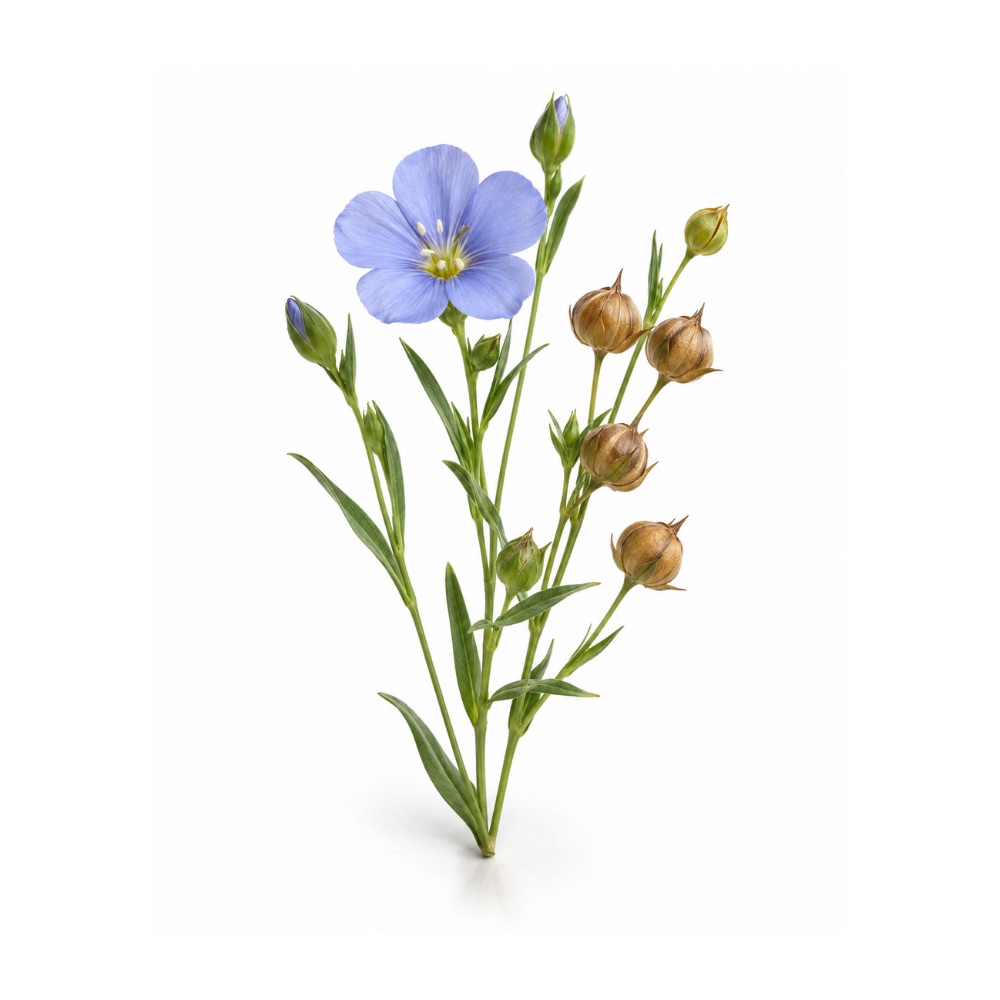
Pictured: Flaxseed
Flax family
A small family of temperate herbs whose one economically vast member, flax, is simultaneously a fibre crop, an oilseed and the densest known plant source of lignans.
1 Herb // 5 Constituents // 5 Notable Members
Overview
Around 14 genera and 250 species of herbs and small shrubs, spread across temperate and subtropical regions but centred on the Mediterranean. Most are slender, narrow-leaved plants with five-petalled flowers whose petals drop within a day of opening. The family is small and botanically unremarkable, and would be a footnote were it not for a single species that has been cultivated for at least nine thousand years.
Shared Traits
In Practice
Flaxseed (Linum usitatissimum) carries essentially the entire medicinal weight of the family, and it does so on three chemically independent fronts.
Lignans. Flax is the densest known dietary source of secoisolariciresinol diglucoside — by a wide margin, typically an order of magnitude above sesame or whole grains. Gut bacteria convert it to the mammalian lignans enterodiol and enterolactone, which bind oestrogen receptors weakly. This is why flax turns up in discussions of hormone-sensitive conditions, and why the evidence there is harder to read than the cardiovascular evidence.
Soluble fibre. The seed coat is heavily mucilaginous, and this is the part of flax with the least ambiguous human data: a real, if modest, LDL-lowering effect, plus the laxative and satiety effects any viscous fibre produces.
Alpha-linolenic acid. The oil is roughly half ALA, the plant-form omega-3. Conversion to EPA and DHA in humans is inefficient, so flax oil is not a substitute for marine omega-3 — a distinction worth making plainly, since it is frequently blurred in marketing.
The preparation matters more than usual. Whole seeds pass through largely intact; the oil carries the ALA but almost none of the lignans or fibre. Ground seed is the form the trials generally use, and the form that delivers all three.
One caution belongs to the genus rather than the seed: fairy flax (Linum catharticum) is, as its name says, a purgative, and raw or immature flaxseed carries cyanogenic glycosides (linustatin, neolinustatin) at levels that make large raw intakes unwise.
Materia Medica
The monograph in the database whose Linaceae membership is recorded on the herb itself — so this list keeps itself current as new herbs land.
Linum usitatissimum
Phytochemistry
The family marker is the lignan series built on secoisolariciresinol, concentrated in the seed coat as its diglucoside. Alongside it sit a distinctive seed-oil profile dominated by alpha-linolenic acid, a heavily mucilaginous arabinoxylan and pectin fraction, cyclic peptides (the orbitides, unusual among seed crops), and cyanogenic glycosides as the family’s chemical defence.
The compounds recorded for this family's single member, grouped by class.
Beyond the Database
Notable members without a monograph yet.
Keep Exploring