
Sinicuichi
Heimia salicifolia
Plant Family
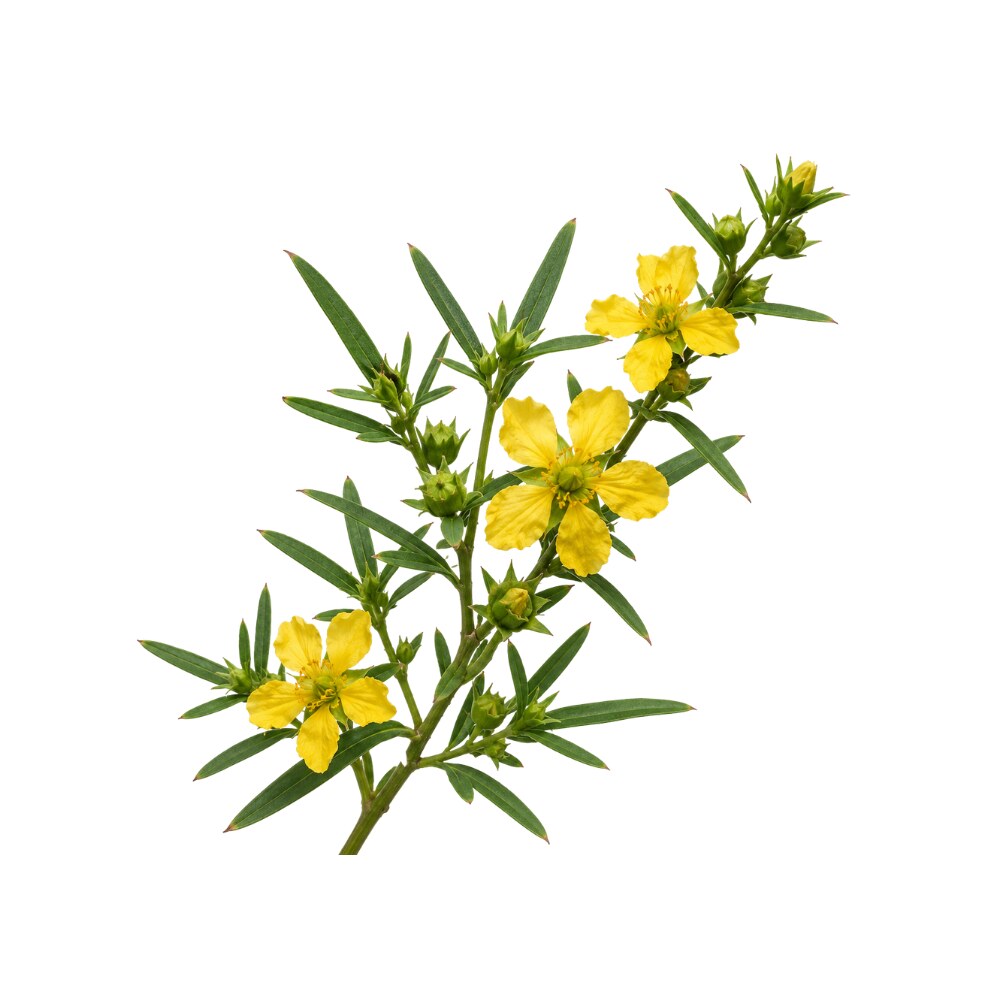
Pictured: Sinicuichi
Loosestrife family
A tannin-rich family spanning pomegranate, henna and purple loosestrife, plus sinicuichi — the Aztec “sun opener” with its unusual auditory pharmacology.
1 Herb // 6 Constituents // 5 Notable Members
Overview
Around 28 genera and 600 species, worldwide but richest in the tropics, spanning herbs, shrubs and trees. Modern classification pulled pomegranate (Punica) into this family, which considerably raised its profile. Its members are usually recognisable by opposite or whorled entire leaves, four- to six-parted flowers with crumpled petals, and a persistent tubular hypanthium.
Shared Traits
In Practice
The family has two quite separate claims on attention.
The first is astringency. Lythraceae are heavily tannin-loaded, and this drives most of the family’s traditional use: purple loosestrife for diarrhoea and dysentery, henna (Lawsonia inermis) as a dye and topical antimicrobial, and pomegranate rind as one of the classic anti-diarrhoeals. Pomegranate is the family’s research heavyweight, its ellagitannins (punicalagins) metabolised by gut bacteria into urolithins, which are the actual circulating compounds behind most of the cardiovascular and anti-inflammatory claims — and which individuals produce in very different amounts depending on their microbiome. That variability is a real and under-discussed limit on the clinical literature.
The second is sinicuichi (Heimia salicifolia), the “sun opener” of Mexican tradition, and it is genuinely odd. The fermented leaf infusion is reported to produce a mild euphoria accompanied by auditory alteration — sounds perceived as distant, muffled or pitch-shifted — plus a yellow tinge to vision. Few plants have an effect profile that specific, and almost none are primarily auditory. The chemistry points to quinolizidine alkaloids, chiefly cryogenine (vertine), with lythrine, nesodine and related bases alongside it. Preclinical work reports anti-inflammatory and smooth-muscle effects for cryogenine, but the auditory phenomenon itself has never been properly investigated, and some later attempts to reproduce it failed. The honest position is that this is an intriguing and poorly verified ethnobotanical report rather than an established pharmacology.
Safety: tannin load limits sustained internal use of the astringent species; the Heimia alkaloids are inadequately characterised, which is itself a reason for caution.
Materia Medica
The monograph in the database whose Lythraceae membership is recorded on the herb itself — so this list keeps itself current as new herbs land.
Heimia salicifolia
Phytochemistry
Hydrolysable tannins, especially ellagitannins (punicalagin, punicalin), are the family’s dominant class. Heimia adds quinolizidine alkaloids (cryogenine, lythrine, nesodine); henna contributes the naphthoquinone lawsone; pomegranate seed carries the conjugated punicic acid.
The compounds recorded for this family's single member, grouped by class.
Beyond the Database
Notable members without a monograph yet.
Keep Exploring