
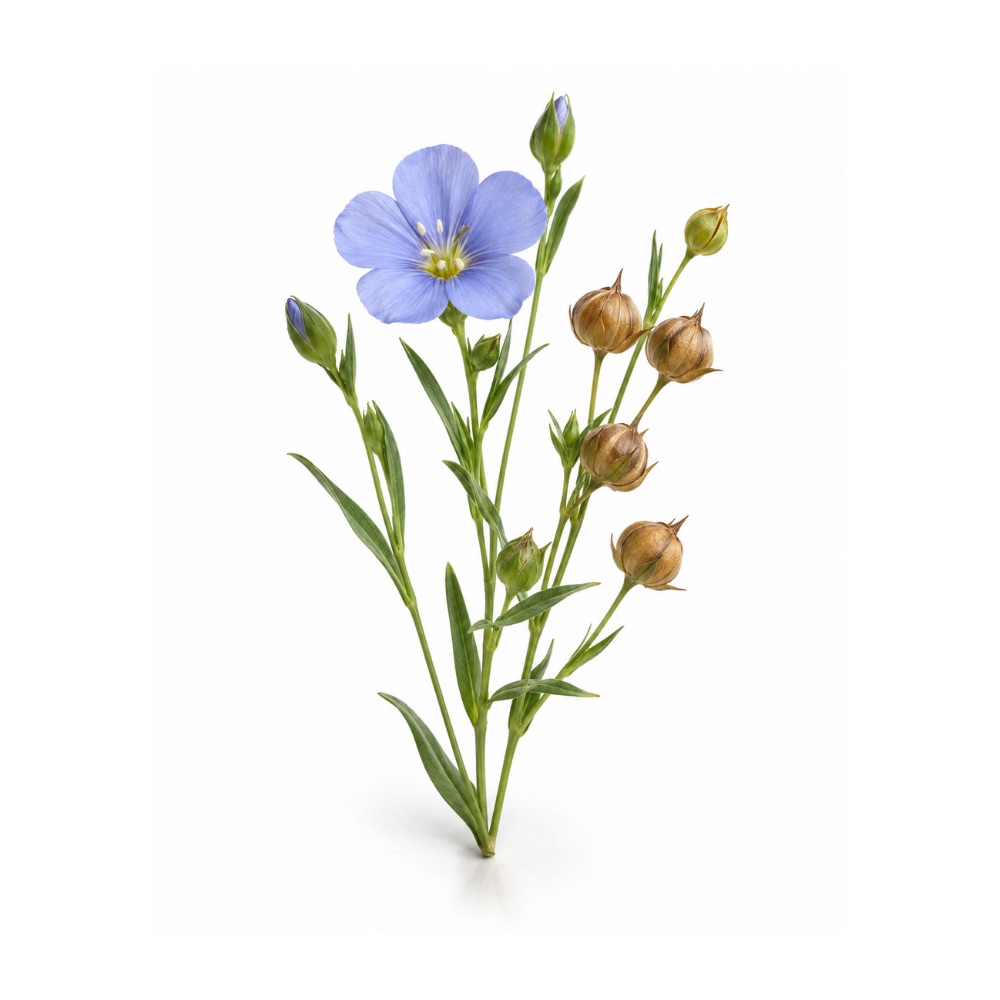
Materia Medica
Flaxseed
Linum usitatissimum
Flaxseed is the seed of the flax plant, an ancient crop grown for linen and oil. The ground seed is rich in soluble fibre and lignans, and is used to lower cholesterol and blood pressure and as a bulk laxative.
What Is Flaxseed?
Flaxseed, or linseed, is the seed of Linum usitatissimum, one of the oldest cultivated plants. The stem gives linen fibre and the seed gives linseed oil, and the seed itself is eaten as a food and taken as a medicine 15Reference 15Linum usitatissimum Linnaeus — species description, habitat and distribution — floraView study →.
Flax has been cultivated since prehistoric times, and its exact origin is uncertain 16,
The seed is rich in gel-forming mucilage, in lignans and in the omega-3 fatty acid alpha-linolenic acid 4,
Flax oil and the ground seed are used differently. The oil carries the fatty acids but not the fibre or lignans.
How Is Flaxseed Used?
Flaxseed is taken as the seed itself, whole, crushed or ground, and stirred into water, cereal, yoghurt or baked food.
- Ground seed (flaxseed meal) — about 30 g a day in most cholesterol and blood-pressure trials 1,
2Reference 1Meta-analysisMeta-analysis of the effects of flaxseed interventions on blood lipidsView study →Reference 2Potent antihypertensive action of dietary flaxseed in hypertensive patients (FLAX-PAD)View study → . - Whole or bruised seed — 10–15 g with a glass of water two or three times a day, as a bulk laxative 12Reference 12Systematic reviewEuropean Union herbal monograph on Linum usitatissimum L., semen (EMA/HMPC/377675/2014), final, first systematic review — regulatory monographView study →.
- Soaked seed — 5–10 g soaked in water to release the mucilage, as a soothing drink for mild digestive discomfort 12Reference 12Systematic reviewEuropean Union herbal monograph on Linum usitatissimum L., semen (EMA/HMPC/377675/2014), final, first systematic review — regulatory monographView study →.
- Lignan extracts — concentrated seed lignans, used in some trials 1,
8Reference 1Meta-analysisMeta-analysis of the effects of flaxseed interventions on blood lipidsView study →Reference 8RCTEffects of a flaxseed-derived lignan supplement in type 2 diabetic patients: a randomised, double-blind, cross-over trialView study → . - Flax oil — pressed from the seed and used as a culinary source of alpha-linolenic acid.
- Poultice — warm ground seed applied to the skin.
Grinding or crushing the seed releases much more of its lignans than swallowing it whole 13Reference 13RCTThe relative bioavailability of enterolignans in humans is enhanced by milling and crushing of flaxseed — randomised crossover trial, n=12View study →. The seed swells as it absorbs water, so it is always taken with plenty of fluid 12Reference 12Systematic reviewEuropean Union herbal monograph on Linum usitatissimum L., semen (EMA/HMPC/377675/2014), final, first systematic review — regulatory monographView study →.
Traditional Uses
Western Herbal Medicine
Flaxseed is a long-standing demulcent and bulk laxative. The mucilaginous seed, or a drink made by soaking it, was taken to soothe irritated digestive and urinary membranes and to ease constipation.
A warm poultice of ground seed was a standard household remedy for boils, skin inflammation and chest complaints.
The EU recognises the soaked seed as a traditional demulcent for mild digestive discomfort, and the whole seed as a laxative for habitual constipation 12Reference 12Systematic reviewEuropean Union herbal monograph on Linum usitatissimum L., semen (EMA/HMPC/377675/2014), final, first systematic review — regulatory monographView study →.
Indications
- High total and LDL cholesterol [ground seed, lignan extract]
- Mild high blood pressure [milled seed]
- Habitual constipation [whole or ground seed; EU monograph]
- Mild digestive discomfort [soaked seed; traditional EU use]
- Raised blood sugar in type 2 diabetes [ground seed, lignan extract]
- Metabolic syndrome [ground seed]
- Boils and skin inflammation [warm seed poultice; Western folk use]
- Menopausal hot flashes [lignan-rich seed] Caution: A phase III placebo-controlled trial of a flaxseed bar providing 410 mg of lignans a day found no benefit over placebo 11.
Botany
Flax is a slender annual herb in the flax family (Linaceae), growing 20–120 cm tall 15,
The leaves are narrow, linear to lance-shaped, and 1–4 cm long 15,
Each flower ripens into a rounded capsule 6–10 mm across, holding up to ten seeds 15,
The seed coat carries a layer of mucilage that swells in water 12,
Distribution
Flax is grown across Europe, Asia and the Americas, from the plains up to about 1,900 m in Pakistan 16,
The cultivated plant has escaped and naturalised in many places. In North America it turns up on roadsides, fields and disturbed ground 15Reference 15Linum usitatissimum Linnaeus — species description, habitat and distribution — floraView study →.
Growing Conditions
Cultivation snapshot for Flaxseed
ZoneUSDA 3–9 as a sown field crop; it wants a cool temperate growing season.
- Full sun on deep, fertile, well-drained loam, sown direct in spring — it is a broadacre crop rather than a garden plant.
- Fibre and seed varieties are the same species bred two ways: fibre flax is grown tall, dense and unbranched for linen; oilseed varieties are shorter, branchier and higher-yielding for seed.
Grow it yourself
Farm Wiki is our cultivation-focused sister site, also run by Justin Cooke.
Pharmacology & Research
Flaxseed has been tested in dozens of randomised controlled trials, pooled in meta-analyses of blood lipids, blood pressure, body weight, inflammation and blood sugar 1,
The clearest findings are a small fall in total and LDL cholesterol and a small fall in blood pressure 1,
Most positive trials used around 30 g a day of milled seed for twelve weeks or more 2,
-
Best-supported: a small, repeatable fall in LDL and total cholesterol from ground seed or lignans (28-trial meta-analysis) 1Reference 1Meta-analysisMeta-analysis of the effects of flaxseed interventions on blood lipidsView study →, and a small fall in blood pressure across two meta-analyses and a 6-month trial 2,
3, .4Reference 2Potent antihypertensive action of dietary flaxseed in hypertensive patients (FLAX-PAD)View study →Reference 3Meta-analysisEffects of flaxseed supplements on blood pressure: a systematic review and meta-analysis of controlled clinical trialsView study →Reference 4Meta-analysisFlaxseed consumption may reduce blood pressure: a systematic review and meta-analysis of controlled trialsView study → -
Emerging, worth watching: lower CRP and IL-6 (54-trial meta-analysis), lower HbA1c in type 2 diabetes, and small weight and waist reductions at 30 g a day or more 5,
6, .7Reference 5Meta-analysisThe effect of flaxseed supplementation on body weight and body composition: a systematic review and meta-analysis of 45 randomised placebo-controlled trialsView study →Reference 6Meta-analysisEffects of flaxseed supplementation on inflammatory biomarkers: a GRADE-assessed systematic review and meta-analysis of randomised controlled trialsView study →Reference 7Meta-analysisFlaxseed supplementation significantly reduces hemoglobin A1c in patients with type 2 diabetes mellitus: a systematic review and meta-analysisView study → - Mechanistically thin / null: menopausal hot flashes, where a phase III trial of 410 mg lignans found no benefit over placebo 11Reference 11RCTA phase III, randomised, placebo-controlled, double-blind trial of flaxseed for the treatment of hot flashes (NCCTG N08C7)View study →.
- The caveat: effect sizes are small and build over weeks, and they belong to the seed and its lignans rather than the oil 1Reference 1Meta-analysisMeta-analysis of the effects of flaxseed interventions on blood lipidsView study →.
The form matters. Ground seed and lignan supplements lowered cholesterol in trials and flaxseed oil did not 1Reference 1Meta-analysisMeta-analysis of the effects of flaxseed interventions on blood lipidsView study →, and grinding releases far more of the seed’s lignans than eating it whole 13Reference 13RCTThe relative bioavailability of enterolignans in humans is enhanced by milling and crushing of flaxseed — randomised crossover trial, n=12View study →.
1. Cholesterol
A meta-analysis of 28 randomised controlled trials found that flaxseed lowered total cholesterol by about 0.10 mmol/L and LDL by about 0.08 mmol/L overall 1Reference 1Meta-analysisMeta-analysis of the effects of flaxseed interventions on blood lipidsView study →.
The reductions were significant for whole flaxseed (total −0.21, LDL −0.16 mmol/L) and for lignan supplements (total −0.28, LDL −0.16 mmol/L), but not for flaxseed oil 1Reference 1Meta-analysisMeta-analysis of the effects of flaxseed interventions on blood lipidsView study →.
Effects were larger in women, particularly after menopause, in people with higher starting cholesterol, and in better-designed trials. HDL and triglycerides did not change 1Reference 1Meta-analysisMeta-analysis of the effects of flaxseed interventions on blood lipidsView study →.
In a 12-week trial in constipated people with type 2 diabetes, cookies containing 10 g of flaxseed twice a day lowered total and LDL cholesterol compared with placebo 10Reference 10Effect of flaxseed or psyllium vs. placebo on management of constipation, weight, glycemia and lipids in constipated patients with type 2 diabetesView study →.
Gap: the effects are small, and depend on the seed or lignan form rather than the oil.
2. Blood Pressure
Two meta-analyses found a small fall in blood pressure.
One, of 15 trials with 1,302 participants, found systolic pressure down 2.85 mmHg and diastolic down 2.39 mmHg. Trials of 12 weeks or more showed larger falls, and systolic pressure fell with flaxseed powder but not with oil or lignan extract 3Reference 3Meta-analysisEffects of flaxseed supplements on blood pressure: a systematic review and meta-analysis of controlled clinical trialsView study →.
The other, of 11 studies, found systolic pressure down 1.77 mmHg and diastolic down 1.58 mmHg. Diastolic pressure fell further with whole flaxseed and with 12 weeks or more of use 4Reference 4Meta-analysisFlaxseed consumption may reduce blood pressure: a systematic review and meta-analysis of controlled trialsView study →.
In the FLAX-PAD trial, 110 people with peripheral artery disease ate foods containing 30 g of milled flaxseed or placebo every day for six months. Systolic pressure was about 10 mmHg lower and diastolic about 7 mmHg lower with flaxseed 2Reference 2Potent antihypertensive action of dietary flaxseed in hypertensive patients (FLAX-PAD)View study →.
In those who started with systolic pressure of 140 mmHg or more, the falls were 15 and 7 mmHg. Blood levels of alpha-linolenic acid correlated with both pressures, and lignan levels with the change in diastolic pressure 2Reference 2Potent antihypertensive action of dietary flaxseed in hypertensive patients (FLAX-PAD)View study →.
Gap: the pooled effect (about 2–3 mmHg) is far smaller than the single FLAX-PAD result (about 10 mmHg), and the large effect has not been replicated in newly diagnosed, untreated hypertension.
3. Body Weight & Composition
A meta-analysis of 45 placebo-controlled trials found small reductions in body weight (−0.99 kg), BMI (−0.30 kg/m²) and waist circumference (−0.80 cm) 5Reference 5Meta-analysisThe effect of flaxseed supplementation on body weight and body composition: a systematic review and meta-analysis of 45 randomised placebo-controlled trialsView study →.
The benefit showed up with whole flaxseed at 30 g a day or more, with 12 weeks or more of use, and in people with a BMI of 27 or higher 5Reference 5Meta-analysisThe effect of flaxseed supplementation on body weight and body composition: a systematic review and meta-analysis of 45 randomised placebo-controlled trialsView study →.
The reductions are small, and the trials varied widely.
4. Anti-Inflammatory
A GRADE-assessed meta-analysis of 54 trials with 3,000 participants found that flaxseed lowered C-reactive protein (standardised mean difference −0.46) and interleukin-6 (−0.64), but did not change TNF-α 6Reference 6Meta-analysisEffects of flaxseed supplementation on inflammatory biomarkers: a GRADE-assessed systematic review and meta-analysis of randomised controlled trialsView study →.
The trials varied a great deal (I² above 80%), and these are blood markers rather than clinical outcomes 6Reference 6Meta-analysisEffects of flaxseed supplementation on inflammatory biomarkers: a GRADE-assessed systematic review and meta-analysis of randomised controlled trialsView study →.
5. Glycemic Control
A meta-analysis of 13 trials in type 2 diabetes found that flaxseed lowered HbA1c, most clearly in people whose HbA1c was 7.0% or higher 7Reference 7Meta-analysisFlaxseed supplementation significantly reduces hemoglobin A1c in patients with type 2 diabetes mellitus: a systematic review and meta-analysisView study →.
Overall, fasting glucose and insulin resistance did not change. In the subgroups with poorer control (fasting glucose of 8.0 mmol/L or more, or HbA1c of 7.0% or more), fasting glucose did fall 7Reference 7Meta-analysisFlaxseed supplementation significantly reduces hemoglobin A1c in patients with type 2 diabetes mellitus: a systematic review and meta-analysisView study →.
In a double-blind crossover trial in 68 people with type 2 diabetes, a flaxseed-derived lignan supplement (360 mg a day for 12 weeks) lowered HbA1c slightly compared with placebo, without changing fasting glucose, insulin or lipids 8Reference 8RCTEffects of a flaxseed-derived lignan supplement in type 2 diabetic patients: a randomised, double-blind, cross-over trialView study →.
6. Constipation
The seed-coat mucilage swells with water, softening the stool and adding bulk 12Reference 12Systematic reviewEuropean Union herbal monograph on Linum usitatissimum L., semen (EMA/HMPC/377675/2014), final, first systematic review — regulatory monographView study →.
In a 4-week trial in 90 adults with functional constipation, 50 g a day of flaxseed flour cut the median Wexner constipation score from 14 to 6.5 and raised weekly bowel movements from 2 to 7. It was somewhat more effective than lactulose at increasing bowel frequency 9Reference 9Effects of flaxseed supplementation on functional constipation and quality of life in a Chinese populationView study →.
In a 12-week single-blind trial in 77 constipated people with type 2 diabetes, 10 g of flaxseed twice a day in cookies improved constipation symptoms and stool consistency compared with placebo 10Reference 10Effect of flaxseed or psyllium vs. placebo on management of constipation, weight, glycemia and lipids in constipated patients with type 2 diabetesView study →.
The EU recognises linseed as a well-established treatment for habitual constipation 12Reference 12Systematic reviewEuropean Union herbal monograph on Linum usitatissimum L., semen (EMA/HMPC/377675/2014), final, first systematic review — regulatory monographView study →.
7. Menopausal Symptoms
A phase III, randomised, placebo-controlled trial in 188 postmenopausal women tested a flaxseed bar providing 410 mg of lignans a day for six weeks. Hot-flash scores fell by 4.9 with flaxseed and 3.5 with placebo, a difference that was not significant (p = 0.29). Slightly more than a third of women in each group halved their hot-flash score 11Reference 11RCTA phase III, randomised, placebo-controlled, double-blind trial of flaxseed for the treatment of hot flashes (NCCTG N08C7)View study →.
Flaxseed lignans are converted by gut bacteria into enterodiol and enterolactone 13Reference 13RCTThe relative bioavailability of enterolignans in humans is enhanced by milling and crushing of flaxseed — randomised crossover trial, n=12View study →, and the EU notes that linseed may have an oestrogenic effect 12Reference 12Systematic reviewEuropean Union herbal monograph on Linum usitatissimum L., semen (EMA/HMPC/377675/2014), final, first systematic review — regulatory monographView study →.
Gap: the best-designed trial found no benefit.
Mechanisms
Flaxseed’s effects come from three parts of the seed. The mucilage in the seed coat swells with water into a gel, which bulks and softens the stool 12Reference 12Systematic reviewEuropean Union herbal monograph on Linum usitatissimum L., semen (EMA/HMPC/377675/2014), final, first systematic review — regulatory monographView study →. The lignans are converted by gut bacteria into the enterolignans enterodiol and enterolactone 13Reference 13RCTThe relative bioavailability of enterolignans in humans is enhanced by milling and crushing of flaxseed — randomised crossover trial, n=12View study →.
The oil in the kernel is rich in alpha-linolenic acid, a plant omega-3 fatty acid. In the FLAX-PAD trial, blood levels of alpha-linolenic acid tracked the fall in blood pressure 2Reference 2Potent antihypertensive action of dietary flaxseed in hypertensive patients (FLAX-PAD)View study →.
| Mechanism | Drives | Key compounds |
|---|---|---|
| Mucilage swells with water into a gel; stool bulked and softened | constipationsatiety/weight | mucilage / soluble fibre |
| Gut-bacterial conversion of lignans to enterodiol and enterolactone; oestrogenic effect | cholesterolblood sugarmenopausal symptoms (null) | secoisolariciresinol diglucoside, matairesinol |
| Omega-3 fatty acid raised in the blood | blood pressureinflammation markers | alpha-linolenic acid |
Clinical Trials
Flaxseed has been tested in many completed human trials and several meta-analyses across lipids, blood pressure, blood sugar, weight and inflammation 1,
| Completed | Planned | Terminated | Preclinical |
|---|---|---|---|
| Numerous RCTs + meta-analyses | Ongoing | At least 1 | Extensive |
Last checked: September 2026.
Phytochemistry
Nearly a quarter of the seed is bulk material, including 3–6% mucilage and 4–7% dietary fibre 12Reference 12Systematic reviewEuropean Union herbal monograph on Linum usitatissimum L., semen (EMA/HMPC/377675/2014), final, first systematic review — regulatory monographView study →. The mucilage sits in the seed coat and forms a gel in water.
Flaxseed is one of the richest dietary sources of lignans 13Reference 13RCTThe relative bioavailability of enterolignans in humans is enhanced by milling and crushing of flaxseed — randomised crossover trial, n=12View study →. The main one is secoisolariciresinol diglucoside, and the seed also contains matairesinol. Gut bacteria convert the plant lignans into enterodiol and enterolactone 13Reference 13RCTThe relative bioavailability of enterolignans in humans is enhanced by milling and crushing of flaxseed — randomised crossover trial, n=12View study →.
The oil is rich in alpha-linolenic acid, a plant omega-3 fatty acid 4Reference 4Meta-analysisFlaxseed consumption may reduce blood pressure: a systematic review and meta-analysis of controlled trialsView study →.
The seed also contains cyanogenic glycosides, mainly linustatin and neolinustatin, with smaller amounts of linamarin 14Reference 14Evaluation of the health risks related to the presence of cyanogenic glycosides in foods other than raw apricot kernels — regulatory risk assessmentView study →.
In the lipid meta-analysis, the whole seed and lignan supplements lowered cholesterol and the oil did not 1Reference 1Meta-analysisMeta-analysis of the effects of flaxseed interventions on blood lipidsView study →.
Constituent Summary
Amounts are for the whole seed.
Polysaccharide2 compounds2 with data
Fatty Acid1 compoundno data
Cyanogenic Glycoside1 compound1 with data
Dosage
Most trials used about 30 g a day of milled seed for twelve weeks or more, or a lignan supplement 1,
| Indication | Preparation | Dose | Est. dried-herb equivalent | Source |
|---|---|---|---|---|
| Cholesterol (LDL, total) | Whole/ground seed, or lignan supplement | ~30 g/day milled seed, ≥12 wk | 30 g (as given) | 1Reference 1Meta-analysisMeta-analysis of the effects of flaxseed interventions on blood lipidsView study → |
| Blood pressure | Milled seed in food | 30 g/day, 6 months | 30 g (as given) | 2Reference 2Potent antihypertensive action of dietary flaxseed in hypertensive patients (FLAX-PAD)View study → |
| Blood pressure (pooled) | Flaxseed powder | Varied; effect larger at ≥12 wk | — | 3, |
| Body weight & composition | Whole flaxseed | ≥30 g/day, ≥12 wk, BMI ≥27 | 30 g (as given) | 5Reference 5Meta-analysisThe effect of flaxseed supplementation on body weight and body composition: a systematic review and meta-analysis of 45 randomised placebo-controlled trialsView study → |
| Glycemic control (T2DM) | Flaxseed-derived lignan capsules | 360 mg lignan/day, 12 wk | — | 8Reference 8RCTEffects of a flaxseed-derived lignan supplement in type 2 diabetic patients: a randomised, double-blind, cross-over trialView study → |
| Constipation | Flaxseed flour with meals | 50 g/day, 4 wk | 50 g (as given) | 9Reference 9Effects of flaxseed supplementation on functional constipation and quality of life in a Chinese populationView study → |
| Constipation (T2DM) | Flaxseed in cookies | 10 g twice daily, 12 wk | 20 g (as given) | 10Reference 10Effect of flaxseed or psyllium vs. placebo on management of constipation, weight, glycemia and lipids in constipated patients with type 2 diabetesView study → |
| Menopausal hot flashes | Flaxseed bar (410 mg lignans) | 6 wk | — | 11Reference 11RCTA phase III, randomised, placebo-controlled, double-blind trial of flaxseed for the treatment of hot flashes (NCCTG N08C7)View study → — null result |
Effects build over weeks rather than days. Take with plenty of fluid.
Traditional Dosage
| System | Preparation | Dose |
|---|---|---|
| EU monograph (well-established use, constipation) | Whole or bruised seed with 150 mL water, milk or juice | 10–15 g, 2–3 times daily; not immediately before bed 12Reference 12Systematic reviewEuropean Union herbal monograph on Linum usitatissimum L., semen (EMA/HMPC/377675/2014), final, first systematic review — regulatory monographView study → |
| EU monograph (traditional use, demulcent) | Seed soaked in 250 mL water, taken half an hour before eating | 5–10 g, up to 3 times daily 12Reference 12Systematic reviewEuropean Union herbal monograph on Linum usitatissimum L., semen (EMA/HMPC/377675/2014), final, first systematic review — regulatory monographView study → |
| Western folk use | Warm ground-seed poultice | Not quantified |
Safety & Pregnancy
Flaxseed is a staple food and is well tolerated. Its cautions come from how the seed swells in water and from its fibre and lignans.
- Take with plenty of fluid. Without enough fluid the seed can swell and block the throat or oesophagus, and it can cause intestinal obstruction. It is not for people with bowel obstruction, narrowing of the gut, oesophageal disease or difficulty swallowing 12Reference 12Systematic reviewEuropean Union herbal monograph on Linum usitatissimum L., semen (EMA/HMPC/377675/2014), final, first systematic review — regulatory monographView study →.
- Medicine timing. The seed can delay the absorption of other medicines, so take it at least half an hour to an hour apart from them. With opioids or loperamide, use it only under medical supervision 12Reference 12Systematic reviewEuropean Union herbal monograph on Linum usitatissimum L., semen (EMA/HMPC/377675/2014), final, first systematic review — regulatory monographView study →.
- Blood pressure and bleeding. It lowers blood pressure a little 2,
3, . Mild antiplatelet activity is a reason for care alongside anticoagulant, antiplatelet or blood-pressure drugs and before surgery.4Reference 2Potent antihypertensive action of dietary flaxseed in hypertensive patients (FLAX-PAD)View study →Reference 3Meta-analysisEffects of flaxseed supplements on blood pressure: a systematic review and meta-analysis of controlled clinical trialsView study →Reference 4Meta-analysisFlaxseed consumption may reduce blood pressure: a systematic review and meta-analysis of controlled trialsView study → - Oestrogenic effect. Long-term use may have an oestrogenic effect, and the EU does not recommend it for women with hormone-dependent tumours 12Reference 12Systematic reviewEuropean Union herbal monograph on Linum usitatissimum L., semen (EMA/HMPC/377675/2014), final, first systematic review — regulatory monographView study →.
- Children. As a medicine, it is not recommended under 12 years of age 12Reference 12Systematic reviewEuropean Union herbal monograph on Linum usitatissimum L., semen (EMA/HMPC/377675/2014), final, first systematic review — regulatory monographView study →.
- Well tolerated in trials. Bloating and wind are common 11,
12Reference 11RCTA phase III, randomised, placebo-controlled, double-blind trial of flaxseed for the treatment of hot flashes (NCCTG N08C7)View study →Reference 12Systematic reviewEuropean Union herbal monograph on Linum usitatissimum L., semen (EMA/HMPC/377675/2014), final, first systematic review — regulatory monographView study → , and serious reactions are very rare 12Reference 12Systematic reviewEuropean Union herbal monograph on Linum usitatissimum L., semen (EMA/HMPC/377675/2014), final, first systematic review — regulatory monographView study →.
Full Safety Detail
Swelling and obstruction. The mucilage swells as it takes up water. Taken without enough fluid, the seed can block the throat or oesophagus and cause choking, or cause intestinal obstruction. Chest pain, vomiting or difficulty swallowing or breathing after taking it needs urgent medical attention 12Reference 12Systematic reviewEuropean Union herbal monograph on Linum usitatissimum L., semen (EMA/HMPC/377675/2014), final, first systematic review — regulatory monographView study →.
Contraindications. The EU monograph lists bowel obstruction or paralysis, abnormal narrowing of the gut, megacolon, diseases of the oesophagus, and difficulty swallowing. As a laxative, it should not be used for a sudden change in bowel habit lasting more than two weeks, for undiagnosed rectal bleeding, or when a laxative has failed to work 12Reference 12Systematic reviewEuropean Union herbal monograph on Linum usitatissimum L., semen (EMA/HMPC/377675/2014), final, first systematic review — regulatory monographView study →.
Other medicines. Bulk laxatives such as linseed can delay the absorption of medicines taken at the same time, so the seed is taken at least half an hour to an hour apart from them. Because of the risk of obstruction, it is used with opioids, loperamide and other drugs that slow the gut only under medical supervision 12Reference 12Systematic reviewEuropean Union herbal monograph on Linum usitatissimum L., semen (EMA/HMPC/377675/2014), final, first systematic review — regulatory monographView study →.
Oestrogenic effect. Studies in healthy women suggest long-term use may have an oestrogenic effect, so the EU does not recommend it for women with hormone-dependent tumours 12Reference 12Systematic reviewEuropean Union herbal monograph on Linum usitatissimum L., semen (EMA/HMPC/377675/2014), final, first systematic review — regulatory monographView study →.
Cyanogenic glycosides. The seed contains cyanogenic glycosides. Cyanide is released from ground linseed more slowly and less completely than from cassava or bitter almonds, and food regulators have found no reports of poisoning from eating linseed 14Reference 14Evaluation of the health risks related to the presence of cyanogenic glycosides in foods other than raw apricot kernels — regulatory risk assessmentView study →.
Side effects. Bloating and wind are common. Allergic reactions, including anaphylaxis-like reactions, occur very rarely 12Reference 12Systematic reviewEuropean Union herbal monograph on Linum usitatissimum L., semen (EMA/HMPC/377675/2014), final, first systematic review — regulatory monographView study →.
Avoid as a medicine. Flaxseed is eaten as a food. As a medicine, the EU monograph does not recommend it during pregnancy or breastfeeding: there are no reports of harm, but safety has not been established, and linseed may have an oestrogenic effect 12Reference 12Systematic reviewEuropean Union herbal monograph on Linum usitatissimum L., semen (EMA/HMPC/377675/2014), final, first systematic review — regulatory monographView study →.
References
- Pan, A., Yu, D., Demark-Wahnefried, W., Franco, O. H., & Lin, X. (2009). Meta-analysis of the effects of flaxseed interventions on blood lipids. American Journal of Clinical Nutrition. https://pubmed.ncbi.nlm.nih.gov/19515737/
- Rodriguez-Leyva, D., Weighell, W., Edel, A. L., et al. (2013). Potent antihypertensive action of dietary flaxseed in hypertensive patients (FLAX-PAD). Hypertension. https://pubmed.ncbi.nlm.nih.gov/24126178/
- Ursoniu, S., Sahebkar, A., Andrica, F., Serban, C., & Banach, M. (2016). Effects of flaxseed supplements on blood pressure: a systematic review and meta-analysis of controlled clinical trials. Clinical Nutrition. https://pubmed.ncbi.nlm.nih.gov/26071633/
- Khalesi, S., Irwin, C., & Schubert, M. (2015). Flaxseed consumption may reduce blood pressure: a systematic review and meta-analysis of controlled trials. Journal of Nutrition. https://pubmed.ncbi.nlm.nih.gov/25740909/
- Mohammadi-Sartang, M., Mazloom, Z., Raeisi-Dehkordi, H., et al. (2017). The effect of flaxseed supplementation on body weight and body composition: a systematic review and meta-analysis of 45 randomised placebo-controlled trials. Obesity Reviews. https://pubmed.ncbi.nlm.nih.gov/28635182/
- Musazadeh, V., Morovatshoar, R., Kavyani, Z., Vajdi, M., & Askari, G. (2024). Effects of flaxseed supplementation on inflammatory biomarkers: a GRADE-assessed systematic review and meta-analysis of randomised controlled trials. Prostaglandins & Other Lipid Mediators. https://pubmed.ncbi.nlm.nih.gov/38971216/
- Xi, H., Zhou, W., Sohaib, M., et al. (2023). Flaxseed supplementation significantly reduces hemoglobin A1c in patients with type 2 diabetes mellitus: a systematic review and meta-analysis. Nutrition Research. https://pubmed.ncbi.nlm.nih.gov/36640581/
- Pan, A., Sun, J., Chen, Y., et al. (2007). Effects of a flaxseed-derived lignan supplement in type 2 diabetic patients: a randomised, double-blind, cross-over trial. PLOS ONE. https://pubmed.ncbi.nlm.nih.gov/17987126/
- Sun, J., Bai, H., Ma, J., et al. (2020). Effects of flaxseed supplementation on functional constipation and quality of life in a Chinese population. Asia Pacific Journal of Clinical Nutrition. https://pubmed.ncbi.nlm.nih.gov/32229443/
- Soltanian, N., & Janghorbani, M. (2019). Effect of flaxseed or psyllium vs. placebo on management of constipation, weight, glycemia and lipids in constipated patients with type 2 diabetes. Clinical Nutrition ESPEN. https://pubmed.ncbi.nlm.nih.gov/30661699/
- Pruthi, S., Qin, R., Terstreip, S. A., et al. (2012). A phase III, randomised, placebo-controlled, double-blind trial of flaxseed for the treatment of hot flashes (NCCTG N08C7). Menopause. https://pubmed.ncbi.nlm.nih.gov/21900849/
- Committee on Herbal Medicinal Products (HMPC) (2015). European Union herbal monograph on Linum usitatissimum L., semen (EMA/HMPC/377675/2014), final, first systematic review — regulatory monograph. European Medicines Agency. https://www.ema.europa.eu/en/documents/herbal-monograph/final-community-herbal-monograph-linum-usitatissimum-l-semen_en.pdf
- Kuijsten, A., Arts, I. C., van’t Veer, P., & Hollman, P. C. (2005). The relative bioavailability of enterolignans in humans is enhanced by milling and crushing of flaxseed — randomised crossover trial, n=12. Journal of Nutrition, 135(12), 2812–2816. https://pubmed.ncbi.nlm.nih.gov/16317125/
- EFSA Panel on Contaminants in the Food Chain (CONTAM), Schrenk, D., Bignami, M., Bodin, L., et al. (2019). Evaluation of the health risks related to the presence of cyanogenic glycosides in foods other than raw apricot kernels — regulatory risk assessment. EFSA Journal, 17(4), e05662. https://pubmed.ncbi.nlm.nih.gov/32626287/
- Morin, N. R. (2016). Linum usitatissimum Linnaeus — species description, habitat and distribution — flora. In Flora of North America Editorial Committee (eds.), Flora of North America North of Mexico, Vol. 12. http://www.efloras.org/florataxon.aspx?flora_id=1&taxon_id=200012411
- Liu, Q., & Zhou, L. (2008). Linum usitatissimum Linnaeus — species description and distribution — flora. In Wu, Z. Y., & Raven, P. H. (eds.), Flora of China, Vol. 11. http://www.efloras.org/florataxon.aspx?flora_id=2&taxon_id=200012411
- Abdulla, P. Linum usitatissimum Linn. — species description and distribution — flora. In Flora of Pakistan (Linaceae). http://www.efloras.org/florataxon.aspx?flora_id=5&taxon_id=200012411



