
Usnea
Usnea spp.
Plant Family
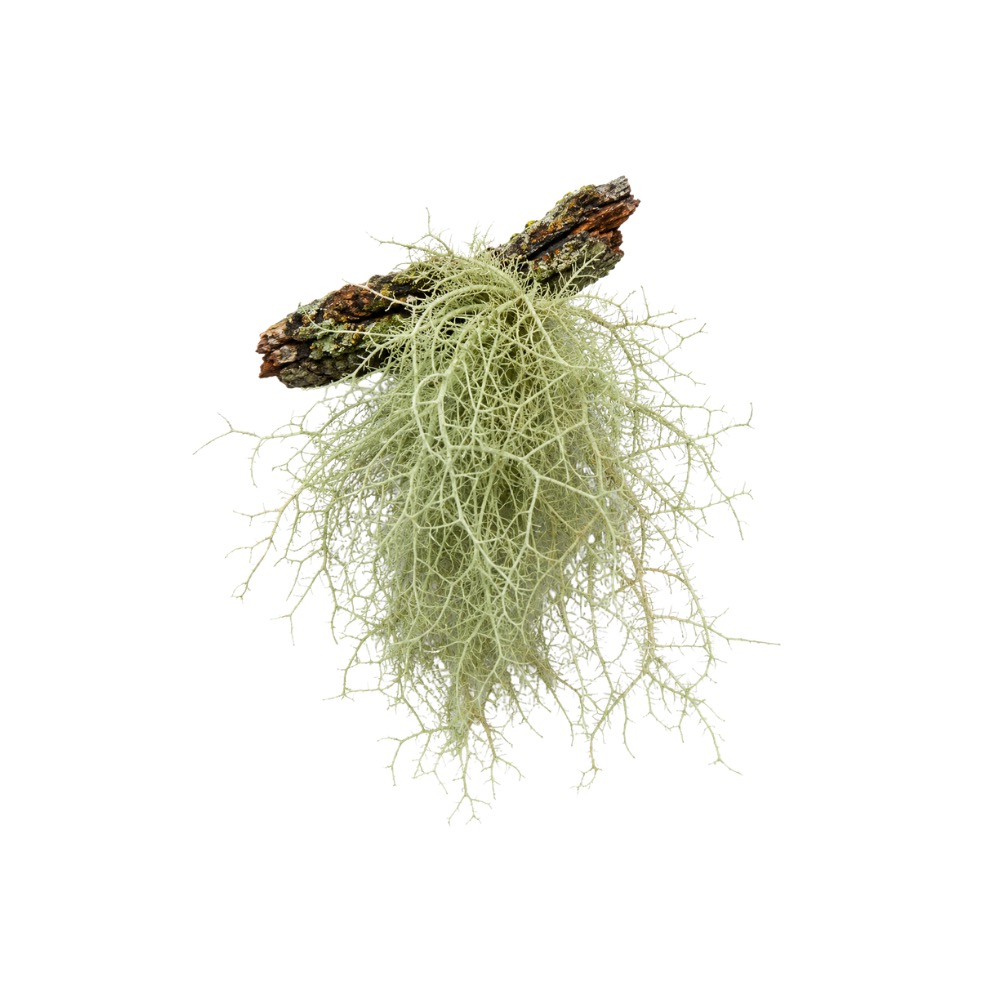
Pictured: Usnea
Shield lichen family
The largest lichen family, a fungal–algal symbiosis rather than a plant; medicinally represented by usnea, whose usnic acid is antibacterial but hepatotoxic in concentrate.
1 Herb // 6 Constituents // 5 Notable Members
Overview
The largest family of lichens — some 80 genera and 2,700 species. A lichen is not a plant: it is a symbiosis, a fungus (the mycobiont) housing photosynthetic algae or cyanobacteria (the photobiont) in a composite body called a thallus. The partnership allows colonisation of bare rock, bark and tundra where neither partner could survive alone, and it grows extremely slowly — a consideration that makes wild harvest a genuine sustainability question.
Parmeliaceae are also among the most sensitive bioindicators of air quality; their absence from an area is a reliable sign of sulfur dioxide pollution.
Shared Traits
In Practice
Usnea — old man’s beard — is the family’s medicinal representative, a pale grey-green fruticose lichen hanging from branches, identified in the field by a white elastic central cord revealed when a strand is gently pulled apart. It has a long record across European, Chinese and North American practice as a topical antiseptic and wound dressing, and internally for respiratory and urinary infection.
The active principle is usnic acid, a dibenzofuran that is genuinely antibacterial — particularly against Gram-positive organisms including Staphylococcus aureus, Streptococcus and Mycobacterium, acting as an uncoupler of oxidative phosphorylation. It has essentially no useful activity against Gram-negatives. For topical and wound use this is a reasonable evidence base by traditional-medicine standards.
The hepatotoxicity is the reason to be careful, and it is not hypothetical. Concentrated usnic acid marketed as a weight-loss aid (the mitochondrial uncoupling that kills bacteria also raises metabolic rate) caused a cluster of acute liver failure cases, including some requiring transplant, leading to product withdrawals and FDA warnings. Whole-lichen traditional preparations at traditional doses have not produced the same signal, but the distinction between “traditional tincture used short-term” and “isolated usnic acid capsule” is the entire safety margin here, and it should never be blurred.
Iceland moss (Cetraria islandica), also in this family, is a different proposition — a demulcent and bitter used for cough and gastritis, with a much gentler profile.
Materia Medica
The monograph in the database whose Parmeliaceae membership is recorded on the herb itself — so this list keeps itself current as new herbs land.
Usnea spp.
Phytochemistry
Depsides and depsidones are the lichen-characteristic classes — usnic acid, atranorin, salazinic and evernic acid — alongside the polysaccharide lichenan and, in Iceland moss, mucilage. These “lichen acids” are largely absent from free-living fungi and algae, arising only from the symbiosis.
The compounds recorded for this family's single member, grouped by class.
Beyond the Database
Notable members without a monograph yet.
Keep Exploring