
Tinder Conk
Fomes fomentarius
Plant Family
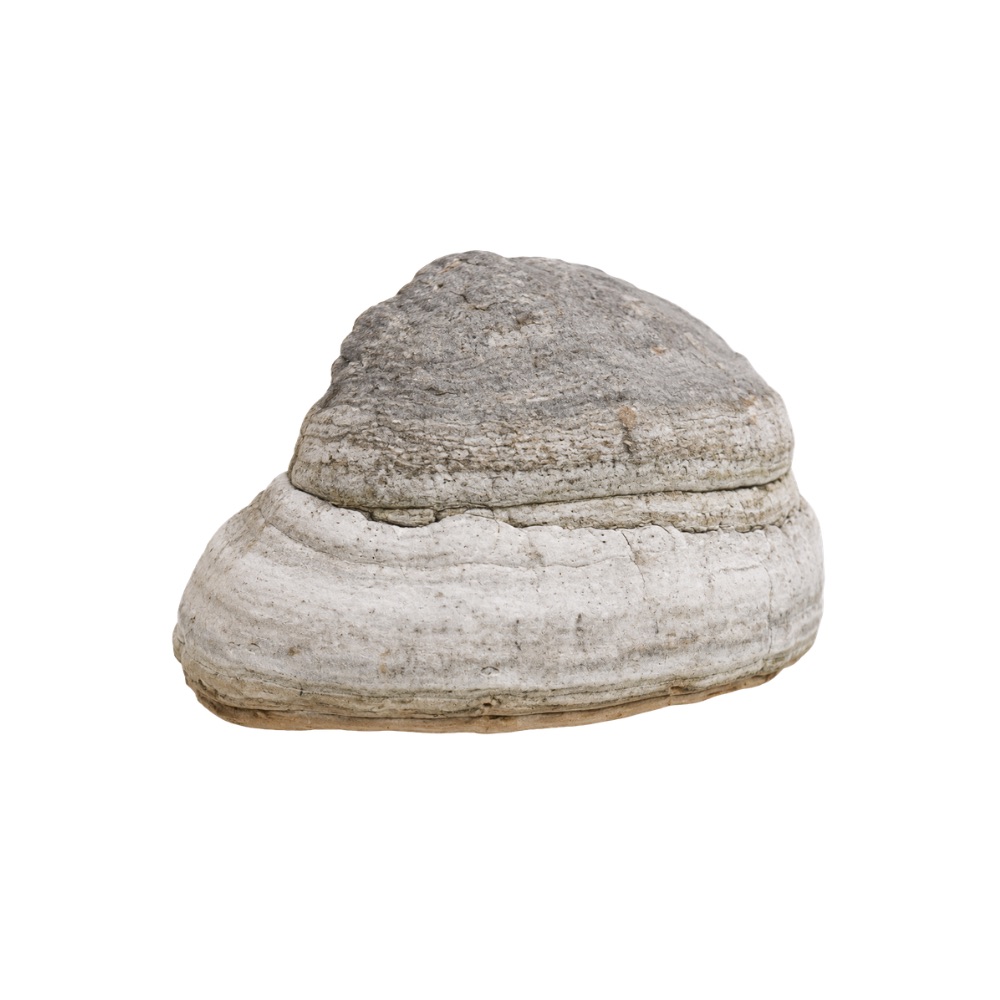
Pictured: Tinder Conk
Polypore family
Tough, pored bracket fungi that decay wood; medicinally a source of beta-glucans, and historically the fire-starting and wound-packing material of prehistoric Europe.
1 Herb // 8 Constituents // 5 Notable Members
Overview
A large family of wood-decaying fungi that dispense with gills entirely: spores are released from the mouths of tightly packed tubes, giving the underside of a bracket its characteristic pored surface. Most are tough, woody or leathery perennials on standing and fallen timber, and they are the principal agents of wood decay in forest ecosystems — a role that makes them ecologically indispensable and, occasionally, structurally destructive.
Shared Traits
In Practice
Tinder conk (Fomes fomentarius), the hoof fungus, has one of the longest documented human uses of any organism. Ötzi the Iceman, who died in the Alps around 3300 BCE, was carrying it — part of a fire-lighting kit, since the fungus’s inner layer processes into amadou, a felt-like material that takes a spark and smoulders reliably. That same amadou served for centuries as a wound dressing and styptic, and was used by barber-surgeons and dentists to staunch bleeding into the 19th century. It is one of the very few materials whose haemostatic use is attested continuously from prehistory to modern memory.
Contemporary interest is more conventional: like most medicinal polypores, F. fomentarius carries beta-glucan polysaccharides with immunomodulatory activity in preclinical models, plus triterpenes and reported antimicrobial and anti-inflammatory effects. There is essentially no human clinical evidence for it specifically, and it would be wrong to imply otherwise — the modern medicinal-polypore evidence base belongs mainly to turkey tail (Trametes versicolor), whose PSK and PSP polysaccharide fractions are licensed adjuncts in Japanese cancer care, and to maitake and reishi.
The family’s broader significance to medicine is worth noting: wood-decay polypores are prolific producers of lignin-degrading enzymes and novel secondary metabolites, and remain an active source of drug leads.
Safety: these are tough, largely inedible fungi used as extracts rather than food. Standard mushroom cautions apply — allergy, and caution with immunosuppressants given the immunomodulatory profile.
Materia Medica
The monograph in the database whose Polyporaceae membership is recorded on the herb itself — so this list keeps itself current as new herbs land.
Fomes fomentarius
Phytochemistry
Beta-glucan polysaccharides are the medicinally relevant class across the family, alongside triterpenoids, ergosterol derivatives, and the polyphenol oxidases and laccases involved in wood decay.
The compounds recorded for this family's single member, grouped by class.
Beyond the Database
Notable members without a monograph yet.
Keep Exploring