
Materia Medica
Death Camas ☠️
Toxicoscordion venenosum
Death camas is a poisonous western North American bulb in the lily group whose steroidal alkaloids slow the heart and drop blood pressure. Its bulbs look like those of edible camas and wild onion, and the plants are only reliably told apart in flower.
What Is Death Camas?
Death camas is a poisonous bulb of western North America, and one of the plants most often mistaken for food. It grows in the same open grasslands and meadows as edible camas and wild onion, and its bulb looks much like theirs 11,
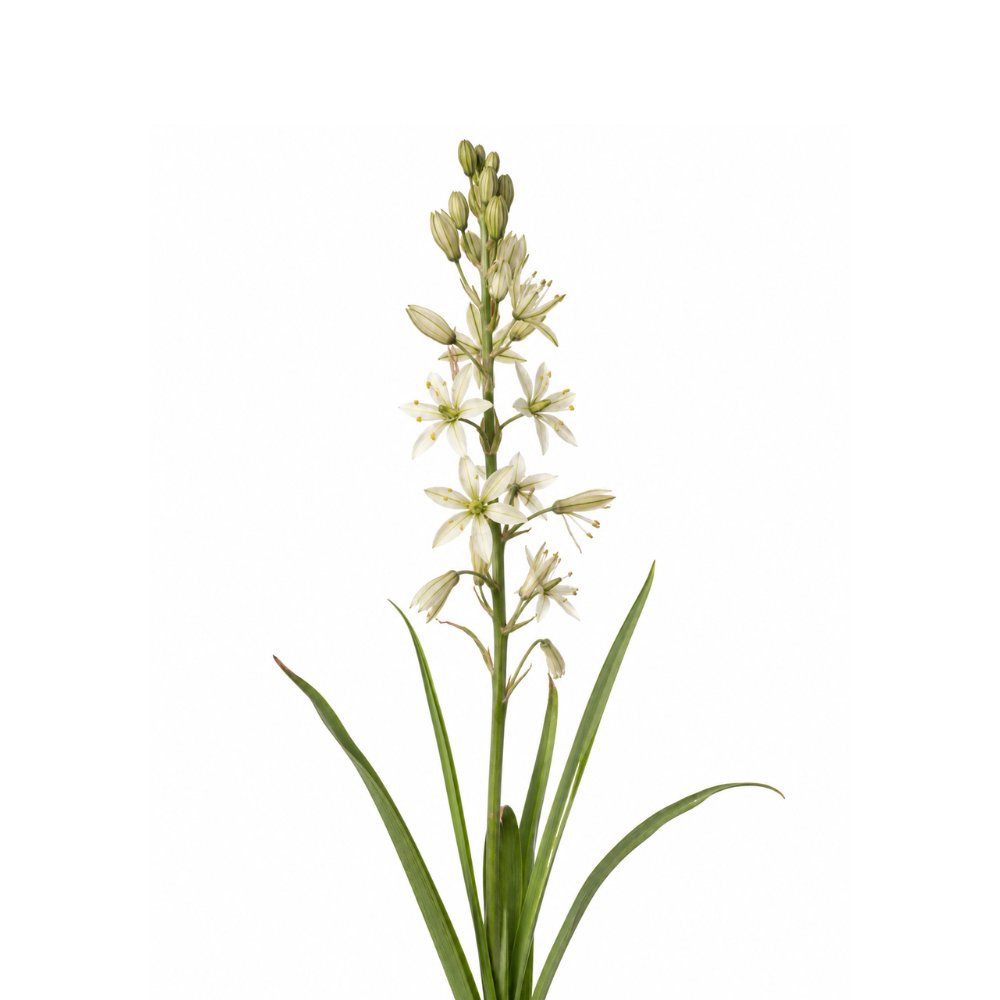
The plant stands 20–70 cm tall, with narrow grass-like leaves and a spike of small cream-coloured flowers in spring 11Reference 11Schwartz, F. C. Zigadenus (including Z. venenosus and its varieties). In Flora of North America Editorial Committee (Eds.), Flora of North America North of Mexico, Vol. 26 (Liliaceae, family treatment by F. H. Utech). http://www.efloras.org/florataxon.aspx?flora_id=1&taxon_id=242102105View study →. Every part of it is toxic, and the dried seeds and capsules are more potent still 11Reference 11Schwartz, F. C. Zigadenus (including Z. venenosus and its varieties). In Flora of North America Editorial Committee (Eds.), Flora of North America North of Mexico, Vol. 26 (Liliaceae, family treatment by F. H. Utech). http://www.efloras.org/florataxon.aspx?flora_id=1&taxon_id=242102105View study →.
Its poisons are steroidal alkaloids related to those of false hellebore. Eaten, they cause vomiting followed by a slow heart and a sharp fall in blood pressure 3,
The plants are easy to tell apart in flower and hard to tell apart by the bulb alone 14Reference 14Bureau of Land ManagementView study →. The published human poisonings followed the gathering of wild bulbs mistaken for food 3,
Identification & Lookalikes
In flower the differences are clear. Death camas has cream-coloured flowers about 5–10 mm across, each of the six tepals carrying a single gland near its base, in a raceme or small panicle 11Reference 11Schwartz, F. C. Zigadenus (including Z. venenosus and its varieties). In Flora of North America Editorial Committee (Eds.), Flora of North America North of Mexico, Vol. 26 (Liliaceae, family treatment by F. H. Utech). http://www.efloras.org/florataxon.aspx?flora_id=1&taxon_id=242102105View study →. Camas has much larger blue to bluish-violet flowers, with tepals 12–35 mm long 12Reference 12A., & Hogan, TView study →; some camas populations also carry white flowers, so colour alone is not enough there 14Reference 14Bureau of Land ManagementView study →. Nodding onion has a drooping umbel of pink or white bell-shaped flowers 13Reference 13W., Jr., & Jacobsen, TView study →.
Out of flower the bulbs are the problem.
| Plant confused with it | How it differs |
|---|---|
| Wild onions (Allium species, including nodding onion, A. cernuum, and meadow garlic, A. canadense) | Every Allium smells and tastes of onion or garlic when crushed 13Reference 13W., Jr., & Jacobsen, TView study →. Nodding onion’s bulbs grow in clusters and have papery outer coats whose cells run in regular vertical rows; it flowers from July to October 13Reference 13W., Jr., & Jacobsen, TView study →. Its leaves range from flat to broadly V-shaped, so leaf shape is not a safe test 13Reference 13W., Jr., & Jacobsen, TView study →. The family in the 2025 case series had been foraging for A. canadense 3Reference 3Case reportAcute death camas (Toxicoscordion venenosum) poisoning in seven family members following foraging for wild onions — case seriesView study → |
| Camas (Camassia quamash) | Tell them apart in flower only. Camas has blue to bluish-violet flowers (occasionally white) 12, |
How to use the onion smell. A crushed Allium bulb smells of onion 13Reference 13W., Jr., & Jacobsen, TView study →. The smell therefore confirms an onion. Death camas has no onion smell, so a bulb with no smell has not been identified as anything, and may be death camas.
⚠ Dormant bulbs of death camas and camas are not reliably told apart. Identify each plant in flower. Native American harvesters dealt with this by identifying death camas while it was in bloom and removing its bulbs from the camas fields 14Reference 14Bureau of Land ManagementView study →.
Botany
Death camas (Toxicoscordion venenosum, formerly Zigadenus venenosus) is a perennial herb that grows from a single, unclustered bulb 10–30 mm long, covered in papery coats 11Reference 11Schwartz, F. C. Zigadenus (including Z. venenosus and its varieties). In Flora of North America Editorial Committee (Eds.), Flora of North America North of Mexico, Vol. 26 (Liliaceae, family treatment by F. H. Utech). http://www.efloras.org/florataxon.aspx?flora_id=1&taxon_id=242102105View study →. The genus has been split several ways, and many older sources file it under Zigadenus 11Reference 11Schwartz, F. C. Zigadenus (including Z. venenosus and its varieties). In Flora of North America Editorial Committee (Eds.), Flora of North America North of Mexico, Vol. 26 (Liliaceae, family treatment by F. H. Utech). http://www.efloras.org/florataxon.aspx?flora_id=1&taxon_id=242102105View study →. The site places it in Melanthiaceae; Flora of North America treats it within the lily family 11Reference 11Schwartz, F. C. Zigadenus (including Z. venenosus and its varieties). In Flora of North America Editorial Committee (Eds.), Flora of North America North of Mexico, Vol. 26 (Liliaceae, family treatment by F. H. Utech). http://www.efloras.org/florataxon.aspx?flora_id=1&taxon_id=242102105View study →.
The plant stands 20–70 cm tall 11Reference 11Schwartz, F. C. Zigadenus (including Z. venenosus and its varieties). In Flora of North America Editorial Committee (Eds.), Flora of North America North of Mexico, Vol. 26 (Liliaceae, family treatment by F. H. Utech). http://www.efloras.org/florataxon.aspx?flora_id=1&taxon_id=242102105View study →. Its leaves are mostly basal, long and narrow, 12–50 cm long and only 2–10 mm wide 11Reference 11Schwartz, F. C. Zigadenus (including Z. venenosus and its varieties). In Flora of North America Editorial Committee (Eds.), Flora of North America North of Mexico, Vol. 26 (Liliaceae, family treatment by F. H. Utech). http://www.efloras.org/florataxon.aspx?flora_id=1&taxon_id=242102105View study →.
The flowers grow in a raceme, sometimes with one or two branches at the base, holding 10–50 flowers 11Reference 11Schwartz, F. C. Zigadenus (including Z. venenosus and its varieties). In Flora of North America Editorial Committee (Eds.), Flora of North America North of Mexico, Vol. 26 (Liliaceae, family treatment by F. H. Utech). http://www.efloras.org/florataxon.aspx?flora_id=1&taxon_id=242102105View study →. Each flower is bell-shaped and 5–10 mm across 11Reference 11Schwartz, F. C. Zigadenus (including Z. venenosus and its varieties). In Flora of North America Editorial Committee (Eds.), Flora of North America North of Mexico, Vol. 26 (Liliaceae, family treatment by F. H. Utech). http://www.efloras.org/florataxon.aspx?flora_id=1&taxon_id=242102105View study →. The six cream-coloured tepals each carry one obovate gland, and the outer tepals often narrow to a stalk-like base, or claw 11Reference 11Schwartz, F. C. Zigadenus (including Z. venenosus and its varieties). In Flora of North America Editorial Committee (Eds.), Flora of North America North of Mexico, Vol. 26 (Liliaceae, family treatment by F. H. Utech). http://www.efloras.org/florataxon.aspx?flora_id=1&taxon_id=242102105View study →.
The fruit is a capsule 8–20 mm long 11Reference 11Schwartz, F. C. Zigadenus (including Z. venenosus and its varieties). In Flora of North America Editorial Committee (Eds.), Flora of North America North of Mexico, Vol. 26 (Liliaceae, family treatment by F. H. Utech). http://www.efloras.org/florataxon.aspx?flora_id=1&taxon_id=242102105View study →.
Death camas has two varieties. Var. venenosum, meadow death camas, has mostly unbranched flower spikes and clawed outer tepals, and grows near the coast and in well-drained grasslands 11Reference 11Schwartz, F. C. Zigadenus (including Z. venenosus and its varieties). In Flora of North America Editorial Committee (Eds.), Flora of North America North of Mexico, Vol. 26 (Liliaceae, family treatment by F. H. Utech). http://www.efloras.org/florataxon.aspx?flora_id=1&taxon_id=242102105View study →. Var. gramineum, grassy death camas, has flower spikes with one or two basal branches and short or no claws, and grows well inland, east of the Cascades and the Rocky Mountains 11Reference 11Schwartz, F. C. Zigadenus (including Z. venenosus and its varieties). In Flora of North America Editorial Committee (Eds.), Flora of North America North of Mexico, Vol. 26 (Liliaceae, family treatment by F. H. Utech). http://www.efloras.org/florataxon.aspx?flora_id=1&taxon_id=242102105View study →.
Related death camases can grow in the same regions. Mountain death camas (Anticlea elegans, formerly Zigadenus elegans) has a heart-shaped gland on each tepal and a partly inferior flower 11Reference 11Schwartz, F. C. Zigadenus (including Z. venenosus and its varieties). In Flora of North America Editorial Committee (Eds.), Flora of North America North of Mexico, Vol. 26 (Liliaceae, family treatment by F. H. Utech). http://www.efloras.org/florataxon.aspx?flora_id=1&taxon_id=242102105View study →. Foothill death camas (Toxicoscordion paniculatum, formerly Zigadenus paniculatus) is a larger plant, and most of the toxicology research has been done on it 1,
Distribution
Death camas grows in western North America 11Reference 11Schwartz, F. C. Zigadenus (including Z. venenosus and its varieties). In Flora of North America Editorial Committee (Eds.), Flora of North America North of Mexico, Vol. 26 (Liliaceae, family treatment by F. H. Utech). http://www.efloras.org/florataxon.aspx?flora_id=1&taxon_id=242102105View study →. Var. venenosum grows in British Columbia and in California, Idaho, Nevada, Oregon, Utah and Washington, from sea level to 2,500 m 11Reference 11Schwartz, F. C. Zigadenus (including Z. venenosus and its varieties). In Flora of North America Editorial Committee (Eds.), Flora of North America North of Mexico, Vol. 26 (Liliaceae, family treatment by F. H. Utech). http://www.efloras.org/florataxon.aspx?flora_id=1&taxon_id=242102105View study →. Var. gramineum grows in Alberta, British Columbia and Saskatchewan, and in Colorado, Idaho, Montana, Nebraska, North Dakota, Oregon, South Dakota, Washington and Wyoming, at 500–1,300 m 11Reference 11Schwartz, F. C. Zigadenus (including Z. venenosus and its varieties). In Flora of North America Editorial Committee (Eds.), Flora of North America North of Mexico, Vol. 26 (Liliaceae, family treatment by F. H. Utech). http://www.efloras.org/florataxon.aspx?flora_id=1&taxon_id=242102105View study →.
South of the United States, death camas reaches Mexico in the Sierra de Juárez of northern Baja California, where herbarium specimens have been collected in open stony ground and meadows since 1925 15,
It grows in coastal areas and well-drained grasslands, and inland in grasslands and open pine woods 11Reference 11Schwartz, F. C. Zigadenus (including Z. venenosus and its varieties). In Flora of North America Editorial Committee (Eds.), Flora of North America North of Mexico, Vol. 26 (Liliaceae, family treatment by F. H. Utech). http://www.efloras.org/florataxon.aspx?flora_id=1&taxon_id=242102105View study →. It flowers from April to July 11Reference 11Schwartz, F. C. Zigadenus (including Z. venenosus and its varieties). In Flora of North America Editorial Committee (Eds.), Flora of North America North of Mexico, Vol. 26 (Liliaceae, family treatment by F. H. Utech). http://www.efloras.org/florataxon.aspx?flora_id=1&taxon_id=242102105View study →.
Camas also grows in both British Columbia and Alberta, as well as across much of the western United States, so the camas lookalike applies over much of death camas’s range 12Reference 12A., & Hogan, TView study →.
Phytochemistry
Death camas’s toxins are steroidal alkaloids. Many of the alkaloids found in Veratrum (false hellebore) have been isolated from most death camas species, including zygadenine and zygacine 11Reference 11Schwartz, F. C. Zigadenus (including Z. venenosus and its varieties). In Flora of North America Editorial Committee (Eds.), Flora of North America North of Mexico, Vol. 26 (Liliaceae, family treatment by F. H. Utech). http://www.efloras.org/florataxon.aspx?flora_id=1&taxon_id=242102105View study →.
Most of the detailed chemistry comes from foothill death camas, a close relative. There, zygacine, the 3-acetyl ester of zygadenine, is usually the most abundant alkaloid 1Reference 1Comparison of the acute toxicity of zygacine versus zygadenine — animalView study →. Two further esters, 3-angeloylzygadenine and 3-veratroylzygadenine, are found mainly in the flowers 1Reference 1Comparison of the acute toxicity of zygacine versus zygadenine — animalView study →.
The esters are far more toxic than zygadenine itself when injected. In a mouse intravenous assay, the lethal doses (LD50) were zygadenine 59.5 mg/kg, zygacine 1.6 mg/kg, 3-angeloylzygadenine 1.0 mg/kg and 3-veratroylzygadenine 0.5 mg/kg 1Reference 1Comparison of the acute toxicity of zygacine versus zygadenine — animalView study →. That makes the esters roughly 40 to 120 times more toxic than zygadenine by that route.
The route of exposure changes the picture. Zygacine’s LD50 in mice is 2.0 mg/kg intravenously and 132 mg/kg by mouth, a 66-fold difference 4Reference 4AnimalThe acute toxicity of the death camas alkaloid zygacine in mice, including the effect of methyllycaconitine coadministration — animalView study →. In sheep and cattle, zygacine is broken down to the less toxic zygadenine in the rumen, liver and blood 5Reference 5Ruminant metabolism of zygacine, the major toxic alkaloid in foothill death camas — animalView study →. The authors of the ester study conclude that zygacine is more toxic than zygadenine when first-pass metabolism is bypassed 1Reference 1Comparison of the acute toxicity of zygacine versus zygadenine — animalView study →.
For the same reason, rumen and serum from livestock suspected of death camas poisoning should be tested for zygadenine rather than zygacine 5Reference 5Ruminant metabolism of zygacine, the major toxic alkaloid in foothill death camas — animalView study →.
Individual plants differ. In one foothill death camas population, a third of the plants carried about three times as much zygacine as the rest, which instead carried more of the other steroidal alkaloids 2Reference 2Identification of two death camas chemotypes within a population and evaluation of toxicity — animalView study →. The two chemotypes’ alkaloid extracts had mouse LD50 values of 2.3 and 3.2 mg/kg, though in sheep they caused the same effects 2Reference 2Identification of two death camas chemotypes within a population and evaluation of toxicity — animalView study →.
Constituent Summary
Figures are from foothill death camas, the species most studied.
Steroidal Alkaloid4 compounds4 with data
Toxicology
Class of poison. Steroidal alkaloid that acts on sodium channels.
Mechanism. The death camas alkaloids belong to the same chemical family as the Veratrum alkaloids, which hold nerve and muscle sodium channels open. The single-channel pharmacology of zygacine itself has not been published, so this is taken from the chemical class. The 2025 case series attributes the poisoning to sodium-channel activation, alpha-adrenergic blockade and increased vagal activity 3Reference 3Case reportAcute death camas (Toxicoscordion venenosum) poisoning in seven family members following foraging for wild onions — case seriesView study →.
Course. The most detailed human account is a series of seven family members, five children and two adults, who ate bulbs of suspected death camas while foraging for wild onion 3Reference 3Case reportAcute death camas (Toxicoscordion venenosum) poisoning in seven family members following foraging for wild onions — case seriesView study →. Nausea, vomiting and abdominal pain began within 30–60 minutes, followed by a slow heart rate (bradycardia) and low blood pressure (hypotension) 3Reference 3Case reportAcute death camas (Toxicoscordion venenosum) poisoning in seven family members following foraging for wild onions — case seriesView study →. All seven were admitted to intensive care. Six were treated with supportive care alone and two needed drugs to raise blood pressure (vasopressors); an 89-year-old woman developed a wide-complex tachycardia treated with amiodarone 3Reference 3Case reportAcute death camas (Toxicoscordion venenosum) poisoning in seven family members following foraging for wild onions — case seriesView study →. All recovered within 24 hours and went home 3Reference 3Case reportAcute death camas (Toxicoscordion venenosum) poisoning in seven family members following foraging for wild onions — case seriesView study →.
Four earlier reports describe the same picture. Eight adults in Utah ate foothill camas bulbs, believing them harmless. All became ill, with nausea, vomiting, abdominal pain, dizziness, near-fainting, low blood pressure and a slow heart, and three needed hospital admission 7Reference 7Case reportIntoxication with foothill camas (Zigadenus paniculatus) — case seriesView study →. A 45-year-old man who ate two “wild onion” bulbs developed severe vomiting, marked hypotension and bradycardia; these responded to fluids and atropine, then returned and were controlled with a dopamine infusion 8Reference 8Case reportZigadenus poisoning treated with atropine and dopamine — case reportView study →. A 50-year-old man who ate foothill death camas presented with severe gut symptoms, hypotension and bradycardia 9Reference 9Case reportZigadenus poisoning — case reportView study →.
The dose. In three cases from 1979, half a bulb to two bulbs caused vomiting, cramping and nausea starting within 1–2 hours and lasting 4–5 hours 10Reference 10Case reportThree cases of Zigadenus (death camas) poisoning — case seriesView study →. Heart rate and blood pressure generally fell, though not in every case 10Reference 10Case reportThree cases of Zigadenus (death camas) poisoning — case seriesView study →.
The pattern to recognise. Vomiting followed by bradycardia and hypotension in several people who ate the same foraged meal points to the plant rather than ordinary food poisoning 3Reference 3Case reportAcute death camas (Toxicoscordion venenosum) poisoning in seven family members following foraging for wild onions — case seriesView study →.
Treatment. There is no specific antidote 7Reference 7Case reportIntoxication with foothill camas (Zigadenus paniculatus) — case seriesView study →. Care is supportive. Atropine may help symptomatic bradycardia and hypotension 7Reference 7Case reportIntoxication with foothill camas (Zigadenus paniculatus) — case seriesView study →. In the 1979 cases it raised the heart rate but did little for blood pressure 10Reference 10Case reportThree cases of Zigadenus (death camas) poisoning — case seriesView study →. The low blood pressure often does not respond to fluids alone and can need atropine and vasopressors 3,
Deaths. Flora of North America states that eating death camas can cause severe illness and occasionally death, even in adults 11Reference 11Schwartz, F. C. Zigadenus (including Z. venenosus and its varieties). In Flora of North America Editorial Committee (Eds.), Flora of North America North of Mexico, Vol. 26 (Liliaceae, family treatment by F. H. Utech). http://www.efloras.org/florataxon.aspx?flora_id=1&taxon_id=242102105View study →. None of the five modern case reports cited here describes a death 3,
Livestock. Death camas is a serious poison of rangeland livestock, especially sheep, which eat it more readily than cattle and are most often poisoned 5,
Traditional & Historical Use
Native American Medicine
Camas bulbs were a staple food for many Native American peoples. They were dug and baked in pits in the ground, and death camas grew in the same fields 14Reference 14Bureau of Land ManagementView study →.
To avoid eating the wrong bulb, harvesters identified death camas while it was in flower and removed its bulbs from the camas fields 14Reference 14Bureau of Land ManagementView study →.
Across the genus, Native Americans also used death camas plants as a painkiller, for rheumatism, as an emetic, for skin and bone complaints, and as a snakebite remedy 11Reference 11Schwartz, F. C. Zigadenus (including Z. venenosus and its varieties). In Flora of North America Editorial Committee (Eds.), Flora of North America North of Mexico, Vol. 26 (Liliaceae, family treatment by F. H. Utech). http://www.efloras.org/florataxon.aspx?flora_id=1&taxon_id=242102105View study →.
Safety & Pregnancy
- The bulbs cannot be reliably told from edible camas outside flowering. Identify each plant in flower.
- Vomiting, then a slow heart and low blood pressure, beginning 30 minutes to 2 hours after eating 3,
10Reference 3Case reportAcute death camas (Toxicoscordion venenosum) poisoning in seven family members following foraging for wild onions — case seriesView study →Reference 10Case reportThree cases of Zigadenus (death camas) poisoning — case seriesView study → . Half a bulb to two bulbs has caused symptoms 10Reference 10Case reportThree cases of Zigadenus (death camas) poisoning — case seriesView study →. - Several people ill after one shared foraged meal points to the plant rather than food poisoning 3Reference 3Case reportAcute death camas (Toxicoscordion venenosum) poisoning in seven family members following foraging for wild onions — case seriesView study →.
- No antidote. Atropine and supportive care are the mainstays 7Reference 7Case reportIntoxication with foothill camas (Zigadenus paniculatus) — case seriesView study →.
- No onion smell proves nothing. Only the presence of the smell confirms an onion 13Reference 13W., Jr., & Jacobsen, TView study →.
- No deaths in the modern case reports. Where recovery time was reported, patients were well within 24 hours 3,
8Reference 3Case reportAcute death camas (Toxicoscordion venenosum) poisoning in seven family members following foraging for wild onions — case seriesView study →Reference 8Case reportZigadenus poisoning treated with atropine and dopamine — case reportView study → .
Full Safety Detail
The onion smell. A bulb that smells of onion is an Allium 13Reference 13W., Jr., & Jacobsen, TView study →. A bulb with no onion smell could be camas or death camas.
Individual plants vary. In one population, some plants carried three times as much zygacine as others 2Reference 2Identification of two death camas chemotypes within a population and evaluation of toxicity — animalView study →, so the amount eaten is a rough guide to severity.
Swallowing versus injection. Zygacine is about 66 times less toxic to mice by mouth than by injection 4Reference 4AnimalThe acute toxicity of the death camas alkaloid zygacine in mice, including the effect of methyllycaconitine coadministration — animalView study →, because it is broken down to the weaker zygadenine on the way in 1,
All parts are toxic. The leaves, bulbs and flowers are all poisonous, and dried seeds and capsules are stronger still 11Reference 11Schwartz, F. C. Zigadenus (including Z. venenosus and its varieties). In Flora of North America Editorial Committee (Eds.), Flora of North America North of Mexico, Vol. 26 (Liliaceae, family treatment by F. H. Utech). http://www.efloras.org/florataxon.aspx?flora_id=1&taxon_id=242102105View study →.
Not applicable. The plant is poisonous, has no dose, and has no use in any population.
References
- Welch, K. D., Gardner, D. R., Lee, S. T., et al. (2024). Comparison of the acute toxicity of zygacine versus zygadenine — animal. Toxicon. https://pubmed.ncbi.nlm.nih.gov/39038665/
- Stonecipher, C. A., Lee, S. T., Welch, K. D., et al. (2022). Identification of two death camas chemotypes within a population and evaluation of toxicity — animal. Toxicon. https://pubmed.ncbi.nlm.nih.gov/35660626/
- Padrez, K. A., Stix, B. L., Cunningham, C. A., et al. (2025). Acute death camas (Toxicoscordion venenosum) poisoning in seven family members following foraging for wild onions — case series. American Journal of Emergency Medicine. https://pubmed.ncbi.nlm.nih.gov/39472268/
- Welch, K. D., Panter, K. E., Gardner, D. R., et al. (2011). The acute toxicity of the death camas alkaloid zygacine in mice, including the effect of methyllycaconitine coadministration — animal. Journal of Animal Science. https://pubmed.ncbi.nlm.nih.gov/21521823/
- Lee, S. T., Stonecipher, C. A., Green, B. T., et al. (2024). Ruminant metabolism of zygacine, the major toxic alkaloid in foothill death camas — animal. Toxicon. https://pubmed.ncbi.nlm.nih.gov/38364982/
- Welch, K. D., Green, B. T., Gardner, D. R., et al. (2013). The effect of low larkspur co-administration on the acute toxicity of death camas in sheep — animal. Toxicon. https://pubmed.ncbi.nlm.nih.gov/24055068/
- Peterson, M. C., & Rasmussen, G. J. (2003). Intoxication with foothill camas (Zigadenus paniculatus) — case series. Journal of Toxicology: Clinical Toxicology. https://pubmed.ncbi.nlm.nih.gov/12645969/
- West, P., & Horowitz, B. Z. (2009). Zigadenus poisoning treated with atropine and dopamine — case report. Journal of Medical Toxicology. https://pubmed.ncbi.nlm.nih.gov/19876855/
- Heilpern, K. L. (1995). Zigadenus poisoning — case report. Annals of Emergency Medicine. https://pubmed.ncbi.nlm.nih.gov/7832360/
- Spoerke, D. G., & Spoerke, S. E. (1979). Three cases of Zigadenus (death camas) poisoning — case series. Veterinary and Human Toxicology. https://pubmed.ncbi.nlm.nih.gov/516364/
- Schwartz, F. C. Zigadenus (including Z. venenosus and its varieties). In Flora of North America Editorial Committee (Eds.), Flora of North America North of Mexico, Vol. 26 (Liliaceae, family treatment by F. H. Utech). http://www.efloras.org/florataxon.aspx?flora_id=1&taxon_id=242102105
- Ranker, T. A., & Hogan, T. Camassia quamash. In Flora of North America Editorial Committee (Eds.), Flora of North America North of Mexico, Vol. 26. http://www.efloras.org/florataxon.aspx?flora_id=1&taxon_id=242101517
- McNeal, D. W., Jr., & Jacobsen, T. D. Allium and Allium cernuum. In Flora of North America Editorial Committee (Eds.), Flora of North America North of Mexico, Vol. 26. http://www.efloras.org/florataxon.aspx?flora_id=1&taxon_id=242101342
- U.S. Bureau of Land Management. Deadly Twins: Camas and Death Camas (Table Rocks education leaflet). https://www.blm.gov/sites/blm.gov/files/tablerocks_deadlytwins_camas.pdf
- Royal Botanic Gardens, Kew. Toxicoscordion venenosum (S.Watson) Rydb. — distribution. In The World Checklist of Vascular Plants (WCVP), via GBIF. https://api.gbif.org/v1/species/207278743/distributions
- GBIF.org. Occurrence records of Toxicoscordion venenosum in Baja California, Mexico — herbarium specimens (SD, RSA, UCR, CIBNOR and others), 1925–2013. https://www.gbif.org/occurrence/search?taxon_key=2741783&country=MX



