
Materia Medica
False Morel ☠️
Gyromitra esculenta
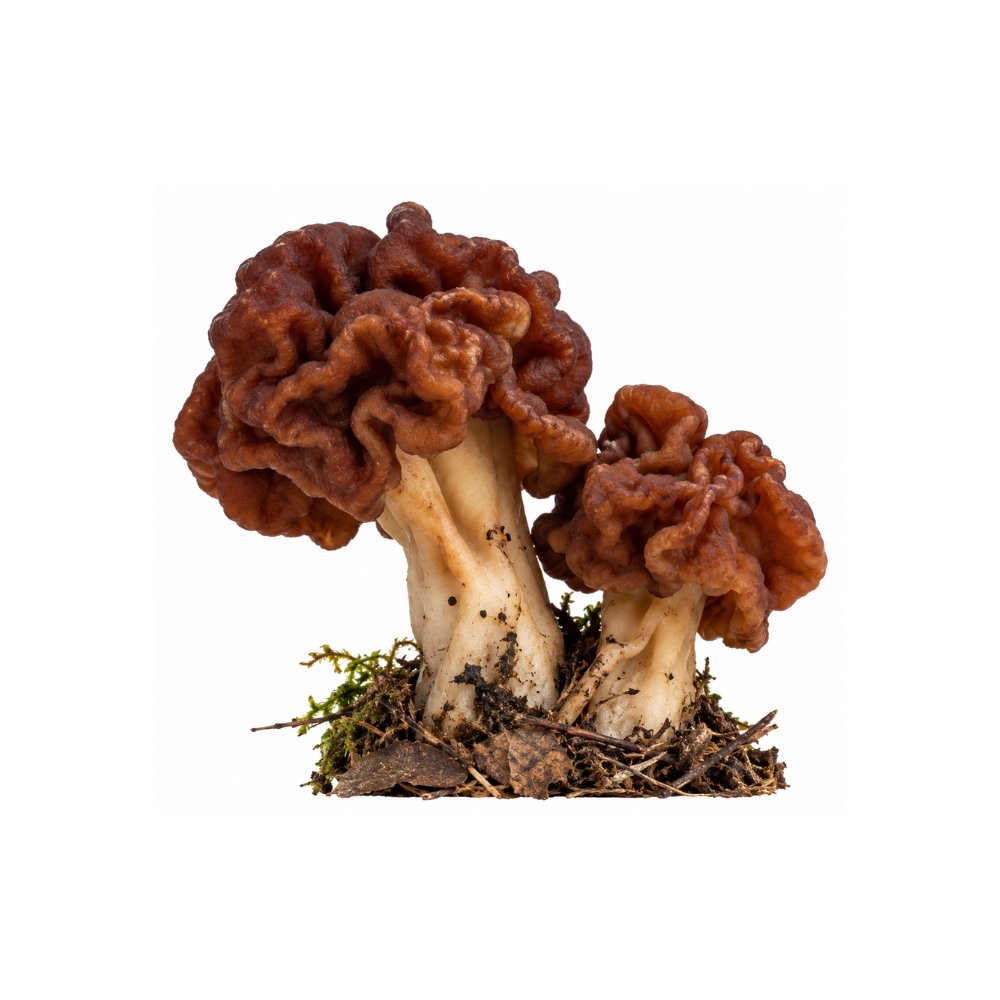
False morel (Gyromitra esculenta) is a spring mushroom of conifer forest with a wrinkled, brain-like cap. Its toxin, gyromitrin, breaks down into monomethylhydrazine, which can cause seizures and liver injury. It is still eaten after boiling in parts of northern Europe.
What Is the False Morel?
The false morel is a poisonous spring mushroom that some people still eat on purpose. It is mistaken for the true morels (Morchella), which are prized edibles, and it grows near conifers in the same season 5Reference 5Case reportPoisoning due to raw Gyromitra esculenta (false morels) west of the Rockies — case reportView study →.
The cap is wrinkled and folded like the surface of a brain, and pinkish tan to reddish brown, darkening with age 5,
Its species name, esculenta, means “edible”. Its toxicity was long disputed because people react to it very differently, and it still appears on lists of edible mushrooms in France and Finland 6Reference 6ReviewWarning on false or true morels and button mushrooms with potential toxicity linked to hydrazinic toxins: an update — reviewView study →.
In Scandinavia it is sold in markets and eaten after boiling 6Reference 6ReviewWarning on false or true morels and button mushrooms with potential toxicity linked to hydrazinic toxins: an update — reviewView study →. Boiling lowers the toxin but does not remove it, and the Finnish Food Authority now advises that eating false morels is no longer recommended 7Reference 7False morels are toxic and require appropriate preparation — consumer guidanceView study →.
Identification & Lookalikes
The confusion is with true morels (Morchella), and cutting the mushroom in half lengthwise is the test.
| Character | True morel (Morchella) | False morel (Gyromitra) |
|---|---|---|
| Cap surface | Distinctly pitted, like a honeycomb, with the stem fused to the bottom of the cap 5, | Wrinkled and folded like a brain, without true pits 5, |
| Inside (cut lengthwise) | Hollow from base to tip 5Reference 5Case reportPoisoning due to raw Gyromitra esculenta (false morels) west of the Rockies — case reportView study → | Cap filled with folded, chambered flesh 11Reference 11Gyromitra esculenta — species descriptionView study →. The stem may be hollow or stuffed 5Reference 5Case reportPoisoning due to raw Gyromitra esculenta (false morels) west of the Rockies — case reportView study →, but it is never one continuous chamber from cap tip to base |
| Colour | Shades of brown 5Reference 5Case reportPoisoning due to raw Gyromitra esculenta (false morels) west of the Rockies — case reportView study → | Pinkish tan to reddish brown, darker with age 11Reference 11Gyromitra esculenta — species descriptionView study →. Colour alone is not reliable |
⚠ Cut every find lengthwise. A true morel is hollow from the tip of the cap to the base of the stem. A related false morel, Verpa bohemica, has a thimble-like cap that sits over the top of the stem without being attached at its lower edge 6Reference 6ReviewWarning on false or true morels and button mushrooms with potential toxicity linked to hydrazinic toxins: an update — reviewView study →.
Mycology
Gyromitra esculenta (Pers.) Fr. belongs to the Discinaceae. Like the true morels it is an ascomycete: its spores form in sacs (asci), eight to a sac, on the surface of the folded cap rather than on gills 11Reference 11Gyromitra esculenta — species descriptionView study →.
The cap is 4–8 cm high and 3–12 cm wide 11Reference 11Gyromitra esculenta — species descriptionView study →. The stem is 3–9 cm long and 1–3.5 cm thick, and often folded so that a cross-section looks like a figure eight 11Reference 11Gyromitra esculenta — species descriptionView study →. The spores are 19–28 × 10–13 µm and smooth 11Reference 11Gyromitra esculenta — species descriptionView study →.
It is officially a saprotroph, living on dead organic matter, but it may also form partnerships with tree roots 11Reference 11Gyromitra esculenta — species descriptionView study →.
Michelot and Toth named G. esculenta and G. gigas as the main species of concern 2Reference 2ReviewPoisoning by Gyromitra esculenta — a reviewView study →. A 2023 survey found gyromitrin in every specimen tested from the G. esculenta group and in G. leucoxantha, and found it more limited across the family than had been thought 9Reference 9Not all bad: gyromitrin has a limited distribution in the false morels as determined by a new ultra high-performance liquid chromatography methodView study →. Treat all Gyromitra as toxic in the field.
Distribution
The false morel grows in spring, mainly under conifers, across northern and mountain North America 11Reference 11Gyromitra esculenta — species descriptionView study →. It is also widespread in Europe 12Reference 12Gyromitra esculenta — occurrence records by province and continentView study →.
In western Canada it has been recorded in British Columbia, Alberta, Saskatchewan and Manitoba 12Reference 12Gyromitra esculenta — occurrence records by province and continentView study →. True and false morels both grow mainly near conifers west of the Rocky Mountains 5Reference 5Case reportPoisoning due to raw Gyromitra esculenta (false morels) west of the Rockies — case reportView study →.
Phytochemistry
The toxin is gyromitrin, acetaldehyde N-methyl-N-formylhydrazone 9Reference 9Not all bad: gyromitrin has a limited distribution in the false morels as determined by a new ultra high-performance liquid chromatography methodView study →. It is volatile and dissolves in water 7Reference 7False morels are toxic and require appropriate preparation — consumer guidanceView study →.
Gyromitrin is broken down by cooking and by stomach acid, first into N-methyl-N-formylhydrazine and then into monomethylhydrazine (MMH) 5Reference 5Case reportPoisoning due to raw Gyromitra esculenta (false morels) west of the Rockies — case reportView study →. MMH is the main toxic agent, and it is a component of rocket fuel 5Reference 5Case reportPoisoning due to raw Gyromitra esculenta (false morels) west of the Rockies — case reportView study →.
MMH boils off at 87.5 °C. Most of it leaves in the steam during cooking, but some can stay in the cooking water 5Reference 5Case reportPoisoning due to raw Gyromitra esculenta (false morels) west of the Rockies — case reportView study →.
Toxin content varies between species and within a species, and with growing conditions, maturity and region 5Reference 5Case reportPoisoning due to raw Gyromitra esculenta (false morels) west of the Rockies — case reportView study →.
Constituent Summary
The toxin and the compound it becomes.
Hydrazone1 compound1 with data
Hydrazine1 compound1 with data
Toxicology
Class of poison. Hydrazine; a pyridoxal-5′-phosphate (active vitamin B6) antagonist, and a carcinogen in animals.
Mechanism. MMH destroys pyridoxine, the cofactor of glutamic acid decarboxylase, the enzyme that makes GABA 6Reference 6ReviewWarning on false or true morels and button mushrooms with potential toxicity linked to hydrazinic toxins: an update — reviewView study →. With less GABA, the brain’s main calming signal, seizures can follow 5,
Water hemlock also causes seizures, but its toxin acts on the GABA-A receptor itself.
MMH can also irritate the gut, break down red blood cells and form methaemoglobin 5Reference 5Case reportPoisoning due to raw Gyromitra esculenta (false morels) west of the Rockies — case reportView study →. Its breakdown products in the liver can cause liver cell death 5Reference 5Case reportPoisoning due to raw Gyromitra esculenta (false morels) west of the Rockies — case reportView study →.
Lethal dose. The lethal dose of gyromitrin is estimated at 20–50 mg/kg in adults and 10–30 mg/kg in children. The lethal dose of MMH is 4.8–8.0 mg/kg in adults and 1.6–4.8 mg/kg in children 5Reference 5Case reportPoisoning due to raw Gyromitra esculenta (false morels) west of the Rockies — case reportView study →.
Course. Stomach symptoms usually start 5–8 hours after the meal, and sometimes as early as 2 hours 5Reference 5Case reportPoisoning due to raw Gyromitra esculenta (false morels) west of the Rockies — case reportView study →. Most people have stomach upset only and recover in 2–6 days 5Reference 5Case reportPoisoning due to raw Gyromitra esculenta (false morels) west of the Rockies — case reportView study →.
In more severe cases, liver injury and nerve symptoms follow: vertigo, unsteadiness, fatigue, tremor and seizures 5Reference 5Case reportPoisoning due to raw Gyromitra esculenta (false morels) west of the Rockies — case reportView study →. Severe poisonings and deaths have been recorded 2Reference 2ReviewPoisoning by Gyromitra esculenta — a reviewView study →.
In 118 poisonings reported to the Michigan Poison & Drug Information Center from 2002 to 2020, stomach symptoms were the most common. About a quarter of patients with symptoms had nerve symptoms, about one in six had liver injury, and none died 10Reference 10Case reportA 19-year longitudinal assessment of gyromitrin-containing (Gyromitra spp.) mushroom poisonings in Michigan — case seriesView study →.
⚠ Onset often falls near the six-hour mark used to separate amatoxin poisoning from simple stomach upsets. A delayed illness after a spring mushroom meal needs both possibilities considered.
Treatment. Treatment is supportive. Intravenous pyridoxine (vitamin B6), 25 mg/kg, is given for serious nerve symptoms because it counters the block on GABA production, and benzodiazepines are used for seizures 8Reference 8ReviewThe most dreadful mushroom toxins: a review of their toxicological mechanisms, chemical structural characteristics, and treatment — reviewView study →.
Pyridoxine may prevent or stop seizures, based largely on animal work 5Reference 5Case reportPoisoning due to raw Gyromitra esculenta (false morels) west of the Rockies — case reportView study →. Two BC patients were given it as a precaution, and the authors could not say whether it prevented nerve symptoms 5Reference 5Case reportPoisoning due to raw Gyromitra esculenta (false morels) west of the Rockies — case reportView study →.
Cooking does not make it safe. Boiling is the most effective way to lower gyromitrin, but toxic residues remain after boiling, and no method removes the toxin completely 7Reference 7False morels are toxic and require appropriate preparation — consumer guidanceView study →. A safe amount has never been set 7Reference 7False morels are toxic and require appropriate preparation — consumer guidanceView study →.
The cooking vapour. Because the toxin is volatile, the cook can inhale it during preparation and become sicker than the people who eat the meal 5Reference 5Case reportPoisoning due to raw Gyromitra esculenta (false morels) west of the Rockies — case reportView study →. Inhaling the vapour during cooking can cause poisoning 8Reference 8ReviewThe most dreadful mushroom toxins: a review of their toxicological mechanisms, chemical structural characteristics, and treatment — reviewView study →.
Carcinogenicity. MMH, its precursor N-methyl-N-formylhydrazine, and raw G. esculenta have caused cancer in animals 8Reference 8ReviewThe most dreadful mushroom toxins: a review of their toxicological mechanisms, chemical structural characteristics, and treatment — reviewView study →. Raw false morel fed to mice caused tumours in the lungs, nasal cavity, blood vessels, stomach, caecum and liver 8Reference 8ReviewThe most dreadful mushroom toxins: a review of their toxicological mechanisms, chemical structural characteristics, and treatment — reviewView study →. No cancers have been reported in people, likely because the mushroom is eaten only now and then 8Reference 8ReviewThe most dreadful mushroom toxins: a review of their toxicological mechanisms, chemical structural characteristics, and treatment — reviewView study →.
Western North America. Serious false morel poisoning has been reported more often in the eastern United States, and it has been suggested that western Gyromitra carry little or no toxin 5Reference 5Case reportPoisoning due to raw Gyromitra esculenta (false morels) west of the Rockies — case reportView study →. In Kamloops, BC, a couple who ate raw false morels both developed liver injury and recovered 5Reference 5Case reportPoisoning due to raw Gyromitra esculenta (false morels) west of the Rockies — case reportView study →.
Traditional & Historical Use
Nordic and European Food Use
The false morel has been eaten as food in Scandinavia, where it is packaged and sold in markets 6Reference 6ReviewWarning on false or true morels and button mushrooms with potential toxicity linked to hydrazinic toxins: an update — reviewView study →. Local cooking methods that partly remove the toxin by boiling are used to justify eating it 6Reference 6ReviewWarning on false or true morels and button mushrooms with potential toxicity linked to hydrazinic toxins: an update — reviewView study →.
The Finnish Food Authority gives this method for lowering the toxin 7Reference 7False morels are toxic and require appropriate preparation — consumer guidanceView study →:
- Boil the fresh mushrooms twice in plenty of water (one part mushrooms to three parts water), for at least five minutes each time.
- Rinse them well in plenty of water after each boil.
- Soak dried mushrooms for at least two hours (100 g to 2 litres of water), then boil them twice in the same way.
- Keep the kitchen well ventilated while drying or boiling, and never reuse the soaking or cooking water.
Even with this method, toxic residues remain, and the Authority advises that eating false morels is no longer recommended 7Reference 7False morels are toxic and require appropriate preparation — consumer guidanceView study →.
The false morel has no medicinal use.
Safety & Pregnancy
- Gyromitrin breaks down into monomethylhydrazine, which lowers the brain’s GABA and can cause seizures 5,
6Reference 5Case reportPoisoning due to raw Gyromitra esculenta (false morels) west of the Rockies — case reportView study →Reference 6ReviewWarning on false or true morels and button mushrooms with potential toxicity linked to hydrazinic toxins: an update — reviewView study → . - Boiling lowers the toxin but does not remove it. No safe amount has been set 7Reference 7False morels are toxic and require appropriate preparation — consumer guidanceView study →.
- The cooking vapour can poison the person cooking 5,
8Reference 5Case reportPoisoning due to raw Gyromitra esculenta (false morels) west of the Rockies — case reportView study →Reference 8ReviewThe most dreadful mushroom toxins: a review of their toxicological mechanisms, chemical structural characteristics, and treatment — reviewView study → . - Causes cancer in animals. No human data exist 8Reference 8ReviewThe most dreadful mushroom toxins: a review of their toxicological mechanisms, chemical structural characteristics, and treatment — reviewView study →.
- Intravenous pyridoxine (vitamin B6) is given for serious nerve symptoms 8Reference 8ReviewThe most dreadful mushroom toxins: a review of their toxicological mechanisms, chemical structural characteristics, and treatment — reviewView study →.
- Cut every find lengthwise. A true morel is hollow from cap tip to stem base; a false morel is not 5,
11Reference 5Case reportPoisoning due to raw Gyromitra esculenta (false morels) west of the Rockies — case reportView study →Reference 11Gyromitra esculenta — species descriptionView study → .
Full Safety Detail
Boiling. Boiling twice in plenty of water, with the water thrown away and the kitchen ventilated, lowers gyromitrin. It never removes all of it, and no safe amount has been set 7Reference 7False morels are toxic and require appropriate preparation — consumer guidanceView study →.
Raw mushrooms. Eating false morels raw has caused liver injury, including in BC 5Reference 5Case reportPoisoning due to raw Gyromitra esculenta (false morels) west of the Rockies — case reportView study →.
The spring season. False morels come up in spring, in the same places and season as true morels 5Reference 5Case reportPoisoning due to raw Gyromitra esculenta (false morels) west of the Rockies — case reportView study →. The brain-like cap and the chambered inside are clear differences, but only to someone who checks.
If someone is ill after a spring mushroom meal, note the time between the meal and the first symptoms, and mention both gyromitrin and amatoxins to the clinician.
Avoid entirely. The Finnish Food Authority says children and pregnant or breastfeeding women should never eat false morels 7Reference 7False morels are toxic and require appropriate preparation — consumer guidanceView study →.
References
- Diaz JH (2005). Syndromic diagnosis and management of confirmed mushroom poisonings — review. Crit Care Med 33(2):427–436. https://pubmed.ncbi.nlm.nih.gov/15699849/
- Michelot D, Toth B (1991). Poisoning by Gyromitra esculenta — a review. J Appl Toxicol 11(4):235–243. https://pubmed.ncbi.nlm.nih.gov/1939997/
- Brandenburg WE, Ward KJ (2018). Mushroom poisoning epidemiology in the United States. Mycologia 110(4):637–641. https://pubmed.ncbi.nlm.nih.gov/30062915/
- Kuo M. Morchella and Gyromitra identification keys. MushroomExpert.com; Trudell S, Ammirati J. Mushrooms of the Pacific Northwest.
- Leathem AM, Dorran TJ (2007). Poisoning due to raw Gyromitra esculenta (false morels) west of the Rockies — case report. CJEM 9(2):127–130. https://pubmed.ncbi.nlm.nih.gov/17391587/
- Lagrange E, Vernoux JP (2020). Warning on false or true morels and button mushrooms with potential toxicity linked to hydrazinic toxins: an update — review. Toxins (Basel) 12(8):482. https://pubmed.ncbi.nlm.nih.gov/32751277/
- Finnish Food Authority (Ruokavirasto) (n.d.). False morels are toxic and require appropriate preparation — consumer guidance. https://www.ruokavirasto.fi/globalassets/tietoa-meista/julkaisut/esitteet/elintarvikkeet/false_morel_fungi.pdf
- Gouvinhas I, Silva J, Alves MJ, Garcia J (2024). The most dreadful mushroom toxins: a review of their toxicological mechanisms, chemical structural characteristics, and treatment — review. EXCLI J 23:833–859. https://pubmed.ncbi.nlm.nih.gov/39165585/
- Dirks AC, Mohamed OG, Schultz PJ, Miller AN, Tripathi A, James TY (2023). Not all bad: gyromitrin has a limited distribution in the false morels as determined by a new ultra high-performance liquid chromatography method. Mycologia 115(1):1–15. https://pubmed.ncbi.nlm.nih.gov/36541902/
- Vohra V, Dirks A, Bonito G, James T, Carroll DK (2024). A 19-year longitudinal assessment of gyromitrin-containing (Gyromitra spp.) mushroom poisonings in Michigan — case series. Toxicon 247:107825. https://pubmed.ncbi.nlm.nih.gov/38908526/
- Kuo M (2012). Gyromitra esculenta — species description. MushroomExpert.com. https://www.mushroomexpert.com/gyromitra_esculenta.html
- GBIF Secretariat (accessed 2026). Gyromitra esculenta — occurrence records by province and continent. GBIF Backbone Taxonomy. https://www.gbif.org/species/5258510



