Materia Medica
Poison Hemlock ☠️
Conium maculatum
Poison hemlock is a tall, hairless, purple-spotted weed of the carrot family, and the poison given to Socrates. Its alkaloids coniine and γ-coniceine act on nicotinic receptors and cause a paralysis that climbs from the legs and stops the breathing.
What Is Poison Hemlock?
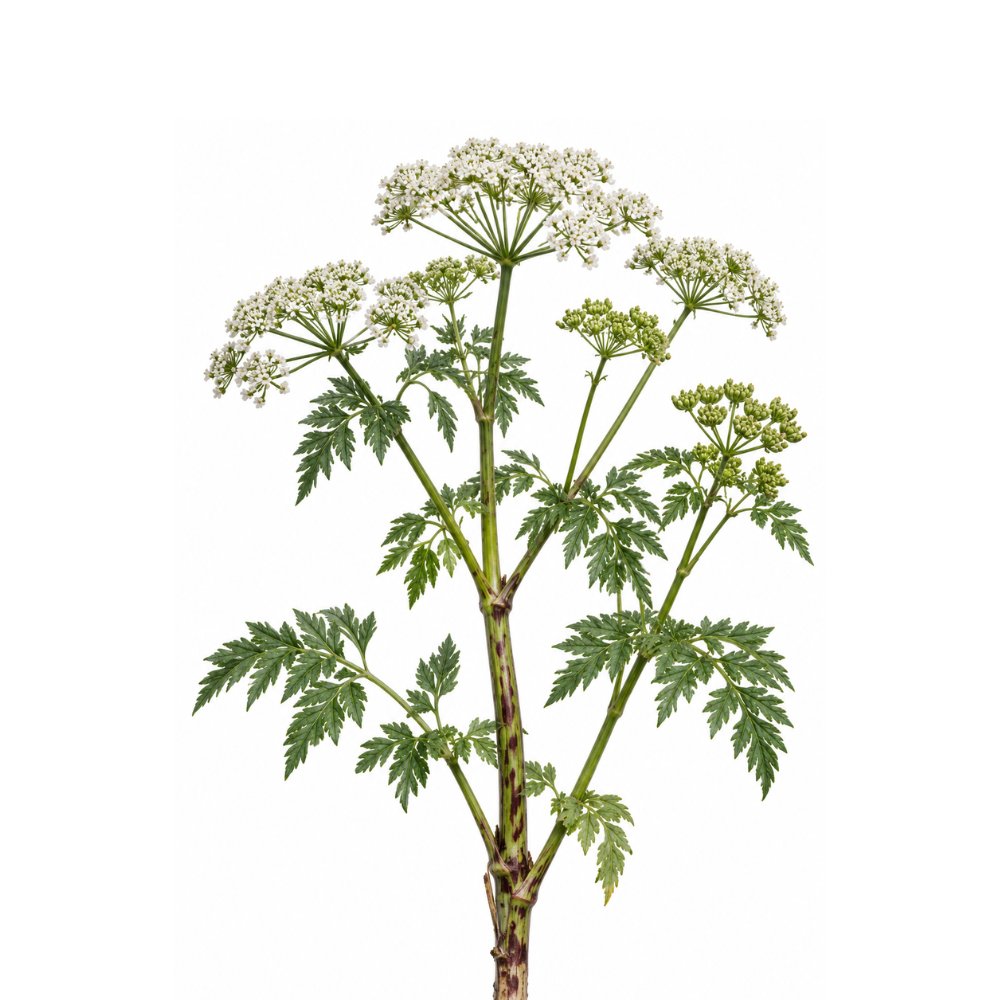
Poison hemlock is a tall biennial weed of the carrot family, with finely divided, fern-like leaves, a smooth purple-spotted stem and flat clusters of small white flowers. Every part of the plant contains poisonous alkaloids 6Reference 6The killer of Socrates: coniine and related alkaloids in the plant kingdom.
Conium maculatum is native to Europe, northern Africa and western Asia, and has spread to North and South America, Australia and New Zealand 6Reference 6The killer of Socrates: coniine and related alkaloids in the plant kingdom. In North America it grows on damp, disturbed ground such as ditches, roadsides and field edges, including in south-western British Columbia 8Reference 8Conium maculatumView study →.
It is the poison given to Socrates in 399 BCE 6Reference 6The killer of Socrates: coniine and related alkaloids in the plant kingdom. Its main alkaloid, coniine, was the first alkaloid to have its structure worked out and the first to be made in a laboratory 6Reference 6The killer of Socrates: coniine and related alkaloids in the plant kingdom.
Its name is often confused with water hemlock, a different plant with a different poison. Water hemlock causes seizures. Poison hemlock causes paralysis.
Identification & Lookalikes
The root is the decisive character. Poison hemlock has a long, whitish taproot that is usually unbranched 6Reference 6The killer of Socrates: coniine and related alkaloids in the plant kingdom. It is solid, never divided into chambers. That single feature separates it from water hemlock (Cicuta), whose rootstock is divided into horizontal chambers.
| Plant confused with it | How it differs |
|---|---|
| Wild parsnip / parsnip | The commonest real-world confusion, and it is the root that gets eaten 6Reference 6The killer of Socrates: coniine and related alkaloids in the plant kingdom |
| Parsley | Poison hemlock leaves are three or four times divided, very finely cut and somewhat glossy 6Reference 6The killer of Socrates: coniine and related alkaloids in the plant kingdom. The mousy smell on crushing is the tell |
| Wild celery | Named in the case literature as a source of confusion |
| Anise | The seeds are mistaken for aniseed, and the seeds carry the most alkaloid 1, |
| Water hemlock (Cicuta) | Chambered rootstock, grows in wetlands, yellow resin in the root |
Other reported mix-ups include chervil, cow parsley and fool’s parsley 6Reference 6The killer of Socrates: coniine and related alkaloids in the plant kingdom.
Supporting characters. The stem is smooth, hollow, finely ridged and hairless, and the leaves are hairless too 6Reference 6The killer of Socrates: coniine and related alkaloids in the plant kingdom. That separates it from hairy-stemmed plants such as wild carrot, cow parsnip and Osmorhiza. Crushed leaves have a strong, unpleasant, musty smell often compared to mouse urine 6,
Purple stem spots are not enough on their own. The reddish-purple blotches on the lower stem give the plant its name, maculatum (“spotted”), and they are its most important identifying feature among the carrot family 6Reference 6The killer of Socrates: coniine and related alkaloids in the plant kingdom. But young plants can show only faint spotting, and water hemlock (Cicuta maculata) can have purple-mottled stems too. Purple on the stem does not tell the two hemlocks apart.
Botany
Poison hemlock (Conium maculatum L.) is a member of the carrot family, Apiaceae. Older toxicology papers use the family’s former name, Umbelliferae 1Reference 1ReviewBiochemistry of hemlock (Conium maculatum L.) alkaloids and their acute and chronic toxicity in livestock. It is usually a biennial, but it can also grow as a winter annual or a short-lived perennial 6Reference 6The killer of Socrates: coniine and related alkaloids in the plant kingdom.
In its first year it forms a low rosette of fern-like leaves. In its second year it sends up an erect, branching stem, usually 1–2 m tall and sometimes up to 3 m 6,
The leaves are 20–40 cm long and finely divided three or four times, with toothed or deeply cut segments. Their stalks widen into a sheath around the stem 6Reference 6The killer of Socrates: coniine and related alkaloids in the plant kingdom.
The small white flowers have five petals and grow in open compound umbels 4–6 cm across 6Reference 6The killer of Socrates: coniine and related alkaloids in the plant kingdom. The fruit is small, 2–3 mm long, with prominent wavy ridges 6,
Three characters should be checked together: purple blotching on a smooth hollow stem, no hairs anywhere, and a rank mousy smell when any part is crushed.
One common name is misleading. “Spotted cowbane” invites confusion with true cowbane, which is water hemlock (Cicuta): a different genus, a different toxin and a different clinical picture 6Reference 6The killer of Socrates: coniine and related alkaloids in the plant kingdom.
Distribution
Poison hemlock is native to Europe, northern Africa and western Asia. It has been introduced to North America, South America, Australia and New Zealand 6Reference 6The killer of Socrates: coniine and related alkaloids in the plant kingdom.
In North America it is one of the most widespread introduced weeds. In British Columbia it grows in wet to moist ditches and disturbed sites in the lowlands. It is locally common in the south-west, around Victoria and Vancouver, and rare in the south-central interior 8Reference 8Conium maculatumView study →.
It favours damp, disturbed ground: roadsides, ditches, fence lines, riverbanks, irrigation channels and field margins. These are the same edges where people forage casually. Its heavy seed production lets it form dense stands that crowd out other plants 1,
It is a listed noxious weed in much of its introduced range. It is a Class B noxious weed in Washington, where it has been listed since 1988 and is also on the state quarantine list 9Reference 9Poison hemlock, Conium maculatumView study →. It is a List B noxious weed in Oregon 10Reference 10Oregon noxious weed profiles: poison hemlockView study →, and has been on Minnesota’s Prohibited – Control list since 2018 11Reference 11Minnesota noxious weed listView study →.
Phytochemistry
Eight piperidine alkaloids have been identified in poison hemlock. Two of them, coniine and γ-coniceine, are usually the most abundant and account for most of the plant’s toxicity 1Reference 1ReviewBiochemistry of hemlock (Conium maculatum L.) alkaloids and their acute and chronic toxicity in livestock.
Coniine (2-propylpiperidine) and γ-coniceine are small, simple piperidine alkaloids 6Reference 6The killer of Socrates: coniine and related alkaloids in the plant kingdom. Minor ones include N-methylconiine and conhydrine.
The balance between the two shifts as the plant grows. γ-Coniceine is the main alkaloid in flower buds and flowers. As the fruit develops it is converted to coniine and then N-methylconiine, which are the main alkaloids in the mature fruit 6Reference 6The killer of Socrates: coniine and related alkaloids in the plant kingdom.
In a mouse study, γ-coniceine was the more toxic of the pair, with an LD₅₀ of 3.7 mg/kg against 5.5 mg/kg for coniine 2Reference 2The actions of varenicline on alkaloids from Conium maculatum (poison hemlock), Lupinus sulphureus (sulphur lupine) and Nicotiana glauca (tree tobacco).
The fruit and seeds hold the most alkaloid. Developing fruit reaches its peak about three weeks after flowering, at up to 3% of dry weight 6Reference 6The killer of Socrates: coniine and related alkaloids in the plant kingdom. Roots and lower stems appear often in human cases because they are mistaken for parsnip and eaten in quantity.
Constituent Summary
Piperidine Alkaloid2 compounds2 with data
Toxicology
Class of poison. Piperidine alkaloids that act on nicotinic acetylcholine receptors.
Mechanism. Coniine and γ-coniceine act at nicotinic acetylcholine receptors 4Reference 4Nicotinic plant poisoning. They first stimulate the receptor and then leave it desensitised, so the muscle can no longer respond 6Reference 6The killer of Socrates: coniine and related alkaloids in the plant kingdom. In cells carrying the human fetal muscle-type receptor, the potency of each form of coniine matched how lethal it was in mice 3Reference 3Stereoselective potencies and relative toxicities of coniine enantiomers. In animals the result is a block at the junction between nerve and muscle, and death when the breathing muscles fail 1Reference 1ReviewBiochemistry of hemlock (Conium maculatum L.) alkaloids and their acute and chronic toxicity in livestock.
The receptors sit at the junction between nerve and muscle, in the autonomic ganglia, in the adrenal medulla and in the brain, which is why the effects vary with the dose 4Reference 4Nicotinic plant poisoning.
Course. Onset typically comes 30 minutes to a few hours after eating. The course runs in two phases 4Reference 4Nicotinic plant poisoning:
- A stimulation phase: burning in the mouth, heavy salivation, nausea and vomiting, sweating, tremor, dilated pupils, a fast heart rate, unsteadiness and muscle twitching.
- An inhibitory phase: a flaccid paralysis that climbs from the legs. Seizures can occur 6Reference 6The killer of Socrates: coniine and related alkaloids in the plant kingdom, and severe poisoning can end in coma and respiratory failure 4Reference 4Nicotinic plant poisoning. The breathing muscles fail last.
How alert the person stays depends on the dose. Mild poisoning can leave them fully awake; severe poisoning brings seizures, drowsiness and coma 4,
Toxic dose. No reliable human lethal dose has been established from a primary study. The figures that circulate in secondary reviews and fact sheets are a toxic dose of about 60 mg of coniine and a lethal dose of 100–300 mg, or in another version 150–300 mg, and the sources do not agree with each other.
Antidote. None. Treatment is supportive and centred on protecting the airway and ventilating the patient through the paralysis, with activated charcoal if the patient arrives early and care for muscle breakdown and kidney failure 4Reference 4Nicotinic plant poisoning. The block wears off as the alkaloid clears, so patients kept breathing through the paralysis recover 4,
Fatal cases. Confirmed North American deaths are documented but rare. A US forensic laboratory reported two, with coniine confirmed in the blood: a 27-year-old woman found in California in 2004 and a man in his forties found in Pennsylvania in 2019 5Reference 5Poison hemlock determination in postmortem samples.
Traditional & Historical Use
Classical Antiquity
Poison hemlock was the state poison of classical Athens. It was given to Socrates in 399 BCE, and Plato’s Phaedo describes the cold and numbness rising from his feet while he went on speaking 6Reference 6The killer of Socrates: coniine and related alkaloids in the plant kingdom.
Greek and Arab physicians used the plant for swellings, hard tumours and joint pain 6Reference 6The killer of Socrates: coniine and related alkaloids in the plant kingdom.
European Medicine
Tinctures and extracts of poison hemlock were used as a sedative and pain reliever. Its antispasmodic action was used for tetanus, asthma, epilepsy, whooping cough and stomach pains, and it was applied externally for herpes, erysipelas and breast tumours 6Reference 6The killer of Socrates: coniine and related alkaloids in the plant kingdom. In Finnish folk medicine it was used as a powder, plaster or poultice for hardened glands, cramp and wounds 6Reference 6The killer of Socrates: coniine and related alkaloids in the plant kingdom.
The dried leaf and juice were official in the London and Edinburgh pharmacopoeias from 1864 to 1898, and the British Pharmaceutical Codex last recognised it in 1938. It was dropped because its preparations varied too much in strength 6Reference 6The killer of Socrates: coniine and related alkaloids in the plant kingdom.
Two chemistry firsts. Coniine was first isolated from poison hemlock in 1826. It was the first alkaloid whose structure was determined (Hofmann, 1881) and the first to be made in a laboratory (Ladenburg, 1886) 6Reference 6The killer of Socrates: coniine and related alkaloids in the plant kingdom.
Birth defects in livestock. When pregnant animals graze poison hemlock while the fetus’s organs are forming, the young can be born with cleft palate and multiple joint contractures (arthrogryposis) 1Reference 1ReviewBiochemistry of hemlock (Conium maculatum L.) alkaloids and their acute and chronic toxicity in livestock. The alkaloids stop the fetus from moving, which causes the deformities 6Reference 6The killer of Socrates: coniine and related alkaloids in the plant kingdom. Cattle are the most sensitive, then pigs, then sheep 6Reference 6The killer of Socrates: coniine and related alkaloids in the plant kingdom.
Safety & Pregnancy
- Lethally poisonous with no antidote. Death is by paralysis of the breathing muscles 1,
4Reference 1ReviewBiochemistry of hemlock (Conium maculatum L.) alkaloids and their acute and chronic toxicity in livestockReference 4Nicotinic plant poisoning . - How alert the person stays depends on the dose. Mild poisoning can leave them fully awake; severe poisoning brings seizures, drowsiness and coma 4,
6, .12Reference 4Nicotinic plant poisoningReference 6The killer of Socrates: coniine and related alkaloids in the plant kingdomReference 12Divergent clinical outcomes after shared poison hemlock ingestion: evidence suggesting a dose-related effect - Breathing support through the paralysis is curative 4,
6Reference 4Nicotinic plant poisoningReference 6The killer of Socrates: coniine and related alkaloids in the plant kingdom . Get them to a hospital that can intubate. - Root mistaken for parsnip, leaves for parsley, seeds for anise in documented cases 6Reference 6The killer of Socrates: coniine and related alkaloids in the plant kingdom.
- Purple stem blotching does not tell it apart from water hemlock; both can show it.
- Causes birth defects in livestock grazed during pregnancy 1Reference 1ReviewBiochemistry of hemlock (Conium maculatum L.) alkaloids and their acute and chronic toxicity in livestock.
Full Safety Detail
Tell emergency services which hemlock. Water hemlock needs strong seizure control with benzodiazepines. Poison hemlock needs an airway and a ventilator. “Hemlock” without the qualifier does not tell the hospital which to prepare for.
Recognising it in progress. Numbness and weakness climbing from the legs, after eating a foraged root or leaf, is the picture. A person who is still alert and talking may not look as ill as they are, which can delay treatment.
Prognosis. The block resolves as the alkaloid clears, so the outcome depends mainly on whether the person reaches breathing support in time 4,
Avoid. The plant is lethally poisonous and has no safe dose. It also causes birth defects in grazing livestock 1Reference 1ReviewBiochemistry of hemlock (Conium maculatum L.) alkaloids and their acute and chronic toxicity in livestock.
References
- López TA, Cid MS, Bianchini ML. Biochemistry of hemlock (Conium maculatum L.) alkaloids and their acute and chronic toxicity in livestock. A review. Toxicon. 1999;37(6):841–865. PMID 10340826.
- Green BT, Lee ST, Welch KD, Cook D, Stonecipher CA. The actions of varenicline on alkaloids from Conium maculatum (poison hemlock), Lupinus sulphureus (sulphur lupine) and Nicotiana glauca (tree tobacco). Toxicon. 2024;252:108184. PMID 39577702.
- Lee ST, Green BT, Welch KD, Pfister JA, Panter KE. Stereoselective potencies and relative toxicities of coniine enantiomers. Chem Res Toxicol. 2008;21(10):2061–2064. PMID 18763813.
- Schep LJ, Slaughter RJ, Beasley DMG. Nicotinic plant poisoning. Clin Toxicol. 2009;47(8):771–781. PMID 19778187.
- Labay LM, Chan-Hosokawa A, Homan JW, et al. Poison hemlock determination in postmortem samples. Forensic Sci Int. 2022;341:111500. PMID 36335848.
- Hotti H, Rischer H. The killer of Socrates: coniine and related alkaloids in the plant kingdom. Molecules. 2017;22(11):1962. PMID 29135964.
- Frank BS, et al. Ingestion of poison hemlock. West J Med. 1995. PMID 8553650.
- Klinkenberg B, ed. Conium maculatum. E-Flora BC: Electronic Atlas of the Flora of British Columbia. University of British Columbia. https://linnet.geog.ubc.ca/Atlas/Atlas.aspx?sciname=Conium%20maculatum
- Washington State Noxious Weed Control Board. Poison hemlock, Conium maculatum. https://www.nwcb.wa.gov/weeds/poison-hemlock
- Oregon Department of Agriculture. Oregon noxious weed profiles: poison hemlock. https://www.oregon.gov/oda/programs/weeds/oregonnoxiousweeds/pages/aboutoregonweeds.aspx
- Minnesota Department of Agriculture. Minnesota noxious weed list. https://www.mda.state.mn.us/plants/pestmanagement/weedcontrol/noxiouslist
- Ucar AB. Divergent clinical outcomes after shared poison hemlock ingestion: evidence suggesting a dose-related effect. Int J Emerg Med. 2026;19(1):83. PMID 41922968.