
Compound Monograph
Arjunin
Arjunin is an obscure minor constituent of arjuna (Terminalia arjuna) bark. Its single primary source describes it as a new ellagitannin — a hydrolysable tannin — not the triterpene saponin that some secondary reviews imply. There is essentially no isolated-molecule pharmacology.

Sources · 1
Where Does It Come From?
Arjunin is a naturally occurring ellagitannin (hydrolysable tannin), found in Arjuna. It is well tolerated orally (low toxicity).
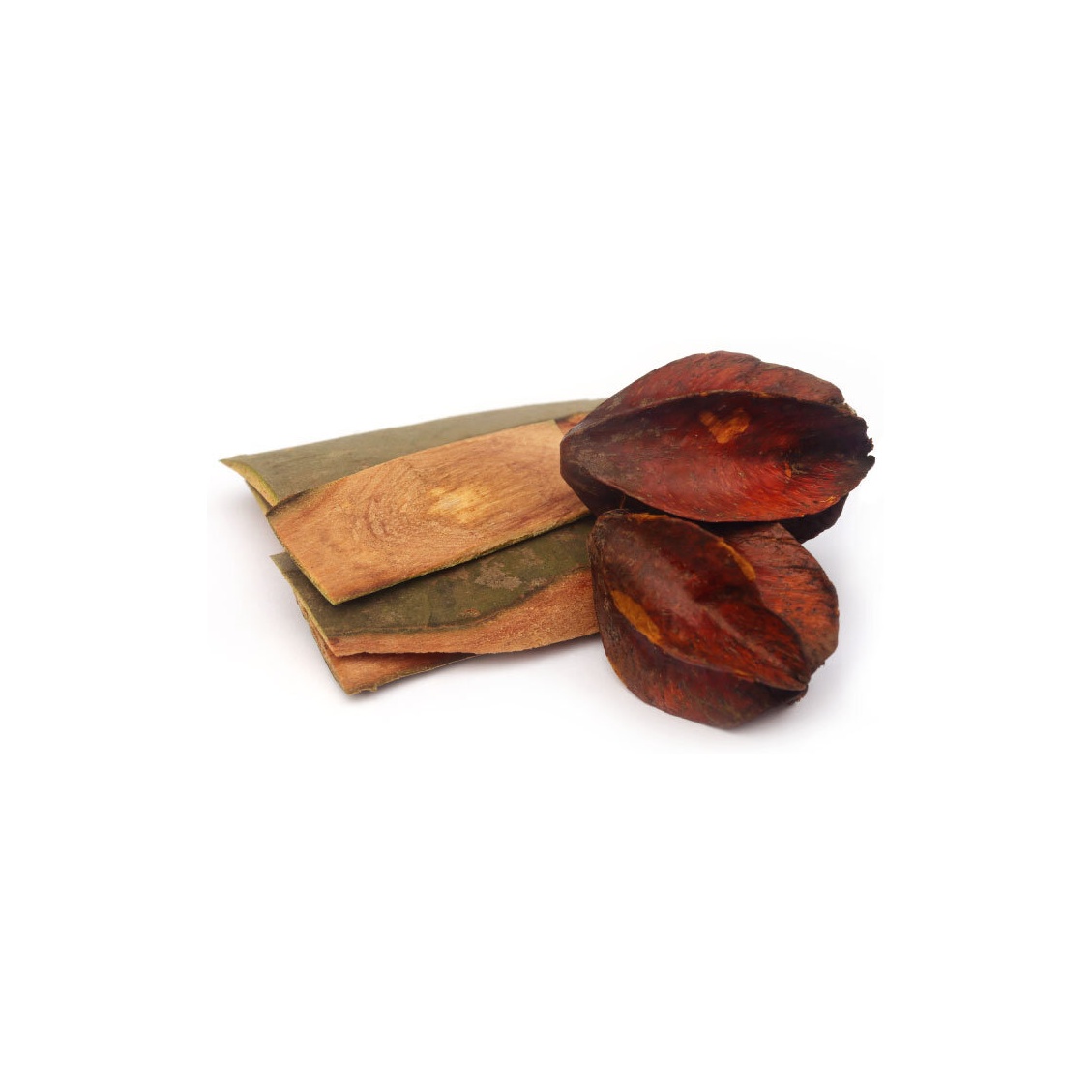
Concentration
Content by Source
Concentrations not reported. No percent-dry-weight or mg/g figures have been published for this compound in its source plants.
Arjunin at a Glance
Arjunin is an obscure minor constituent of arjuna (Terminalia arjuna), the Combretaceae tree whose bark is a classical Ayurvedic cardiac tonic. It is not one of the molecules the cardiac reputation is built on — that story belongs to the bark’s oleanane triterpenes and its bulk tannin fraction, and above all to the whole extract.
Its identity needs stating carefully, because the literature is muddy. The only primary paper to name and isolate “arjunin” describes it as a new ellagitannin — a hydrolysable (phenolic) tannin — elucidated by spectroscopy 1Reference 1A tannin anti-cancer promotor from Terminalia arjunaView study →. Several secondary reviews and compiled constituent lists instead file “arjunin” among arjuna’s triterpenoid saponins, conflating it with the differently-named saponin glycosides of the same bark. This page follows the primary source: arjunin is a tannin, and its isolated-molecule pharmacology is, honestly, close to nonexistent.
Arjunin Among the Arjuna Constituents
Terminalia arjuna bark carries several overlapping chemical families, and arjunin’s place in them is frequently reported wrongly. Getting it right is the point.
What the primary source says. The compound named “arjunin” comes from a single 1998 Phytochemistry note by Kandil and Nassar, which isolated it as a new ellagitannin alongside four known tannins and two phenolic acids, structures assigned by spectroscopic analysis 1Reference 1A tannin anti-cancer promotor from Terminalia arjunaView study →. Ellagitannins are hydrolysable tannins that release ellagic acid (and sugars) on breakdown — the same phenolic-tannin family as arjuna’s other reported hydrolysable tannin, casuarinin 3Reference 3Antiherpes simplex virus type 2 activity of casuarinin from the bark of Terminalia arjuna LinnView study →. On this evidence arjunin sits with the bark’s phenolics/tannins, next to ellagic acid, gallic acid and the catechin-type flavanols — not with the terpenes.
Where the confusion comes from. Arjuna’s cardioactive reputation rests on a suite of oleanane triterpenes — arjunolic acid, arjunic acid and arjungenin (all built on the oleanolic-acid skeleton) — together with their saponin glycosides, arjunetin and the arjunosides/arjunglucosides. Because the saponin names (arjunetin, the arjun-glycosides) and “arjunin” are near-homonyms, several reviews and databases list arjunin among the triterpenoid saponins. That is almost certainly a nomenclature conflation: the only isolation paper for the exact name “arjunin” places it in the tannin fraction, not the triterpene fraction 1Reference 1A tannin anti-cancer promotor from Terminalia arjunaView study →.
The honest bottom line. Whatever the label, arjunin is a minor, thinly-documented molecule. Its full structure is not widely reproduced in secondary literature, its abundance in the bark has not been quantified, and — unlike the arjuna triterpenes or the whole extract — it has no body of dedicated bioassay behind it. Do not read the bark’s cardiac evidence onto this one tannin.
Major Natural Sources
| Source | Part | Fraction | Notes |
|---|---|---|---|
| Arjuna (Terminalia arjuna) | Bark (leaves also reported) | Ellagitannin / tannin fraction | The only plant from which the named compound “arjunin” has been isolated 1Reference 1A tannin anti-cancer promotor from Terminalia arjunaView study → |
Arjunin has not been reported as a named isolate from any species other than T. arjuna. Ellagitannins as a class are widespread across the plant kingdom, but that does not mean this specific molecule occurs elsewhere.
What It's Used For
There is very little to report, and it is important not to inflate it. No study has tested isolated arjunin in an animal or a person. What exists is the context of its discovery and what can reasonably be inferred from its chemical class.
Support is an experimental score — weighted by study type (human > animal > in vitro) and volume. A beta, not a validated metric. For arjunin the scores are uniformly very low: there is no isolated-compound bioassay, so every row rests on fraction-level or whole-class inference. Read this table as a map of what is absent.
Arjunin was described in the course of isolating a tannin anti-cancer promotor fraction from Terminalia arjuna — that is, material studied for inhibition of tumour promotion, the framing of the 1998 report in which arjunin appears as one newly-named ellagitannin among four known tannins and two phenolic acids 1Reference 1A tannin anti-cancer promotor from Terminalia arjunaView study →. This is fraction-level, preclinical context: arjunin was not separated out and assayed on its own, so the activity cannot be attributed to it specifically.
Gap: no purified-arjunin cytotoxicity, tumour-promotion or in-vivo cancer data exist; the signal belongs to a mixed tannin fraction, and arjunin’s individual contribution is unknown 1Reference 1A tannin anti-cancer promotor from Terminalia arjunaView study →.
As a hydrolysable tannin that yields ellagic acid on breakdown, arjunin belongs to a chemical class with well-known radical-scavenging and astringent behaviour, and arjuna’s tannin/polyphenol fraction is broadly credited with the bark’s antioxidant character 2Reference 2ReviewMedicinal properties of Terminalia arjuna (Roxb.) Wight & Arn.: A reviewView study →. That is class reasoning, not measurement — arjunin itself has not been run in any antioxidant assay.
Gap: no isolated-compound antioxidant assay (ORAC/DPPH/cellular) has been performed on arjunin; it is inferred from the family, and within arjuna’s phenolic fraction it is one minor contributor among catechins, gallotannins, gallic acid and ellagic acid 2Reference 2ReviewMedicinal properties of Terminalia arjuna (Roxb.) Wight & Arn.: A reviewView study →.
Mechanisms
| Target / pathway | Effect | Relevant to |
|---|---|---|
| Hydrolysis to ellagic acid + sugar | ellagitannins break down to release ellagic acid, the actual circulating aglycone precursor | identity / pharmacokinetics |
| Phenolic radical scavenging | class-level antioxidant/astringent behaviour of the tannin fraction | antioxidant (class inference) |
No mechanism has been demonstrated for arjunin as an isolated molecule. The rows above are the class behaviour of ellagitannins, offered so the page is not silent — not evidence about this compound specifically.
Pharmacokinetics
No pharmacokinetic study of arjunin exists. What can be said is inherited from its class: ellagitannins and their ellagic-acid product are poorly absorbed intact, and their systemic effects are largely mediated by gut-microbiota conversion to urolithins, which vary widely between individuals (the “urolithin metabotypes”) 4Reference 4Biological significance of urolithins, the gut microbial ellagic acid-derived metabolites: the evidence so farView study →. If arjunin behaves as a typical ellagitannin, its own oral bioavailability would be low and any downstream activity would depend on microbial metabolism rather than on the parent molecule — a caveat that undercuts reading in-vitro tannin effects as oral effects. This is class-level expectation, not measured data for arjunin.
Clinical Trials
There are no clinical trials of arjunin — none completed, planned, terminated, or, for the isolated molecule, even preclinical in the usual single-agent sense. Human evidence for arjuna belongs to the whole bark extract, not to this constituent.
| Completed | Planned | Terminated | Preclinical |
|---|---|---|---|
| — | — | — | Fraction-level only (co-isolation in a tannin anti-tumour-promoter study) 1Reference 1A tannin anti-cancer promotor from Terminalia arjunaView study → |
Last checked: July 2026.
Isolate vs. Plant Studies
This molecule is a pure case of the plant-not-isolate problem. Every meaningful piece of evidence about Terminalia arjuna — the cardiotonic, hypolipidaemic and antioxidant work — used crude water/alcohol bark extract or bark powder, typically 500 mg three times daily or a standardised water extract 2Reference 2ReviewMedicinal properties of Terminalia arjuna (Roxb.) Wight & Arn.: A reviewView study →. None of it isolates arjunin, and arjunin’s own literature is a single isolation note in which it was never purified for individual bioassay 1Reference 1A tannin anti-cancer promotor from Terminalia arjunaView study →. There is therefore no isolate evidence to transfer, and the whole-extract evidence cannot be attributed to this one minor tannin. Any product marketed as containing or acting through “arjunin” would be making a claim the literature does not support.
Discovery & Synthesis
First reported. The name “arjunin” enters the chemical literature in 1998, when F. E. Kandil and M. I. Nassar isolated it from Terminalia arjuna as a new ellagitannin, alongside four known tannins and two phenolic acids, and assigned its structure by spectroscopic analysis (Phytochemistry 47(8):1567–1568) 1Reference 1A tannin anti-cancer promotor from Terminalia arjunaView study →. The etymology is straightforward — the compound is named for arjuna, the tree.
Synthesis. No total synthesis of arjunin has been reported; like other complex plant ellagitannins it is obtained, when at all, by extraction and chromatographic isolation from the bark, not by manufacture. Given its obscurity there is no commercial production to speak of.
Patents: not yet researched.
Toxicity & Safety
Arjunin carries a low flag by default — it is a minor plant ellagitannin in a bark with a long history of traditional dietary/medicinal use, and ellagitannins as a dietary class are generally low-toxicity. But this is a flag from context, not from data: no toxicology, genotoxicity, reproductive or interaction study has been performed on isolated arjunin, so absence of reported harm must not be read as demonstrated safety.
- Low-concern by class. A minor ellagitannin in a traditionally-consumed bark; dietary ellagitannins are generally regarded as low-toxicity.
- No isolate safety data. No toxicology, genotoxicity or interaction testing exists for arjunin as a purified compound — the low flag is inferred, not measured.
- Judge safety at the herb, not the molecule. Any real-world exposure is via whole arjuna-bark preparations; tannins can also reduce absorption of iron and some drugs, so intake questions belong on the arjuna herb page, not here.
Dosage
There is no dose for arjunin — it has never been administered as an isolated compound. Human exposure occurs only as one minor tannin within whole arjuna bark preparations, which are dosed as the crude material (traditionally around 500 mg bark powder three times daily, or a standardised bark water extract), not as any single molecule. These are research/traditional figures for the herb and are not a personal recommendation.
References
- Kandil FE, Nassar MI (1998). A tannin anti-cancer promotor from Terminalia arjuna. Phytochemistry 47(8):1567–1568. https://pubmed.ncbi.nlm.nih.gov/9612958/
- Amalraj A, Gopi S (2017). Medicinal properties of Terminalia arjuna (Roxb.) Wight & Arn.: A review. Journal of Traditional and Complementary Medicine. https://pubmed.ncbi.nlm.nih.gov/28053890/
- Cheng HY, Lin CC, Lin TC (2002). Antiherpes simplex virus type 2 activity of casuarinin from the bark of Terminalia arjuna Linn. Antiviral Research. https://pubmed.ncbi.nlm.nih.gov/12206882/
- Espín JC, Larrosa M, García-Conesa MT, Tomás-Barberán F (2013). Biological significance of urolithins, the gut microbial ellagic acid-derived metabolites: the evidence so far. Evidence-Based Complementary and Alternative Medicine. https://pubmed.ncbi.nlm.nih.gov/23781257/



