
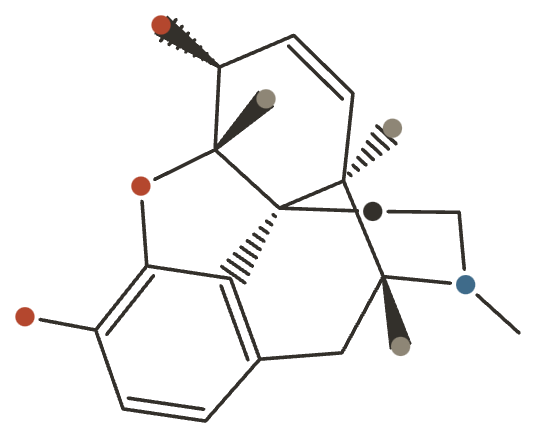
Compound Monograph
Morphine
Morphine is the principal alkaloid of opium and the reference drug for moderate-to-severe pain — a WHO essential medicine with a large randomised record in cancer pain. That record belongs to a standardised, clinician-titrated pharmaceutical; the plant it comes from delivers an unmeasurable dose, and habitual consumption of crude opium is classified as carcinogenic to humans.

Sources · 1
Where Does It Come From?
Morphine is a naturally occurring morphinan alkaloid (benzylisoquinoline-derived opiate), found in Opium poppy. It is flagged as poisonous.
Concentration
Content by Source
Concentrations not reported. No percent-dry-weight or mg/g figures have been published for this compound in its source plants.
Morphine at a Glance
Morphine is the principal alkaloid of opium and the molecule against which every other opioid analgesic is measured. It binds the mu-opioid receptor, and that single action produces both the reason it is on the WHO Model List of Essential Medicines and every one of its hazards: analgesia, sedation, constipation, euphoria, tolerance, dependence and — at enough exposure — the respiratory arrest that kills 7Reference 7ReviewOpioid Analgesia and Opioid-Induced Adverse Effects: A Review — reviewView study →.
Its clinical record is real and specific. A Cochrane review of oral morphine for cancer pain covers 62 studies and 4,241 participants, and the wider Cochrane overview of opioids in cancer pain concludes that roughly 19 people in 20 who can tolerate an opioid have moderate-or-severe pain brought down to mild or none within 14 days 1,
The plant is a different subject. Alkaloid content in poppy material varies by orders of magnitude with cultivar, plant part and processing, so a home preparation has no knowable dose 10,
The Drug and the Plant Are Not the Same Thing
Almost everything written about morphine is written about a pharmaceutical: a purified molecule of known mass, in a tablet or ampoule of stated strength, given by someone who can measure the response and reverse an overdose. None of those properties survives the trip back to the plant.
Content is not fixed. In the Tasmanian pharmaceutical cultivar C048-6-14-64, morphine, codeine and thebaine together account for 91.2% of the latex alkaloids. In the condiment cultivar “Marianne”, grown for seed, morphinan alkaloids fall to 18.8% of the total and the latex is dominated instead by narcotoline and noscapine 13Reference 13Comparative qualitative and quantitative determination of alkaloids in narcotic and condiment Papaver somniferum cultivarsView study →. Same species, opposite chemistry. Plant part matters too: the alkaloid profile differs between latex, stem, leaf and root, and morphine concentration falls down the stem toward the roots while codeine rises 13Reference 13Comparative qualitative and quantitative determination of alkaloids in narcotic and condiment Papaver somniferum cultivarsView study →.
The seed coat is the practical hazard. Culinary poppy seed carries no latex, but seeds are contaminated with alkaloid from the capsule during harvest. When home-brewing recipes taken from user forums were applied to commercially sold seed and the extract quantified by LC-MS/MS, morphine recovery ranged from under 1 to 2,788 mg/kg of seed — and the authors concluded that regardless of extraction conditions, lethal amounts of morphine can be rinsed off poppy seed by these methods 8Reference 8Quantification of Morphine, Codeine, and Thebaine in Home-Brewed Poppy Seed Tea by LC-MS/MSView study →. Two young men in that study’s originating cases died with high blood morphine at autopsy; a separate report documents two further cases of severe opiate toxicity after poppy-seed tea 8,
And the crude material carries a risk the purified drug does not. IARC’s working group classified opium consumption as Group 1, carcinogenic to humans, with the evidence strongest for cancers of the urinary bladder, larynx and lung 11Reference 11ReviewCarcinogenicity of opium consumption — IARC Monographs evaluationView study →. An accompanying systematic review and meta-analysis of 2 prospective cohorts and 33 case-control studies put the pooled relative risk for ever-or-regular use at 7.97 (95% CI 4.79–13.3) for laryngeal cancer and 1.50 (1.13–1.99) for oesophageal cancer, with risk rising alongside cumulative exposure 12Reference 12Meta-analysisThe carcinogenicity of opium consumption: a systematic review and meta-analysis — meta-analysisView study →. This is a finding about smoked and eaten opium — a complex, pyrolysed mixture — not about morphine as a molecule, and it is one of the clearest cases anywhere of a plant preparation and its purified constituent pointing in opposite directions.
Established Medical Use
Oral morphine remains the reference analgesic for moderate-to-severe cancer pain, in immediate-release and modified-release forms, and modified-release products hold for 12 or 24 hours depending on formulation 1Reference 1Systematic reviewOral morphine for cancer pain — systematic reviewView study →. It is used across acute severe pain, post-operative pain and palliative care, and it is one of the few drugs on the WHO essential-medicines list with no adequate substitute for its indication.
The access story is the counterweight to the overdose story. The Lancet Commission on Palliative Care and Pain Relief documented an enormous global imbalance in the distribution of morphine-equivalent opioids, in which the countries with the greatest burden of untreated terminal pain receive a small fraction of the supply — a shortage of a cheap, off-patent, plant-derived medicine, sustained largely by regulation and procurement rather than by cost 19Reference 19ReviewAlleviating the access abyss in palliative care and pain relief-an imperative of universal health coverage: the Lancet Commission report — reviewView study →. Morphine is simultaneously one of the most over-prescribed and one of the most under-supplied medicines in the world, depending on where the question is asked.
Morphine Is Partly Its Own Prodrug
The most counter-intuitive fact about morphine is that much of its analgesia is not performed by morphine.
Morphine is heavily glucuronidated in the liver, chiefly by UGT2B7, into two metabolites with completely different behaviour. Morphine-3-glucuronide (M3G) is the larger fraction and is not an analgesic at all — it does not activate the mu receptor and is implicated instead in the neuroexcitatory effects (myoclonus, hyperalgesia, agitation) seen at high exposure. Morphine-6-glucuronide (M6G) is a mu agonist of higher affinity than the parent. Both are highly water-soluble, but only M6G crosses the blood-brain barrier in meaningful quantity 6Reference 6ReviewMorphine metabolism, transport and brain disposition — reviewView study →.
Working from published receptor-binding, protein-binding and concentration data, a quantitative review estimated M6G’s share of the total mu-receptor-mediated analgesic effect at 96.6% after oral morphine, and 85–91% after subcutaneous, intravenous and rectal dosing 5Reference 5ReviewMorphine-6-glucuronide is responsible for the analgesic effect after morphine administration: a quantitative review of morphine, morphine-6-glucuronide, and morphine-3-glucuronide — reviewView study →. Because M6G is cleared renally and accumulates when the kidneys do not clear it, that share rises to an estimated 97.6% in renal insufficiency — which is why the authors argue morphine may be regarded as a prodrug, and why kidney function, not liver function, is the variable that most often forces a dose change 5,
Two practical consequences follow. Oral morphine and injected morphine are not simply the same drug at different bioavailabilities — the oral route, with its heavier first-pass glucuronidation, delivers proportionally more of the active metabolite. And renal impairment is a genuine accumulation hazard rather than a theoretical one, because the compound that does the work is the one the kidney is failing to remove 5,
What It's Used For
Morphine’s evidence base is unusually lopsided: enormous in cancer pain, thin and equivocal everywhere else, and absent for anything the plant can deliver.
The marquee use, and the isolate is the thing studied. The Cochrane review of oral morphine for cancer pain includes 62 studies with 4,241 participants; where individual results were reported, 96% (362/377) achieved pain no worse than mild, and daily doses ranged from 25 mg to 2,000 mg with typical averages between 100 mg and 250 mg 1Reference 1Systematic reviewOral morphine for cancer pain — systematic reviewView study →.
The overview across nine opioid reviews sets the headline figure — around 19 of 20 patients with moderate or severe pain who tolerate an opioid reach mild or no pain within 14 days 2Reference 2Systematic reviewOpioids for cancer pain - an overview of Cochrane reviews — systematic reviewView study →.
Adverse events were common and predictable, and about 6% of participants stopped morphine because they could not tolerate them 1Reference 1Systematic reviewOral morphine for cancer pain — systematic reviewView study →.
Gap: Cochrane grades the underlying evidence very low. Most trials were small, old, and built to show equivalence between formulations for registration purposes rather than to test morphine against placebo, so the effect size is anchored more in clinical experience than in trial design 1,
Opioids are given for breathlessness in advanced disease on the reasoning that they blunt the perception of air hunger rather than treating its cause. A Cochrane review of 26 randomised trials in 526 participants found a small improvement in dyspnoea scores — a mean post-treatment difference of 0.28 points favouring opioids — on low-quality evidence, with the change-from-baseline analysis weaker still 4Reference 4Meta-analysisOpioids for the palliation of refractory breathlessness in adults with advanced disease and terminal illness — meta-analysisView study →.
Nausea and vomiting were 4.7 times more likely than with placebo, constipation three times, drowsiness 2.9 times, and no study showed a quality-of-life gain 4Reference 4Meta-analysisOpioids for the palliation of refractory breathlessness in adults with advanced disease and terminal illness — meta-analysisView study →.
Gap: the trials are individually tiny and inconsistently reported, and the review found no evidence at all supporting the nebulised route that is sometimes used 4Reference 4Meta-analysisOpioids for the palliation of refractory breathlessness in adults with advanced disease and terminal illness — meta-analysisView study →.
Where the cancer-pain record does not carry over. Five randomised double-blind cross-over studies in 236 participants with diabetic neuropathy, chemotherapy-induced neuropathy, postherpetic neuralgia, phantom-limb pain and lumbar radiculopathy titrated oral morphine to 90–180 mg daily or the maximum tolerated dose 3Reference 3Systematic reviewMorphine for chronic neuropathic pain in adults — systematic reviewView study →.
In an exploratory pooled analysis, some improvement was reported by 63% on morphine against 36% on placebo (NNT 3.7) — but the pre-specified outcome of substantial pain relief showed no difference from placebo across three studies, and the review’s conclusion is that there is insufficient evidence to support or refute any efficacy in neuropathic pain 3Reference 3Systematic reviewMorphine for chronic neuropathic pain in adults — systematic reviewView study →.
Gap: this is a null-adjacent result for a drug in constant use for exactly this indication. The evidence was graded very low, the participant numbers are small, and the imputation methods used for withdrawals would tend to flatter morphine rather than disadvantage it 3Reference 3Systematic reviewMorphine for chronic neuropathic pain in adults — systematic reviewView study →.
There is no trial literature for any home poppy preparation, and there is a measurement literature explaining why there cannot usefully be one. Morphine recovered from commercially sold poppy seed by four home-brewing methods ranged from under 1 to 2,788 mg/kg, with yield varying between extractions of the same material — and lethal quantities were obtainable regardless of the method used 8Reference 8Quantification of Morphine, Codeine, and Thebaine in Home-Brewed Poppy Seed Tea by LC-MS/MSView study →.
Fatal and near-fatal poisonings from poppy-seed tea are documented 8,
For crude opium, the exposure that has been studied at scale is epidemiological rather than therapeutic, and its finding is Group 1 carcinogenicity 11,
Gap: the whole category fails on preparation rather than on plausibility. The alkaloid is genuinely present and genuinely active; it is the dose that cannot be known, which is the one thing a mu-opioid agonist requires 8,
Mechanisms
| Target / pathway | Effect | Relevant to |
|---|---|---|
| Mu-opioid receptor (MOR) | agonist — inhibits ascending nociceptive transmission and activates descending inhibition | analgesiaand every adverse effect below |
| Mu receptors in the brainstem respiratory centres | reduced sensitivity to rising CO₂ → hypoventilation, then apnoea | fatal overdose |
| Mu receptors in the enteric nervous system | slowed propulsive motility, increased fluid absorption | constipation; the antidiarrhoeal action |
| Mesolimbic dopamine signalling (disinhibition of VTA neurons) | reward, euphoria, reinforcement | dependence and addiction |
| Receptor desensitisation, internalisation and adaptive signalling | tolerance with repeated exposure; withdrawal on cessation | dose escalationphysical dependence |
| UGT2B7 glucuronidation → M6G | higher-affinity mu agonist that crosses the blood-brain barrier | most of the analgesic effect after any route |
| UGT2B7 glucuronidation → M3G | non-analgesic; associated with neuroexcitation at high exposure | myoclonusagitationhyperalgesia |
The row that matters is the first one. Morphine has no separate “good” receptor — the analgesia and the respiratory depression come from the same target, which is why titration and monitoring, rather than a safer dose, are the whole of clinical practice 7Reference 7ReviewOpioid Analgesia and Opioid-Induced Adverse Effects: A Review — reviewView study →.
Pharmacokinetics
Oral morphine is absorbed well but subjected to heavy first-pass metabolism, so oral bioavailability is a fraction of the injected equivalent and oral doses run considerably higher than parenteral ones for the same effect 6Reference 6ReviewMorphine metabolism, transport and brain disposition — reviewView study →. Metabolism is glucuronidation rather than oxidation — chiefly by UGT2B7, with interindividual variation in that enzyme and in the transport proteins moving the metabolites across the blood-brain barrier 6Reference 6ReviewMorphine metabolism, transport and brain disposition — reviewView study →. The products are M3G in larger quantity and M6G in smaller, and it is M6G that supplies most of the analgesia, at an estimated 96.6% of the effect after oral dosing 5Reference 5ReviewMorphine-6-glucuronide is responsible for the analgesic effect after morphine administration: a quantitative review of morphine, morphine-6-glucuronide, and morphine-3-glucuronide — reviewView study →. Both glucuronides are cleared by the kidney, so renal impairment causes accumulation of the active metabolite and prolongs both analgesia and risk — the practical reason morphine is dose-reduced or avoided in renal failure 5,
Clinical Trials
Morphine is not an experimental agent; the relevant record is a completed one. Cochrane has synthesised the randomised literature across cancer pain (62 studies), neuropathic pain (5 studies) and breathlessness in advanced disease (26 studies), and the recurring theme is that a drug in universal use has been tested less rigorously than its status implies 1,
| Completed | Planned | Terminated | Preclinical |
|---|---|---|---|
| Extensive — cancer pain, neuropathic pain, palliative breathlessness (all Cochrane-synthesised) | — | — | Mechanistic work on tolerance, hyperalgesia and metabolite pharmacology |
Last checked: September 2026.
Isolate vs. Plant Studies
This molecule is a clean case: the entire human evidence base is isolate evidence, and that is a strength rather than a caveat. Every trial in the Cochrane reviews used pharmaceutical morphine sulfate or hydrochloride at a stated dose, in a stated formulation, titrated against a measured response 1,
There is no corresponding literature for whole opium or any poppy preparation as a therapy, and the reason is structural rather than accidental: the raw material cannot be dosed. Alkaloid content varies severalfold between cultivars, plant parts and processing methods 13Reference 13Comparative qualitative and quantitative determination of alkaloids in narcotic and condiment Papaver somniferum cultivarsView study →, and the one place where a home preparation has been quantified — poppy-seed tea — the measured range spanned more than three orders of magnitude in the same study 8Reference 8Quantification of Morphine, Codeine, and Thebaine in Home-Brewed Poppy Seed Tea by LC-MS/MSView study →. The evidence that does exist for habitual crude-opium use is epidemiological and negative: Group 1 carcinogenicity for bladder, larynx and lung 11,
So the usual isolate-versus-plant caution runs backwards here. The concern with most plant constituents is that isolate data are being used to sell a herb; the concern with morphine is that a plant is being used to approximate a drug whose entire value rests on knowing the dose.
Prevalence in Nature
Morphine is essentially a single-species molecule. It occurs in the latex of the opium poppy (Papaver somniferum), which produces around a hundred different benzylisoquinoline alkaloids, and it is absent or trace-level in the other Papaver species that have been examined for morphinan production 14,
Within the plant it is not evenly spread. The dried latex of a pharmaceutical cultivar is dominated by the morphinans — 91.2% of latex alkaloids as morphine, codeine and thebaine in the Tasmanian elite line C048-6-14-64 — while roots accumulate a different class entirely, chiefly sanguinarine and its relatives. Stems show a gradient, with morphine decreasing and codeine increasing toward the base of the plant 13Reference 13Comparative qualitative and quantitative determination of alkaloids in narcotic and condiment Papaver somniferum cultivarsView study →. A condiment cultivar grown for seed inverts the picture: 18.8% morphinans, with narcotoline and noscapine making up 80.5% of latex alkaloids 13Reference 13Comparative qualitative and quantitative determination of alkaloids in narcotic and condiment Papaver somniferum cultivarsView study →. Culinary seed itself carries no latex, but is contaminated with alkaloid from the capsule at harvest — which is the whole basis of the poppy-seed exposure literature 8,
Its Role in Plants
Morphine sits at the end of a long biosynthetic branch. All of the poppy’s benzylisoquinoline alkaloids descend from L-tyrosine by way of (S)-reticuline, the branch-point intermediate from which the pathway divides toward the morphinans, the phthalideisoquinolines such as noscapine, and the 1-benzylisoquinolines such as papaverine 14,
The alkaloids are made and stored in the laticifers, the specialised cells that produce the latex, which is consistent with a defensive role: a bitter, neuroactive exudate released at the site of damage. That is plant biology, not pharmacology — the poppy is not making an analgesic.
Discovery & Synthesis
Morphine’s isolation is a founding event in pharmacology. Working in Paderborn in the first years of the nineteenth century, the apothecary’s assistant Friedrich Sertürner separated a crystalline base from opium and set out the work in full in his 1817 paper in Annalen der Physik, alongside meconic acid 17Reference 17Ueber das Morphium, eine neue salzfähige Grundlage, und die Mekonsäure, als Hauptbestandtheile des OpiumsView study →. He named it after Morpheus for its soporific effect. It was the first alkaloid ever isolated from a plant, and it established the idea that a plant drug’s activity could be traced to a single definable compound — the principle the rest of the discipline is built on 16,
Structural elucidation took another 130 years; Robert Robinson’s derivation of the structural formula was recognised with the 1947 Nobel Prize in Chemistry 16Reference 16The Chemical History of Morphine: An 8000-year Journey, from Resin to de-novo SynthesisView study →. The first total synthesis was achieved by Marshall Gates and Gilg Tschudi at the University of Rochester in 1952 18Reference 18The Synthesis of MorphineView study →, later published in full detail — a landmark of synthetic organic chemistry that solved the molecule’s five contiguous stereocentres and its bridged pentacyclic skeleton.
Manufacture today is still agricultural. No total synthesis has ever come close to competing on cost with extraction from licensed poppy crops, so the world’s morphine, and the thebaine that feeds most semi-synthetic opioids, is still farmed 16Reference 16The Chemical History of Morphine: An 8000-year Journey, from Resin to de-novo SynthesisView study →. That leaves the supply of an essential medicine dependent on a small number of licensed growing countries — the economic and political fact behind both the access shortfall and the diversion problem 16,
Patents: not yet researched.
Toxicity & Safety
Morphine is flagged poisonous on the strength of a single mechanism: enough of it stops breathing. This is not a rare idiosyncratic reaction but the predictable high end of the same dose-response curve that produces the analgesia.
- A clinician-titrated pharmaceutical has a well-characterised safety profile. Adverse effects are common but predictable, and overdose is reversible with naloxone if it is recognised in time.
- Respiratory depression is the killing mechanism. Mu agonism blunts the brainstem response to carbon dioxide; the risk multiplies with alcohol, benzodiazepines, gabapentinoids and any other CNS depressant.
- Tolerance and physical dependence develop with repeated use, and withdrawal on stopping is a physiological event, not a failure of will.
- Renal impairment causes the active metabolite to accumulate. M6G is cleared by the kidney and does most of the analgesic work, so failing kidneys turn a stable dose into a rising one.
- No poppy preparation has a knowable dose, and habitual crude-opium consumption is classified as carcinogenic to humans.
Full Safety & Interactions Detail
Respiratory depression and overdose. All clinically used opioids are mu-opioid receptor agonists, and the major adverse effects are direct consequences of that receptor action 7Reference 7ReviewOpioid Analgesia and Opioid-Induced Adverse Effects: A Review — reviewView study →. Mu agonism in the brainstem reduces the ventilatory response to rising carbon dioxide; as dose rises past the analgesic range, breathing slows and then stops. Risk is highest in the opioid-naive, in sleep-disordered breathing, and — above all — in combination with other central nervous system depressants, which is a pharmacodynamic interaction and does not require any metabolic pathway to be shared.
Tolerance, dependence and hyperalgesia. Repeated exposure produces analgesic tolerance and physical dependence through receptor desensitisation and downstream adaptive signalling, and these are among the reasons for dose escalation and patient non-compliance in long-term use 7Reference 7ReviewOpioid Analgesia and Opioid-Induced Adverse Effects: A Review — reviewView study →. A related and less intuitive phenomenon is opioid-induced hyperalgesia — increased pain sensitivity caused by the opioid itself. A meta-analysis of post-surgical patients found that higher intra-operative opioid doses were associated with greater pain and greater morphine consumption in the first 24 hours after surgery, the opposite of the intended effect 20Reference 20Meta-analysisOpioid-induced hyperalgesia in patients after surgery: a systematic review and a meta-analysis — meta-analysisView study →.
Renal impairment. Because M6G supplies the large majority of the analgesic effect and is renally cleared, kidney function is the dominant determinant of how much drug a given dose actually delivers; in renal insufficiency an estimated 97.6% of the effect after oral dosing is metabolite-driven, and accumulation over successive doses is the expected behaviour rather than the exception 5Reference 5ReviewMorphine-6-glucuronide is responsible for the analgesic effect after morphine administration: a quantitative review of morphine, morphine-6-glucuronide, and morphine-3-glucuronide — reviewView study →. M3G, the non-analgesic metabolite, accumulates too and is associated with neuroexcitatory phenomena such as myoclonus and agitation 6Reference 6ReviewMorphine metabolism, transport and brain disposition — reviewView study →.
Common effects. Constipation, nausea and vomiting, sedation, pruritus, urinary retention and dizziness are frequent; in the cancer-pain trials adverse events were common and predictable, and around 6% of participants discontinued because of them 1Reference 1Systematic reviewOral morphine for cancer pain — systematic reviewView study →. Constipation in particular does not attenuate with time the way sedation does.
Interactions. Morphine is glucuronidated rather than oxidised, so it largely avoids the CYP-mediated interactions that dominate the opioid class. The interactions that matter are additive CNS depression — alcohol, benzodiazepines, gabapentinoids, sedating antihistamines, other opioids — and anything that impairs renal clearance of the glucuronide metabolites 5,
Crude opium and carcinogenicity. This is a hazard of the raw plant material, not of the purified molecule. IARC classifies opium consumption as Group 1, carcinogenic to humans, with sufficient evidence for bladder, larynx and lung cancer 11Reference 11ReviewCarcinogenicity of opium consumption — IARC Monographs evaluationView study →; the supporting meta-analysis reports pooled relative risks up to 7.97 for laryngeal cancer among ever-or-regular users, with a dose-response relationship across cumulative exposure 12Reference 12Meta-analysisThe carcinogenicity of opium consumption: a systematic review and meta-analysis — meta-analysisView study →. Morphine as an isolated drug carries no such classification.
Reproductive note. Opioid alkaloids cross the placenta and pass into breast milk, and neonatal opioid withdrawal following maternal use is a recognised outcome; poppy-seed tea has been a documented exposure route. Pregnancy and lactation decisions belong to the prescribing context, where the preparation and dose are known.
Morphine is a controlled substance in essentially every jurisdiction and is not available for self-directed use. Nothing here is a protocol; overdose reversal, dose selection and tapering are clinical procedures.
Dosage
Morphine has no self-administered dose, and none can be derived from a plant. What follows is what was used in the trials.
| Setting | Form | Dose used in research |
|---|---|---|
| Cancer pain (Cochrane, 62 studies) | Oral, immediate- or modified-release | 25–2,000 mg/day, most study averages 100–250 mg/day, reached by titration 1Reference 1Systematic reviewOral morphine for cancer pain — systematic reviewView study → |
| Chronic neuropathic pain (Cochrane, 5 studies) | Oral | Titrated to 90–180 mg/day or the maximum tolerated dose 3Reference 3Systematic reviewMorphine for chronic neuropathic pain in adults — systematic reviewView study → |
| Refractory breathlessness (Cochrane, 26 studies) | Oral or parenteral | Low doses relative to analgesic use; nebulised route not supported 4Reference 4Meta-analysisOpioids for the palliation of refractory breathlessness in adults with advanced disease and terminal illness — meta-analysisView study → |
The spread in that first row is the point: an eighty-fold range of daily doses, all of them correct for the patient they were titrated in. Morphine has no standard dose, only a starting dose and a method. Oral and parenteral doses are not interchangeable, since first-pass glucuronidation changes both the quantity and the metabolite mix that reaches the receptor 5,
Poppy preparations have no dose at all. In the one study to quantify a home method, morphine yield from commercial poppy seed spanned under 1 to 2,788 mg/kg, varied between extractions of the same material, and reached lethal quantities by every recipe tested 8Reference 8Quantification of Morphine, Codeine, and Thebaine in Home-Brewed Poppy Seed Tea by LC-MS/MSView study →.
These are doses recorded in research and clinical practice, not a personal recommendation.
References
- Wiffen PJ, Wee B, Moore RA (2016). Oral morphine for cancer pain — systematic review. Cochrane Database Syst Rev. https://pubmed.ncbi.nlm.nih.gov/27105021/
- Wiffen PJ, Wee B, Derry S, et al. (2017). Opioids for cancer pain - an overview of Cochrane reviews — systematic review. Cochrane Database Syst Rev. https://pubmed.ncbi.nlm.nih.gov/28683172/
- Cooper TE, Chen J, Wiffen PJ, et al. (2017). Morphine for chronic neuropathic pain in adults — systematic review. Cochrane Database Syst Rev. https://pubmed.ncbi.nlm.nih.gov/28530786/
- Barnes H, McDonald J, Smallwood N, et al. (2016). Opioids for the palliation of refractory breathlessness in adults with advanced disease and terminal illness — meta-analysis. Cochrane Database Syst Rev. https://pubmed.ncbi.nlm.nih.gov/27030166/
- Klimas R, Mikus G (2014). Morphine-6-glucuronide is responsible for the analgesic effect after morphine administration: a quantitative review of morphine, morphine-6-glucuronide, and morphine-3-glucuronide — review. Br J Anaesth. https://pubmed.ncbi.nlm.nih.gov/24985077/
- De Gregori S, De Gregori M, Ranzani GN, et al. (2012). Morphine metabolism, transport and brain disposition — review. Metab Brain Dis. https://pubmed.ncbi.nlm.nih.gov/22193538/
- Paul AK, Smith CM, Rahmatullah M, et al. (2021). Opioid Analgesia and Opioid-Induced Adverse Effects: A Review — review. Pharmaceuticals (Basel). https://pubmed.ncbi.nlm.nih.gov/34832873/
- Powers, Erickson, Swortwood (2018). Quantification of Morphine, Codeine, and Thebaine in Home-Brewed Poppy Seed Tea by LC-MS/MS. Journal of Forensic Sciences. https://doi.org/10.1111/1556-4029.13664
- Spyres, van Wijk, Lapoint, et al. (2018). Two cases of severe opiate toxicity after ingestion of poppy seed tea — case report. Toxicology Communications. https://doi.org/10.1080/24734306.2018.1540178
- Carlin, Dean, Ames (2020). Opium Alkaloids in Harvested and Thermally Processed Poppy Seeds. Frontiers in Chemistry. https://doi.org/10.3389/fchem.2020.00737
- Warnakulasuriya S, Cronin-Fenton D, Jinot J, et al. (2020). Carcinogenicity of opium consumption — IARC Monographs evaluation. The Lancet Oncology. https://doi.org/10.1016/S1470-2045(20)30611-2
- M Filho A, Turner MC, Warnakulasuriya S, et al. (2023). The carcinogenicity of opium consumption: a systematic review and meta-analysis — meta-analysis. Eur J Epidemiol. https://pubmed.ncbi.nlm.nih.gov/36773182/
- Frick S, Kramell R, Schmidt J, et al. (2005). Comparative qualitative and quantitative determination of alkaloids in narcotic and condiment Papaver somniferum cultivars. J Nat Prod. https://pubmed.ncbi.nlm.nih.gov/15921406/
- Vadhel A, Bashir S, Mir AH, et al. (2023). Opium alkaloids, biosynthesis, pharmacology and association with cancer occurrence — review. Open Biol. https://pubmed.ncbi.nlm.nih.gov/37132222/
- Beaudoin GA, Facchini PJ (2014). Benzylisoquinoline alkaloid biosynthesis in opium poppy — review. Planta. https://pubmed.ncbi.nlm.nih.gov/24671624/
- Brook K, Bennett J, Desai SP (2017). The Chemical History of Morphine: An 8000-year Journey, from Resin to de-novo Synthesis. J Anesth Hist. https://pubmed.ncbi.nlm.nih.gov/28641826/
- Sertuerner (1817). Ueber das Morphium, eine neue salzfähige Grundlage, und die Mekonsäure, als Hauptbestandtheile des Opiums. Annalen der Physik. https://doi.org/10.1002/andp.18170550104
- Gates M, Tschudi G (1952). The Synthesis of Morphine. Journal of the American Chemical Society. https://doi.org/10.1021/ja01124a538
- Knaul FM, Farmer PE, Krakauer EL, et al. (2018). Alleviating the access abyss in palliative care and pain relief-an imperative of universal health coverage: the Lancet Commission report — review. Lancet. https://pubmed.ncbi.nlm.nih.gov/29032993/
- Fletcher D, Martinez V (2014). Opioid-induced hyperalgesia in patients after surgery: a systematic review and a meta-analysis — meta-analysis. Br J Anaesth. https://pubmed.ncbi.nlm.nih.gov/24829420/



