
Compound Monograph
Taxine B
Taxine B is the cardiotoxic principal of yew — a taxane pseudoalkaloid that blocks cardiac sodium and calcium currents at the same time. There is no antidote, and the one documented rescue is mechanical: veno-arterial ECMO.

Sources · 3
Where Does It Come From?
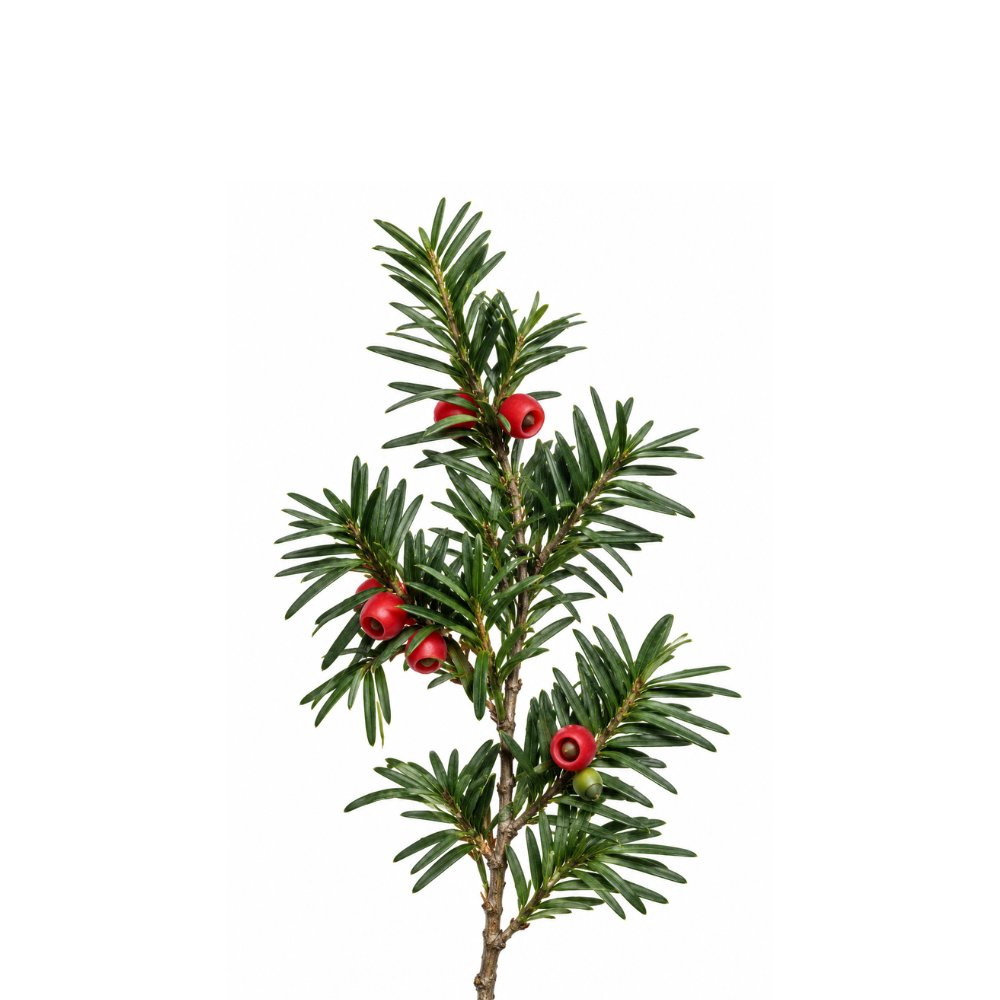
Taxine B is a naturally occurring taxane diterpenoid pseudoalkaloid, found in Pacific yew and 2 other sources. It is flagged as poisonous.
Concentration
Content by Source
Concentrations not reported. No percent-dry-weight or mg/g figures have been published for this compound in its source plants.
Taxine B at a Glance
Taxine B is the molecule that makes yew a poison. It is a taxane diterpenoid pseudoalkaloid — the principal member of a mixture of more than thirty related compounds — and it accounts for roughly 30% of the yew alkaloid fraction against about 1.3% for its milder relative taxine A 2,
It works by blocking two cardiac ion currents at once. Under voltage clamp in isolated guinea-pig ventricular myocytes, taxine inhibits both the sodium current and the calcium current in a dose-dependent way; at the highest concentration tested, the sodium-current index fell to about 9% of control 1Reference 1In vitroTekol, Y., Kameyama, M. (1987). [Electrophysiology of the mechanisms of action of the yew toxin, taxine, on the heart] — in vitro electrophysiology, isolated guinea-pig ventricular myocytes. Arzneimittelforschung. https://pubmed.ncbi.nlm.nih.gov/2440454/View study →. The result is a myocardium that is simultaneously slow to conduct and poorly contractile, and the clinical picture follows directly: widening QRS, high-grade AV block, bradycardia or wide-complex tachycardia, hypotension, cardiogenic shock and asystole 2,
There is no antidote. The interventions tried in case reports — sodium bicarbonate, digoxin-specific antibody fragments by analogy, intravenous lipid emulsion, atropine, overdrive pacing — have little proven benefit, and that is what makes the mechanism matter: single-target rescues address one of two simultaneous blockades. The one documented rescue is mechanical — veno-arterial extracorporeal membrane oxygenation, taking over the circulation until the toxin clears 3,
Taxine B has no therapeutic use and never has. It should not be confused with paclitaxel, the antimitotic chemotherapy drug from the same tree: different molecule, different target, no overlap in pharmacology. No preparation of yew delivers one without the other.
The Electrophysiology
The single dedicated electrophysiology study is what everything else about this molecule rests on. Tekol and Kameyama applied taxine sulfate to enzymatically isolated single guinea-pig ventricular myocytes under current and voltage clamp, at three concentrations across two orders of magnitude 1Reference 1In vitroTekol, Y., Kameyama, M. (1987). [Electrophysiology of the mechanisms of action of the yew toxin, taxine, on the heart] — in vitro electrophysiology, isolated guinea-pig ventricular myocytes. Arzneimittelforschung. https://pubmed.ncbi.nlm.nih.gov/2440454/View study →:
| Taxine concentration | Calcium current (ICa) amplitude | dV/dtmax — the sodium-current index |
|---|---|---|
| 10⁻⁶ g/mL | 87.1% of control | 75.4% of control |
| 10⁻⁵ g/mL | 67.8% of control | 53.3% of control |
| 10⁻⁴ g/mL | 24.4% of control | 9.4% of control |
Three things in that table decide how the poisoning behaves.
Both currents fall, and the sodium current falls further. At the top concentration the myocardium retains about a quarter of its calcium current and under a tenth of its sodium conduction. Sodium entry sets the upstroke of the action potential and therefore conduction velocity; calcium entry drives contraction. Losing both is not two problems, it is one problem that cannot be treated from either side.
The dose-response is smooth, not a threshold. Even the lowest concentration produced a measurable reduction in both currents. There is no exposure that is pharmacologically silent — only exposures that are small enough not to matter clinically.
Recovery is partial. Washing the toxin out restored only some of the current, which is consistent with the slow, uncertain recovery seen in patients who survive.
One honest limit belongs with the numbers: the study used taxine sulfate, the alkaloid mixture, not purified taxine B. The attribution of the cardiotoxicity specifically to taxine B rests on the wider literature comparing the two principal taxines, where taxine B is consistently the stronger cardiotoxin 2,
Why Treatment Fails, and What Works
Most cardiac poisonings have a counter-move. Digitalis has antibody fragments; sodium-channel blockade has bicarbonate; calcium-channel blockade has calcium, glucagon and high-dose insulin. Taxine B presents both blockades at once, which is why the counter-moves individually underperform: correcting the sodium block does nothing for a heart that cannot contract, and supporting contractility does nothing for a heart that cannot conduct.
The interventions reported in the case literature — sodium bicarbonate for QRS widening, digoxin-specific Fab on pharmacological analogy, intravenous lipid emulsion, atropine, transvenous overdrive pacing, haemodialysis — are reasonable attempts rather than established therapy, and severe poisoning is largely resistant to all of them 2,
What has worked is mechanical circulatory support. Two independently reported cases describe veno-arterial extracorporeal membrane oxygenation rescuing yew-induced cardiogenic shock with full neurological recovery: a 39-year-old with toxic cardiogenic shock after yew ingestion 3Reference 3Case reportCardiogenic shock due to yew poisoning rescued by VA-ECMO: case report and literature review — case reportView study →, and a 53-year-old who presented after eating roughly 200 yew berries in mixed tachy- and bradyarrhythmias including ventricular tachycardia and periods of asystole, weaned from VA-ECMO after four days and discharged on day 12 4Reference 4Case reportTaxine alkaloid poisoning successfully supported with venoarterial extracorporeal membrane oxygenation: a case report — case reportView study →.
That fits the mechanism rather than fighting it. The blockade is reversible and the toxin clears; the problem is surviving the interval. Taking over the circulation until it does is a more logical answer than attempting to reverse two channel blockades simultaneously, and both reports argue for early rather than salvage initiation.
Detection: 3,5-Dimethoxyphenol
Taxine B is difficult to find in a patient and easy to miss, which matters because the diagnosis is often the thing that gets someone to a centre with ECMO.
3,5-dimethoxyphenol (3,5-DMP) is the main taxane metabolite recovered from blood and is used as the marker of yew ingestion 5,
The one case with a perimortem quantification gives a sense of the scale involved. A 22-year-old found apnoeic and pulseless after a witnessed seizure, with Taxus baccata material on her person, had a perimortem serum taxine B of 80.9 µg/mL and 3,5-DMP of 86.9 ng/mL 5Reference 5Case reportFatal Taxus baccata ingestion with perimortem serum taxine B quantification — case reportView study →. That is a single data point and not a threshold, but it is the only published serum taxine B concentration tied to a documented fatal outcome.
What It's Used For
Taxine B has no therapeutic use and no indications to score. Everything established about it is toxicology: dual blockade of cardiac sodium and calcium currents, and the clinical picture that follows from it.
Mechanisms
| Target / pathway | Effect | Relevant to |
|---|---|---|
| Cardiac voltage-gated sodium channels | Dose-dependent inhibition; dV/dtmax to 9.4% of control at 10⁻⁴ g/mL 1Reference 1In vitroTekol, Y., Kameyama, M. (1987). [Electrophysiology of the mechanisms of action of the yew toxin, taxine, on the heart] — in vitro electrophysiology, isolated guinea-pig ventricular myocytes. Arzneimittelforschung. https://pubmed.ncbi.nlm.nih.gov/2440454/View study → | slowed conduction — widening QRSAV blockasystole |
| Cardiac L-type calcium channels | Dose-dependent inhibition; ICa to 24.4% of control at the same concentration 1Reference 1In vitroTekol, Y., Kameyama, M. (1987). [Electrophysiology of the mechanisms of action of the yew toxin, taxine, on the heart] — in vitro electrophysiology, isolated guinea-pig ventricular myocytes. Arzneimittelforschung. https://pubmed.ncbi.nlm.nih.gov/2440454/View study → | reduced contractility — hypotensioncardiogenic shock |
| Potassium outward current | Inconsistent effects; no coherent action established 1Reference 1In vitroTekol, Y., Kameyama, M. (1987). [Electrophysiology of the mechanisms of action of the yew toxin, taxine, on the heart] — in vitro electrophysiology, isolated guinea-pig ventricular myocytes. Arzneimittelforschung. https://pubmed.ncbi.nlm.nih.gov/2440454/View study → | not part of the toxidrome |
| Atrioventricular conduction | Second- and third-degree block, bradycardia, wide-complex rhythms 7, | the presenting rhythm disturbance |
| Central nervous system | Seizure reported in acute presentations 5, | the prodromeand the reason a collapse may be witnessed as a fit |
There is no tubulin interaction. Taxine B and paclitaxel share a source tree and a taxane skeleton, and nothing else — the antimitotic mechanism belongs to paclitaxel alone.
Toxicokinetics
No formal pharmacokinetic study of taxine B in humans exists, and there will not be one. What the case literature establishes is indirect but consistent.
Onset is biphasic and deceptive. Early symptoms are non-specific — nausea, vomiting, dizziness, abdominal pain, sometimes seizure — and after an interval the cardiac deterioration can be abrupt and refractory 2Reference 2ReviewTaxines: a review of the mechanism and toxicity of yew (Taxus spp.) alkaloids — reviewView study →. The accurate description is not “no warning” but an unremarkable prodrome followed by a cliff.
The parent compounds appear to be cleared or metabolised quickly, since taxines are often undetectable in serum by the time a sample reaches the laboratory while the metabolite 3,5-DMP remains measurable 8Reference 8Case reportA suicide attempt by intoxication with Taxus baccata leaves and ultra-fast liquid chromatography-electrospray ionization-tandem mass spectrometry, analysis of patient serum and different plant samples — case reportView study →. That the blockade is reversible — partial current recovery on washout in vitro 1Reference 1In vitroTekol, Y., Kameyama, M. (1987). [Electrophysiology of the mechanisms of action of the yew toxin, taxine, on the heart] — in vitro electrophysiology, isolated guinea-pig ventricular myocytes. Arzneimittelforschung. https://pubmed.ncbi.nlm.nih.gov/2440454/View study →, and full neurological recovery in ECMO-supported patients after four days of support 4Reference 4Case reportTaxine alkaloid poisoning successfully supported with venoarterial extracorporeal membrane oxygenation: a case report — case reportView study → — points the same way.
Human Data
There are no trials, and there will not be any. The human evidence is a case literature — fatal ingestions with analytical confirmation 5,
| Completed | Planned | Terminated | Preclinical |
|---|---|---|---|
| None(case series and poison-centre data only) | — | — | One dedicated electrophysiology study 1Reference 1In vitroTekol, Y., Kameyama, M. (1987). [Electrophysiology of the mechanisms of action of the yew toxin, taxine, on the heart] — in vitro electrophysiology, isolated guinea-pig ventricular myocytes. Arzneimittelforschung. https://pubmed.ncbi.nlm.nih.gov/2440454/View study → |
Last checked: September 2026.
Isolate vs. Plant Studies
This molecule inverts the usual problem. Almost everything published concerns the mixture rather than the isolate, and the plant material is the thing people are actually exposed to.
The defining electrophysiology used taxine sulfate — the crude alkaloid mixture from Taxus baccata — not purified taxine B 1Reference 1In vitroTekol, Y., Kameyama, M. (1987). [Electrophysiology of the mechanisms of action of the yew toxin, taxine, on the heart] — in vitro electrophysiology, isolated guinea-pig ventricular myocytes. Arzneimittelforschung. https://pubmed.ncbi.nlm.nih.gov/2440454/View study →. The clinical cases are ingestions of needles, berries or leaves, which deliver the full mixture plus everything else in the tissue 3,
That attribution is well accepted and is not the same thing as a clamp experiment on the pure compound. It is worth stating plainly, because “taxine B blocks sodium and calcium channels” is a sentence carrying one mixture experiment and a body of comparative chemistry behind it.
Prevalence in Nature
Taxine B occurs across the genus Taxus and effectively nowhere else. Within the yew alkaloid fraction it is the dominant member at roughly 30%, with taxine A at about 1.3% and more than thirty further related compounds making up the remainder 2Reference 2ReviewTaxines: a review of the mechanism and toxicity of yew (Taxus spp.) alkaloids — reviewView study →. Concentration is highest in the needles; the red aril flesh is the one part of the plant that is not toxic, though the seed inside it is 6Reference 6ObservationalIs the yew really poisonous to you? — poison-centre observational seriesView study →.
Species matters, and it runs opposite to what the drug story suggests. Taxus brevifolia — the Pacific yew, the tree paclitaxel came from — is reported to carry lower taxine levels than the ornamental T. baccata and T. cuspidata that dominate the human case literature. Nearly every published poisoning involves a European or Japanese yew from a garden or hedge rather than a Pacific yew from a forest, which is a sampling fact as much as a chemical one. This comparison rests on secondary literature rather than on a head-to-head assay.
The taxanes as a class derive from the diterpene taxadiene, and the Taxus genome carries a taxadiene biosynthesis gene cluster alongside a distinctive grouping of CYP725A cytochrome P450 genes 12Reference 12The Taxus genome provides insights into paclitaxel biosynthesisView study →. That work was done to map paclitaxel biosynthesis; where the taxine branch diverges from it is not established.
Discovery & Synthesis
“Taxine” was originally a fraction, not a molecule. Nineteenth-century chemistry described a crude alkaloid extract from yew and gave it that name, and for a long time the singular noun concealed a mixture of more than thirty compounds. Separating them required HPLC, mass spectrometry and NMR, and it was that separation which allowed the cardiotoxicity to be attributed to taxine B rather than to “taxine” generally 2Reference 2ReviewTaxines: a review of the mechanism and toxicity of yew (Taxus spp.) alkaloids — reviewView study →.
The pharmacological turn came in 1987, with the voltage-clamp study establishing sodium- and calcium-current inhibition as the mechanism 1Reference 1In vitroTekol, Y., Kameyama, M. (1987). [Electrophysiology of the mechanisms of action of the yew toxin, taxine, on the heart] — in vitro electrophysiology, isolated guinea-pig ventricular myocytes. Arzneimittelforschung. https://pubmed.ncbi.nlm.nih.gov/2440454/View study → — replacing a long-standing description of yew as simply “cardiotoxic” with a specific and testable account.
There is no manufacture. Taxine B is not made, not sold and not used; it is isolated in small quantities as an analytical standard. No total synthesis has been pursued, because there is no reason to want any.
Patents: not yet researched.
Toxicity & Safety
Taxine B has no use, so its entire profile is toxicological. Two numbers should be held together: severe poisoning is close to untreatable, and severe poisoning is rare.
- No antidote exists. Sodium bicarbonate, digoxin-specific Fab, lipid emulsion, atropine and pacing have all been tried with little proven benefit 2,
7Reference 2ReviewTaxines: a review of the mechanism and toxicity of yew (Taxus spp.) alkaloids — reviewView study →Reference 7Case reportYew poisoning - pathophysiology, clinical picture, management and perspective of fat emulsion utilization — review with case reportsView study → . - Dual sodium and calcium channel blockade produces a heart that is both slow to conduct and poorly contractile, which is why single-mechanism rescues underperform 1Reference 1In vitroTekol, Y., Kameyama, M. (1987). [Electrophysiology of the mechanisms of action of the yew toxin, taxine, on the heart] — in vitro electrophysiology, isolated guinea-pig ventricular myocytes. Arzneimittelforschung. https://pubmed.ncbi.nlm.nih.gov/2440454/View study →.
- The prodrome is unremarkable and the deterioration is abrupt. Nausea, dizziness and vomiting, then cardiac collapse that can be sudden 2Reference 2ReviewTaxines: a review of the mechanism and toxicity of yew (Taxus spp.) alkaloids — reviewView study →.
- Severe outcomes are rare. 11,197 Taxus exposures over a decade of US poison-centre data produced no fatalities, with 92.5% showing no effect at all 6Reference 6ObservationalIs the yew really poisonous to you? — poison-centre observational seriesView study →.
- VA-ECMO has produced full recovery in independently reported cases of yew-induced cardiogenic shock 3,
4Reference 3Case reportCardiogenic shock due to yew poisoning rescued by VA-ECMO: case report and literature review — case reportView study →Reference 4Case reportTaxine alkaloid poisoning successfully supported with venoarterial extracorporeal membrane oxygenation: a case report — case reportView study → . - Fatal cases are predominantly intentional, using correctly identified ornamental yew rather than a foraging mistake 6Reference 6ObservationalIs the yew really poisonous to you? — poison-centre observational seriesView study →.
- Every part is toxic except the red aril flesh — and the seed inside it is toxic if chewed 6Reference 6ObservationalIs the yew really poisonous to you? — poison-centre observational seriesView study →.
- Retain gastric material if ingestion is suspected: the parent taxines are often undetectable in serum by the time it is sampled 8Reference 8Case reportA suicide attempt by intoxication with Taxus baccata leaves and ultra-fast liquid chromatography-electrospray ionization-tandem mass spectrometry, analysis of patient serum and different plant samples — case reportView study →.
Full Safety Detail
Reading the two numbers together. A poisoning that is nearly untreatable when severe, and a decade of exposures with zero deaths, sound contradictory but are not. Almost all reported exposures are young children mouthing an aril — the flesh is non-toxic and an intact seed passes through — while the severe cases come from needles or chewed seeds in quantity, usually deliberately 6Reference 6ObservationalIs the yew really poisonous to you? — poison-centre observational seriesView study →. Risk here is concentrated at the extreme end of the distribution rather than spread across it. A child who has swallowed an aril is a call to a poison centre rather than an emergency; whether the seed was chewed is the variable that changes the answer.
The toxidrome. Gastrointestinal symptoms and dizziness first, sometimes with seizure, then the cardiac phase: widening QRS, second- or third-degree atrioventricular block, bradycardia or wide-complex tachycardia, hypotension progressing to cardiogenic shock and asystole 7,
Why treatment fails. Combined sodium and calcium channel blockade leaves no single target to reverse. The listed interventions address one arm of the mechanism at a time, which is a plausible reason none has established itself despite decades of attempts 2,
Detection. 3,5-dimethoxyphenol is the marker used in practice, since the parent taxines clear or metabolise quickly 5,
No dose data of any kind is defensible. The frequently repeated “minimum lethal dose of around 50–100 g of needles for an adult”, and its per-kilogram restatements, are compilation figures propagating through secondary sources without a traceable primary experiment. No reproductive, developmental or chronic-exposure dataset exists, because no exposure to this molecule is ever intentional.
And the other molecule in the same tree. Yew also makes paclitaxel, an antimitotic chemotherapy drug with an entirely unrelated mechanism. No preparation of the plant separates them, and neither is a reason to make one.
Dosage
There is none. Taxine B has no therapeutic use in humans or animals, no preparation, and no exposure that is intended.
The figures that exist are exposure data rather than doses. A perimortem serum taxine B concentration of 80.9 µg/mL accompanied a fatal Taxus baccata ingestion 5Reference 5Case reportFatal Taxus baccata ingestion with perimortem serum taxine B quantification — case reportView study →; one survivor had eaten roughly 200 berries 4Reference 4Case reportTaxine alkaloid poisoning successfully supported with venoarterial extracorporeal membrane oxygenation: a case report — case reportView study →. The commonly cited lethal quantity of yew needles is a compilation figure without a traceable primary source and should not be treated as an established threshold.
References
- Tekol, Y., Kameyama, M. (1987). [Electrophysiology of the mechanisms of action of the yew toxin, taxine, on the heart] — in vitro electrophysiology, isolated guinea-pig ventricular myocytes. Arzneimittelforschung. https://pubmed.ncbi.nlm.nih.gov/2440454/
- Wilson, C. R., Sauer, J., Hooser, S. B. (2001). Taxines: a review of the mechanism and toxicity of yew (Taxus spp.) alkaloids — review. Toxicon. https://pubmed.ncbi.nlm.nih.gov/10978734/
- Schreiber, N., Manninger, M., Pätzold, S., et al. (2022). Cardiogenic shock due to yew poisoning rescued by VA-ECMO: case report and literature review — case report. Channels (Austin). https://pubmed.ncbi.nlm.nih.gov/35942511/
- Ward, C., Meeks, D., Trimlett, R., et al. (2022). Taxine alkaloid poisoning successfully supported with venoarterial extracorporeal membrane oxygenation: a case report — case report. Eur Heart J Case Rep. https://pubmed.ncbi.nlm.nih.gov/35187392/
- Arens, A. M., Anaebere, T. C., Horng, H., et al. (2016). Fatal Taxus baccata ingestion with perimortem serum taxine B quantification — case report. Clin Toxicol (Phila). https://pubmed.ncbi.nlm.nih.gov/27436403/
- Krenzelok, E. P., Jacobsen, T. D., Aronis, J. (1998). Is the yew really poisonous to you? — poison-centre observational series. J Toxicol Clin Toxicol. https://pubmed.ncbi.nlm.nih.gov/9656977/
- Rutkiewicz, A., Schab, P., Kubicius, A., et al. (2019). Yew poisoning - pathophysiology, clinical picture, management and perspective of fat emulsion utilization — review with case reports. Anaesthesiol Intensive Ther. https://pubmed.ncbi.nlm.nih.gov/31769262/
- Kobusiak-Prokopowicz, M., Marciniak, A., Ślusarczyk, S., et al. (2016). A suicide attempt by intoxication with Taxus baccata leaves and ultra-fast liquid chromatography-electrospray ionization-tandem mass spectrometry, analysis of patient serum and different plant samples — case report. BMC Pharmacol Toxicol. https://pubmed.ncbi.nlm.nih.gov/27577698/
- Beike, J., Karger, B., Meiners, T., et al. (2003). LC-MS determination of Taxus alkaloids in biological specimens — case report. Int J Legal Med. https://pubmed.ncbi.nlm.nih.gov/14530985/
- G N, Chan, M., Gue, Y. X., et al. (2020). Fatal heart block from intentional yew tree (Taxus baccata) ingestion — case report. Eur Heart J Case Rep. https://pubmed.ncbi.nlm.nih.gov/32128497/
- Zutter, A., Hauri, K., Evers, K. S., et al. (2019). “Chaotic Arrhythmia” During Successful Resuscitation After Ingestion of Yew (Taxus baccata) Needles — case report. Pediatr Emerg Care. https://pubmed.ncbi.nlm.nih.gov/28590987/
- Xiong, X., Gou, J., Liao, Q., et al. (2021). The Taxus genome provides insights into paclitaxel biosynthesis. Nat Plants. https://pubmed.ncbi.nlm.nih.gov/34267359/



