
Materia Medica
Pacific Yew ☠️
Taxus brevifolia
Pacific yew is a slow-growing evergreen understorey tree of the Pacific Northwest, with flat needles and single seeds held in red fleshy cups. Yews carry cardiotoxic taxine alkaloids, and Pacific yew bark was the original source of the cancer drug paclitaxel.
What Is Pacific Yew?
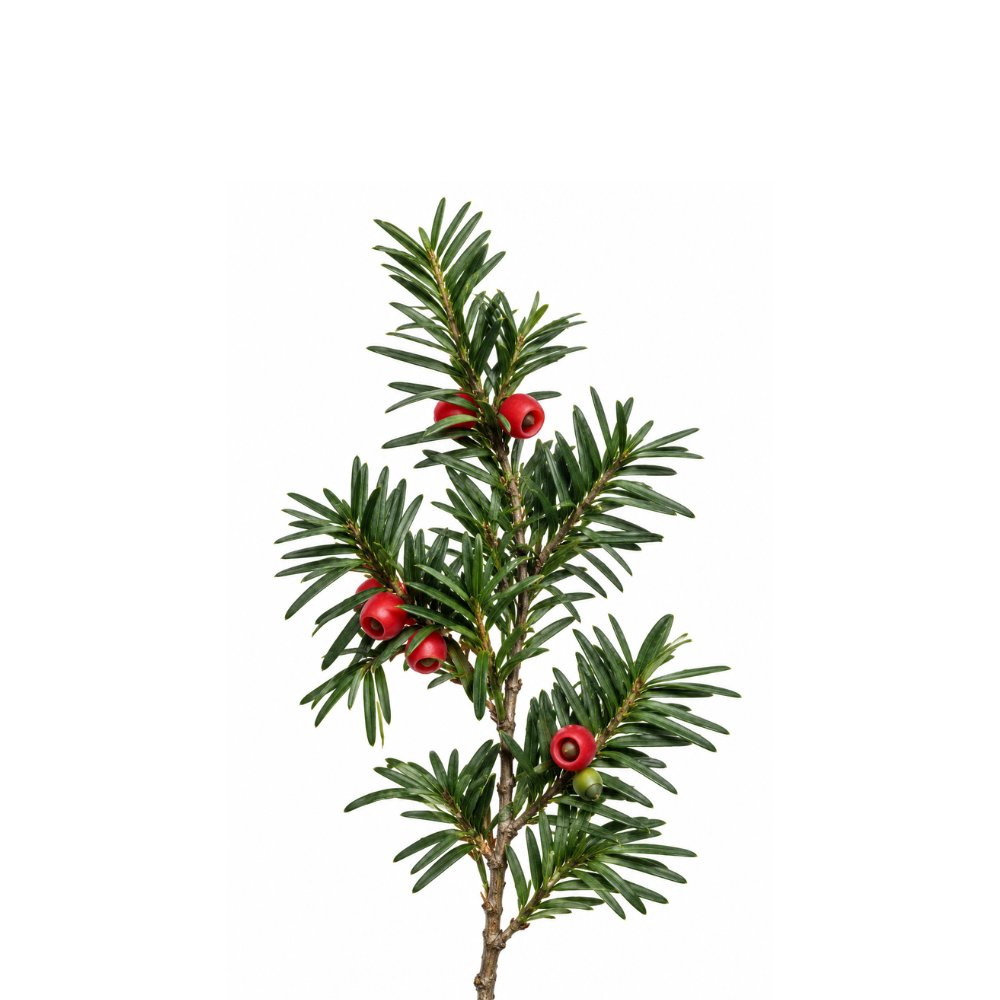
Pacific yew is a slow-growing evergreen tree of the Pacific Northwest understorey, with flat dark needles and, on female trees, single seeds held in bright red fleshy cups called arils 16,
It grows in the shade of larger conifers from southeast Alaska to central California and inland to the northern Rocky Mountains 17Reference 17Taxus brevifolia, Pacific yewView study →. Its hard, elastic wood was prized for bows and tools by the peoples of the Northwest Coast 17Reference 17Taxus brevifolia, Pacific yewView study →.
Yews contain taxine alkaloids, which are cardiotoxic and give the genus its reputation as a poison 1Reference 1ReviewTaxines: a review of the mechanism and toxicity of yew (Taxus spp.) alkaloids — reviewView study →. Pacific yew bark is also where paclitaxel was first found, a molecule that stabilises microtubules and became a major chemotherapy drug 3,
The yews most often behind human poisonings are the ornamental English and Japanese yews, which are planted widely in gardens and hedges 16Reference 16Taxus brevifolia Nuttall, and genus TaxusView study →.
Identification & Lookalikes
Yew is not usually mistaken for an edible plant. The usual exposure is a child eating the conspicuous red arils.
In yews, the foliage, bark and seeds are toxic, but the fleshy red aril is not 8,
| Part | Status |
|---|---|
| Aril flesh (the red fleshy cup) | Non-toxic |
| Seed inside the aril | Toxic |
| Needles | Toxic — with bark and stems the main hazardous parts |
| Bark and stems | Toxic |
A swallowed aril whose seed passes intact is therefore a very different event from a chewed seed.
Recognising the tree. Pacific yew has flat needles that usually look two-ranked along the twig. They are shiny yellow-green above and paler beneath, and soft-pointed rather than sharp to the touch 16Reference 16Taxus brevifolia Nuttall, and genus TaxusView study →. The bark is thin and scaly, with purplish outer scales over reddish inner ones 16Reference 16Taxus brevifolia Nuttall, and genus TaxusView study →. The tree bears no seed cones; each seed sits in a red aril instead 16Reference 16Taxus brevifolia Nuttall, and genus TaxusView study →.
Botany
Pacific yew (Taxus brevifolia Nutt.) is a conifer in the Taxaceae. Male and female cones grow on separate plants 16Reference 16Taxus brevifolia Nuttall, and genus TaxusView study →.
It is a shrub or small tree, commonly 6–12 m tall at maturity 17Reference 17Taxus brevifolia, Pacific yewView study →. The Flora of North America gives a maximum of 15 m, occasionally 25 m, with a trunk up to 60 cm across, occasionally 120 cm 16Reference 16Taxus brevifolia Nuttall, and genus TaxusView study →. The trunk may be straight or contorted, and is often fluted 16Reference 16Taxus brevifolia Nuttall, and genus TaxusView study →.
The bark is scaly. Its outer scales are purplish to purplish brown, and the inner scales are reddish to reddish purple 16Reference 16Taxus brevifolia Nuttall, and genus TaxusView study →.
The needles are 1–2.9 cm long and usually slightly curved. They are shiny yellow-green above and pale green beneath, with two broad pale bands of pores on the underside 16Reference 16Taxus brevifolia Nuttall, and genus TaxusView study →.
The seed is ovoid, 5–6.5 mm long, and ripens from late summer into autumn 16Reference 16Taxus brevifolia Nuttall, and genus TaxusView study →. It sits in a soft, scarlet, cup-shaped aril that is open at the tip and leaves the hard seed coat exposed 16Reference 16Taxus brevifolia Nuttall, and genus TaxusView study →.
Pacific yew grows very slowly. It is the most shade-tolerant tree in the Pacific Northwest 17Reference 17Taxus brevifolia, Pacific yewView study →.
Distribution
Pacific yew grows along the Pacific Coast from southeastern Alaska through western British Columbia to central California 17Reference 17Taxus brevifolia, Pacific yewView study →. Inland, it grows from southeastern British Columbia through northwestern Montana and northern Idaho into eastern Washington and Oregon, and it reaches Alberta 16,
It grows in cool, moist, shaded places: open to dense forest, streamsides, moist flats, slopes, deep ravines and coves, from sea level to 2,200 m 16Reference 16Taxus brevifolia Nuttall, and genus TaxusView study →. It is commonly found beneath western hemlock, Douglas-fir and Pacific silver fir 17Reference 17Taxus brevifolia, Pacific yewView study →.
It is usually a scattered understorey tree. In parts of northern Idaho it forms dense, shrubby stands, which dominate about 16,000 ha of the South Fork of the Clearwater drainage 17Reference 17Taxus brevifolia, Pacific yewView study →.
The IUCN assesses Pacific yew as Near Threatened 18Reference 18Taxus brevifoliaView study →. Its population is estimated to have fallen by 10–30% over the last three generations, and a generation is likely to exceed 30 years 18Reference 18Taxus brevifoliaView study →. The decline came from logging and from bark harvesting for paclitaxel production in the 1980s and 1990s 18Reference 18Taxus brevifoliaView study →.
Pacific yew recovers slowly after disturbance. Broadcast burning after clearcutting has virtually eliminated it in some areas, and after one hot slash burn in northern Idaho, seedlings did not appear for at least six years 17Reference 17Taxus brevifolia, Pacific yewView study →. Large trees are also poached for their wood, and in some areas the species has been nearly extirpated 16Reference 16Taxus brevifolia Nuttall, and genus TaxusView study →.
Since the development of other sources of paclitaxel, the rate of decline has slowed 18Reference 18Taxus brevifoliaView study →. The drug is now made from needles of cultivated yews and from cell cultures, rather than from wild bark 15Reference 15ReviewDrugs that changed society: microtubule-targeting agents belonging to taxanoids, macrolides and non-ribosomal peptides — reviewView study →. There is no herbal product to source.
Phytochemistry
Yews carry two separate groups of compounds.
The taxine alkaloids are the poison. They are diterpenoid pseudoalkaloids built on a 6/8/6 tricyclic taxane skeleton. The two principal members are taxine A and taxine B. In English yew, taxine B makes up about 30% of the alkaloid fraction and is the more cardiotoxic; taxine A makes up about 1.8% 14Reference 14Case reportTaxus baccata intoxication: the sun after the electrical storm — case reportView study →.
An early analysis did not find taxine in Pacific yew, and poisoning by Pacific yew has not been conclusively recorded 16Reference 16Taxus brevifolia Nuttall, and genus TaxusView study →. The English and Japanese yews are the best documented for toxicity 16Reference 16Taxus brevifolia Nuttall, and genus TaxusView study →.
Paclitaxel is a taxane diterpenoid found in the bark in small amounts 15Reference 15ReviewDrugs that changed society: microtubule-targeting agents belonging to taxanoids, macrolides and non-ribosomal peptides — reviewView study →. It works in an entirely different way, by stabilising microtubules and stopping cell division 4,
Constituent Summary
Taxine figures are from English yew.
Diterpenoid Alkaloid2 compounds2 with data
Diterpene1 compound1 with data
Toxicology
Class of poison. Diterpenoid pseudoalkaloid; a blocker of sodium and calcium channels in the heart.
Mechanism. Taxine blocks both the sodium current and the calcium current in heart muscle cells. In isolated guinea-pig heart cells, taxine from English yew reduced both currents in a dose-dependent way. At the highest concentration, the index of sodium current fell to about 9% of control 12Reference 12In vitroElectrophysiology of the mechanisms of action of the yew toxin, taxine, on the heart — in vitro electrophysiology (isolated guinea-pig ventricular myocytes)View study →. Clinically this appears as widening QRS, bradycardia or wide-complex tachycardia, hypotension, cardiogenic shock and arrest.
Course. Early symptoms are nausea, vomiting, dizziness and abdominal pain, sometimes with seizure 1,
The early signs are mild and easily dismissed. Cardiac deterioration can then be abrupt and refractory 1Reference 1ReviewTaxines: a review of the mechanism and toxicity of yew (Taxus spp.) alkaloids — reviewView study →.
How often serious harm happens. US poison centres recorded 11,197 Taxus exposures between 1985 and 1994, and 96.4% involved children under 12 2Reference 2Case reportIs the yew really poisonous to you? — poison-centre case seriesView study →. Of the 7,269 with a recorded outcome, 92.5% had no effect and 7.0% had minor effects. Thirty had moderate effects, four had major effects, and none died 2Reference 2Case reportIs the yew really poisonous to you? — poison-centre case seriesView study →.
Serious and fatal cases in the medical literature are mostly intentional ingestions of leaves and branches of ornamental yew 8,
Lethal dose. The lethal oral dose of yew leaves has been estimated at 0.6–1.3 g per kg of body weight 1,
Antidote — none proven. There is no validated antidote, and supportive care is the mainstay 8Reference 8Case reportCardiogenic shock due to yew poisoning rescued by VA-ECMO — case report and literature review. https://pubmed.ncbi.nlm.nih.gov/35942511/View study →. Case reports describe sodium bicarbonate, digoxin-specific antibody fragments, lipid emulsion and albumin dialysis 8Reference 8Case reportCardiogenic shock due to yew poisoning rescued by VA-ECMO — case report and literature review. https://pubmed.ncbi.nlm.nih.gov/35942511/View study →. Atropine works poorly against the bradycardia 19Reference 19ReviewNatural taxanes: from plant composition to human pharmacology and toxicity — reviewView study →. Defibrillation and overdrive pacing have repeatedly failed against taxine arrhythmias 8Reference 8Case reportCardiogenic shock due to yew poisoning rescued by VA-ECMO — case report and literature review. https://pubmed.ncbi.nlm.nih.gov/35942511/View study →. Haemodialysis is unlikely to remove the taxines, because they are large, widely distributed and bound to protein 19Reference 19ReviewNatural taxanes: from plant composition to human pharmacology and toxicity — reviewView study →.
Circulatory support. Veno-arterial extracorporeal membrane oxygenation (VA-ECMO) has rescued patients in yew-induced cardiogenic shock. It supports the circulation until the toxin clears. A 39-year-old man made a full neurological recovery this way, and the authors counted several similar published cases 8Reference 8Case reportCardiogenic shock due to yew poisoning rescued by VA-ECMO — case report and literature review. https://pubmed.ncbi.nlm.nih.gov/35942511/View study →.
Traditional & Historical Use
Native American Medicine and Technology
Pacific yew wood is fine-grained, heavy, hard and very strong 17Reference 17Taxus brevifolia, Pacific yewView study →. Native Americans made harpoons, spear handles, eating utensils, wedges, paddles, and clubs used in battle and for hunting seals from it 17Reference 17Taxus brevifolia, Pacific yewView study →.
It was renowned for bows. The Salish called it “bow plant”, and its bows tended to be broad, short and flat 17Reference 17Taxus brevifolia, Pacific yewView study →.
Tonics made from Pacific yew were used medicinally by many peoples of the Pacific Northwest 17Reference 17Taxus brevifolia, Pacific yewView study →. The fleshy arils were sometimes eaten, although the seeds are poisonous 17Reference 17Taxus brevifolia, Pacific yewView study →.
European History: English Yew
English yew (Taxus baccata) has been known as a poison since antiquity 8Reference 8Case reportCardiogenic shock due to yew poisoning rescued by VA-ECMO — case report and literature review. https://pubmed.ncbi.nlm.nih.gov/35942511/View study →. Julius Caesar records that Catuvolcus, king of half of the Eburones, too old to endure war or flight, killed himself with the juice of the yew tree, “of which there is a great abundance in Gaul and Germany” 20Reference 20Perseus Digital Library. https://www.perseus.tufts.edu/hopper/text?doc=Perseus:text:1999.02.0001:book=6:chapter=31View study →.
The Drugs Derived From It
⚠⚠ Everything in this section is about intravenous cytotoxic chemotherapy, and none of it transfers to the plant. No preparation of yew delivers paclitaxel without taxine.
The discovery. Paclitaxel was found during a National Cancer Institute screening programme in the 1960s 15Reference 15ReviewDrugs that changed society: microtubule-targeting agents belonging to taxanoids, macrolides and non-ribosomal peptides — reviewView study →. Wani, Taylor, Wall, Coggon and McPhail reported the isolation and structure of taxol from Pacific yew in 1971 3Reference 3Plant antitumor agents VI: the isolation and structure of taxol, a novel antileukaemic and antitumour agent from Taxus brevifoliaView study →.
The mechanism. Earlier antimitotics, such as the vinca alkaloids and colchicine, work by blocking microtubule assembly. Paclitaxel does the opposite: it promotes microtubule assembly and stabilises microtubules against breakdown, which stops cell division. This was first shown in a cell-free assembly assay in 1979 4Reference 4In vitroPromotion of microtubule assembly in vitro by taxol — in vitroView study →, and then in intact mouse fibroblasts in 1980 5Reference 5In vitroTaxol stabilizes microtubules in mouse fibroblast cells — in vitroView study →.
The clinical record belongs to the molecule. In the Gynecologic Oncology Group’s GOG-111 randomised trial (n = 410), cisplatin plus paclitaxel was compared with cisplatin plus cyclophosphamide in advanced ovarian cancer. Response was 73% against 60%, median progression-free survival 18 months against 13, and median overall survival 38 months against 24 (P<0.001) 6Reference 6RCTCyclophosphamide and cisplatin compared with paclitaxel and cisplatin in patients with stage III and stage IV ovarian cancer (GOG-111) — randomised controlled trialView study →.
The larger ICON3 trial (n = 2,074) compared paclitaxel plus carboplatin with carboplatin alone or a cyclophosphamide–doxorubicin–cisplatin regimen. It found no difference in overall survival: hazard ratio 0.98 (95% CI 0.87–1.10), P = 0.74 7Reference 7RCTPaclitaxel plus carboplatin versus standard chemotherapy in women with ovarian cancer — randomised controlled trialView study →. The two trials used different comparators.
Paclitaxel and its semisynthetic relative docetaxel are now used against several cancers 15Reference 15ReviewDrugs that changed society: microtubule-targeting agents belonging to taxanoids, macrolides and non-ribosomal peptides — reviewView study →.
Immune activity. In mouse macrophages, paclitaxel mimics bacterial lipopolysaccharide, activating TLR4 and MyD88 signalling and the release of inflammatory signals 9Reference 9In vitroThe role of MyD88 and TLR4 in the LPS-mimetic activity of Taxol — in vitro and mouse macrophageView study →. This effect is unrelated to its action on cell division.
The supply problem. Paclitaxel occurs only in small amounts in the bark, and about 1 g could be isolated from the bark of three trees 15Reference 15ReviewDrugs that changed society: microtubule-targeting agents belonging to taxanoids, macrolides and non-ribosomal peptides — reviewView study →. Harvesting the bark kills the tree. Supply was secured by semisynthesis from 10-deacetylbaccatin III, which is extracted from yew needles that the tree regrows 10,
An endophytic fungus. Taxomyces andreanae, a fungus isolated from the inner bark of Pacific yew, produced taxol and related compounds in culture 11Reference 11In vitroTaxol and taxane production by Taxomyces andreanae, an endophytic fungus of Pacific yew — in vitroView study →. It did not become a production route.
Safety & Pregnancy
- Yew foliage, bark and seeds are toxic. The red aril flesh is not, but the seed inside it is 8,
16Reference 8Case reportCardiogenic shock due to yew poisoning rescued by VA-ECMO — case report and literature review. https://pubmed.ncbi.nlm.nih.gov/35942511/View study →Reference 16Taxus brevifolia Nuttall, and genus TaxusView study → . - Serious poisoning is abrupt and largely resistant to treatment. No antidote is proven 1,
8Reference 1ReviewTaxines: a review of the mechanism and toxicity of yew (Taxus spp.) alkaloids — reviewView study →Reference 8Case reportCardiogenic shock due to yew poisoning rescued by VA-ECMO — case report and literature review. https://pubmed.ncbi.nlm.nih.gov/35942511/View study → . - The early symptoms are mild — nausea and dizziness — and cardiac collapse can follow suddenly.
- 11,197 exposures, no deaths in a decade of US poison-centre data; 92.5% of those with a recorded outcome had no effect 2Reference 2Case reportIs the yew really poisonous to you? — poison-centre case seriesView study →.
- Fatal cases are mostly intentional, using ornamental yew 8Reference 8Case reportCardiogenic shock due to yew poisoning rescued by VA-ECMO — case report and literature review. https://pubmed.ncbi.nlm.nih.gov/35942511/View study →.
- There is no herbal preparation. Paclitaxel is intravenous chemotherapy.
Full Safety Detail
Why most exposures are harmless. Almost all exposures involve young children 2Reference 2Case reportIs the yew really poisonous to you? — poison-centre case seriesView study →. The aril flesh is not toxic 8,
A child who has swallowed an aril. Whether the seed was chewed is the detail that matters. In the US series, gut decontamination made no difference to the outcome 2Reference 2Case reportIs the yew really poisonous to you? — poison-centre case seriesView study →.
Why treatment fails. Blocking both sodium and calcium channels leaves the heart slow to conduct and weak to contract. The usual rescue drugs act on one problem or the other, not both 8,
Avoid entirely. The plant is cardiotoxic and has no safe dose. Paclitaxel in pregnancy is a specialist cancer-care decision and says nothing about the plant.
References
- Wilson CR, Sauer J, Hooser SB. (2001). Taxines: a review of the mechanism and toxicity of yew (Taxus spp.) alkaloids — review. Toxicon. https://pubmed.ncbi.nlm.nih.gov/10978734/
- Krenzelok EP, Jacobsen TD, Aronis J. (1998). Is the yew really poisonous to you? — poison-centre case series. Journal of Toxicology: Clinical Toxicology. https://pubmed.ncbi.nlm.nih.gov/9656977/
- Wani MC, Taylor HL, Wall ME, Coggon P, McPhail AT. (1971). Plant antitumor agents VI: the isolation and structure of taxol, a novel antileukaemic and antitumour agent from Taxus brevifolia. Journal of the American Chemical Society. https://pubmed.ncbi.nlm.nih.gov/5553076/
- Schiff PB, Fant J, Horwitz SB. (1979). Promotion of microtubule assembly in vitro by taxol — in vitro. Nature. https://pubmed.ncbi.nlm.nih.gov/423966/
- Schiff PB, Horwitz SB. (1980). Taxol stabilizes microtubules in mouse fibroblast cells — in vitro. Proceedings of the National Academy of Sciences USA. https://doi.org/10.1073/pnas.77.3.1561
- McGuire WP, Hoskins WJ, Brady MF, et al. (1996). Cyclophosphamide and cisplatin compared with paclitaxel and cisplatin in patients with stage III and stage IV ovarian cancer (GOG-111) — randomised controlled trial. New England Journal of Medicine. https://pubmed.ncbi.nlm.nih.gov/7494563/
- International Collaborative Ovarian Neoplasm (ICON3) Group. (2002). Paclitaxel plus carboplatin versus standard chemotherapy in women with ovarian cancer — randomised controlled trial. The Lancet. https://pubmed.ncbi.nlm.nih.gov/12241653/
- Schreiber N, Manninger M, Pätzold S, et al. (2022). Cardiogenic shock due to yew poisoning rescued by VA-ECMO — case report and literature review. https://pubmed.ncbi.nlm.nih.gov/35942511/
- Byrd-Leifer CA, Block EF, Takeda K, Akira S, Ding A. (2001). The role of MyD88 and TLR4 in the LPS-mimetic activity of Taxol — in vitro and mouse macrophage. European Journal of Immunology. https://pubmed.ncbi.nlm.nih.gov/11500829/
- Kou P, Yu Y, Wang H, Zhang Y, Jin Z, Yu F. (2024). An integrated strategy based on 10-DAB extraction and in-situ whole-cell biotransformation of renewable Taxus needles to produce baccatin III — bioprocess. Molecules. https://doi.org/10.3390/molecules29112586
- Stierle A, Strobel G, Stierle D. (1993). Taxol and taxane production by Taxomyces andreanae, an endophytic fungus of Pacific yew — in vitro. Science. https://pubmed.ncbi.nlm.nih.gov/8097061/
- Tekol Y, Kameyama M. (1987). Electrophysiology of the mechanisms of action of the yew toxin, taxine, on the heart — in vitro electrophysiology (isolated guinea-pig ventricular myocytes). Arzneimittelforschung. https://pubmed.ncbi.nlm.nih.gov/2440454/
- Turner NJ. (1998). Plant Technology of First Peoples in British Columbia. UBC Press — ethnobotanical reference.
- Pinto A, Lemos T, Silveira I, Aragão I. (2021). Taxus baccata intoxication: the sun after the electrical storm — case report. Revista Brasileira de Terapia Intensiva. https://pubmed.ncbi.nlm.nih.gov/33886867/
- Christensen SB. (2022). Drugs that changed society: microtubule-targeting agents belonging to taxanoids, macrolides and non-ribosomal peptides — review. Molecules. https://doi.org/10.3390/molecules27175648
- Hils MH. (1993). Taxus brevifolia Nuttall, and genus Taxus. In: Flora of North America Editorial Committee, eds. Flora of North America North of Mexico, Vol. 2. http://www.efloras.org/florataxon.aspx?flora_id=1&taxon_id=233501253 and http://www.efloras.org/florataxon.aspx?flora_id=1&taxon_id=132355
- Tirmenstein DA. (1990). Taxus brevifolia, Pacific yew. In: Fire Effects Information System. USDA Forest Service, Rocky Mountain Research Station. https://research.fs.usda.gov/feis/species-reviews/taxbre
- Thomas P. Taxus brevifolia. Threatened Conifers of the World. Royal Botanic Garden Edinburgh (summarising the IUCN Red List assessment, 2013: e.T34041A2841142). https://threatenedconifers.rbge.org.uk/conifers/taxus-brevifolia
- Nižnanský Ľ, Osinová D, Kuruc R, et al. (2022). Natural taxanes: from plant composition to human pharmacology and toxicity — review. International Journal of Molecular Sciences. https://pubmed.ncbi.nlm.nih.gov/36555256/
- Caesar GJ. Commentarii de Bello Gallico, Book 6, chapter 31. Trans. McDevitte WA, Bohn WS (1869). Perseus Digital Library. https://www.perseus.tufts.edu/hopper/text?doc=Perseus:text:1999.02.0001:book=6:chapter=31



