
San Pedro
Echinopsis pachanoi
Plant Family
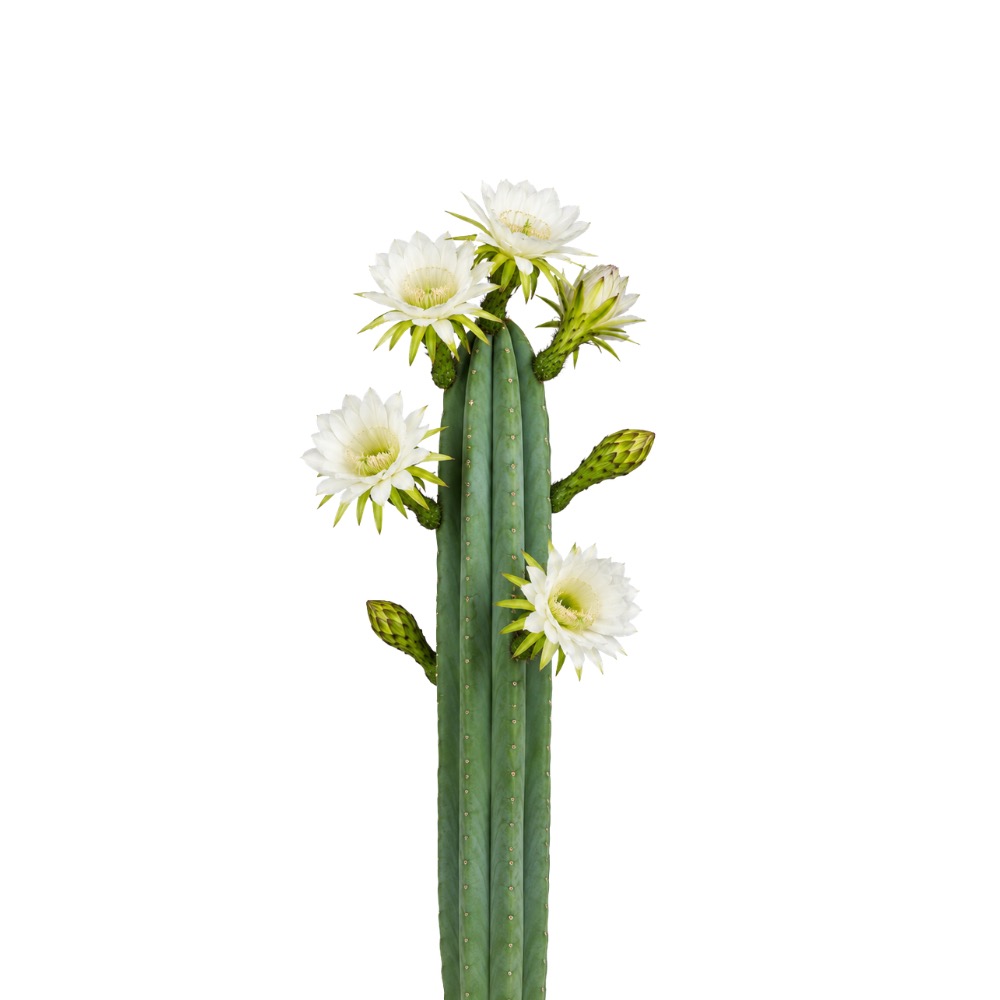
Pictured: San Pedro
Cactus family
New World stem succulents defined by the areole, and the botanical home of the mescaline-bearing ceremonial cacti of the Americas.
1 Herb // 5 Constituents // 6 Notable Members
Overview
Around 130 genera and 1,750 species, almost entirely restricted to the Americas. The family’s defining structure is the areole — a cushion-like bud from which spines, flowers and branches all arise; no other plant group has it, and its presence distinguishes a true cactus from the many unrelated succulents that resemble one. Nearly all cacti are stem succulents with leaves reduced to spines, using CAM photosynthesis to open their stomata at night and lose almost no water.
Shared Traits
In Practice
The family’s significance to this database is psychoactive and ceremonial rather than pharmacological in the ordinary sense.
San Pedro (Echinopsis pachanoi, formerly Trichocereus) is a tall columnar cactus of the Andes with an archaeological record of ceremonial use stretching back some three thousand years — depictions at Chavín de Huántar make it one of the oldest documented plant sacraments anywhere. Its active constituent is mescaline, a phenethylamine psychedelic acting as a partial agonist at the 5-HT2A receptor, the same primary target as psilocybin and LSD despite belonging to a different chemical class.
Mescaline’s pharmacology is distinguished mainly by scale and duration: active doses are in the hundreds of milligrams — far higher than the tryptamine psychedelics — and effects run 10 to 14 hours. Peyote (Lophophora williamsii), the family’s other great sacrament, is used by the Native American Church and is now conservation-listed after over-harvesting; San Pedro grows far faster and is under no comparable pressure.
Elsewhere the family is nutritional: prickly pear (Opuntia) pads and fruit are eaten widely, with a mucilage and betalain content that has attracted interest for glycaemic and antioxidant effects, on thin clinical evidence.
Safety concerns are primarily psychological and legal — mescaline is a controlled substance in most jurisdictions. Physiologically, nausea and vomiting are near-universal early effects, and the sympathomimetic load warrants caution in cardiovascular disease.
Materia Medica
The monograph in the database whose Cactaceae membership is recorded on the herb itself — so this list keeps itself current as new herbs land.
Echinopsis pachanoi
Phytochemistry
Phenethylamine alkaloids — mescaline, hordenine, tyramine, 3,4-dimethoxyphenethylamine — are the family’s pharmacological signature, concentrated in the columnar and globular ceremonial species. More broadly: betalain pigments in place of anthocyanins, mucilage polysaccharides, and triterpene saponins.
The compounds recorded for this family's single member, grouped by class.
Beyond the Database
Notable members without a monograph yet.
Keep Exploring