
Materia Medica
San Pedro
Echinopsis pachanoi
San Pedro is a fast-growing columnar cactus of the Andes whose stem contains the psychedelic alkaloid mescaline. As huachuma, it has been taken for thousands of years in Andean healing ceremonies.
What Is San Pedro?
San Pedro is a tall, fast-growing columnar cactus of the Andes, and the sacred plant huachuma of Andean healing ceremonies. Its stem contains mescaline, the psychedelic alkaloid also found in peyote.
Echinopsis pachanoi is native to the dry mountain shrublands of Peru and southern Ecuador, at 2,000–3,200 m 16Reference 16Trichocereus macrogonus pachanoi (San Pedro cactus) — species profile (range, habitat, uses and IUCN status)View study →. It grows into a many-stemmed, tree-like cactus 3–6 m tall 16,
Two controlled trials in healthy volunteers have measured the effects of pure mescaline, and surveys of people who have taken it report improvements in mood, anxiety and substance use 2,
San Pedro is often confused with its close relative the Peruvian torch cactus (Trichocereus peruvianus) 17Reference 17Cereus pachanoi (Echinopsis pachanoi) — species description. https://llifle.com/Encyclopedia/CACTI/Family/Cactaceae/8472/Cereus_pachanoiView study →.
How Is San Pedro Used?
- Stem decoction — the ceremonial preparation. The green stem is sliced and boiled for hours into a bitter drink.
- Chopped young stems — sold in markets in Ecuador, northern Peru and Bolivia 17Reference 17Cereus pachanoi (Echinopsis pachanoi) — species description. https://llifle.com/Encyclopedia/CACTI/Family/Cactaceae/8472/Cereus_pachanoiView study →.
- Stem-tip poultice and flower infusion — minor folk remedies in Bolivia and Ecuador 16Reference 16Trichocereus macrogonus pachanoi (San Pedro cactus) — species profile (range, habitat, uses and IUCN status)View study →.
- Living plant — grown as an ornamental, a hedge and a living fence 16,
17Reference 16Trichocereus macrogonus pachanoi (San Pedro cactus) — species profile (range, habitat, uses and IUCN status)View study →Reference 17Cereus pachanoi (Echinopsis pachanoi) — species description. https://llifle.com/Encyclopedia/CACTI/Family/Cactaceae/8472/Cereus_pachanoiView study → .
Traditional Uses
Andean Ceremonial Healing
San Pedro is the huachuma or wachuma of the Andes. Mescaline-containing cacti have been used in Peru, Mexico and the United States for more than 6,000 years 8Reference 8ReviewDark Classics in Chemical Neuroscience: Mescaline — reviewView study →, and archaeological evidence for San Pedro’s own ritual use in Peru dates to at least 1500 BC 16Reference 16Trichocereus macrogonus pachanoi (San Pedro cactus) — species profile (range, habitat, uses and IUCN status)View study →.
In the classic ceremony a curandero leads a night-long healing rite. The stem is boiled for hours into a bitter decoction, and the cactus is placed on the mesa, the healer’s altar. The rites treat enchantment and bad luck 16Reference 16Trichocereus macrogonus pachanoi (San Pedro cactus) — species profile (range, habitat, uses and IUCN status)View study →.
Healers recognise several kinds of San Pedro by the number of ribs. Seven-ribbed plants are the most common. Four-ribbed plants are rare and held to have special power, each rib standing for one of the “four winds” of the cardinal directions 16,
Spanish chroniclers of the 16th century called these cacti “diabolic”, and their use was prohibited, but it continued to the present day 8Reference 8ReviewDark Classics in Chemical Neuroscience: Mescaline — reviewView study →.
Andean Folk Medicine
In La Paz and El Alto in Bolivia, a poultice of the mashed and heated stem tips is used for mumps, wounds and acne. In Ecuador an infusion of the flowers is taken for nervous conditions 16Reference 16Trichocereus macrogonus pachanoi (San Pedro cactus) — species profile (range, habitat, uses and IUCN status)View study →.
Indications
- Ceremonial and spiritual healing [stem decoction; Andean curanderismo]
- Mumps, wounds and acne [heated stem-tip poultice; Bolivian folk use]
- Nervous conditions [flower infusion; Ecuadorian folk use]
- Low mood, anxiety and problem substance use [cactus or mescaline; contemporary use] Caution: The human evidence is self-report from surveys of people who took mescaline. No controlled trial in patients exists 6,
7 .
Botany
San Pedro is a large, many-stemmed columnar cactus in the cactus family (Cactaceae). It forms a small tree 3–6 m tall, with upright, flexible branches that rise mostly from the base 16,
The stems are 6–15 cm thick. They are pale green to blue-green and slightly waxy when young, turning dark green with age 16,
The spines are highly variable and often absent. When present there are three to seven, dark yellow to light brown, the longest 1–2 cm 17Reference 17Cereus pachanoi (Echinopsis pachanoi) — species description. https://llifle.com/Encyclopedia/CACTI/Family/Cactaceae/8472/Cereus_pachanoiView study →.
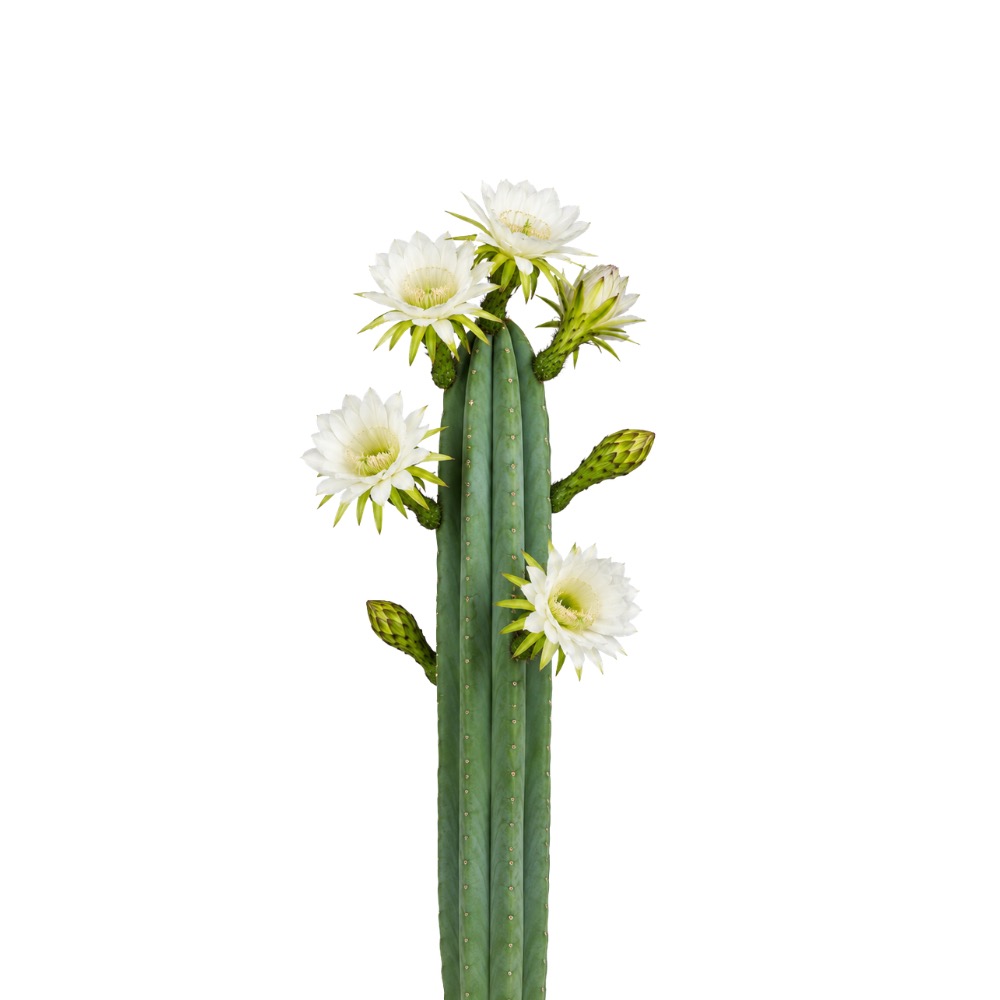
The flowers are very large, white and fragrant, up to 22 cm across. They open at night and stay open through the following day. Their outer segments are brick red. The buds form in the areoles near the tips of the branches, and the flower tube and fruit are covered in scales and black, curled hairs 17Reference 17Cereus pachanoi (Echinopsis pachanoi) — species description. https://llifle.com/Encyclopedia/CACTI/Family/Cactaceae/8472/Cereus_pachanoiView study →. The fruit is oblong and dark green, 5–6 cm long 17Reference 17Cereus pachanoi (Echinopsis pachanoi) — species description. https://llifle.com/Encyclopedia/CACTI/Family/Cactaceae/8472/Cereus_pachanoiView study →.
Botanists who divide the broad genus Echinopsis place San Pedro in Trichocereus, as Trichocereus macrogonus var. pachanoi 16Reference 16Trichocereus macrogonus pachanoi (San Pedro cactus) — species profile (range, habitat, uses and IUCN status)View study →.
Distribution
San Pedro grows wild in the Andes from Peru to southern Ecuador, in dry shrublands at 2,000–3,200 m 16Reference 16Trichocereus macrogonus pachanoi (San Pedro cactus) — species profile (range, habitat, uses and IUCN status)View study →.
It is widely grown as an ornamental and in rituals, and is planted around houses in Peru and as hedges in tropical gardens worldwide 16,
Sourcing: San Pedro is widely cultivated and easy to grow from cuttings. The IUCN assessed it in 2017 as Least Concern, with a wide range and a stable population. Its use as an ornamental and in rituals is not considered a threat, because the plant is also cultivated for both 16Reference 16Trichocereus macrogonus pachanoi (San Pedro cactus) — species profile (range, habitat, uses and IUCN status)View study →.
Growing Conditions
Cultivation snapshot for San Pedro
- Full sun for the best form and color.
- Because it is a montane rather than desert cactus, it tolerates and even enjoys more water than most cacti during active growth — but still needs fertile, sharply free-draining soil (amended with pumice or perlite) to avoid rot.
- One of the fastest-growing columnar cacti, often adding around 30 cm a year.
- Very easy from stem cuttings (which clone the parent) as well as seed, and hardier than most cacti — tolerating brief lows near −9 °C (roughly USDA zones 8b–10).
Grow it yourself
Farm Wiki is our cultivation-focused sister site, also run by Justin Cooke.
Pharmacology & Research
San Pedro is studied through its main alkaloid, mescaline (3,4,5-trimethoxyphenethylamine), a classic serotonergic psychedelic 5,
Since 2020 a research group in Basel has run two randomised, placebo-controlled trials of mescaline in healthy volunteers. They measured its dose-dependent effects, its pharmacokinetics and its action at the 5-HT2A receptor 2,
The therapeutic signals for anxiety, depression and addiction come from animal studies, surveys of people who took mescaline, and a 2026 systematic review of reports 5,
-
Best-supported: mescaline produces dose-dependent psychedelic effects in humans. The 5-HT2A blocker ketanserin reduced and shortened them, pointing to the 5-HT2A receptor 2,
3Reference 2RCTAcute dose-dependent effects of mescaline in a double-blind, placebo-controlled, randomised study in healthy subjectsView study →Reference 3RCTComparative acute effects of mescaline, LSD, and psilocybin in a randomised, double-blind, placebo-controlled cross-over study in healthy participantsView study → . Its pharmacokinetics and effects on blood pressure and heart rate are now well characterised 4Reference 4Pharmacokinetics, pharmacodynamics and urinary recovery of oral mescaline hydrochloride in healthy participants — phase I pharmacokinetic analysisView study →. -
Emerging, worth watching: self-reported improvements in anxiety, depression and problem substance use among people taking mescaline outside a clinic, and anxiolytic-like effects in animals 5,
6, .7Reference 5ReviewMescaline: the forgotten psychedelic — reviewView study →Reference 6ObservationalNaturalistic use of mescaline is associated with self-reported psychiatric improvements and enduring positive life changes — observational cross-sectional surveyView study →Reference 7Systematic reviewThe ethnopharmacological use of mescaline for psychiatric disorders: a systematic reviewView study → -
Mechanistically thin: the anti-addiction and trauma signals rest on surveys and population data, not controlled trials 6,
10, .11Reference 6ObservationalNaturalistic use of mescaline is associated with self-reported psychiatric improvements and enduring positive life changes — observational cross-sectional surveyView study →Reference 10ObservationalThe association between naturalistic use of psychedelics and co-occurring substance use disorders — observational (cross-sectional) studyView study →Reference 11ObservationalAssociations between psychedelic use and cannabis use disorder in a nationally representative sample — observational studyView study → -
The caveat: every controlled result used synthetic mescaline at a fixed dose; the cactus delivers a variable amount and no standardised preparation exists 1,
4Reference 1New mescaline concentrations from 14 taxa/cultivars of Echinopsis spp. (Cactaceae) (“San Pedro”) and their relevance to shamanic practice — analytical (HPLC) studyView study →Reference 4Pharmacokinetics, pharmacodynamics and urinary recovery of oral mescaline hydrochloride in healthy participants — phase I pharmacokinetic analysisView study → .
The trials used pure mescaline, not the cactus. Every human study gave measured doses of synthetic mescaline hydrochloride, while San Pedro is taken as a whole-stem decoction whose mescaline content varies widely from plant to plant 1Reference 1New mescaline concentrations from 14 taxa/cultivars of Echinopsis spp. (Cactaceae) (“San Pedro”) and their relevance to shamanic practice — analytical (HPLC) studyView study →.
1. Psychedelic / 5-HT2A Activity
This is the only property of mescaline established under controlled conditions.
In a double-blind, placebo-controlled crossover study, 16 healthy volunteers took 100, 200, 400 and 800 mg of mescaline. Doses above 100 mg produced dose-dependent psychedelic effects. The effects lasted from 6.4 hours at 100 mg to 14 hours at 800 mg. Blood pressure rose at doses above 100 mg, and heart rate rose with dose 2Reference 2RCTAcute dose-dependent effects of mescaline in a double-blind, placebo-controlled, randomised study in healthy subjectsView study →.
Giving the 5-HT2A blocker ketanserin with 800 mg of mescaline reduced and shortened the effects to the level of the 100–200 mg doses. This points to the 5-HT2A receptor as the main site of action 2Reference 2RCTAcute dose-dependent effects of mescaline in a double-blind, placebo-controlled, randomised study in healthy subjectsView study →. Mescaline also acts at 5-HT2C, α-adrenergic and dopamine receptors 5Reference 5ReviewMescaline: the forgotten psychedelic — reviewView study →.
A crossover trial in 32 healthy volunteers compared 300 or 500 mg of mescaline with LSD and psilocybin. At equally strong doses the experiences were alike. Mescaline lasted longest, 11.1 hours on average, against 8.2 hours for LSD and 4.9 hours for psilocybin 3Reference 3RCTComparative acute effects of mescaline, LSD, and psilocybin in a randomised, double-blind, placebo-controlled cross-over study in healthy participantsView study →.
Pooled modelling of 105 doses in 49 people showed that exposure rose in step with dose, with a peak at about 2 hours and a half-life of 3.5 hours. About half of each dose (53%) left the body unchanged in the urine 4Reference 4Pharmacokinetics, pharmacodynamics and urinary recovery of oral mescaline hydrochloride in healthy participants — phase I pharmacokinetic analysisView study →.
Gap: all of this used synthetic mescaline hydrochloride at measured doses — no controlled study has dosed the San Pedro decoction itself, whose alkaloid content is uncontrolled 1Reference 1New mescaline concentrations from 14 taxa/cultivars of Echinopsis spp. (Cactaceae) (“San Pedro”) and their relevance to shamanic practice — analytical (HPLC) studyView study →.
2. Anxiolytic
A 2023 review reports anxiolytic-like effects of mescaline in animals, together with more social behaviour and more movement 5Reference 5ReviewMescaline: the forgotten psychedelic — reviewView study →.
In humans the evidence is self-report. In an anonymous online survey of 452 people who had taken mescaline outside a clinic, 68–86% of those with a history of anxiety, depression, PTSD or substance use disorder reported improvement after their most memorable experience. Those who improved reported stronger mystical-type experiences, psychological insight and ego dissolution 6Reference 6ObservationalNaturalistic use of mescaline is associated with self-reported psychiatric improvements and enduring positive life changes — observational cross-sectional surveyView study →.
Gap: no randomised or open-label trial in patients exists, and the human evidence is retrospective self-report 6Reference 6ObservationalNaturalistic use of mescaline is associated with self-reported psychiatric improvements and enduring positive life changes — observational cross-sectional surveyView study →.
3. Antidepressant
In the same survey, a majority of respondents with a history of depression reported improvement after mescaline. Psychological insight during the experience was linked to higher odds of improvement 6Reference 6ObservationalNaturalistic use of mescaline is associated with self-reported psychiatric improvements and enduring positive life changes — observational cross-sectional surveyView study →.
A 2026 systematic review found 66 relevant studies, of which only 10 could be analysed. They reported improvements in depression scales, well-being, nicotine dependence, alcohol use and obsessions, but the literature was too limited and variable for firm conclusions 7Reference 7Systematic reviewThe ethnopharmacological use of mescaline for psychiatric disorders: a systematic reviewView study →.
A comparative review found that evidence for therapeutic use of the psychedelics studied remains scarce, apart from psilocybin for depression 9Reference 9ReviewSerotonergic psychedelics: a comparative review of efficacy, safety, pharmacokinetics and binding profile — reviewView study →.
Gap: there is no mescaline-specific efficacy trial for depression 7,
4. Anti-Addiction
Classic psychedelics, mescaline among them, have been used to support addiction treatment from ceremonial settings to clinical trials. That ceremonial record includes peyote (Lophophora williamsii), a different cactus 10Reference 10ObservationalThe association between naturalistic use of psychedelics and co-occurring substance use disorders — observational (cross-sectional) studyView study →.
In a 2017 US survey of 56,276 people, past use of peyote or mescaline was linked to lower odds of substance use disorder in the past year (adjusted odds ratio 0.68). Past use of LSD or psilocybin was linked to higher odds. The authors could not say whether the difference came from the drugs themselves or from the ceremonial settings in which peyote is usually taken 10Reference 10ObservationalThe association between naturalistic use of psychedelics and co-occurring substance use disorders — observational (cross-sectional) studyView study →.
A later national analysis found that psilocybin and LSD use were linked to higher rates of cannabis use disorder; it did not report a link for mescaline 11Reference 11ObservationalAssociations between psychedelic use and cannabis use disorder in a nationally representative sample — observational studyView study →.
Gap: the data are observational and cannot establish cause and effect 10,
5. Post-Traumatic Stress
In the naturalistic survey, respondents with a history of PTSD were among those reporting improvement after mescaline. This is a small, self-selected group answering from memory 6Reference 6ObservationalNaturalistic use of mescaline is associated with self-reported psychiatric improvements and enduring positive life changes — observational cross-sectional surveyView study →.
Gap: no animal model, mechanistic study or clinical trial has examined mescaline for trauma-related disorders 6Reference 6ObservationalNaturalistic use of mescaline is associated with self-reported psychiatric improvements and enduring positive life changes — observational cross-sectional surveyView study →.
Mechanisms
Mescaline is a phenethylamine that acts as an agonist at serotonin 5-HT2A and 5-HT2C receptors. Its psychedelic effects are attributed mainly to 5-HT2A, and it also binds α-adrenergic and dopamine receptors 5,
About half of an oral dose leaves the body unchanged in the urine, and much of the rest as its main metabolite, 3,4,5-trimethoxyphenylacetic acid 4Reference 4Pharmacokinetics, pharmacodynamics and urinary recovery of oral mescaline hydrochloride in healthy participants — phase I pharmacokinetic analysisView study →.
| Mechanism | Drives | Key compounds |
|---|---|---|
| 5-HT2A receptor agonism (reduced by ketanserin) | psychedelic activity; possible anxiolytic/antidepressant signal | mescaline |
| 5-HT2C receptor agonism | subjective and mood effects | mescaline |
| α1A/α2A-adrenergic agonism | rise in blood pressure and heart rate | mescaline |
| Dopamine D1/D2/D3 agonism | social and locomotor effects in animals | mescaline |
Clinical Trials
Two completed phase I trials in healthy volunteers, both from one Basel group, measured mescaline’s acute effects, pharmacokinetics and receptor action. No controlled trial in patients has been completed, none is registered, and none used San Pedro itself.
| Completed | Planned | Terminated | Preclinical |
|---|---|---|---|
| 2 | 0 | 0 | ~30+ |
Last checked: July 2026.
Phytochemistry
The main alkaloid is mescaline, measured in the green outer tissue of the stem 1,
3-Methoxytyramine has been isolated from the stem alongside mescaline 18Reference 18Cactus alkaloidsView study →. Lophophine, homopiperonylamine and lobivine are minor phenethylamines also found in peyote 19Reference 19Ecstasy analogues found in cacti — analyticalView study →. The protoalkaloids hordenine and tyramine and the isoquinoline anhalonidine are also listed among its constituents.
Mescaline is also a major alkaloid of the related wachuma cacti T. peruvianus and T. bridgesii, and of peyote 8Reference 8ReviewDark Classics in Chemical Neuroscience: Mescaline — reviewView study →.
Constituent Summary
Amounts are percentages of dry stem.
Amine Alkaloid4 compounds1 with data
Isoquinoline Alkaloid1 compoundno data
Dosage
Every controlled dose in the research is synthetic mescaline hydrochloride, not the cactus.
| Indication | Preparation | Dose | Est. dried-herb equivalent | Source |
|---|---|---|---|---|
| Psychedelic / acute effects | Synthetic mescaline HCl, oral | 100, 200, 400 or 800 mg (effects above 100 mg) | — | 2Reference 2RCTAcute dose-dependent effects of mescaline in a double-blind, placebo-controlled, randomised study in healthy subjectsView study → |
| Psychedelic (moderate–high) | Synthetic mescaline HCl, oral | 300 or 500 mg | — | 3Reference 3RCTComparative acute effects of mescaline, LSD, and psilocybin in a randomised, double-blind, placebo-controlled cross-over study in healthy participantsView study → |
Traditional Dosage
| System | Preparation | Dose |
|---|---|---|
| Andean curanderismo (huachuma) | Fresh stem sliced and boiled for hours into a bitter decoction | Not quantified; measured as a length of stem |
Safety & Pregnancy
San Pedro produces a long mescaline experience. The main risks are interactions with serotonergic and MAOI drugs and strain on the heart, and the mescaline content of the cactus varies widely from plant to plant 1,
- Drug interactions. Avoid with MAOIs, SSRIs and other serotonergic drugs. The cactus’s tyramine-type amines may add a hypertensive risk with MAOIs.
- Heart and mental health. Raises blood pressure and heart rate 2Reference 2RCTAcute dose-dependent effects of mescaline in a double-blind, placebo-controlled, randomised study in healthy subjectsView study →. Avoid with heart conditions, and with a personal or family history of psychosis, bipolar disorder or mania 13Reference 13Meta-analysisPsychedelic-induced hypomania and mania: a systematic review and meta-analysisView study →.
- Unpredictable dose. Mescaline content varies widely between plants, so the dose from raw cactus is hard to judge 1Reference 1New mescaline concentrations from 14 taxa/cultivars of Echinopsis spp. (Cactaceae) (“San Pedro”) and their relevance to shamanic practice — analytical (HPLC) studyView study →.
- Long experience; nausea common. Effects last 6–14 hours, depending on the dose; nausea and vomiting are common 2,
3, .7Reference 2RCTAcute dose-dependent effects of mescaline in a double-blind, placebo-controlled, randomised study in healthy subjectsView study →Reference 3RCTComparative acute effects of mescaline, LSD, and psilocybin in a randomised, double-blind, placebo-controlled cross-over study in healthy participantsView study →Reference 7Systematic reviewThe ethnopharmacological use of mescaline for psychiatric disorders: a systematic reviewView study → - Legality varies. The living cactus is often legal as an ornamental, but preparing mescaline for consumption is typically prohibited — check local law.
Full Safety & Interactions Detail
Duration. Mescaline’s effects last from about 6 hours at low doses to 14 hours at high ones 2,
Drug interactions. Mescaline acts on serotonin and adrenaline receptors, so combining it with MAOIs, SSRIs or other serotonergic drugs risks serotonin toxicity. The tyramine-type amines in the cactus may add a hypertensive risk with MAOIs.
Heart. Mescaline raises blood pressure at doses above 100 mg and raises heart rate with dose 2Reference 2RCTAcute dose-dependent effects of mescaline in a double-blind, placebo-controlled, randomised study in healthy subjectsView study →. Heart disease is a reason to avoid it.
Mental health. A personal or family history of psychosis or bipolar disorder is a reason to avoid it. A 2026 review of psychedelics found mood switches, including hypomania or mania, in 5.8% of people in controlled psilocybin trials and 30% in naturalistic studies of people with bipolar disorder. The risk was higher with bipolar I disorder, a family history, use with other drugs, and unsupervised use 13Reference 13Meta-analysisPsychedelic-induced hypomania and mania: a systematic review and meta-analysisView study →.
Nausea. Nausea and vomiting are common, and were frequent at 800 mg 2,
Dose. Mescaline content varies widely between plants, so the dose delivered by raw cactus is hard to predict 1Reference 1New mescaline concentrations from 14 taxa/cultivars of Echinopsis spp. (Cactaceae) (“San Pedro”) and their relevance to shamanic practice — analytical (HPLC) studyView study →.
Law. The living cactus is often legal to grow as an ornamental, while extracting or preparing mescaline for consumption is typically prohibited. Check local law.
Avoid. Mescaline raises blood pressure and heart rate 2Reference 2RCTAcute dose-dependent effects of mescaline in a double-blind, placebo-controlled, randomised study in healthy subjectsView study →, and its safety in pregnancy and breastfeeding has not been studied.
References
- Ogunbodede O, McCombs D, Trout K, Daley P, Terry M. (2010). New mescaline concentrations from 14 taxa/cultivars of Echinopsis spp. (Cactaceae) (“San Pedro”) and their relevance to shamanic practice — analytical (HPLC) study. J Ethnopharmacol. https://pubmed.ncbi.nlm.nih.gov/20637277/
- Klaiber A, Schmid Y, Becker AM, et al. (2024). Acute dose-dependent effects of mescaline in a double-blind, placebo-controlled, randomised study in healthy subjects. Transl Psychiatry. https://pubmed.ncbi.nlm.nih.gov/39349427/
- Ley L, Holze F, Arikci D, et al. (2023). Comparative acute effects of mescaline, LSD, and psilocybin in a randomised, double-blind, placebo-controlled cross-over study in healthy participants. Neuropsychopharmacology. https://pubmed.ncbi.nlm.nih.gov/37231080/
- Mueller L, Klaiber A, Ley L, et al. (2025). Pharmacokinetics, pharmacodynamics and urinary recovery of oral mescaline hydrochloride in healthy participants — phase I pharmacokinetic analysis. Clin Pharmacokinet. https://pubmed.ncbi.nlm.nih.gov/40658345/
- Vamvakopoulou IA, Narine KAD, Campbell I, et al. (2023). Mescaline: the forgotten psychedelic — review. Neuropharmacology. https://pubmed.ncbi.nlm.nih.gov/36252614/
- Agin-Liebes G, Haas TF, Lancelotta R, et al. (2021). Naturalistic use of mescaline is associated with self-reported psychiatric improvements and enduring positive life changes — observational cross-sectional survey. ACS Pharmacol Transl Sci. https://pubmed.ncbi.nlm.nih.gov/33860184/
- Shaw J, Yong A, Lee J, et al. (2026). The ethnopharmacological use of mescaline for psychiatric disorders: a systematic review. Int J Mol Sci. https://pubmed.ncbi.nlm.nih.gov/41977267/
- Cassels BK, Sáez-Briones P. (2018). Dark Classics in Chemical Neuroscience: Mescaline — review. ACS Chem Neurosci. https://pubmed.ncbi.nlm.nih.gov/29847089/
- Holze F, Singh N, Liechti ME, et al. (2024). Serotonergic psychedelics: a comparative review of efficacy, safety, pharmacokinetics and binding profile — review. Biol Psychiatry Cogn Neurosci Neuroimaging. https://pubmed.ncbi.nlm.nih.gov/38301886/
- Rabinowitz J, Lev-Ran S, Gross R. (2022). The association between naturalistic use of psychedelics and co-occurring substance use disorders — observational (cross-sectional) study. Front Psychiatry. https://pubmed.ncbi.nlm.nih.gov/36704738/
- Zech JM, Yaden DB, Jones GM. (2025). Associations between psychedelic use and cannabis use disorder in a nationally representative sample — observational study. Drug Alcohol Depend. https://pubmed.ncbi.nlm.nih.gov/39586127/
- Xu T, Wong S, Le GH, et al. (2026). Cardiac consequences associated with psychedelic use: 5-HT2B-mediated valvular heart disease — systematic review. Pharmacopsychiatry. https://pubmed.ncbi.nlm.nih.gov/41643722/
- Eskinazi M, Nasserdine R, Cusin RM, et al. (2026). Psychedelic-induced hypomania and mania: a systematic review and meta-analysis. Mol Psychiatry. https://pubmed.ncbi.nlm.nih.gov/42215638/
- Moreno-Pedraza A, Rosas-Román I, Garcia-Rojas NS, et al. (2019). Elucidating the distribution of plant metabolites from native tissues (mescaline mapped in an Echinopsis pachanoi cross-section) — analytical imaging study. Anal Chem. https://pubmed.ncbi.nlm.nih.gov/30636413/
- López-Giménez JF, González-Maeso J. (2018). Hallucinogens and serotonin 5-HT2A receptor-mediated signaling pathways — review. Curr Top Behav Neurosci. https://pubmed.ncbi.nlm.nih.gov/28677096/
- Useful Tropical Plants. Trichocereus macrogonus pachanoi (San Pedro cactus) — species profile (range, habitat, uses and IUCN status). https://tropical.theferns.info/viewtropical.php?id=Echinopsis+pachanoi
- LLIFLE — Encyclopedia of Living Forms. (2005). Cereus pachanoi (Echinopsis pachanoi) — species description. https://llifle.com/Encyclopedia/CACTI/Family/Cactaceae/8472/Cereus_pachanoi
- Crosby DM, McLaughlin JL. (1973). Cactus alkaloids. XIX. Crystallization of mescaline HCl and 3-methoxytyramine HCl from Trichocereus pachanoi — analytical. Lloydia. https://pubmed.ncbi.nlm.nih.gov/4773270/
- Bruhn JG, El-Seedi HR, Stephanson N, Beck O, Shulgin AT. (2008). Ecstasy analogues found in cacti — analytical. J Psychoactive Drugs. https://pubmed.ncbi.nlm.nih.gov/18720674/



