
Hydrangea
Hydrangea arborescens
Plant Family
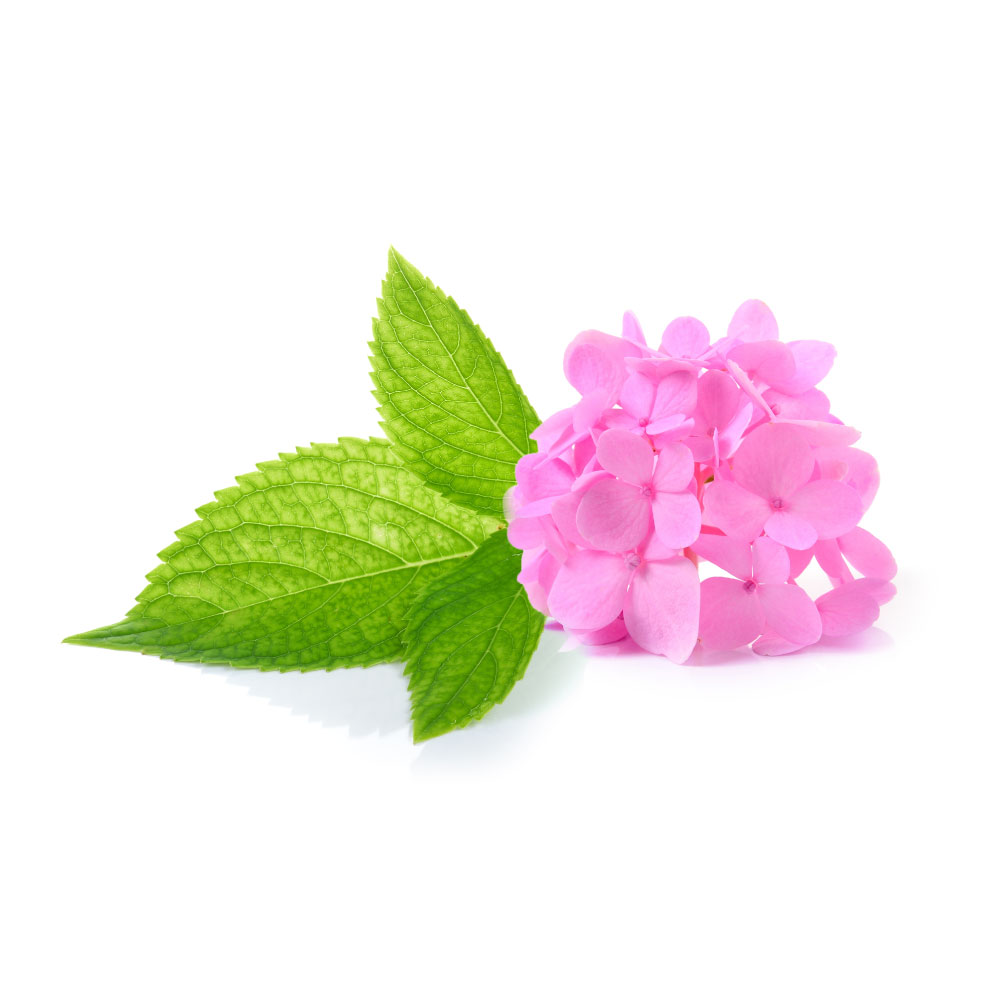
Pictured: Hydrangea
Hydrangea family
Ornamental shrubs and small trees whose medicinal use is confined to hydrangea root, a traditional North American remedy for urinary gravel.
1 Herb // 5 Constituents // 5 Notable Members
Overview
Around 17 genera and 220 species of shrubs, small trees and climbers, mostly of temperate East Asia and the Americas. Familiar in gardens for the showy sterile florets that ring the margin of each flower head — these are advertising structures with no reproductive function, surrounding the small fertile flowers at the centre. The famous colour shift of garden hydrangeas, blue in acid soil and pink in alkaline, is an aluminium-availability effect rather than a pigment change.
Shared Traits
In Practice
Hydrangea (Hydrangea arborescens), the wild or seven-bark hydrangea of eastern North America, is the family’s single medicinal entry. Its rhizome and root were a Cherokee remedy adopted into 19th-century Eclectic and Physiomedicalist practice, where it was used almost exclusively for urinary gravel, stones and cystitis — a lithotriptic and mild diuretic, often paired with gravel root or stone root.
The traditional claim is specific and consistent across sources, which counts for something. What does not yet exist is any meaningful modern investigation: there are no controlled human trials, and the pharmacological literature is thin. Constituents identified include the dihydroisocoumarin hydrangenol, coumarins such as umbelliferone, and the stilbene-like hydrangeic acid, which has attracted some interest for metabolic effects in animal models. None of that yet explains a lithotriptic action, and it would be dishonest to present the mechanism as understood.
Two safety points are worth stating. The family carries cyanogenic glycosides, and hydrangea leaves and buds have caused cyanide-type poisoning in livestock and, rarely, in people; the root is the part used and is regarded as the safer material, but quantity matters. Second, the plant is reported to contain a saponin capable of causing gastrointestinal upset. Traditional dosing was conservative and short-course, which was probably wise.
Note that “hydrangea” also appears in the supplement market as Hydrangea macrophylla var. thunbergii, the source of the sweet tea amacha — a different species with a different profile.
Materia Medica
The monograph in the database whose Hydrangeaceae membership is recorded on the herb itself — so this list keeps itself current as new herbs land.
Hydrangea arborescens
Phytochemistry
Dihydroisocoumarins (hydrangenol, phyllodulcin) are the family’s more distinctive class, alongside cyanogenic glycosides, coumarins, saponins, and flavonoid glycosides.
The compounds recorded for this family's single member, grouped by class.
Beyond the Database
Notable members without a monograph yet.
Keep Exploring