
Materia Medica
Sinicuichi
Heimia salicifolia
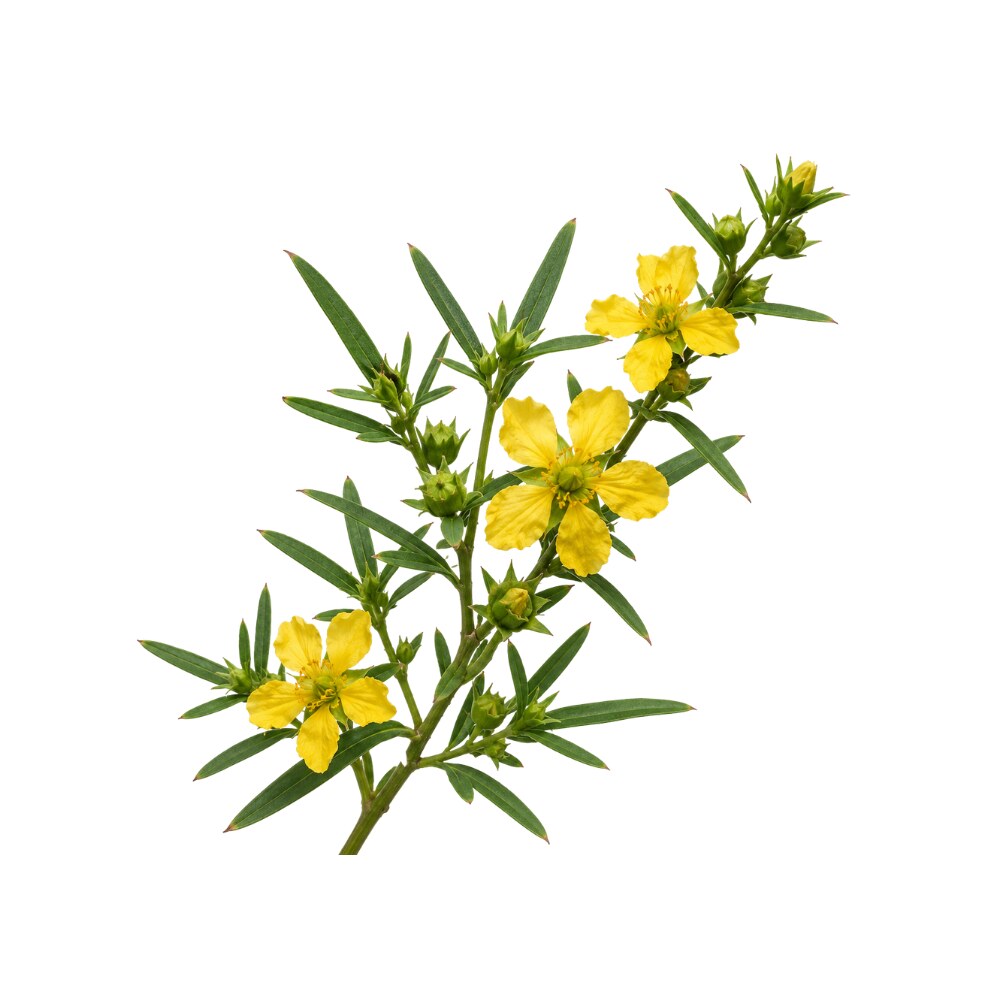
Sinicuichi is a willow-leaved shrub with bright yellow flowers, native from Texas and Mexico to Argentina. Its leaves are made into a lightly fermented drink with mild psychoactive effects, and it contains a family of alkaloids led by cryogenine, also called vertine.
What Is Sinicuichi?
Sinicuichi is a slender, willow-leaved shrub of the loosestrife family, with bright yellow flowers. Its leaves are made into a lightly fermented drink that is taken in Mexico and parts of South America for its mild psychoactive effects 17Reference 17Graham, S. A. (n.d.). Heimia salicifolia — species description, habitat and distribution; and genus Heimia. In Flora of North America, Vol. 10 (Lythraceae). eFloras. http://www.efloras.org/florataxon.aspx?flora_id=1&taxon_id=220006152View study →.
Heimia salicifolia grows wild from southeastern Texas and Mexico to northern Argentina, on moist ground along streams in brushland 17Reference 17Graham, S. A. (n.d.). Heimia salicifolia — species description, habitat and distribution; and genus Heimia. In Flora of North America, Vol. 10 (Lythraceae). eFloras. http://www.efloras.org/florataxon.aspx?flora_id=1&taxon_id=220006152View study →. Its aerial parts also have a wide folk reputation as a medicine 1Reference 1ReviewHeimia salicifolia: a phytochemical and phytopharmacologic review — reviewView study →.
The plant contains a family of alkaloids, of which cryogenine (also called vertine) is the most studied 1Reference 1ReviewHeimia salicifolia: a phytochemical and phytopharmacologic review — reviewView study →. Research has focused on its anti-inflammatory and antispasmodic effects in animals.
How Is Sinicuichi Used?
- Fermented leaf drink — the leaves are brewed or fermented in water, and the drink is taken for its effects 2Reference 2Case reportIdentification of sinicuichi alkaloids in human serum after intoxication caused by oral intake of a Heimia salicifolia extract — case reportView study →.
- Aerial parts — used in folk medicine, including in post-partum baths and for wound healing 1Reference 1ReviewHeimia salicifolia: a phytochemical and phytopharmacologic review — reviewView study →.
Traditional Uses
Mexican & South American Folk Medicine
The leaves are wilted and left to ferment in water in the sun, and the juice is drunk for its gently intoxicating, relaxing effects. Users describe a dreamy euphoria, drowsiness, and changes in hearing, with sounds seeming muffled or distant, sometimes with a shift in pitch. The drink is also said to stir old memories.
In Mexico and parts of South America it is used in traditional medicine and religious rites to bring on mild auditory and visual effects 17Reference 17Graham, S. A. (n.d.). Heimia salicifolia — species description, habitat and distribution; and genus Heimia. In Flora of North America, Vol. 10 (Lythraceae). eFloras. http://www.efloras.org/florataxon.aspx?flora_id=1&taxon_id=220006152View study →. The name “sun opener” refers to the sunlit preparation and the mellow quality the drink is said to bring.
As a medicine, the aerial parts are used against syphilis, to induce sweating, to bring down fever, as a laxative and as a diuretic 1Reference 1ReviewHeimia salicifolia: a phytochemical and phytopharmacologic review — reviewView study →. They are also used as a strong anti-inflammatory, as a sleep aid and for healing wounds, and are added to post-partum baths 1,
In Argentine folk medicine a boiling-water extract of the aerial parts is among the plants used against infection 16Reference 16In vitroIn vitro antibacterial activity of Argentine folk medicinal plants against Salmonella typhi — in vitroView study →.
Indications
- Mild, dreamy intoxication with altered hearing [fermented leaf drink; Mexican folk use]
- Inflammation [aerial parts; folk use]
- Sleeplessness [aerial parts; folk use]
- Fever [aerial parts; folk use]
- Fluid retention [aerial parts; folk use]
- Constipation [aerial parts; folk use]
- Wounds [aerial parts; folk use]
- Post-partum care, in baths [aerial parts; folk use]
- Syphilis [aerial parts; historical folk use]
Botany
Sinicuichi is a shrub or subshrub of the loosestrife family (Lythraceae), growing 0.5–3 m tall and hairless throughout 17Reference 17Graham, S. A. (n.d.). Heimia salicifolia — species description, habitat and distribution; and genus Heimia. In Flora of North America, Vol. 10 (Lythraceae). eFloras. http://www.efloras.org/florataxon.aspx?flora_id=1&taxon_id=220006152View study →. Its stems are erect and sparsely branched, and four-angled or narrowly winged 17Reference 17Graham, S. A. (n.d.). Heimia salicifolia — species description, habitat and distribution; and genus Heimia. In Flora of North America, Vol. 10 (Lythraceae). eFloras. http://www.efloras.org/florataxon.aspx?flora_id=1&taxon_id=220006152View study →.
The leaves are opposite or nearly so, stalkless, and narrowly lance-shaped, 15–55 mm long and 2–10 mm wide 17Reference 17Graham, S. A. (n.d.). Heimia salicifolia — species description, habitat and distribution; and genus Heimia. In Flora of North America, Vol. 10 (Lythraceae). eFloras. http://www.efloras.org/florataxon.aspx?flora_id=1&taxon_id=220006152View study →. From a distance the plant has the look of a small willow.
The flowers grow singly in the leaf axils, forming leafy spikes along the upper stems. Each has usually six bright yellow petals, 5–10 mm long, which fall early 17Reference 17Graham, S. A. (n.d.). Heimia salicifolia — species description, habitat and distribution; and genus Heimia. In Flora of North America, Vol. 10 (Lythraceae). eFloras. http://www.efloras.org/florataxon.aspx?flora_id=1&taxon_id=220006152View study →.
The fruit is a small, round capsule 3–4.5 mm across, holding more than 200 tiny seeds 17Reference 17Graham, S. A. (n.d.). Heimia salicifolia — species description, habitat and distribution; and genus Heimia. In Flora of North America, Vol. 10 (Lythraceae). eFloras. http://www.efloras.org/florataxon.aspx?flora_id=1&taxon_id=220006152View study →.
Distribution
Sinicuichi is native from southeastern Texas through Mexico, and in South America south to northern Argentina, with a gap in Central America 17Reference 17Graham, S. A. (n.d.). Heimia salicifolia — species description, habitat and distribution; and genus Heimia. In Flora of North America, Vol. 10 (Lythraceae). eFloras. http://www.efloras.org/florataxon.aspx?flora_id=1&taxon_id=220006152View study →. It has been introduced in the West Indies and Central America 17Reference 17Graham, S. A. (n.d.). Heimia salicifolia — species description, habitat and distribution; and genus Heimia. In Flora of North America, Vol. 10 (Lythraceae). eFloras. http://www.efloras.org/florataxon.aspx?flora_id=1&taxon_id=220006152View study →.
It grows on moist soil and along streamsides in brushland, from sea level to 1,500 m 17Reference 17Graham, S. A. (n.d.). Heimia salicifolia — species description, habitat and distribution; and genus Heimia. In Flora of North America, Vol. 10 (Lythraceae). eFloras. http://www.efloras.org/florataxon.aspx?flora_id=1&taxon_id=220006152View study →.
Growing Conditions
Cultivation snapshot for Sinicuichi
- Grows best in full sun (with a little afternoon shade in the hottest climates), which brings the freest flowering.
- Prefers moist but well-drained soil of almost any type and appreciates steady moisture, though it is moderately drought-tolerant once established.
- Fairly frost-hardy for a subtropical shrub (roughly USDA zones 9–11): a hard freeze may cut back the top growth, but it usually resprouts from the base.
- Very easily raised from seed — surface-sow the tiny seed in full sun for quick germination — and also from cuttings.
Grow it yourself
Farm Wiki is our cultivation-focused sister site, also run by Justin Cooke.
Phytochemistry
Sinicuichi contains a family of quinolizidine alkaloids built on a biphenyl lactone skeleton. The four most studied are cryogenine (vertine), lyfoline, lythrine and nesodine 1Reference 1ReviewHeimia salicifolia: a phytochemical and phytopharmacologic review — reviewView study →.
A 2008 re-investigation isolated nine alkaloids from the plant: two new ones, 9β-hydroxyvertine and a quinolizidine acetate, and seven known ones, including lythrine, vertine, lyfoline, epi-lyfoline, lythridine, heimidine and dehydrodecodine 15Reference 15In vitroAlkaloids from Heimia salicifolia — in vitroView study →. The plant is also reported to contain sinicuichine.
In a forensic analysis, five alkaloids were detected in the plant material 2Reference 2Case reportIdentification of sinicuichi alkaloids in human serum after intoxication caused by oral intake of a Heimia salicifolia extract — case reportView study →.
The plant also contains astringent tannins.
Constituent Summary
No quantitative content is published for these alkaloids in the dried herb.
Quinolizidine Alkaloid5 compoundsno data
Tannin1 compoundno data
Pharmacology & Research
The research on sinicuichi (Heimia salicifolia) is small and almost entirely preclinical: about two dozen primary papers, most from one pharmacology programme active between the 1960s and 1980s, plus phytochemistry 1Reference 1ReviewHeimia salicifolia: a phytochemical and phytopharmacologic review — reviewView study →.
The best-characterised activity is anti-inflammatory. Its most studied alkaloid, cryogenine (vertine), inhibits prostaglandin synthase in vitro and reduces inflammation in several rodent models 3,
There are no clinical trials. The human data is a preliminary clinical evaluation of two isolated alkaloids taken by mouth, which produced none of the psychoactive effects attributed to the brew, and one forensic case report 1,
-
Best-supported: anti-inflammatory activity of cryogenine and nesodine — prostaglandin-synthase inhibition in vitro plus replicated rodent oedema, arthritis and granuloma models 3,
4, .11Reference 3In vitroProstaglandin synthetase inhibition by alkaloids of Heimia salicifolia — in vitroView study →Reference 4AnimalAnti-inflammatory evaluation of cryogenine — animal modelView study →Reference 11AnimalEvaluation of immunosuppressive potential of cryogenine using developing and established adjuvant arthritis in rats — ratView study → -
Emerging, worth watching: a mild sedative effect seen in animal behaviour, although oral isolated alkaloids gave no psychoactive effect in people 1,
9Reference 1ReviewHeimia salicifolia: a phytochemical and phytopharmacologic review — reviewView study →Reference 9Pharmacodynamics of cryogenine, an alkaloid isolated from Heimia salicifoliaView study → ; and a preclinical antimalarial signal from two isolated alkaloids 15Reference 15In vitroAlkaloids from Heimia salicifolia — in vitroView study →. -
Mechanistically thin: antispasmodic, diuretic and antibacterial claims rest on isolated-tissue, single-study or crude-extract data 1,
16Reference 1ReviewHeimia salicifolia: a phytochemical and phytopharmacologic review — reviewView study →Reference 16In vitroIn vitro antibacterial activity of Argentine folk medicinal plants against Salmonella typhi — in vitroView study → . - The caveat: everything is preclinical, most of it on isolated alkaloids rather than the fermented brew, and no dose or alkaloid content is established.
The research used isolated alkaloids, and the tradition uses a fermented leaf drink. Given by mouth, the purified alkaloids did not reproduce the brew’s psychoactive effect, so the findings do not map directly onto the drink people take 1Reference 1ReviewHeimia salicifolia: a phytochemical and phytopharmacologic review — reviewView study →.
1. Anti-Inflammatory
Two of the plant’s alkaloids, cryogenine and nesodine, inhibited prostaglandin synthetase from bovine seminal vesicles about 2.5 and 2.2 times as potently as aspirin. Indomethacin was about 2,800 times as potent as aspirin in the same assay. The authors suggested the activity may help explain the plant’s folk use 3Reference 3In vitroProstaglandin synthetase inhibition by alkaloids of Heimia salicifolia — in vitroView study →.
In animals, cryogenine reduced thermal paw oedema, croton-oil inflammation, cotton-pellet granuloma and adjuvant-induced arthritis 4,
In rats with adjuvant arthritis, oral cryogenine at 100 mg/kg/day reduced the non-immune inflammation as well as phenylbutazone did. Unlike cyclophosphamide, it gave no protection against the later immune-mediated inflammation, so it acts as an anti-inflammatory rather than an immunosuppressant 11Reference 11AnimalEvaluation of immunosuppressive potential of cryogenine using developing and established adjuvant arthritis in rats — ratView study →.
The review of this work notes that the effect depends partly on an intact pituitary–adrenal system and partly on prostaglandin-synthase inhibition 1Reference 1ReviewHeimia salicifolia: a phytochemical and phytopharmacologic review — reviewView study →.
Gap: no human studies, no dose-ranging in the fermented brew, and potency far below standard anti-inflammatory drugs.
2. Sedative / Ataractic
Early studies described a tranquillising (ataractic) action of cryogenine in animals that did not depend on depleting or blocking catecholamines 1,
In a 2008 forensic case, a 26-year-old man drank sinicuichi tea he had fermented for 24 hours with yeast and sugar. He came to hospital with muscle pain in his limbs and tongue and a slightly raised temperature, was treated, and was released the following afternoon. The five alkaloids found in the plant material were all detected in his serum 2Reference 2Case reportIdentification of sinicuichi alkaloids in human serum after intoxication caused by oral intake of a Heimia salicifolia extract — case reportView study →.
In a preliminary clinical evaluation, vertine (cryogenine) and lythrine taken by mouth appeared to lack the psychoactive effect attributed to native brews 1Reference 1ReviewHeimia salicifolia: a phytochemical and phytopharmacologic review — reviewView study →.
Gap: the active principle of the traditional psychoactive effect has not been identified, isolated alkaloids do not reproduce it, and the only other human data is an uncontrolled case report.
3. Antispasmodic
Vertine relaxes many isolated tissues against several different agonists, and the effect appears to act largely on the muscle itself rather than through nerve receptors 1Reference 1ReviewHeimia salicifolia: a phytochemical and phytopharmacologic review — reviewView study →.
On isolated rat uterus, cryogenine acted in part as a competitive inhibitor of synthetic bradykinin 5Reference 5In vitroEvaluation of cryogenine on rat paw thermal oedema and rat isolated uterus — rat, in vitroView study →, and an in vitro study compared it with cyproheptadine and diphenhydramine as an antagonist of histamine and serotonin 14Reference 14In vitroComparative in vitro evaluation of cryogenine, cyproheptadine, and diphenhydramine as antagonists of furtrethonium, histamine, and serotonin — in vitroView study →.
The data come largely from one research programme and from isolated tissue only, with no live-animal or human confirmation.
4. Diuretic
Folk use includes a diuretic reputation. In animals, lythrine and decinine were shown to be true hydrodiuretics; decinine is a related alkaloid found in Decodon verticillatus, not in this plant 1Reference 1ReviewHeimia salicifolia: a phytochemical and phytopharmacologic review — reviewView study →.
The review suggested they might prove useful in Addison’s disease and nephrosis 1Reference 1ReviewHeimia salicifolia: a phytochemical and phytopharmacologic review — reviewView study →. The effect belongs to a minor alkaloid and a related-species alkaloid, in animals, and has not been studied in the whole herb.
5. Antimalarial
A 2008 phytochemical study isolated nine alkaloids from Heimia salicifolia and found that vertine (cryogenine) and epi-lyfoline had moderate antimalarial activity in vitro 15Reference 15In vitroAlkaloids from Heimia salicifolia — in vitroView study →.
This is a single in vitro result on isolated compounds, with no in vivo confirmation.
6. Antibacterial
In a screen of 132 samples from Argentine folk-medicine plants, a boiling-water extract of Heimia salicifolia aerial parts was among the more active against Salmonella typhi by agar-well diffusion 16Reference 16In vitroIn vitro antibacterial activity of Argentine folk medicinal plants against Salmonella typhi — in vitroView study →.
This is a single crude-extract screen against one organism, with no identification of the active compound and no in vivo follow-up.
Mechanisms
Cryogenine (vertine) has been studied for its inhibition of prostaglandin synthase and for an anti-inflammatory action that partly depends on the pituitary–adrenal system. It has also been studied for antagonism of bradykinin, histamine and serotonin, and for direct relaxation of smooth muscle.
Taken by mouth as an isolated alkaloid, cryogenine did not reproduce the brew’s psychoactive effect, and the compound responsible for that effect has not been identified 1Reference 1ReviewHeimia salicifolia: a phytochemical and phytopharmacologic review — reviewView study →.
| Mechanism | Drives | Key compounds |
|---|---|---|
| Prostaglandin-synthase (COX) inhibition | anti-inflammatory | cryogenine, nesodine |
| Pituitary–adrenal-dependent anti-inflammatory action | anti-inflammatory (in vivo) | cryogenine |
| Competitive bradykinin antagonism | anti-inflammatoryantispasmodic | cryogenine |
| Histamine / serotonin receptor antagonism (in vitro) | antispasmodicsedative | cryogenine |
| Musculotropic smooth-muscle relaxation | antispasmodic | vertine |
Clinical Trials
No registered clinical trials were identified on ClinicalTrials.gov for Heimia salicifolia, sinicuichi or cryogenine.
| Completed | Planned | Terminated | Preclinical |
|---|---|---|---|
| 0 | 0 | 0 | ~20 |
Last checked: August 2026.
Dosage
There is no established dose. No efficacy trial exists, and the alkaloid content of the dried herb has not been measured. Traditional use is a small volume of the lightly fermented leaf drink, and its strength varies with the fermentation and the plant’s origin, so start low.
Traditional Dosage
| System | Preparation | Dose |
|---|---|---|
| Mexican and South American folk use | Fresh or wilted leaves, lightly fermented in water to make the “sun opener” drink | Not quantified; taken as a small volume of the fermented drink |
Safety & Pregnancy
Sinicuichi is mildly psychoactive and little studied in people. Start low, avoid alcohol and other sedatives, and do not drive after use.
- Psychoactive and little studied. It alters perception, and there is no controlled human research. A man who drank a home-fermented brew went to hospital with muscle pain and a raised temperature 2Reference 2Case reportIdentification of sinicuichi alkaloids in human serum after intoxication caused by oral intake of a Heimia salicifolia extract — case reportView study →.
- Avoid in pregnancy. There is no reproductive or pregnancy data.
- Sedation and driving. Drowsiness is reported. Avoid alcohol, other sedatives and driving. No interaction study has been done.
- Smoking risk. Smoking any plant material carries respiratory risk.
Full Safety Detail
Human exposure. In the one documented case, a 26-year-old man drank sinicuichi tea he had fermented for 24 hours with yeast and sugar. He came to hospital with muscle pain in his limbs and tongue and a slightly raised temperature, was treated with dimenhydrinate, and was released the next afternoon. The plant’s alkaloids were confirmed in his serum 2Reference 2Case reportIdentification of sinicuichi alkaloids in human serum after intoxication caused by oral intake of a Heimia salicifolia extract — case reportView study →.
Sedation. The brew is reported to bring exhilaration, altered awareness, a slow heart rate, muscle relaxation and a pleasant faintness 2Reference 2Case reportIdentification of sinicuichi alkaloids in human serum after intoxication caused by oral intake of a Heimia salicifolia extract — case reportView study →. Do not combine it with alcohol or other sedatives, and do not drive after use. No drug-interaction or CYP study has been done.
A different “cryogénine”. 1950s reports of haemolytic anaemia from “cryogénine” refer to a synthetic fever drug of the same trade name (phenylsemicarbazide), not the Heimia alkaloid.
Avoid. There are no reproductive-toxicity, pregnancy or breastfeeding data for Heimia salicifolia. It is psychoactive, and its alkaloids reach the bloodstream when the brew is drunk 2Reference 2Case reportIdentification of sinicuichi alkaloids in human serum after intoxication caused by oral intake of a Heimia salicifolia extract — case reportView study →.
References
- Malone, M. H., & Rother, A. (1994). Heimia salicifolia: a phytochemical and phytopharmacologic review — review. Journal of Ethnopharmacology. https://pubmed.ncbi.nlm.nih.gov/7934084/
- Kempf, J., et al. (2008). Identification of sinicuichi alkaloids in human serum after intoxication caused by oral intake of a Heimia salicifolia extract — case report. Forensic Science International. https://pubmed.ncbi.nlm.nih.gov/18621494/
- Lema, W. J., Blankenship, J. W., & Malone, M. H. (1986). Prostaglandin synthetase inhibition by alkaloids of Heimia salicifolia — in vitro. Journal of Ethnopharmacology. https://pubmed.ncbi.nlm.nih.gov/3086627/
- Kaplan, H. R., Wolke, R. E., & Malone, M. H. (1967). Anti-inflammatory evaluation of cryogenine — animal model. Journal of Pharmaceutical Sciences. https://pubmed.ncbi.nlm.nih.gov/6060584/
- Malone, M. H., & Trottier, R. W. (1973). Evaluation of cryogenine on rat paw thermal oedema and rat isolated uterus — rat, in vitro. British Journal of Pharmacology. https://pubmed.ncbi.nlm.nih.gov/4733728/
- Kosersky, D. S., Brown, J. K., & Malone, M. H. (1973). Effects of cryogenine on adjuvant-induced arthritis and serum turbidity in rats — rat. Journal of Pharmaceutical Sciences. https://pubmed.ncbi.nlm.nih.gov/4762166/
- Byrne, J. A., & Malone, M. H. (1981). Protective effects of cryogenine, lythrine and certain derivatives in croton oil induced inflammation — animal. Proceedings of the Western Pharmacology Society. https://pubmed.ncbi.nlm.nih.gov/7255446/
- Omaye, S. T., DeCato, L., & Malone, M. H. (1982). Effects of selected anti-inflammatory agents and cryogenine on serum protein changes induced by cotton pellet granuloma in the rat — rat. Proceedings of the Western Pharmacology Society. https://pubmed.ncbi.nlm.nih.gov/7150427/
- Robichaud, R. C., et al. (1964). Pharmacodynamics of cryogenine, an alkaloid isolated from Heimia salicifolia. I — animal. Archives Internationales de Pharmacodynamie et de Thérapie. https://pubmed.ncbi.nlm.nih.gov/14204497/
- Robichaud, R. C., et al. (1965). Pharmacodynamics of cryogenine, an alkaloid isolated from Heimia salicifolia. II — animal. Archives Internationales de Pharmacodynamie et de Thérapie. https://pubmed.ncbi.nlm.nih.gov/5885005/
- Watson, W. C., & Malone, M. H. (1977). Evaluation of immunosuppressive potential of cryogenine using developing and established adjuvant arthritis in rats — rat. Journal of Pharmaceutical Sciences. https://pubmed.ncbi.nlm.nih.gov/903870/
- Nucifora, T. L., & Malone, M. H. (1971). Comparative psychopharmacologic investigation of cryogenine, certain non-steroid anti-inflammatory compounds, lupin alkaloids and cyproheptadine — animal. Archives Internationales de Pharmacodynamie et de Thérapie. https://pubmed.ncbi.nlm.nih.gov/5089223/
- Kosersky, D. S., & Malone, M. H. (1971). Evaluation of cryogenine in rat sympathetic ganglia — rat. Journal of Pharmaceutical Sciences. https://pubmed.ncbi.nlm.nih.gov/5128957/
- Trottier, R. W., et al. (1969). Comparative in vitro evaluation of cryogenine, cyproheptadine, and diphenhydramine as antagonists of furtrethonium, histamine, and serotonin — in vitro. Journal of Pharmaceutical Sciences. https://pubmed.ncbi.nlm.nih.gov/4390721/
- Rumalla, C. S., Jadhav, A. N., Smillie, T., Fronczek, F. R., & Khan, I. A. (2008). Alkaloids from Heimia salicifolia — in vitro. Phytochemistry. https://pubmed.ncbi.nlm.nih.gov/18374955/
- Pérez, C., & Anesini, C. (1994). In vitro antibacterial activity of Argentine folk medicinal plants against Salmonella typhi — in vitro. Journal of Ethnopharmacology. https://pubmed.ncbi.nlm.nih.gov/7990503/
- Graham, S. A. (n.d.). Heimia salicifolia — species description, habitat and distribution; and genus Heimia. In Flora of North America, Vol. 10 (Lythraceae). eFloras. http://www.efloras.org/florataxon.aspx?flora_id=1&taxon_id=220006152



