
Materia Medica
Baneberry ☠️
Actaea rubra
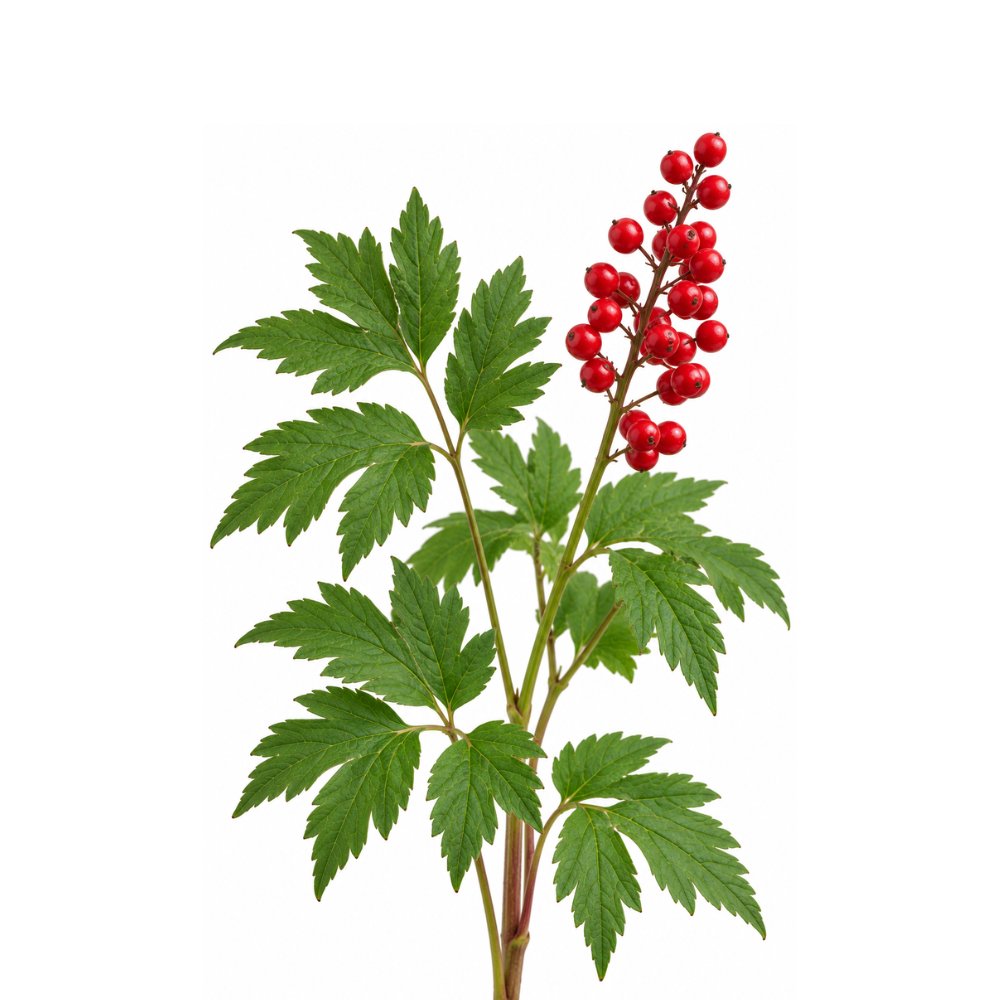
Baneberry is a woodland perennial of northern North America with lacy compound leaves and glossy red or white berries. The berries are bitter and poisonous, causing burning, stomach upset and dizziness, though no human poisoning case has been published.
What Is Baneberry?
Baneberry is a woodland perennial with lacy, deeply divided leaves, a small cluster of white flowers in spring and glossy red or white berries in late summer. Each berry carries a small dark “eye”, the remains of the stigma 5Reference 5Actaea and Actaea rubraView study →. The berries are poisonous and can make people ill 3Reference 3Actaea rubraView study →.
Actaea rubra grows in moist woods right across northern North America, from Alaska and the Yukon to Newfoundland, and south in the mountains to California, Arizona and New Mexico 3,
No human poisoning by this species has been published in the medical literature. The best-known account is a 1903 self-experiment in which about six berries caused a racing, irregular pulse, visual disturbance and confusion for about an hour 4Reference 4An experiment with the fruit of red baneberry.
Identification & Lookalikes
The berries are what get eaten, so the berry-bearing lookalikes are what matter.
| Plant confused with it | How it differs |
|---|---|
| Red elderberry (Sambucus racemosa), a relative of elder | A shrub, sometimes 2–6 m tall, with opposite compound leaves and many small berries in a large branched cluster 7Reference 7Sambucus racemosa, red elderberryView study →. Baneberry is a herb, with its berries on a short spike. The woody habit and opposite leaves separate them at once |
| Bunchberry (Cornus canadensis) | A low plant 5–25 cm tall, with leaves in a whorl of six (sometimes four) at the top of the stem and a tight central bunch of 5–15 red drupes 8Reference 8Cornus canadensisView study → |
Baneberry’s own combination: a herb 40–100 cm tall, large leaves divided two or three times into sharply toothed leaflets, and glossy berries each carrying a dark eye, on slender dull green or brown stalks 3,
The berries taste bitter. In the 1903 self-experiment the taste was described as nauseous, bitter and puckery, and the author concluded that no child would eat the fruit by choice 4Reference 4An experiment with the fruit of red baneberry. The taste probably limits how much people eat.
Botany
Baneberry (Actaea rubra (Aiton) Willd.) is a perennial herb in the buttercup family, Ranunculaceae 5Reference 5Actaea and Actaea rubraView study →. Older names include A. spicata var. rubra, A. arguta, A. eburnea and A. neglecta 5Reference 5Actaea and Actaea rubraView study →. It belongs to a circumboreal group and is very similar to the black-fruited European baneberry, A. spicata, with which it is sometimes merged 5Reference 5Actaea and Actaea rubraView study →.
It grows 40–100 cm tall, with one to several branched stems from a thick vertical rootstock just below the soil surface 3Reference 3Actaea rubraView study →. The leaves are alternate and divided two or three times, with sharply toothed and lobed leaflets that may be hairless or hairy underneath 3,
The spring flowers form a short spike, often as wide as it is long. Each flower has small white petals and showy stamens, and a rose-like scent 3,
The berries are red or white. The white-fruited form, sometimes named forma neglecta, is frequent, and in many places more common than the red 5Reference 5Actaea and Actaea rubraView study →.
Black cohosh, a widely used medicinal herb, is now placed in the same genus as Actaea racemosa. The shared genus name says nothing about safety.
Distribution
Baneberry grows in moist woods across northern North America 3Reference 3Actaea rubraView study →. In the west its range runs from Alaska south through the Coast Ranges and the Sierra Nevada to California, and through the Rocky Mountains to Arizona and New Mexico 3Reference 3Actaea rubraView study →. It crosses the continent to New England, Newfoundland and Labrador, and in the east and Midwest reaches south to New Jersey, Indiana, Iowa and Kansas 3,
It grows mostly in deciduous forest, and also in mixed coniferous forest, open pine or spruce woodland, swales, streambanks and swamps, from sea level to 3,500 m 5Reference 5Actaea and Actaea rubraView study →. It does best on cool, moist, nutrient-rich sites 3Reference 3Actaea rubraView study →.
It is a common understory plant. It is not of conservation concern and is not a weed. It is sometimes grown in woodland gardens 3Reference 3Actaea rubraView study →.
Phytochemistry
The toxin in baneberry has not been identified. It is usually attributed to protoanemonin, the irritant released from the glucoside ranunculin when buttercup-family plants are crushed. That chemistry is well established for the family, but it has not been measured in A. rubra.
The root has been analysed for other compounds. It contains eleven triterpene xylosides of the 9,19-cyclolanostane type, including rubraside A, along with a β-sitosterol glucoside. These showed no cytotoxic, oestrogenic or antioxidant activity in laboratory tests 6Reference 6Phytochemical study of Actaea rubra and biological screenings of isolates.
The berries, the part people eat, have not been chemically analysed. Floras rank the toxic parts as berries, then rootstock, then leaves, but no measurement backs that ranking for this species.
A separate substance acting on the heart is sometimes suggested to explain a slowed or irregular pulse. It has not been isolated.
Constituent Summary
Glycoside1 compound1 with data
Lactone1 compound1 with data
Toxicology
Class of poison. A presumed irritant lactone, not a receptor or channel toxin.
Mechanism. If protoanemonin is responsible, it acts by direct chemical irritation of the mouth, throat and gut. It is a reactive lactone that binds to proteins on contact, causing irritation and inflammation of the lining it touches.
Course. Early signs are burning of the mouth and throat and salivation, followed by cramping, nausea, vomiting, diarrhoea and dizziness. No timed case series exists for this species.
The 1903 self-experiment. In 1903, Alice Bacon of Bradford, Vermont, tested the berries on herself, fearing that children might eat them 4Reference 4An experiment with the fruit of red baneberry. She took three doses two days apart, doubling the amount each time 4Reference 4An experiment with the fruit of red baneberry:
- A small dose caused only slight burning in the stomach.
- Double that caused a quicker pulse and a return of the stomach burning within half an hour, lasting about 15 minutes.
- Twice that again, which she put at about six berries, caused visual disturbance (blue spots, then “sparks of fire”), headache, confusion, wrong words in speech and severe dizziness. Her lips and throat were parched, swallowing was hard, and she had intense stomach burning, colic and back pain. Her pulse rose to 125 and was irregular, with fluttering of the heart.
The symptoms lasted about an hour, and she felt normal three hours after the dose. She estimated that a dozen berries would probably be enough to kill 4Reference 4An experiment with the fruit of red baneberry.
Potency. No reliable dose figure exists. The “six berries” figure repeated in field guides appears to come from this single self-experiment. It records the dose that made one adult very ill, not a measured lethal dose, and it involved no children.
Confirmed human fatalities. None documented in North America. No case report of human poisoning by A. rubra, of any severity, appears in the medical literature. Standard botanical references state that North American baneberries have not been reported to cause death in people or livestock in the United States.
Antidote. None exists. Treatment is supportive and aimed at the symptoms.
Traditional & Historical Use
Native American Medicine
Several Native American peoples used preparations of the root for coughs and colds, sores, bleeding, stomach aches, syphilis and wasting. The whole plant was used as a purgative, and an infusion of the stems to increase milk flow. The plant was also used in ceremonies 5Reference 5Actaea and Actaea rubraView study →.
Safety & Pregnancy
- Berries cause burning of the mouth and throat, then severe stomach upset and dizziness.
- Six berries made an adult very ill in a 1903 self-experiment, with a pulse of 125, confusion and visual disturbance 4Reference 4An experiment with the fruit of red baneberry.
- No published human poisoning case report for this species.
- No documented North American death in people or livestock.
- The toxin has not been identified in this species; protoanemonin is attributed from the buttercup family.
- Common in shaded forest, and the glossy berries are attractive to children.
Full Safety Detail
If a child eats the berries. Call a poison centre. On the evidence available, the illness is unpleasant and passes, but the evidence is thin.
The taste. The berries are strongly bitter, which probably keeps most people from eating many 4Reference 4An experiment with the fruit of red baneberry.
Heart and brain effects. The one detailed human account records a fast, irregular pulse and confusion after about six berries 4Reference 4An experiment with the fruit of red baneberry. Anyone who has eaten more than a taste should be assessed.
Avoid. The plant is poisonous and has no safe use.
References
- Burrows GE, Tyrl RJ. Toxic Plants of North America. 2nd ed.
- Kingsbury JM. Poisonous Plants of the United States and Canada. 1964.
- Crane MF. Actaea rubra. In: Fire Effects Information System. USDA Forest Service, Rocky Mountain Research Station, Fire Sciences Laboratory; 1990. https://research.fs.usda.gov/feis/species-reviews/actrub
- Bacon AE. An experiment with the fruit of red baneberry. Rhodora. 1903;5(51):77–79.
- Ford BA. Actaea and Actaea rubra. In: Flora of North America Editorial Committee, eds. Flora of North America North of Mexico, vol. 3. 1997. http://www.efloras.org/florataxon.aspx?flora_id=1&taxon_id=233500024
- Ali Z, Khan SI, Khan IA. Phytochemical study of Actaea rubra and biological screenings of isolates. Planta Med. 2006;72(14):1350–1352. PMID 17024608.
- Fryer JL. Sambucus racemosa, red elderberry. In: Fire Effects Information System. USDA Forest Service; 2008. https://research.fs.usda.gov/feis/species-reviews/samrac
- Murrell ZE, Poindexter DB. Cornus canadensis. In: Flora of North America Editorial Committee, eds. Flora of North America North of Mexico, vol. 12. 2016. http://www.efloras.org/florataxon.aspx?flora_id=1&taxon_id=242443972



