Materia Medica
Death Cap ☠️
Amanita phalloides
Death cap (Amanita phalloides) is a European mushroom introduced to British Columbia, where it now fruits under planted broadleaf trees and native Garry oak. Its amatoxins cause most of the world's fatal mushroom poisonings.
What Is the Death Cap?
The death cap is a European mushroom that causes most of the world’s fatal mushroom poisonings 6,
It is not native to North America. Genetic evidence shows that North American populations came from Europe, and it is the only known invasive ectomycorrhizal fungus on the continent 5Reference 5The ectomycorrhizal fungus Amanita phalloides was introduced and is expanding its range on the west coast of North AmericaView study →. It most likely arrived on the roots of imported trees 1Reference 1The death cap mushroom (Amanita phalloides) moves to a native tree in Victoria, British Columbia — field and DNA studyView study →.
In British Columbia it was first collected in 1997, under European sweet chestnut trees near Mission 1Reference 1The death cap mushroom (Amanita phalloides) moves to a native tree in Victoria, British Columbia — field and DNA studyView study →. It now grows mainly in cities and suburbs around Vancouver and Victoria, under planted broadleaf trees such as hornbeam, beech, linden and English oak 1Reference 1The death cap mushroom (Amanita phalloides) moves to a native tree in Victoria, British Columbia — field and DNA studyView study →.
In 2015 it was found fruiting with Garry oak (Quercus garryana), BC’s only native oak, in Saanich 1Reference 1The death cap mushroom (Amanita phalloides) moves to a native tree in Victoria, British Columbia — field and DNA studyView study →. It is no longer tied only to imported trees.
Identification & Lookalikes
Identifying a death cap takes care, and anyone unsure should ask an expert.
| Confused with | Documented in BC |
|---|---|
| Puffball (immature, unopened button stage) | Yes — the 2003 Victoria case 2Reference 2ReviewThe world’s most poisonous mushroom, Amanita phalloides, is growing in BC — clinical reviewView study → |
| Paddy straw mushroom (Volvariella volvacea) | Yes — the 2008 Langley case 2, |
| Other Asian Amanita species | Listed as a common confusion by the BC Centre for Disease Control 6Reference 6Amanita phalloides mushrooms in city environments in British Columbia: briefing package for parks and municipalities — public health guidanceView study → |
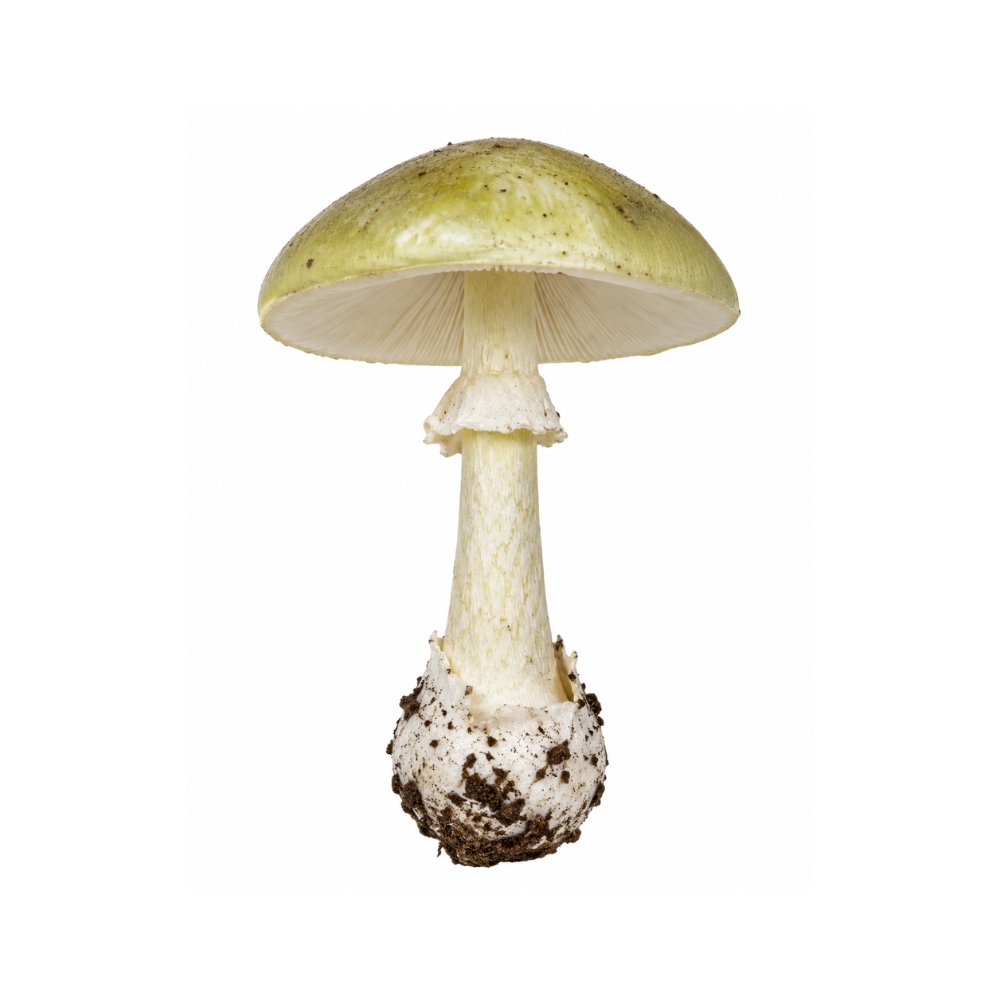
Characters to know. The cap is 4–16 cm across and dull green, olive, yellowish or brownish. White forms occur, rarely 8Reference 8Amanita phalloides — species descriptionView study →.
The gills are white and free from the stem or nearly so 8Reference 8Amanita phalloides — species descriptionView study →. The stem carries a white, skirt-like ring that usually persists but is sometimes lost 8Reference 8Amanita phalloides — species descriptionView study →.
The base of the stem sits in a white, sack-like cup, the volva 8Reference 8Amanita phalloides — species descriptionView study →. The cup is often below ground and is missed when the mushroom is picked rather than dug 6Reference 6Amanita phalloides mushrooms in city environments in British Columbia: briefing package for parks and municipalities — public health guidanceView study →. The spore print is white 8Reference 8Amanita phalloides — species descriptionView study →.
⚠ The button stage is the dangerous one. A young death cap can be completely wrapped in its outer veil, which makes it look like a puffball unless it is cut in half 2Reference 2ReviewThe world’s most poisonous mushroom, Amanita phalloides, is growing in BC — clinical reviewView study →. Cut any suspected puffball in half lengthwise: a button Amanita shows the outline of a developing cap, gills and stem inside.
Mycology
Amanita phalloides (Vaill. ex Fr.) Link belongs to the Amanitaceae 1Reference 1The death cap mushroom (Amanita phalloides) moves to a native tree in Victoria, British Columbia — field and DNA studyView study →. It is an ectomycorrhizal fungus, living in partnership with the roots of trees 1Reference 1The death cap mushroom (Amanita phalloides) moves to a native tree in Victoria, British Columbia — field and DNA studyView study →.
In BC its hosts are planted European trees: sweet chestnut, European beech, European hornbeam, linden and English oak 1Reference 1The death cap mushroom (Amanita phalloides) moves to a native tree in Victoria, British Columbia — field and DNA studyView study →. It has also formed ectomycorrhizas with native Garry oak, confirmed by DNA sequencing of the root tips 1Reference 1The death cap mushroom (Amanita phalloides) moves to a native tree in Victoria, British Columbia — field and DNA studyView study →. No BC collection has been associated with conifers 1Reference 1The death cap mushroom (Amanita phalloides) moves to a native tree in Victoria, British Columbia — field and DNA studyView study →.
In California its most common host is the native coast live oak 1,
Distribution
The death cap is native to Europe, where it is widespread 6Reference 6Amanita phalloides mushrooms in city environments in British Columbia: briefing package for parks and municipalities — public health guidanceView study →. In North America it grows along the West Coast from Los Angeles County to Vancouver Island, and in the eastern United States 5,
In BC it grows mainly in the south-west. It has been recorded in the Fraser Valley, in Vancouver and its neighbouring municipalities, around Victoria on southern Vancouver Island, and on Galiano Island 1,
In Victoria it has been found under linden in the Uplands neighbourhood, under hornbeam near the Crystal Garden, and under beech and English oak along city boulevards 1Reference 1The death cap mushroom (Amanita phalloides) moves to a native tree in Victoria, British Columbia — field and DNA studyView study →. In 2025 it was found in Comox, near Filberg Park and Baybrook Park 7Reference 7Public notice: death cap mushrooms found in Comox — municipal notice. https://www.comox.ca/government-bylaws/news-alerts/public-notice-death-cap-mushrooms-found-comoxView study →.
It grows mostly in cities and towns, in school yards, parks, streets and gardens 6Reference 6Amanita phalloides mushrooms in city environments in British Columbia: briefing package for parks and municipalities — public health guidanceView study →. In 2018 it had not yet been found in a BC forest 6Reference 6Amanita phalloides mushrooms in city environments in British Columbia: briefing package for parks and municipalities — public health guidanceView study →.
Phytochemistry
The lethal compounds are the amatoxins, which are bicyclic octapeptides (ring-shaped peptides of eight amino acids) 3Reference 3Treatment of amatoxin poisoning: 20-year retrospective analysisView study →.
α-Amanitin and β-amanitin are the main amatoxins 9Reference 9ReviewThe most dreadful mushroom toxins: a review of their toxicological mechanisms, chemical structural characteristics, and treatment — reviewView study →. The lethal dose of amatoxins for a person is estimated at about 0.1 mg/kg of body weight, or 7–8 mg, and one mushroom can hold that much 9Reference 9ReviewThe most dreadful mushroom toxins: a review of their toxicological mechanisms, chemical structural characteristics, and treatment — reviewView study →.
Phalloidin belongs to a second group, the phallotoxins. Phallotoxins are not absorbed from the gut, so they add little to human poisoning 9Reference 9ReviewThe most dreadful mushroom toxins: a review of their toxicological mechanisms, chemical structural characteristics, and treatment — reviewView study →.
Amatoxins are heat-stable. Cooking, drying and freezing do not destroy them, and boiling the mushroom and throwing the water away does not remove them 2,
Constituent Summary
The main toxins of the death cap.
Cyclic Peptide3 compounds3 with data
Toxicology
Class of poison. Bicyclic octapeptide; an inhibitor of RNA polymerase II.
Mechanism. Amatoxins bind to and inhibit RNA polymerase II, the enzyme that copies DNA into messenger RNA. Protein production stops and the cell dies 3,
The course of poisoning.
- Delay. Symptoms begin 6 to 24 hours after eating 2Reference 2ReviewThe world’s most poisonous mushroom, Amanita phalloides, is growing in BC — clinical reviewView study →. The delay is characteristically longer than 6 hours, with a mean around 12, and occasionally stretches toward 36–48 hours 3Reference 3Treatment of amatoxin poisoning: 20-year retrospective analysisView study →.
- Gastrointestinal phase. Cramping, abdominal pain, vomiting and severe watery diarrhoea, which can cause dehydration 6Reference 6Amanita phalloides mushrooms in city environments in British Columbia: briefing package for parks and municipalities — public health guidanceView study →.
- False recovery. From about 24 to 72 hours after eating the person may feel better, and often describes it as getting over a cold or flu 2,
6Reference 2ReviewThe world’s most poisonous mushroom, Amanita phalloides, is growing in BC — clinical reviewView study →Reference 6Amanita phalloides mushrooms in city environments in British Columbia: briefing package for parks and municipalities — public health guidanceView study → . The liver damage continues during this time 6Reference 6Amanita phalloides mushrooms in city environments in British Columbia: briefing package for parks and municipalities — public health guidanceView study →. - Liver and kidney phase. Serious liver injury shows 2 to 4 days after the meal 10Reference 10Phylogenetic analysis of the distribution of deadly amatoxins among the little brown mushrooms of the genus GalerinaView study →, and the BC review places the liver and kidney phase at 4 to 9 days after eating 2Reference 2ReviewThe world’s most poisonous mushroom, Amanita phalloides, is growing in BC — clinical reviewView study →. Signs include jaundice, liver failure, kidney failure, bleeding problems, seizures and coma 6Reference 6Amanita phalloides mushrooms in city environments in British Columbia: briefing package for parks and municipalities — public health guidanceView study →. In severe poisoning, death comes 7 to 10 days after the first symptoms 6Reference 6Amanita phalloides mushrooms in city environments in British Columbia: briefing package for parks and municipalities — public health guidanceView study →.
Even with hospital treatment, 10–30% of people who eat a death cap die 1,
⚠ Any mushroom illness that begins more than six hours after the meal is an emergency, however well the person looks by the time they are seen. The false recovery is part of the poisoning.
Treatment. Treatment is supportive care, measures to clear amatoxins through the kidneys and to interrupt their recirculation through the bile, and the proposed antidotes 2Reference 2ReviewThe world’s most poisonous mushroom, Amanita phalloides, is growing in BC — clinical reviewView study →. Once acute liver failure sets in, liver transplantation is the only definitive treatment 2Reference 2ReviewThe world’s most poisonous mushroom, Amanita phalloides, is growing in BC — clinical reviewView study →.
In a 20-year analysis of 2,108 hospitalised patients, silibinin (from milk thistle) and N-acetylcysteine were the most effective treatments 3Reference 3Treatment of amatoxin poisoning: 20-year retrospective analysisView study →. High-dose penicillin was the most often used but showed little benefit 3Reference 3Treatment of amatoxin poisoning: 20-year retrospective analysisView study →.
Silibinin blocks the transporter (OATP1B3) that carries amatoxins into liver cells 2Reference 2ReviewThe world’s most poisonous mushroom, Amanita phalloides, is growing in BC — clinical reviewView study →.
⚠ A Canadian access note. Intravenous silibinin (Legalon SIL) has been used in Europe for many years, but in Canada it is available only through Health Canada’s Special Access Programme 2Reference 2ReviewThe world’s most poisonous mushroom, Amanita phalloides, is growing in BC — clinical reviewView study →.
Confirmed BC cases. Three poisonings are on record in BC 1,
- 2003, Victoria. A 43-year-old man ate an immature death cap he took for a puffball. He recovered after hospital treatment 2Reference 2ReviewThe world’s most poisonous mushroom, Amanita phalloides, is growing in BC — clinical reviewView study →.
- 2008, Langley (Greater Vancouver). A 63-year-old woman ate a death cap she took for a paddy straw mushroom, gathered on an agricultural property. She recovered after hospital treatment 2,
14, .15Reference 2ReviewThe world’s most poisonous mushroom, Amanita phalloides, is growing in BC — clinical reviewView study →Reference 14Amanita phalloides — poisonous mushrooms: history of Amanita phalloides in British ColumbiaView study →Reference 15Amanita phalloides — death capView study → - October 2016, Victoria. A three-year-old boy died after eating soup containing a death cap his family had picked on a residential street 2,
6Reference 2ReviewThe world’s most poisonous mushroom, Amanita phalloides, is growing in BC — clinical reviewView study →Reference 6Amanita phalloides mushrooms in city environments in British Columbia: briefing package for parks and municipalities — public health guidanceView study → . It is the one death among BC’s three recorded poisonings 1,6Reference 1The death cap mushroom (Amanita phalloides) moves to a native tree in Victoria, British Columbia — field and DNA studyView study →Reference 6Amanita phalloides mushrooms in city environments in British Columbia: briefing package for parks and municipalities — public health guidanceView study → .
In the United States. Poison centres recorded about 133,700 mushroom exposures from 1999 to 2016, around 7,400 a year. There were 52 deaths, about 2.9 a year, and 68–89% of them came from cyclopeptide (amatoxin-type) mushrooms 4Reference 4ObservationalMushroom poisoning epidemiology in the United StatesView study →.
Traditional & Historical Use
The death cap has no medicinal or culinary tradition.
Roman writers recorded that the emperor Claudius died in 54 CE after a dish of mushrooms, and the death cap is often named as the poison. A 2002 review argued that the 10–15 hour delay of death cap poisoning does not fit the ancient accounts, and that a stroke better explains his death 11Reference 11ReviewThe death of Claudius — historical reviewView study →.
Phalloidin, tagged with a fluorescent dye, is the standard stain for actin filaments in fixed cells and tissues 12Reference 12ReviewActin visualization at a glance — reviewView study →. Amanitin is being developed as the cell-killing payload in antibody-drug conjugates for cancer, and these have entered early clinical trials 13Reference 13ReviewFungal ribosomally synthesized and post-translationally modified peptides (F-RiPPs): biosynthesis, genome mining, structural diversity, and translational potential as targeted anticancer ADC payloads — reviewView study →.
Safety & Pregnancy
- Causes most of the world’s fatal mushroom poisonings. One cap can kill an adult 2,
9Reference 2ReviewThe world’s most poisonous mushroom, Amanita phalloides, is growing in BC — clinical reviewView study →Reference 9ReviewThe most dreadful mushroom toxins: a review of their toxicological mechanisms, chemical structural characteristics, and treatment — reviewView study → . - Symptoms start 6–24 hours after eating, and the false recovery that follows is part of the poisoning 2,
3Reference 2ReviewThe world’s most poisonous mushroom, Amanita phalloides, is growing in BC — clinical reviewView study →Reference 3Treatment of amatoxin poisoning: 20-year retrospective analysisView study → . - Amatoxins are heat-stable. Cooking, drying and freezing do not destroy them 2,
6Reference 2ReviewThe world’s most poisonous mushroom, Amanita phalloides, is growing in BC — clinical reviewView study →Reference 6Amanita phalloides mushrooms in city environments in British Columbia: briefing package for parks and municipalities — public health guidanceView study → . - Established in BC and now fruiting with native Garry oak 1Reference 1The death cap mushroom (Amanita phalloides) moves to a native tree in Victoria, British Columbia — field and DNA studyView study →. It grows mostly in cities and suburbs 6Reference 6Amanita phalloides mushrooms in city environments in British Columbia: briefing package for parks and municipalities — public health guidanceView study →.
- BC’s recorded death was a three-year-old in Victoria, October 2016 2Reference 2ReviewThe world’s most poisonous mushroom, Amanita phalloides, is growing in BC — clinical reviewView study →.
- IV silibinin is available in Canada only through the Special Access Programme 2Reference 2ReviewThe world’s most poisonous mushroom, Amanita phalloides, is growing in BC — clinical reviewView study →.
Full Safety Detail
Timing. Illness that begins within six hours of a wild mushroom meal points away from amatoxins. Illness that begins later points toward them. The time between the meal and the first symptoms should be established and recorded, and feeling better by the time of the hospital visit is no reassurance.
Where it grows. The death cap grows in school yards, parks, streets and gardens, where children and pets can reach it 6Reference 6Amanita phalloides mushrooms in city environments in British Columbia: briefing package for parks and municipalities — public health guidanceView study →. BC’s fatal case was a mushroom picked from a city street 2Reference 2ReviewThe world’s most poisonous mushroom, Amanita phalloides, is growing in BC — clinical reviewView study →.
Who is at risk. The BC Centre for Disease Control notes a particular risk for recent immigrants from Asia and Europe who forage for food, because the death cap resembles mushrooms eaten in those regions 6Reference 6Amanita phalloides mushrooms in city environments in British Columbia: briefing package for parks and municipalities — public health guidanceView study →.
For anyone learning mushrooms. Dig rather than pick, so the cup at the base can be seen, and take a spore print.
Not applicable. Lethally poisonous, with no dose and no use in any population.
References
- Berch SM, Kroeger P, Finston T (2017). The death cap mushroom (Amanita phalloides) moves to a native tree in Victoria, British Columbia — field and DNA study. Botany 95(4):435–440. https://cdnsciencepub.com/doi/10.1139/cjb-2016-0183
- Moor-Smith M, Li R, Ahmad O (2019). The world’s most poisonous mushroom, Amanita phalloides, is growing in BC — clinical review. BCMJ 61(1):20–24. https://bcmj.org/articles/worlds-most-poisonous-mushroom-amanita-phalloides-growing-bc
- Enjalbert F, Rapior S, Nouguier-Soulé J, et al. (2002). Treatment of amatoxin poisoning: 20-year retrospective analysis. J Toxicol Clin Toxicol 40(6):715–757. https://pubmed.ncbi.nlm.nih.gov/12475187/
- Brandenburg WE, Ward KJ (2018). Mushroom poisoning epidemiology in the United States. Mycologia 110(4):637–641. https://pubmed.ncbi.nlm.nih.gov/30062915/
- Pringle A, Adams RI, Cross HB, Bruns TD (2009). The ectomycorrhizal fungus Amanita phalloides was introduced and is expanding its range on the west coast of North America. Mol Ecol 18(5):817–833. https://pubmed.ncbi.nlm.nih.gov/19207260/
- McIntyre L, Kroeger P, Berch S, et al. (2018). Amanita phalloides mushrooms in city environments in British Columbia: briefing package for parks and municipalities — public health guidance. BC Centre for Disease Control. https://www.bccdc.ca/resource-gallery/Documents/Educational%20Materials/EH/FPS/Fruit%20and%20Veg/AmanitaPhalloidesMushroomsInCityEnvironmentsInBritishColumbiaBriefingPackageForParksAndMunicipalities.pdf
- Town of Comox (2025). Public notice: death cap mushrooms found in Comox — municipal notice. https://www.comox.ca/government-bylaws/news-alerts/public-notice-death-cap-mushrooms-found-comox
- Kuo M (2013). Amanita phalloides — species description. MushroomExpert.com. https://www.mushroomexpert.com/amanita_phalloides.html
- Gouvinhas I, Silva J, Alves MJ, Garcia J (2024). The most dreadful mushroom toxins: a review of their toxicological mechanisms, chemical structural characteristics, and treatment — review. EXCLI J 23:833–859. https://pubmed.ncbi.nlm.nih.gov/39165585/
- Landry B, Whitton J, Bazzicalupo AL, Ceska O, Berbee ML (2021). Phylogenetic analysis of the distribution of deadly amatoxins among the little brown mushrooms of the genus Galerina. PLoS One 16(2):e0246575. https://pubmed.ncbi.nlm.nih.gov/33566818/
- Marmion VJ, Wiedemann TE (2002). The death of Claudius — historical review. J R Soc Med 95(5):260–261. https://pubmed.ncbi.nlm.nih.gov/11983773/
- Melak M, Plessner M, Grosse R (2017). Actin visualization at a glance — review. J Cell Sci 130(3):525–530. https://pubmed.ncbi.nlm.nih.gov/28082420/
- Gopukumar ST, Saha M, Das P, et al. (2026). Fungal ribosomally synthesized and post-translationally modified peptides (F-RiPPs): biosynthesis, genome mining, structural diversity, and translational potential as targeted anticancer ADC payloads — review. Fitoterapia 192:107283. https://pubmed.ncbi.nlm.nih.gov/42119713/
- Vancouver Mycological Society. Amanita phalloides — poisonous mushrooms: history of Amanita phalloides in British Columbia. https://vanmyco.org/about-mushrooms/poisonous/amanita-phalloides/
- Beaty Biodiversity Museum, University of British Columbia. Amanita phalloides — death cap. In Mushrooms Up! Edible and Poisonous Species of Coastal BC and the Pacific Northwest. https://explore.beatymuseum.ubc.ca/mushroomsup/A_phalloides.html