
Materia Medica
Larkspur ☠️
Delphinium glaucum
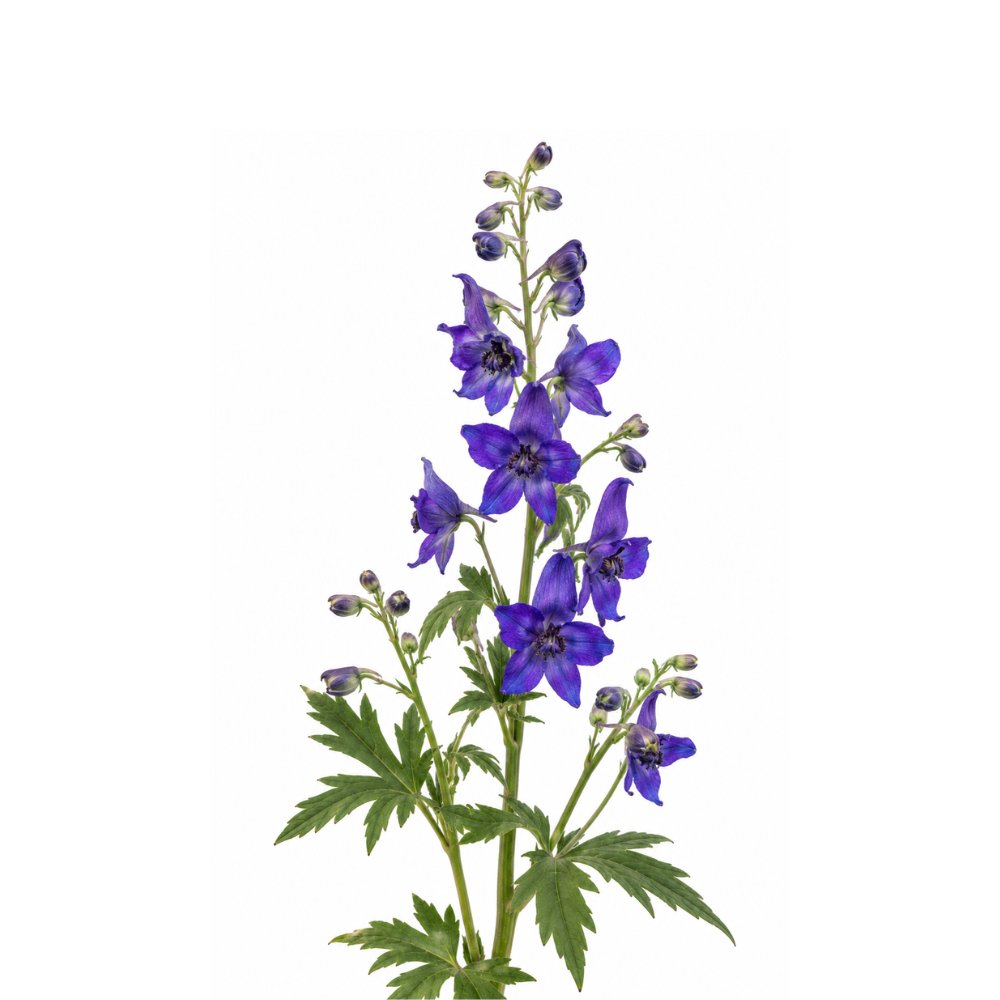
Larkspur is a tall perennial of western North American mountain meadows with spikes of blue-purple spurred flowers. Its alkaloid methyllycaconitine blocks nicotinic receptors, making the plant a major cause of cattle deaths on western rangelands.
What Is Larkspur?
Larkspur is a tall perennial of mountain meadows in western North America, with deeply divided leaves and spikes of blue-purple spurred flowers 20Reference 20Delphinium glaucum SView study →. It is a major cause of cattle deaths on western rangelands 11Reference 11Comparison of the serum toxicokinetics of larkspur toxins in cattle, sheep and goats — animalView study →.
Tall larkspur (Delphinium glaucum) grows in wet meadows, thickets, bogs, streamsides and open conifer woods from Alaska and the Yukon south to California and Colorado 20Reference 20Delphinium glaucum SView study →. Low larkspur (D. bicolor) is a smaller plant of drier meadow edges and open woodland 21Reference 21Delphinium bicolor NuttallView study →.
Its toxins are norditerpenoid alkaloids, chiefly methyllycaconitine, which block nicotinic acetylcholine receptors at the junction between nerve and muscle 10Reference 10ReviewBiomarkers and their potential for detecting livestock plant poisonings in Western North America — reviewView study →. Poisoned cattle weaken, collapse and can die of respiratory paralysis 7,
Human poisoning is rare 8Reference 8Case reportHuman poisoning due to Delphinium species in the Himalayan region of Nepal — case reportView study →. The reported human cases involve Asian Delphinium species taken as herbal medicines 8,
Identification & Lookalikes
Larkspur and monkshood have similar deeply divided leaves and grow in the same meadows. They are told apart by the flower.
| Character | |
|---|---|
| Larkspur (Delphinium) | The uppermost sepal is drawn backward into a single hollow spur 20Reference 20Delphinium glaucum SView study → |
| Monkshood (Aconitum) | The uppermost sepal forms a hood arching over the flower. No spur |
Both plants are poisonous. The distinction tells which poisoning to expect: larkspur alkaloids block the junction between nerve and muscle 10Reference 10ReviewBiomarkers and their potential for detecting livestock plant poisonings in Western North America — reviewView study →, while monkshood causes heart rhythm disturbances.
Botany
Tall larkspur (Delphinium glaucum S.Watson) is a perennial in the Ranunculaceae. It is one of about 300 species in the genus 20Reference 20Delphinium glaucum SView study →.
Its stems are usually 100–200 cm tall, occasionally up to 300 cm. They are hairless, and green and waxy-bloomed at the base 20Reference 20Delphinium glaucum SView study →.
The plant carries 15–20 leaves along the stem. They are round to pentagonal in outline, 2–11 cm long, and deeply divided into 5–9 or more pointed lobes 20Reference 20Delphinium glaucum SView study →.
The flowers grow in a long raceme of usually 40–90 flowers 20Reference 20Delphinium glaucum SView study →. The sepals are bluish purple to lavender, and the upper sepal ends in a straight spur 10–15 mm long 20Reference 20Delphinium glaucum SView study →. The fruits are pods 9–20 mm long 20Reference 20Delphinium glaucum SView study →.
Low larkspur (D. bicolor Nutt.) is a much smaller plant, with stems 10–40 cm tall, occasionally 70 cm 21Reference 21Delphinium bicolor NuttallView study →. Its leaves sit mostly near the base, and it carries 3–12 dark blue flowers with spurs 13–23 mm long 21Reference 21Delphinium bicolor NuttallView study →.
Distribution
Tall larkspur grows from Alaska, the Yukon and the Northwest Territories south through British Columbia and Alberta 20Reference 20Delphinium glaucum SView study →. In the United States it reaches Washington, Oregon, California, Nevada, Idaho, Montana, Utah, Wyoming and Colorado 20Reference 20Delphinium glaucum SView study →.
It grows in meadows, wet thickets, bogs, streamsides and open conifer woods, from sea level to 3,200 m 20Reference 20Delphinium glaucum SView study →. It is naturalised, not native, at its sites in Saskatchewan and Manitoba 20Reference 20Delphinium glaucum SView study →.
In Utah and Colorado it hybridises so freely with D. barbeyi that the hybrids are more common in many areas than either parent 20Reference 20Delphinium glaucum SView study →.
Low larkspur grows on dry meadow edges, in sage scrub and in open woodland, from 600 to 3,100 m 21Reference 21Delphinium bicolor NuttallView study →. It is found in Alberta, British Columbia and Saskatchewan, and south to Idaho, Montana, Wyoming and the Dakotas 21Reference 21Delphinium bicolor NuttallView study →.
Phytochemistry
The toxic alkaloids are the MSAL-type norditerpenoid alkaloids (N-(methylsuccinimido)anthranoyllycoctonine type) 3Reference 3AnimalThe effect of 7,8-methylenedioxylycoctonine-type diterpenoid alkaloids on the toxicity of methyllycaconitine in mice — animalView study →. They sit within a larger pool of less toxic MDL-type (7,8-methylenedioxylycoctonine) alkaloids 3Reference 3AnimalThe effect of 7,8-methylenedioxylycoctonine-type diterpenoid alkaloids on the toxicity of methyllycaconitine in mice — animalView study →.
Methyllycaconitine (MLA) and 14-deacetylnudicauline are the major toxins in tall larkspur 2Reference 2Influence of alkaloid concentration on acceptability of tall larkspur (Delphinium spp.) to cattle and sheepView study →. Nudicauline belongs to the same group.
Toxic alkaloids make up about 20–50% of the total alkaloid in tall larkspur 2Reference 2Influence of alkaloid concentration on acceptability of tall larkspur (Delphinium spp.) to cattle and sheepView study →. The MSAL-type alkaloids are typically more than 20 times as toxic as the MDL-type 3Reference 3AnimalThe effect of 7,8-methylenedioxylycoctonine-type diterpenoid alkaloids on the toxicity of methyllycaconitine in mice — animalView study →. Some larkspur populations carry mostly one type and some mostly the other 4,
In tall larkspur (D. barbeyi), the concentration of toxic and total alkaloid in the leaves and stems falls as the plant matures, while the concentration in flowers and pods rises 1Reference 1Distribution of norditerpene alkaloids in tall larkspur plant parts through the growing seasonView study →. The concentration in the root falls during early growth and rises again at the end of the season 1Reference 1Distribution of norditerpene alkaloids in tall larkspur plant parts through the growing seasonView study →.
Cattle eat more larkspur as it matures 2Reference 2Influence of alkaloid concentration on acceptability of tall larkspur (Delphinium spp.) to cattle and sheepView study →. In feeding and field trials, alkaloid concentration did not predict how much larkspur cattle ate; the stage of growth did 2Reference 2Influence of alkaloid concentration on acceptability of tall larkspur (Delphinium spp.) to cattle and sheepView study →.
Constituent Summary
Diterpenoid Alkaloid2 compounds2 with data
Toxicology
Class of poison. Norditerpenoid alkaloid; a competitive blocker of nicotinic acetylcholine receptors.
Mechanism. Larkspur alkaloids block nicotinic acetylcholine receptors at the junction between nerve and muscle, which stops acetylcholine from activating them 10Reference 10ReviewBiomarkers and their potential for detecting livestock plant poisonings in Western North America — reviewView study →. Methyllycaconitine is also a potent antagonist at the neuronal α7 nicotinic receptor 17Reference 17In vitroMethyllycaconitine is a potent antagonist of α-conotoxin-MII-sensitive presynaptic nicotinic acetylcholine receptors in rat striatum — in vitroView study →.
The less toxic alkaloids add to the toxicity. The MDL-type alkaloids deltaline and 14-O-acetyldictyocarpine are much weaker on their own. In mice given the alkaloids by injection, the lethal dose of MLA was 4.4 mg/kg alone 3Reference 3AnimalThe effect of 7,8-methylenedioxylycoctonine-type diterpenoid alkaloids on the toxicity of methyllycaconitine in mice — animalView study →. Adding deltaline at 1:1, 1:5 and 1:25 ratios lowered it to 2.7, 2.5 and 1.9 mg/kg, and 14-O-acetyldictyocarpine at 1:25 lowered it to 1.5 mg/kg 3Reference 3AnimalThe effect of 7,8-methylenedioxylycoctonine-type diterpenoid alkaloids on the toxicity of methyllycaconitine in mice — animalView study →.
This was not because more MLA reached the body: MLA levels and its clearance from brain and muscle were unchanged 3Reference 3AnimalThe effect of 7,8-methylenedioxylycoctonine-type diterpenoid alkaloids on the toxicity of methyllycaconitine in mice — animalView study →. In cattle, a higher ratio of MDL-type to MSAL-type alkaloids also meant less MSAL-type alkaloid was needed to cause poisoning 4Reference 4The effect of 7,8-methylenedioxylycoctonine-type diterpenoid alkaloids on the toxicity of tall larkspur in cattle — animalView study →. The toxicity of a larkspur population therefore depends on both its toxic alkaloid content and its total alkaloid content 4Reference 4The effect of 7,8-methylenedioxylycoctonine-type diterpenoid alkaloids on the toxicity of tall larkspur in cattle — animalView study →.
Course in cattle. The signs are resistance to exercise, muscle weakness, trembling, lack of coordination and a rapid heart rate 10,
In one study of cows given larkspur daily, poisoning was most severe 5–9 hours after each dose, and the effect built up over about 4 days 14Reference 14Description of a scale for rating the clinical response of cattle poisoned by larkspur — animalView study →. Early signs can be subtle and brief, and exertion makes them temporarily worse 14Reference 14Description of a scale for rating the clinical response of cattle poisoned by larkspur — animalView study →.
Species differences. Sheep and horses are less susceptible than cattle, and grazing sheep through larkspur pasture before cattle is a common recommendation 11,
Dose in cattle. Toxicity depends on the dose of MSAL-type alkaloid, the ratio of MDL-type to MSAL-type alkaloids, and how much the animal ate, all of which vary by species, site and year 2,
Kinetics. In five steers given a single oral dose of D. barbeyi, none showed overt signs of poisoning, but heart rate rose to a peak of about 79 beats per minute at 17 hours, tracking serum MLA 5Reference 5Serum elimination profiles of methyllycaconitine and deltaline in cattle following oral administration of larkspur (Delphinium barbeyi) — animalView study →. Serum MLA peaked at 8.8 hours and deltaline at 5.0 hours. Their elimination half-lives were 20.5 hours for MLA and 8.2 hours for deltaline, and 99% of both cleared from the serum within six days 5Reference 5Serum elimination profiles of methyllycaconitine and deltaline in cattle following oral administration of larkspur (Delphinium barbeyi) — animalView study →.
A comparison of D. barbeyi and D. glaucescens supported a clearance time of about seven days 6Reference 6A toxicokinetic comparison of norditerpenoid alkaloids from Delphinium barbeyi and D. glaucescens in cattle — animalView study →.
Treatment in cattle. Poisoned animals should be kept calm and quiet, because agitation or exercise can turn a non-fatal dose into a lethal one 13Reference 13ReviewLarkspur poisoning of cattle: plant and animal factors that influence plant toxicity — reviewView study →. Because the block is competitive, cholinesterase inhibitors can reverse it. Intravenous physostigmine rapidly reversed tall larkspur poisoning in recumbent steers, though repeated injections were usually needed 15Reference 15Reversal of tall larkspur (Delphinium barbeyi) poisoning in cattle with physostigmine — animalView study →. Neostigmine reversed the heart effects and has been used to rescue recumbent cattle 13,
Human cases. Human poisoning is rare 8Reference 8Case reportHuman poisoning due to Delphinium species in the Himalayan region of Nepal — case reportView study →. The reported cases involve Asian medicinal species. In Nepal, a 32-year-old man who took a Delphinium preparation called “Nirmasi” as a tonic developed vomiting, low blood pressure and a slow heart rate, and recovered with supportive care 8Reference 8Case reportHuman poisoning due to Delphinium species in the Himalayan region of Nepal — case reportView study →.
In another case, a man accidentally ate the root of Delphinium denudatum, a South Asian herbal root containing aconitine-like alkaloids that act on sodium channels 9Reference 9Case reportSodium-channel-mediated ventricular arrhythmia after Delphinium denudatum ingestion — case reportView study →. He developed ventricular arrhythmia, which was controlled with lidocaine and magnesium 9Reference 9Case reportSodium-channel-mediated ventricular arrhythmia after Delphinium denudatum ingestion — case reportView study →. That mechanism is closer to monkshood than to range larkspur.
Traditional & Historical Use
European Folk Medicine: Stavesacre (Delphinium Staphisagria)
A related Mediterranean species, Delphinium staphisagria, known as stavesacre, appears among the historical louse remedies of European pharmacy 19Reference 19ReviewAncient treatment for lice: a source of suggestions for carriers of other infectious diseases? — historical reviewView study →.
Neuroscience
Methyllycaconitine is widely used in research as a selective antagonist of the α7 nicotinic acetylcholine receptor 17Reference 17In vitroMethyllycaconitine is a potent antagonist of α-conotoxin-MII-sensitive presynaptic nicotinic acetylcholine receptors in rat striatum — in vitroView study →. Tritiated MLA is used as a nicotinic radioligand 18Reference 18In vitroPharmacological properties of α9α10 nicotinic acetylcholine receptors revealed by heterologous expression of subunit chimeras — in vitroView study →.
Its selectivity is not absolute. MLA also blocks α-conotoxin-MII-sensitive receptors on dopamine nerve terminals, thought to contain α3 or α6 subunits 17Reference 17In vitroMethyllycaconitine is a potent antagonist of α-conotoxin-MII-sensitive presynaptic nicotinic acetylcholine receptors in rat striatum — in vitroView study →. It binds α9α10 receptors with high affinity 18Reference 18In vitroPharmacological properties of α9α10 nicotinic acetylcholine receptors revealed by heterologous expression of subunit chimeras — in vitroView study →.
Safety & Pregnancy
- Human poisoning is rare. The reported cases involve Asian medicinal species 8,
9Reference 8Case reportHuman poisoning due to Delphinium species in the Himalayan region of Nepal — case reportView study →Reference 9Case reportSodium-channel-mediated ventricular arrhythmia after Delphinium denudatum ingestion — case reportView study → . - A major cause of cattle deaths on western rangelands, killing by respiratory paralysis 7,
11Reference 7ReviewPlant-animal interactions in larkspur poisoning in cattle — reviewView study →Reference 11Comparison of the serum toxicokinetics of larkspur toxins in cattle, sheep and goats — animalView study → . - Cattle eat more larkspur as it matures 2Reference 2Influence of alkaloid concentration on acceptability of tall larkspur (Delphinium spp.) to cattle and sheepView study →, and the plant moves alkaloid into its flowers and pods 1Reference 1Distribution of norditerpene alkaloids in tall larkspur plant parts through the growing seasonView study →.
- Do not identify it by its leaves. Monkshood foliage is similar, and monkshood is far more dangerous to people.
- There is no herbal use.
Full Safety Detail
Livestock. The seasonal pattern matters most for managing cattle: alkaloid moves into flowers and pods as the plant matures 1Reference 1Distribution of norditerpene alkaloids in tall larkspur plant parts through the growing seasonView study →, cattle eat more of it at the same time 2Reference 2Influence of alkaloid concentration on acceptability of tall larkspur (Delphinium spp.) to cattle and sheepView study →, and moving poisoned animals makes the outcome worse 13,
Foragers. Larkspur matters to foragers mainly as a lookalike of monkshood. The spur on the larkspur flower and the hood on the monkshood flower tell them apart.
Not applicable. The plant has no dose and no use in any population.
References
- Ralphs, M. H., & Gardner, D. R. (2003). Distribution of norditerpene alkaloids in tall larkspur plant parts through the growing season. Journal of Chemical Ecology. https://pubmed.ncbi.nlm.nih.gov/14584673/
- Pfister, J. A., Manners, G. D., Gardner, D. R., et al. (1996). Influence of alkaloid concentration on acceptability of tall larkspur (Delphinium spp.) to cattle and sheep. Journal of Chemical Ecology. https://pubmed.ncbi.nlm.nih.gov/24225934/
- Welch, K. D., Panter, K. E., Gardner, D. R., et al. (2008). The effect of 7,8-methylenedioxylycoctonine-type diterpenoid alkaloids on the toxicity of methyllycaconitine in mice — animal. Journal of Animal Science. https://pubmed.ncbi.nlm.nih.gov/18539831/
- Welch, K. D., Green, B. T., Gardner, D. R., et al. (2012). The effect of 7,8-methylenedioxylycoctonine-type diterpenoid alkaloids on the toxicity of tall larkspur in cattle — animal. Journal of Animal Science. https://pubmed.ncbi.nlm.nih.gov/22247113/
- Green, B. T., Welch, K. D., Gardner, D. R., et al. (2009). Serum elimination profiles of methyllycaconitine and deltaline in cattle following oral administration of larkspur (Delphinium barbeyi) — animal. American Journal of Veterinary Research. https://pubmed.ncbi.nlm.nih.gov/19566479/
- Green, B. T., Welch, K. D., Gardner, D. R., et al. (2011). A toxicokinetic comparison of norditerpenoid alkaloids from Delphinium barbeyi and D. glaucescens in cattle — animal. Journal of Applied Toxicology. https://pubmed.ncbi.nlm.nih.gov/20635330/
- Ralphs, M. H., Olsen, J. D., Pfister, J. A., & Manners, G. D. (1988). Plant-animal interactions in larkspur poisoning in cattle — review. Journal of Animal Science. https://pubmed.ncbi.nlm.nih.gov/3049494/
- Adhikari, S., & Bhandari, A. (2020). Human poisoning due to Delphinium species in the Himalayan region of Nepal — case report. Journal of the Nepal Medical Association. https://pubmed.ncbi.nlm.nih.gov/34506390/
- Rassani, N., & Grauer, K. (2026). Sodium-channel-mediated ventricular arrhythmia after Delphinium denudatum ingestion — case report. JACC: Case Reports. https://pubmed.ncbi.nlm.nih.gov/41746248/
- Green BT, Welch KD, Lee ST, Stonecipher CA, Gardner DR, Stegelmeier BL. (2023). Biomarkers and their potential for detecting livestock plant poisonings in Western North America — review. Frontiers in Veterinary Science. https://pubmed.ncbi.nlm.nih.gov/36908517/
- Welch KD, Gardner DR, Green BT, Stonecipher CA, Cook D, Pfister JA. (2016). Comparison of the serum toxicokinetics of larkspur toxins in cattle, sheep and goats — animal. Toxicon. https://pubmed.ncbi.nlm.nih.gov/27374834/
- Bachler J, Ehlert K. (2022). Poisonous plants on rangelands: larkspur and poisonvetch. South Dakota State University Extension. https://extension.sdstate.edu/poisonous-plants-rangelands-larkspur-and-poisonvetch
- Green BT, et al. (2020). Larkspur poisoning of cattle: plant and animal factors that influence plant toxicity — review. Rangelands 42(1):1–8. https://doi.org/10.1016/j.rala.2020.01.004
- Olsen JD, Sisson DV. (1991). Description of a scale for rating the clinical response of cattle poisoned by larkspur — animal. American Journal of Veterinary Research. https://pubmed.ncbi.nlm.nih.gov/2035926/
- Pfister JA, Panter KE, Manners GD, Cheney CD. (1994). Reversal of tall larkspur (Delphinium barbeyi) poisoning in cattle with physostigmine — animal. Veterinary and Human Toxicology. https://pubmed.ncbi.nlm.nih.gov/7900266/
- Green BT, Pfister JA, Cook D, Welch KD, Stegelmeier BL, Lee ST. (2009). Effects of larkspur (Delphinium barbeyi) on heart rate and electrically evoked electromyographic response of the external anal sphincter in cattle — animal. American Journal of Veterinary Research. https://pubmed.ncbi.nlm.nih.gov/19335112/
- Mogg AJ, Whiteaker P, McIntosh JM, Marks M, Collins AC, Wonnacott S. (2002). Methyllycaconitine is a potent antagonist of α-conotoxin-MII-sensitive presynaptic nicotinic acetylcholine receptors in rat striatum — in vitro. Journal of Pharmacology and Experimental Therapeutics. https://pubmed.ncbi.nlm.nih.gov/12065717/
- Baker ER, Zwart R, Sher E, Millar NS. (2004). Pharmacological properties of α9α10 nicotinic acetylcholine receptors revealed by heterologous expression of subunit chimeras — in vitro. Molecular Pharmacology. https://pubmed.ncbi.nlm.nih.gov/14742688/
- Vicentini CB, Manfredini S, Contini C. (2018). Ancient treatment for lice: a source of suggestions for carriers of other infectious diseases? — historical review. Le Infezioni in Medicina. https://pubmed.ncbi.nlm.nih.gov/29932096/
- Warnock MJ. (1997). Delphinium glaucum S. Watson, and genus Delphinium. In: Flora of North America Editorial Committee, eds. Flora of North America North of Mexico, Vol. 3. http://www.efloras.org/florataxon.aspx?flora_id=1&taxon_id=233500500
- Warnock MJ. (1997). Delphinium bicolor Nuttall. In: Flora of North America North of Mexico, Vol. 3. http://www.efloras.org/florataxon.aspx?flora_id=1&taxon_id=233500477 and http://www.efloras.org/florataxon.aspx?flora_id=1&taxon_id=233500478



