
Materia Medica
Monkshood ☠️
Aconitum columbianum
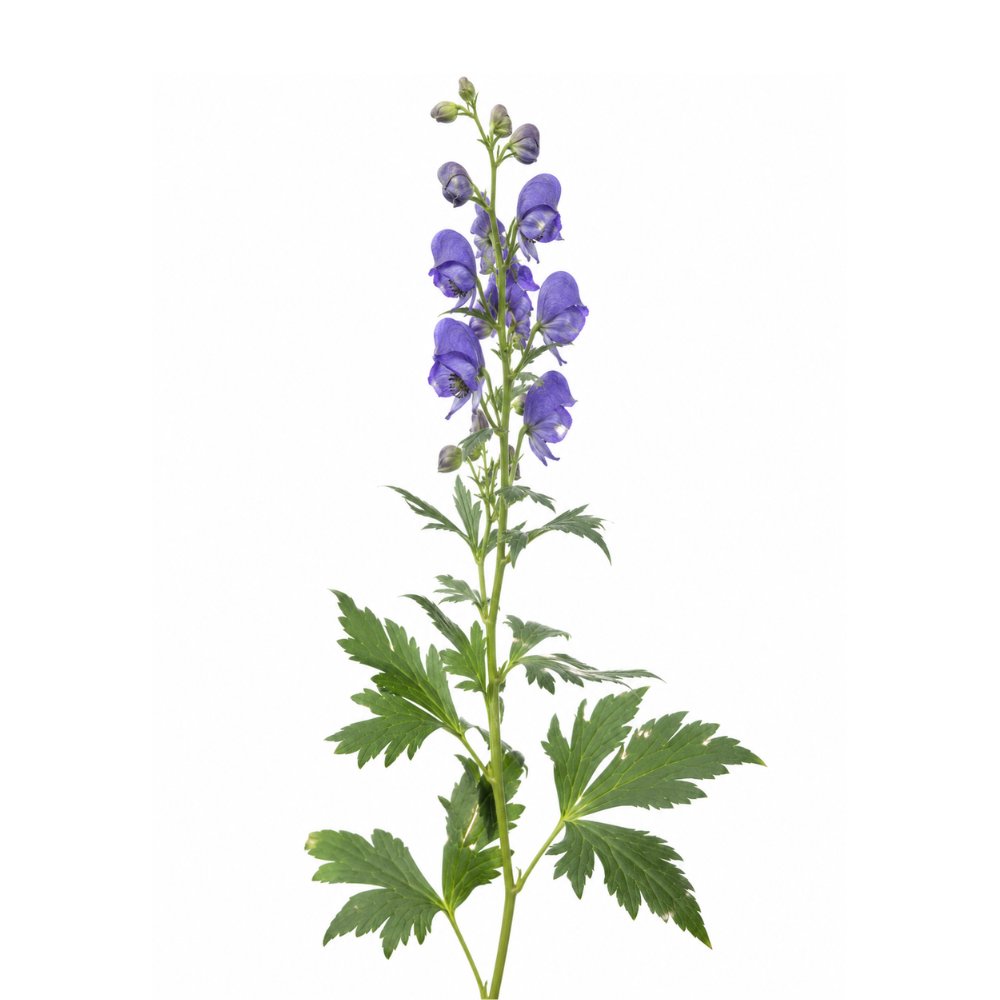
Monkshood is a tall mountain wildflower with hooded blue-purple flowers. Its roots carry aconitine, a heart poison that holds sodium channels open; long boiling breaks the alkaloid down, which is how processed Asian aconite root, fu zi, is made.
What Is Monkshood?
Monkshood is a tall perennial of moist mountain meadows and streambanks, with deeply divided leaves and hooded blue-purple flowers. Its tuberous roots hold aconitine and related alkaloids, which are heart and nerve poisons 4Reference 4Aconite poisoning.
In western North America the common species is Aconitum columbianum, which grows from British Columbia south to Mexico. A northern species, A. delphiniifolium, reaches Alberta, the Yukon and Alaska 5Reference 5Aconitum, AView study →. Monkshood often grows alongside larkspur, which it closely resembles.
Raw aconite root is extremely toxic 4Reference 4Aconite poisoning. Processed aconite root, fu zi, is made from an Asian species and has a monograph in the Chinese Pharmacopoeia. The difference between them is prolonged boiling, which breaks the toxic alkaloids down 4,
Identification & Lookalikes
Do not identify this plant by its leaves. The palmately divided leaves of monkshood (Aconitum) and larkspur (Delphinium) are easily confused.
Flower structure is the reliable character. Both have five petal-like sepals.
| Character | |
|---|---|
| Monkshood (Aconitum) | The upper sepal forms a hood or helmet that arches over the flower and hides two small nectar petals 5Reference 5Aconitum, AView study →. No spur shows outside the flower |
| Larkspur (Delphinium) | The upper sepal is drawn backward into a single hollow spur |
The rule: a hood and no visible spur is monkshood; a backward-pointing spur is larkspur.
Both genera carry diterpenoid alkaloids and both are dangerous 5Reference 5Aconitum, AView study →. The distinction matters for knowing what to expect: aconitine causes heart rhythm problems, while larkspur’s methyllycaconitine blocks the nerve-muscle junction.
Botany
Aconitum columbianum Nutt. and A. delphiniifolium DC. are perennials in the buttercup family, Ranunculaceae 5Reference 5Aconitum, AView study →.
A. columbianum grows from a tuberous root up to 6 cm long, which produces one (rarely two) daughter tubers pressed close against it. Its stems are 0.2–3 m tall, and can be erect and stout or twining and reclining 5Reference 5Aconitum, AView study →. The leaves are deeply divided into three to five (sometimes seven) segments, 5–15 cm wide, with cut and toothed margins 5Reference 5Aconitum, AView study →.
The flowers grow in open spikes or branched clusters. They are usually blue, sometimes white or cream, and 18–50 mm tall from the tips of the lower sepals to the top of the hood 5Reference 5Aconitum, AView study →. Plants in the Sierra Nevada, the Klamath Mountains and the Oregon Cascades carry small bulbils in the leaf axils (subsp. viviparum) 5Reference 5Aconitum, AView study →.
A. delphiniifolium is a smaller plant, with slender stems 0.1–1 m tall. Its leaves are divided to the base into narrow lobes, and its hood is usually lower and more crescent-shaped 5Reference 5Aconitum, AView study →.
The flower is the source of every common name. The upper sepal is enlarged into an arching hood that encloses the rest of the flower like a cowl 5Reference 5Aconitum, AView study →. Larkspur grows in the same meadows with similar leaves but carries a backward-pointing spur instead.
The medicinal species are Asian. A. carmichaelii is the source of fu zi 6Reference 6Aconitum carmichaelii: a clinical-regulatory synthesis of traditional use, toxicological evidence, and global safety governance. The Asian species dominate the clinical poisoning literature through under-processed or overdosed decoctions, not foraging 4,
Distribution
A. columbianum grows mainly in western North America. It is found in British Columbia and south through Washington, Oregon, Idaho and Montana to California, Nevada, Utah, Colorado, Wyoming, Arizona and New Mexico, east to South Dakota, and into Mexico 5Reference 5Aconitum, AView study →.
Small, isolated populations also grow in Iowa, Wisconsin, Ohio and New York, sometimes in cold air draining from caves. They are probably relicts left behind since the last glacial period 5Reference 5Aconitum, AView study →.
It grows in spring-fed bogs, seeps, meadows, along streams and in other wet places, from 300 to 3,500 m 5Reference 5Aconitum, AView study →.
A. delphiniifolium carries the genus further north. It grows in Alberta, British Columbia, the Yukon, the Northwest Territories and Alaska, and in Russia, in meadows, along creeks, in thickets and woods, on rocky slopes and on alpine tundra up to 1,700 m 5Reference 5Aconitum, AView study →.
Phytochemistry
The toxins are C19 diester-diterpenoid alkaloids, which carry an acetyl ester at C-8 and a benzoyl ester at C-14 6Reference 6Aconitum carmichaelii: a clinical-regulatory synthesis of traditional use, toxicological evidence, and global safety governance.
Aconitine is the principal one, with mesaconitine, hypaconitine and jesaconitine alongside it 4,
Alkaloids carrying both ester groups are the most toxic 6Reference 6Aconitum carmichaelii: a clinical-regulatory synthesis of traditional use, toxicological evidence, and global safety governance. Removing them, first the acetyl and then the benzoyl, turns aconitine into benzoylaconine and then aconine, each far less toxic than the last 6Reference 6Aconitum carmichaelii: a clinical-regulatory synthesis of traditional use, toxicological evidence, and global safety governance. This is the chemistry behind aconite processing.
Aconitum alkaloids range from almost harmless to deadly 5Reference 5Aconitum, AView study →. Flora of North America notes that the little information available suggests A. columbianum is probably not one of the most toxic aconites 5Reference 5Aconitum, AView study →.
Constituent Summary
Diterpenoid Alkaloid3 compounds3 with data
Toxicology
Class of poison. Diester-diterpenoid alkaloid that keeps sodium channels switched on.
Mechanism. Aconitine binds to receptor site 2 on the voltage-gated sodium channel 1,
Course. Symptoms start within minutes to about 1–2 hours, on average about 44 minutes after ingestion 6Reference 6Aconitum carmichaelii: a clinical-regulatory synthesis of traditional use, toxicological evidence, and global safety governance. The telling early sign is numbness and tingling of the face, the area around the mouth and the limbs, with nausea, vomiting and abdominal pain 4Reference 4Aconite poisoning. Muscle weakness in the limbs may follow 4Reference 4Aconite poisoning.
The heart effects include low blood pressure, chest pain, palpitations, a slow or fast heart rate, ventricular tachycardia and ventricular fibrillation 4Reference 4Aconite poisoning. Bidirectional ventricular tachycardia has also been recorded 10Reference 10Various morphologies of bidirectional ventricular tachycardia caused by aconite “Torikabuto” poisoning. These arrhythmias often resist electrical cardioversion and antiarrhythmic drugs 4Reference 4Aconite poisoning. Deaths come from arrhythmias and cardiac arrest, most often within the first 24 hours 4,
Toxic dose. A single dose of 2–6 mg of aconitine is reported to be fatal in humans 6Reference 6Aconitum carmichaelii: a clinical-regulatory synthesis of traditional use, toxicological evidence, and global safety governance. The lowest lethal oral dose has been estimated at about 1–2 mg 7Reference 7ReviewToxicology and detoxification processing of Fuzi (Aconitum carmichaelii Debeaux lateral root): a comprehensive review integrating historical perspectives and modern research. These are estimates carried through reviews, not doses measured in people.
Antidote. None. Care is supportive and focused on the heart: close monitoring of blood pressure and rhythm, atropine for a slow heart rate, drugs to support blood pressure, and amiodarone or flecainide as first-line antiarrhythmics. In arrhythmias or shock that do not respond, early cardiopulmonary bypass is recommended 4Reference 4Aconite poisoning.
Fatalities. The overall hospital death rate in aconite poisoning is about 5.5% 4Reference 4Aconite poisoning. Most recorded cases are Asian and come from herbal medicine, not foraging. In a five-year Hong Kong series of 52 confirmed cases, the causes were prescribing too much aconite, aconite dispensed by mistake in place of another herb, inadequately processed herb and dispensing errors; there were no deaths 8Reference 8Case reportAconite poisoning over 5 years: a case series in Hong Kong and lessons towards herbal safety. No fatal poisoning from A. columbianum or A. delphiniifolium appears in the case literature.
Skin Contact
Human skin lets aconitine and mesaconitine through in laboratory diffusion tests 3Reference 3Aconite poisoning following the percutaneous absorption of Aconitum alkaloids. Aconite tinctures and raw aconite roots applied to the skin have caused both fatal and non-fatal poisoning 3Reference 3Aconite poisoning following the percutaneous absorption of Aconitum alkaloids. Both are highly concentrated, and the risk is higher when they are held against the skin under a covering or applied to broken skin 3Reference 3Aconite poisoning following the percutaneous absorption of Aconitum alkaloids.
The reported cases involve these concentrated preparations, not brushing against the growing plant 3Reference 3Aconite poisoning following the percutaneous absorption of Aconitum alkaloids.
Why Processed Aconite Is a Different Material
Prolonged boiling breaks the ester groups off step by step, from diester to monoester to the alkaloid core 6Reference 6Aconitum carmichaelii: a clinical-regulatory synthesis of traditional use, toxicological evidence, and global safety governance. Aconitine becomes benzoylaconine, then aconine. Mouse oral LD₅₀ values show the drop:
| Compound | Mouse oral LD₅₀ | Change |
|---|---|---|
| Aconitine | about 1.8 mg/kg 6Reference 6Aconitum carmichaelii: a clinical-regulatory synthesis of traditional use, toxicological evidence, and global safety governance | — |
| Benzoylaconine | about 70 mg/kg 6Reference 6Aconitum carmichaelii: a clinical-regulatory synthesis of traditional use, toxicological evidence, and global safety governance | about 40 times less toxic |
| Mesaconitine | about 1.9 mg/kg 7Reference 7ReviewToxicology and detoxification processing of Fuzi (Aconitum carmichaelii Debeaux lateral root): a comprehensive review integrating historical perspectives and modern research | — |
| Benzoylmesaconine | about 810 mg/kg 7Reference 7ReviewToxicology and detoxification processing of Fuzi (Aconitum carmichaelii Debeaux lateral root): a comprehensive review integrating historical perspectives and modern research | about 400 times less toxic |
Another review gives a higher LD₅₀ for benzoylaconine, about 1.5 g/kg, which would make the drop larger still 7Reference 7ReviewToxicology and detoxification processing of Fuzi (Aconitum carmichaelii Debeaux lateral root): a comprehensive review integrating historical perspectives and modern research.
Processed aconite is lower-risk, not risk-free. Poisoning still happens when too much is taken or when toxic alkaloids remain after processing 6Reference 6Aconitum carmichaelii: a clinical-regulatory synthesis of traditional use, toxicological evidence, and global safety governance. None of this applies to the wild plant in a meadow: the safety belongs to a controlled processing step, not to the genus.
Traditional & Historical Use
Traditional Chinese Medicine
Fu zi, Aconiti Lateralis Radix Praeparata, is the processed lateral (daughter) root of Aconitum carmichaelii. The Chinese Pharmacopoeia recognises several processed forms, including salt-processed, black-sliced, white-sliced and boiled root 6Reference 6Aconitum carmichaelii: a clinical-regulatory synthesis of traditional use, toxicological evidence, and global safety governance.
Aconite was first recorded in Shennong’s Materia Medica, the earliest Chinese herbal text. Because it is considered hot and dry, it was used for cold limbs, painful knees, difficulty walking, poor circulation and spasms 6Reference 6Aconitum carmichaelii: a clinical-regulatory synthesis of traditional use, toxicological evidence, and global safety governance. Today fu zi is usually given with other herbs, including for shock after a heart attack, low blood pressure and chronic heart failure 6Reference 6Aconitum carmichaelii: a clinical-regulatory synthesis of traditional use, toxicological evidence, and global safety governance.
The pharmacopoeia limits the remaining diester alkaloids in processed fu zi to 0.020% or less, and gives a daily dose of 3–15 g, decocted first 6Reference 6Aconitum carmichaelii: a clinical-regulatory synthesis of traditional use, toxicological evidence, and global safety governance.
Bulleyaconitine A, a diterpenoid alkaloid from Aconitum, is in clinical use as a pain reliever 9Reference 9Analgesic effects of bulleyaconitine A: new advances in research from ion channel targets to clinical translation.
Native American Medicine
The Salishan peoples used A. delphiniifolium medicinally 5Reference 5Aconitum, AView study →.
European and American Medicine
Aconitum has been used as a medicine and as a source of poisons throughout history 5Reference 5Aconitum, AView study →. Use of its alkaloids in Western medicine was largely abandoned by the late 1930s and early 1940s 5Reference 5Aconitum, AView study →.
Safety & Pregnancy
- Lethally poisonous raw, with no antidote. Ventricular arrhythmias often resist treatment 4Reference 4Aconite poisoning.
- Numbness and tingling around the mouth, soon after eating, is the telling early sign 4Reference 4Aconite poisoning.
- Concentrated preparations pass through the skin, especially broken or covered skin 3Reference 3Aconite poisoning following the percutaneous absorption of Aconitum alkaloids: tinctures and raw root, not the growing plant.
- No fatal case from the North American species appears in the case literature, and A. columbianum is probably not one of the most toxic aconites 5Reference 5Aconitum, AView study →.
- Do not identify it by its leaves. Larkspur leaves look almost the same. Use the hood.
- Processing does not transfer. Fu zi is lower-risk because of what boiling does to the esters, not because Aconitum is forgiving 6Reference 6Aconitum carmichaelii: a clinical-regulatory synthesis of traditional use, toxicological evidence, and global safety governance.
Full Safety Detail
The lethal dose. Reviews give 2–6 mg of aconitine as a fatal dose and about 1–2 mg as the lowest lethal dose 6,
Why the arrhythmias are hard to treat. Sodium channels that stay switched on cause extra beats across the heart muscle, which is why bidirectional ventricular tachycardia appears and why standard drugs and cardioversion often fail 4,
Where poisonings come from. Mostly from herbal decoctions: too high a dose, poorly processed root, or aconite dispensed in error 8Reference 8Case reportAconite poisoning over 5 years: a case series in Hong Kong and lessons towards herbal safety. Misidentified root dug on purpose is the other route.
Avoid entirely. The raw plant has no safe dose, and processed aconite is a prescribing decision for a trained practitioner, not self-treatment.
References
- Wright SN. Comparison of aconitine-modified human heart (hH1) and rat skeletal (µ1) muscle Na⁺ channels: an important role for external Na⁺ ions. J Physiol. 2002;538(Pt 3):759–771. PMID 11826163.
- Chan TYK, et al. Aconite poisoning: mechanisms, processing chemistry and clinical course. Toxicology review, 2021.
- Chan TYK. Aconite poisoning following the percutaneous absorption of Aconitum alkaloids. Forensic Sci Int. 2012;223(1–3):25–27. PMID 22766196.
- Chan TYK. Aconite poisoning. Clin Toxicol. 2009;47(4):279–285. PMID 19514874.
- Brink DE, Woods JA. Aconitum, A. columbianum and A. delphiniifolium. In: Flora of North America Editorial Committee, eds. Flora of North America North of Mexico, vol. 3. 1997. http://www.efloras.org/florataxon.aspx?flora_id=1&taxon_id=233500014
- Tan RY, Ooi PJ, Xu X, et al. Aconitum carmichaelii: a clinical-regulatory synthesis of traditional use, toxicological evidence, and global safety governance. Front Pharmacol. 2026;17:1830589. PMID 42440987.
- Zhang Y, Bai H, Zhou R, et al. Toxicology and detoxification processing of Fuzi (Aconitum carmichaelii Debeaux lateral root): a comprehensive review integrating historical perspectives and modern research. Front Pharmacol. 2026;17:1750573. PMID 42147340.
- Chen SP, Ng SW, Poon WT, et al. Aconite poisoning over 5 years: a case series in Hong Kong and lessons towards herbal safety. Drug Saf. 2012;35(7):575–587. PMID 22631223.
- Yin Z, Song X, Zhu C, Hou A, Chen R. Analgesic effects of bulleyaconitine A: new advances in research from ion channel targets to clinical translation. Front Pharmacol. 2026;16:1733973. PMID 41625327.
- Kitamura T, Fukamizu S, Hojo R, et al. Various morphologies of bidirectional ventricular tachycardia caused by aconite “Torikabuto” poisoning. J Cardiol Cases. 2013;7(2):e42–e44. PMID 30533117.



