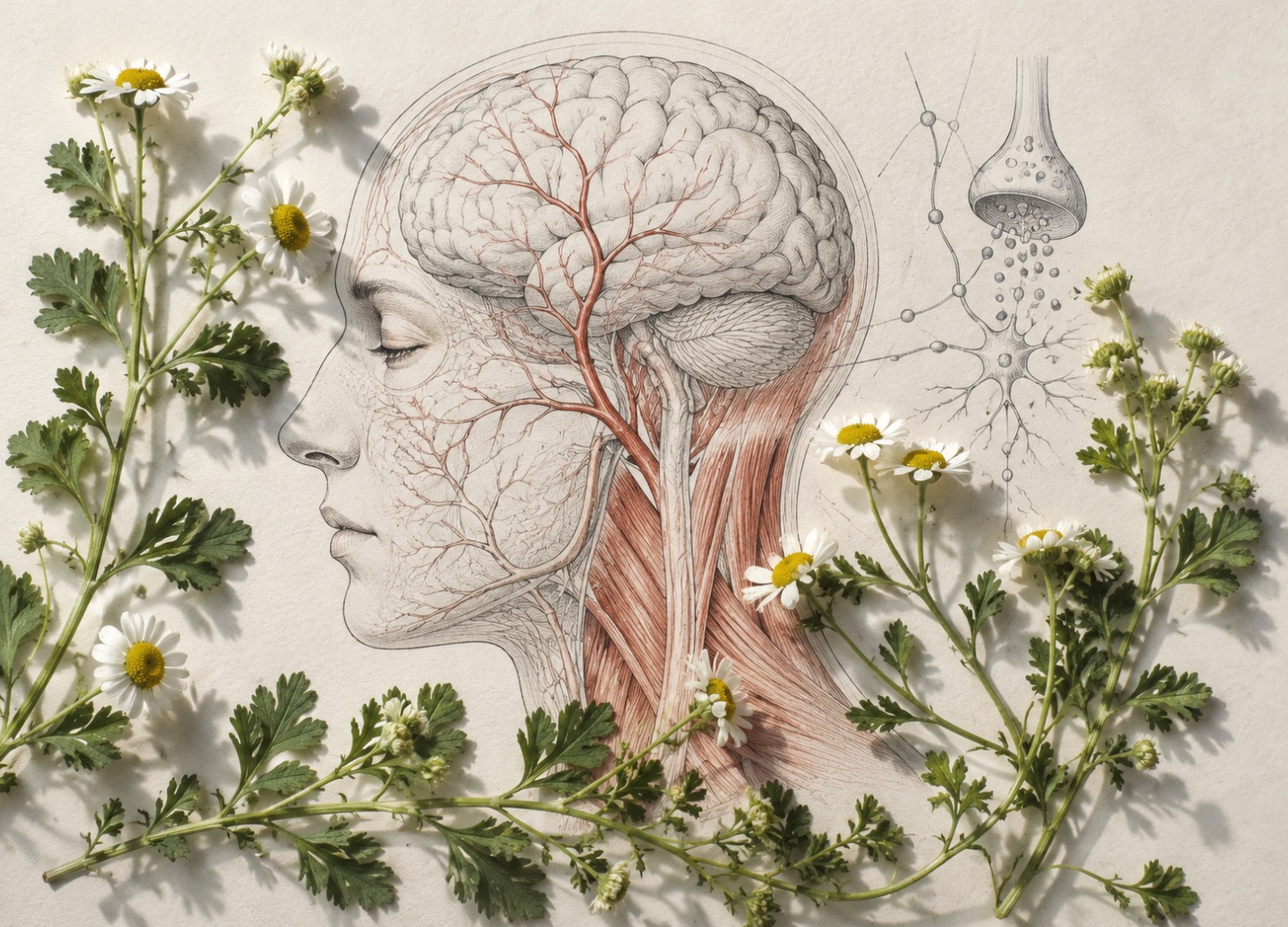
If you asked a room full of herbalists for the single best herb for migraines, most would give you the same answer without hesitation: feverfew (Tanacetum parthenium). It’s the herb with the longest track record, the most research behind it, and — in clinical practice — a reputation for genuinely changing lives for people who’d tried everything else.
Migraine is common and badly under-treated. In the United States, roughly 1 in 8 adults has migraine over any given year — about 11.7% overall, and far more women (17.1%) than men (5.6%) [1]. About a quarter of them have attacks frequent or disabling enough that they should be offered a preventive treatment — yet most never get one, or can’t tolerate the drugs on offer [1]. That’s the space feverfew has quietly filled for decades: a well-tolerated daily herb that, used properly, can meaningfully cut how often and how hard migraines strike.
Let’s make the case for it — properly, with the evidence — and then get you set up to actually succeed with it.
Bottom line — Feverfew is the best-evidenced, most trusted herbal preventive for migraine — used correctly, as a standardised extract or whole leaf taken daily, it can meaningfully reduce how often attacks strike.
Why Feverfew Is the Go-To Herb for Migraine
Feverfew isn’t just folklore — it’s the herbal migraine preventive with the most clinical evidence behind it, and an official place in modern neurology guidance.
- Proven
- Promising
- Shaky
- Unsupported
Here’s what four decades of research actually found:
- The landmark trial used a standardised supercritical CO₂ extract (MIG-99) at 6.25 mg three times a day. Over 16 weeks it clearly beat placebo, cutting migraine frequency — a rigorous, double-blind, multicentre study, exactly the kind of evidence critics say herbs never have [3].
- A dose-response study from the same group pinned down 6.25 mg as the effective dose, working best in the people who needed it most — those with frequent attacks [4].
- The classic whole-dried-leaf trials — Murphy 1988 [5] and Johnson 1985 [6] — found fewer attacks, less severe attacks, and less vomiting on feverfew than placebo.
- On the strength of this, the American Academy of Neurology and American Headache Society give feverfew (MIG-99) an official Level B — “probably effective” rating for preventing migraine [9]. That’s a real, earned designation — the same tier as magnesium and riboflavin, and more than almost any other herb can claim for any condition.
And here’s the clincher for calling it the best herb we have: the only botanical with stronger trial evidence was butterbur (Petasites), rated Level A in 2012 — but the guideline panel withdrew that recommendation in 2015 after unpurified butterbur products were linked to serious liver toxicity [16]. That leaves feverfew standing as the best-evidenced herbal migraine preventive that’s also safe and widely usable. It’s not a close race.
When the Research Lags Behind What Practitioners See
Here’s the honest part — and it’s not the knock it sounds like. The 2015 Cochrane review called the trial evidence “favourable but not yet conclusive” and asked for more studies [2]. That caution says less about feverfew than about who funds migraine research.
Large, expensive prevention trials get run for patentable drugs that can recoup the cost. An unpatentable garden herb doesn’t attract that money, so the feverfew studies we have are smaller and fewer than a pharmaceutical would get — not because feverfew failed, but because nobody stands to profit from proving it works. Absence of a fifty-million-dollar trial is not evidence of absence of effect.
Meanwhile, feverfew has been used for headache since antiquity — the physician Dioscorides reached for it for “all hot inflammations” — and generations of herbalists and, increasingly, physicians keep prescribing it because they watch it work. That real-world, repeated-observation experience is exactly how feverfew’s migraine use was discovered in the first place: it was patient reports in the 1980s that sent researchers to the lab, not the other way around. Traditional and clinical experience isn’t a substitute for trials, but it’s genuine evidence in its own right — and here it points the same direction the trials do.
Getting Results: Preparation Is Everything
If there’s one reason someone tries feverfew and says “it didn’t do anything for me,” it’s almost always this — and it’s fixable.
“Feverfew” isn’t one thing. How the leaf is grown, harvested, and extracted changes what ends up in the bottle, and off-the-shelf products vary enormously — many cheap capsules contain very little active compound at all [10]. In one trial an alcoholic extract didn’t outperform placebo, while whole dried leaf and the CO₂ extract did — a direct demonstration that the preparation, not the herb, is what fails [7][15].
So set yourself up to succeed:
- Choose a standardised CO₂ extract (the MIG-99 type) or genuine whole dried leaf — the forms that actually worked in the trials.
- Look for standardisation to at least 0.2% parthenolide, and buy from a maker you trust.
- Give it time. Feverfew is a preventive, not a painkiller — take it every day and judge it after at least 8–12 weeks, not a few doses.
Get those three right and you’re using feverfew the way the successful studies — and successful patients — did.
For an Attack in Progress: Feverfew + Ginger
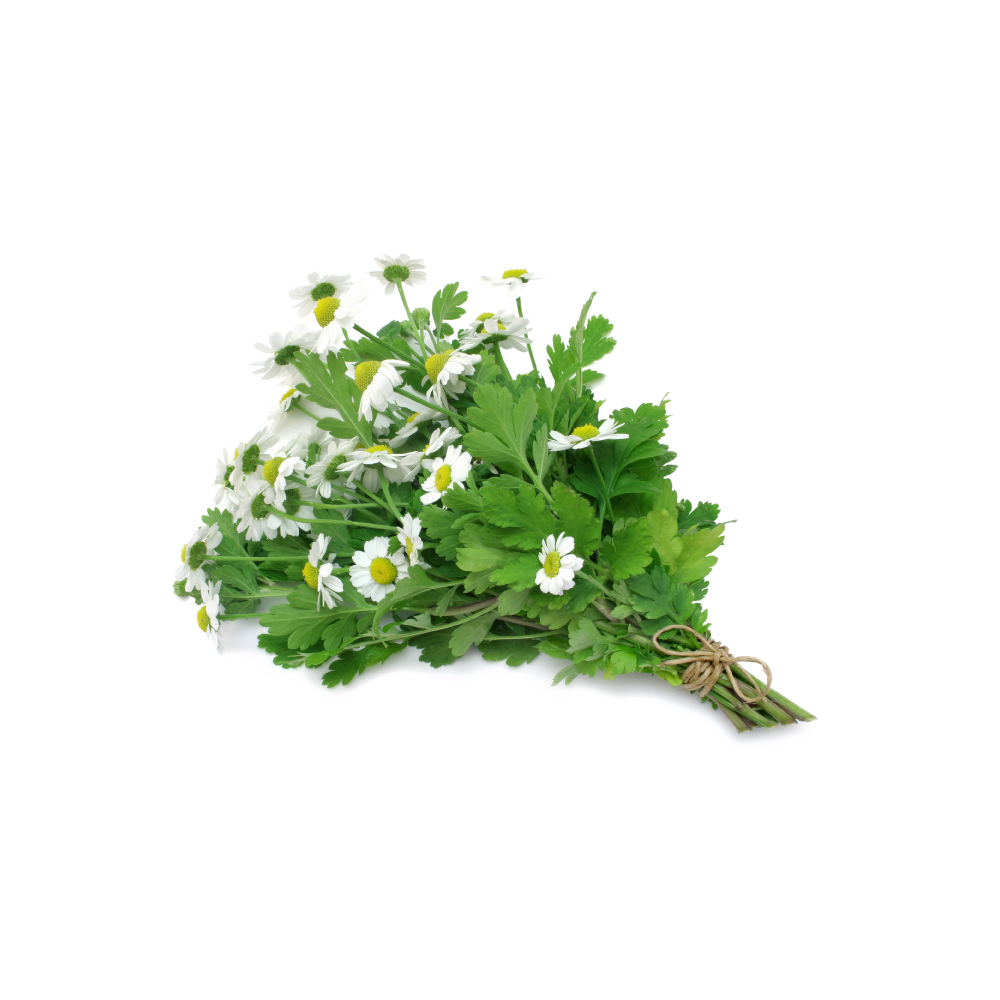
Feverfew’s main job is prevention — a daily herb that makes attacks rarer over time. But there’s a promising option for acute relief too: a feverfew-plus-ginger preparation taken under the tongue at the very first sign of an attack. In a placebo-controlled study, twice as many people were pain-free at two hours on the feverfew-ginger combination as on placebo [8]. Ginger brings its own anti-nausea and anti-inflammatory punch, making the pairing a natural fit. It’s an encouraging direction — and a reminder that feverfew’s usefulness in migraine keeps widening as it’s studied.
How Feverfew Works
Part of what makes feverfew so effective is that it doesn’t work through a single narrow mechanism — it touches several of the pathways involved in a migraine at once, which may be exactly why it helps such a varied condition. The best-studied actions:
- It calms platelets. Feverfew blocks the release of serotonin and other granules from platelets [11] — and a surge of platelet serotonin is one of the classic events thought to set off a migraine.
- It dampens inflammation at the source. Parthenolide directly inhibits IκB kinase, switching off NF-κB, a master control for inflammatory genes [13]. Notably this is a different route from aspirin and ibuprofen (which block COX enzymes) — one reason feverfew often helps people whom ordinary painkillers don’t.
- It blocks a prostaglandin precursor. Feverfew inhibits platelet phospholipase A₂, cutting off arachidonic acid before it becomes inflammatory prostaglandins [12].
- It relaxes blood-vessel reactivity — feverfew acts on the smooth muscle of blood vessels, part of the vascular picture in migraine [14].
That multi-target action is a real strength. Migraine is a complex condition that varies enormously from person to person, and a herb working on several fronts at once is far more likely to help across that variety than a drug aimed at a single receptor. It’s a big part of why feverfew has helped so many people whose migraines have very different underlying triggers.
How to Use Feverfew for Migraines
Two things matter most: take it daily as a preventive, and give it time to build.
Feverfew isn’t a fast fix, and that’s a feature, not a flaw — instead of masking a symptom, it works gradually to make migraines less frequent and less severe. Expect to give it at least a couple of months of consistent use before judging it. In those early weeks, keep using whatever you normally rely on for an acute attack (your usual pain relief, a dark quiet room, a cold compress) — feverfew is building your defences in the background.
Typical doses:
- Standardised CO₂ extract (MIG-99 type): 6.25 mg three times daily — the dose from the landmark trial [3].
- Dried leaf / capsules: commonly 50–150 mg of dried leaf per day, standardised to at least 0.2% parthenolide [10].
- Liquid extract: feverfew tinctures are usually 1:5; a common daily range is 1–3 mL. Follow the product’s label.
Many longtime users keep a potted feverfew going and take it fresh — a lovely tradition. Just note that chewing fresh leaves is the usual cause of feverfew’s one common side effect (mouth ulcers), so capsules or extracts are the gentler everyday route.
- Taper, don’t quit cold. After months of use, stopping abruptly can bring a short-lived rebound — headaches, restlessness, poor sleep, joint stiffness (“post-feverfew syndrome”). Wind it down gradually and you’ll avoid it [6][10].
- Prefer capsules/extract over chewing fresh leaves, which is the main cause of mouth ulcers [10].
- Not during pregnancy. Feverfew has a traditional uterine-stimulant reputation and no pregnancy safety data — avoid it while pregnant, and while breastfeeding to be safe [10].
- Daisy-family allergy? If you react to ragweed, chrysanthemum, marigold or daisies, feverfew (an Asteraceae) may not suit you.
- On blood thinners or heading for surgery? Feverfew mildly reduces platelet activity, so use care alongside anticoagulant/antiplatelet medication and pause it before surgery [11].
- Check in with your practitioner if you take regular medication or your migraine pattern is new or changing.
Frequently Asked Questions
Is feverfew really the best herb for migraine?
Will it stop a migraine I already have?
How long before I know if it’s working?
Which form should I buy?
Why isn’t there more research?
Can I just grow it and take it fresh?
Building a Complete Migraine Plan Around Feverfew
Feverfew is the cornerstone, and it works even better as part of a broader preventive routine:
- Track and manage your triggers — stress, skipped meals, dehydration, poor sleep, and alcohol are the usual suspects.
- Protect your sleep — irregular sleep is one of the most reliable migraine triggers.
- Lower your stress load — regular exercise, yoga, and meditation genuinely help.
- Stack complementary supports — magnesium and riboflavin (vitamin B2) share feverfew’s Level-B evidence tier and pair well with it [9].
- Get a proper diagnosis — new, severe, or changing headaches always deserve a professional assessment.
For the full botanical picture, see the feverfew monograph, and for the wider view on head pain, the headaches condition guide.
References
- Lipton, R. B., Bigal, M. E., Diamond, M., Freitag, F., Reed, M. L., & Stewart, W. F. (2007). Migraine prevalence, disease burden, and the need for preventive therapy. Neurology, 68(5), 343–349. Link
- Wider, B., Pittler, M. H., & Ernst, E. (2015). Feverfew for preventing migraine. Cochrane Database of Systematic Reviews, (4), CD002286. Link
- Diener, H. C., Pfaffenrath, V., Schnitker, J., Friede, M., & Henneicke-von Zepelin, H. H. (2005). Efficacy and safety of 6.25 mg t.i.d. feverfew CO₂-extract (MIG-99) in migraine prevention — a randomized, double-blind, multicentre, placebo-controlled study. Cephalalgia, 25(11), 1031–1041. Link
- Pfaffenrath, V., Diener, H. C., Fischer, M., Friede, M., & Henneicke-von Zepelin, H. H. (2002). The efficacy and safety of Tanacetum parthenium (feverfew) in migraine prophylaxis — a double-blind, multicentre, randomized placebo-controlled dose-response study. Cephalalgia, 22(7), 523–532. Link
- Murphy, J. J., Heptinstall, S., & Mitchell, J. R. (1988). Randomised double-blind placebo-controlled trial of feverfew in migraine prevention. Lancet, 2(8604), 189–192. Link
- Johnson, E. S., Kadam, N. P., Hylands, D. M., & Hylands, P. J. (1985). Efficacy of feverfew as prophylactic treatment of migraine. British Medical Journal (Clinical Research Ed.), 291(6495), 569–573. Link
- De Weerdt, C. J., Bootsma, H. P. R., & Hendriks, H. (1996). Herbal medicines in migraine prevention: randomized double-blind placebo-controlled crossover trial of a feverfew preparation. Phytomedicine, 3(3), 225–230. Link
- Cady, R. K., Goldstein, J., Nett, R., Mitchell, R., Beach, M. E., & Browning, R. (2011). A double-blind placebo-controlled pilot study of sublingual feverfew and ginger (LipiGesic M) in the treatment of migraine. Headache, 51(7), 1078–1086. Link
- Holland, S., Silberstein, S. D., Freitag, F., Dodick, D. W., Argoff, C., & Ashman, E. (2012). Evidence-based guideline update: NSAIDs and other complementary treatments for episodic migraine prevention in adults. Neurology, 78(17), 1346–1353. Link
- Pareek, A., Suthar, M., Rathore, G. S., & Bansal, V. (2011). Feverfew (Tanacetum parthenium L.): A systematic review. Pharmacognosy Reviews, 5(9), 103–110. Link
- Heptinstall, S., White, A., Williamson, L., & Mitchell, J. R. (1985). Extracts of feverfew inhibit granule secretion in blood platelets and polymorphonuclear leucocytes. Lancet, 1(8437), 1071–1074. Link
- Makheja, A. N., & Bailey, J. M. (1982). A platelet phospholipase inhibitor from the medicinal herb feverfew (Tanacetum parthenium). Prostaglandins, Leukotrienes and Medicine, 8(6), 653–660. Link
- Kwok, B. H. B., Koh, B., Ndubuisi, M. I., Elofsson, M., & Crews, C. M. (2001). The anti-inflammatory natural product parthenolide from the medicinal herb feverfew directly binds to and inhibits IκB kinase. Chemistry & Biology, 8(8), 759–766. Link
- Barsby, R. W. J., Salan, U., Knight, D. W., & Hoult, J. R. S. (1992). Feverfew extracts and parthenolide irreversibly inhibit vascular responses of the rabbit aorta. Journal of Pharmacy and Pharmacology, 44(9), 737–740. Link
- Barsby, R. W. J., Salan, U., Knight, D. W., & Hoult, J. R. S. (1993). Feverfew and vascular smooth muscle: extracts from fresh and dried plants show opposing pharmacological profiles, dependent upon sesquiterpene lactone content. Planta Medica, 59(1), 20–25. Link
- Butterbur. StatPearls [Internet]. Treasure Island (FL): StatPearls Publishing (updated 2024). — Notes butterbur’s 2012 Level A rating for migraine prevention and its subsequent withdrawal over pyrrolizidine-alkaloid hepatotoxicity in unpurified products. Link
Clinical herbalist and the writer behind The Sunlight Experiment — an evidence-based pharmacopoeia of herbs, supplements, and the chemistry behind them.