
Compound Monograph
Gentianine
Gentianine is a pyridine-type monoterpene alkaloid associated with gentian and Swertia — but much of the reported "gentianine" is not a genuine plant constituent at all: it forms when the herb's bitter secoiridoids (gentiopicroside, swertiamarin, sweroside) react with ammonia during extraction. It has a real but entirely preclinical anti-inflammatory and CNS signal, with no human data.

Sources · 6
Where Does It Come From?
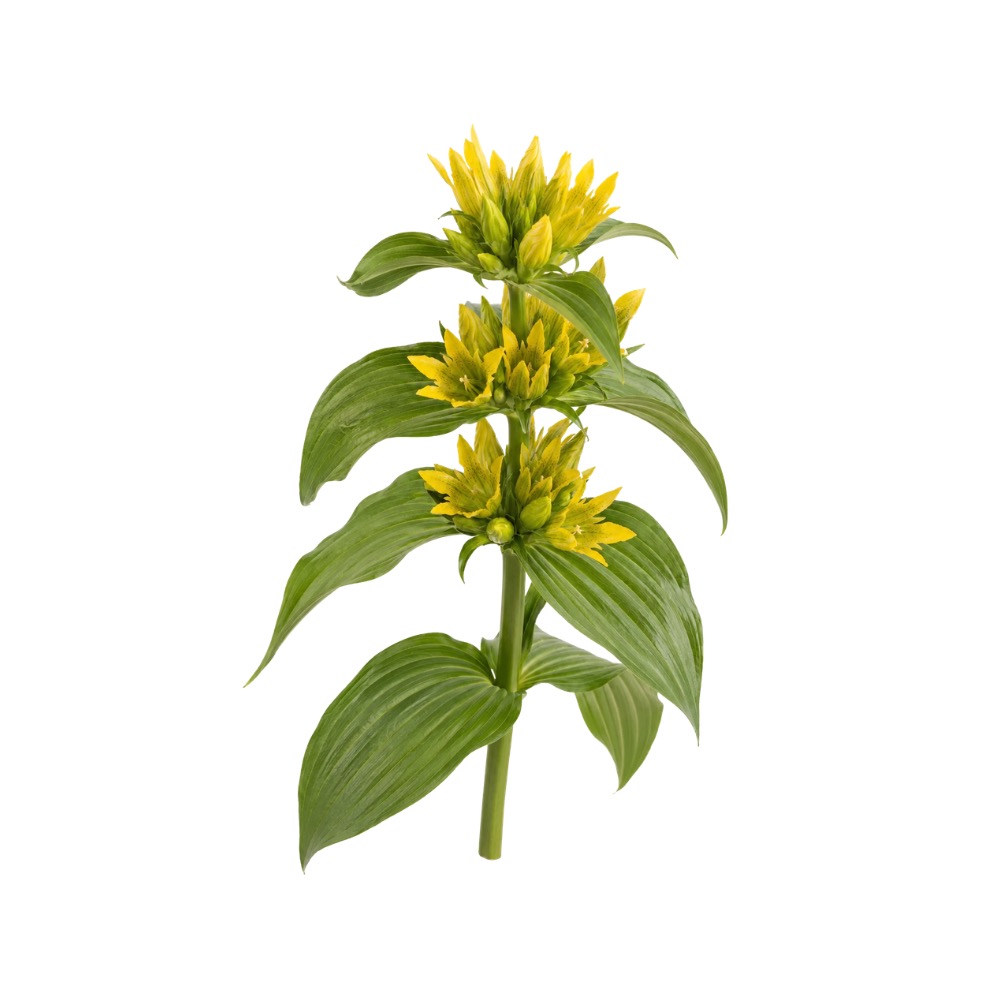
Gentianine is a naturally occurring pyridine (monoterpene) alkaloid — iridoid-derived; largely an extraction artifact, found in Yellow gentian, Chinese gentian, Large-leaf gentian and 3 other sources. It is well tolerated orally (low toxicity).
Concentration
Content by Source
Concentrations not reported. No percent-dry-weight or mg/g figures have been published for this compound in its source plants.
Gentianine at a Glance
Gentianine is a pyridine-type monoterpene alkaloid — a 3-vinylpyridine fused to a pyranone ring — associated with gentian (Gentiana) and Swertia 1Reference 1Pyridine alkaloids with activity in the central nervous systemView study →. It is structurally an iridoid-derived alkaloid, tied to the same secoiridoid chemistry that makes these roots intensely bitter.
The single most important thing to understand about it is that much of the “gentianine” reported in gentian and Swertia is not a genuine plant constituent. It forms readily when the herb’s bitter secoiridoids — gentiopicroside, swertiamarin and sweroside — react with ammonia during extraction and isolation, so a great deal of the alkaloid credited to these plants is an artifact of the laboratory workup rather than something the living plant makes in quantity 1Reference 1Pyridine alkaloids with activity in the central nervous systemView study →. This caveat runs underneath everything else on the page.
Beyond that chemistry, gentianine has a modest, entirely preclinical pharmacology: a fairly consistent anti-inflammatory signal across rodent models, a CNS signal that runs from an old sedative/antipsychotic characterisation to modern anti-neuroinflammatory stroke work, and a metabolic (PPAR-γ) signal seen when it is studied as a metabolite of swertiamarin 2,
An Iridoid-Derived Alkaloid (and Extraction Artifact)
Gentianine belongs to a small group of monoterpene (iridoid-derived) alkaloids in which the nitrogen sits in a pyridine ring built on a monoterpene skeleton 1Reference 1Pyridine alkaloids with activity in the central nervous systemView study →. In the Gentianaceae, that skeleton is the same one that underlies the family’s defining secoiridoids — gentiopicroside (gentiopicrin), swertiamarin and sweroside (the bitter glycosides of gentian and chirata, described in the gentian monograph).
The connection is not just biosynthetic — it is procedural. These secoiridoids carry aldehyde/enol-ether functionality that reacts with ammonia: when ammonia is present during extraction (as an added base, or from ammonium salts), nitrogen is incorporated into the iridoid framework and a pyridine alkaloid is generated. Gentianine (and the related gentialutine) are the classic textbook examples of alkaloids produced by basic ammonia extraction of the secoiridoids rather than pre-existing as major constituents 1Reference 1Pyridine alkaloids with activity in the central nervous systemView study →. The practical consequences are worth stating plainly:
- Reported content is unreliable as a measure of what the plant contains. A “gentianine” figure from an ammonia-based isolation partly measures the method, not the botany.
- The genuine in-planta amount is low and uncertain. Small quantities do appear to occur naturally, but the headline abundance is inflated by artifact formation 1Reference 1Pyridine alkaloids with activity in the central nervous systemView study →.
- It is a real molecule with real chemistry — the artifact caveat is about provenance and quantity, not about whether gentianine “exists.” Once formed (in a flask, or plausibly in the body from swertiamarin — see below), it is a bona-fide compound that can be dosed and studied 7Reference 7Anti-diabetic activity of swertiamarin is due to an active metabolite, gentianine, that upregulates PPAR-γ gene expression in 3T3-L1 cellsView study →.
This is the honest frame for the pharmacology that follows: a genuinely characterised alkaloid whose link to the whole herb is chemically slippery.
What It's Used For
Gentianine’s research base is small, rodent- and cell-only, and split across a few unrelated disease models. The through-line is anti-inflammatory signalling; the CNS and metabolic strands are thinner.
Support is an experimental score — weighted by study type (human > animal > in vitro) and volume. A beta, not a validated metric. All scores are capped low here: the entire evidence base is preclinical isolate work, and provenance is muddied by the artifact issue.
The best-supported strand, though still all rodent/cell. Oral gentianine (10–100 mg/kg) suppressed LPS-induced TNF-α and IL-6 in rats (ED₅₀ ≈ 38 mg/kg for each), while IL-1α was unchanged — the first clean demonstration of selective cytokine suppression by the isolate 3Reference 3AnimalEffects of gentianine on the production of pro-inflammatory cytokines in male Sprague-Dawley rats treated with lipopolysaccharide (LPS)View study →.
In Freund’s complete adjuvant arthritis it reduced IL-6, IL-1β and TNF-α and improved paw pathology, working through Rho/NF-κB and TGF-β/Smad-3 signalling 4Reference 4AnimalProtective effect of gentianine, a compound from Du Huo Ji Sheng Tang, against Freund’s complete adjuvant-induced arthritis in ratsView study →.
In DSS ulcerative colitis (12.5–50 mg/kg/day) it dose-dependently reduced disease activity, colon injury and MPO by inhibiting TLR4/NLRP3-mediated pyroptosis (IL-1β, IL-18) 5Reference 5Gentianine alleviates dextran sulfate sodium-induced ulcerative colitis via inhibition of TLR4/NLRP3-mediated pyroptosisView study →, and its stroke benefit is likewise attributed to damped TLR4/NF-κB neuroinflammation 6Reference 6Machine learning enables discovery of gentianine targeting TLR4/NF-κB pathway to repair ischemic stroke injuryView study →.
Gap: all isolated-molecule animal/cell work across unrelated models; no human data, and no study connects the effect back to a realistic whole-herb dose of the (partly artefactual) alkaloid 1,
The oldest and the newest threads. Bhattacharya’s 1974 letter characterised gentianine as centrally active in rats — reducing spontaneous motility and producing sedation at 10–20 mg/kg i.p., with hind-limb paralysis and catalepsy at 50–100 mg/kg — and framed it as an “antipsychotic” profile 2Reference 2Chemical constituents of Gentianaceae XI: antipsychotic activity of gentianineView study →.
Broader reviews of pyridine CNS alkaloids place it among centrally active but mechanistically ill-defined compounds 1Reference 1Pyridine alkaloids with activity in the central nervous systemView study →.
The modern re-entry is indirect: in a machine-learning-guided study, gentianine reduced infarct volume and microglial inflammation in a mouse stroke (tMCAO) model via TLR4/MyD88/NF-κB suppression 6Reference 6Machine learning enables discovery of gentianine targeting TLR4/NF-κB pathway to repair ischemic stroke injuryView study → — a neuro-inflammatory rather than neurotransmitter mechanism.
Gap: the 1974 behavioural work is old, brief and unreplicated at the receptor level; the modern effect is really the anti-inflammatory mechanism again; no human CNS data of any kind exist 1,
A single, mechanistically interesting cell study. In 3T3-L1 adipocytes, the secoiridoid swertiamarin had little direct effect, but gentianine — its metabolite — increased adipogenesis and upregulated PPAR-γ, GLUT-4 and adiponectin, so the authors attributed swertiamarin’s reported anti-diabetic activity to its conversion into gentianine 7Reference 7Anti-diabetic activity of swertiamarin is due to an active metabolite, gentianine, that upregulates PPAR-γ gene expression in 3T3-L1 cellsView study →.
This is notable because it implies gentianine can form from the secoiridoid in the body, not only in an ammonia flask.
Gap: one in-vitro adipocyte study; no in-vivo glycaemic outcome for gentianine itself, no human data, and the biotransformation-in-vivo step is inferred rather than fully mapped 7Reference 7Anti-diabetic activity of swertiamarin is due to an active metabolite, gentianine, that upregulates PPAR-γ gene expression in 3T3-L1 cellsView study →.
Mechanisms
| Target / pathway | Effect | Relevant to |
|---|---|---|
| NF-κB (incl. Rho/NF-κB) | suppression of NF-κB-driven inflammatory transcription | anti-inflammatory / arthritis |
| TLR4 / MyD88 signalling | reduced TLR4–MyD88–NF-κB activation (endotoxin, stroke, colitis) | anti-inflammatory / neuroprotective |
| NLRP3 inflammasome / pyroptosis | inhibited NLRP3-mediated pyroptosis; ↓ IL-1β, IL-18 | colitis |
| MAPK (p38 / ERK / JNK) & TGF-β/Smad-3 | modulation of inflammatory/fibrotic signalling | arthritis |
| Pro-inflammatory cytokines (TNF-α, IL-6) | dose-dependent suppression (ED₅₀ ≈ 38 mg/kg) | endotoxaemia |
| PPAR-γ / GLUT-4 / adiponectin | upregulation; ↑ adipogenesis | metabolic (as swertiamarin metabolite) |
The recurring node is TLR4/NF-κB-centred inflammation — most of gentianine’s disparate effects reduce to damping that axis, which is why one “anti-inflammatory” mechanism reappears under CNS and gut headings.
Pharmacokinetics
Human PK is absent; the useful data are one rat study. After oral dosing, gentianine is absorbed and extensively metabolised — four metabolites were identified in rat plasma (three of them novel), via N-oxidation, epoxidation, dihydroxylation of the vinyl double bond and lactone hydrolysis, with metabolite half-lives on the order of ~5–12 h 8Reference 8AnimalDetermination of the metabolic profile of gentianine after oral administration to rats by high performance liquid chromatography/electrospray ionization-trap mass spectrometryView study →. Two points matter for interpreting the page: (1) the parent is turned over rapidly into multiple oxidised products, so plasma gentianine is not the whole exposure story; and (2) the separate 3T3-L1 finding implies gentianine can also arise in vivo from the secoiridoid swertiamarin 7Reference 7Anti-diabetic activity of swertiamarin is due to an active metabolite, gentianine, that upregulates PPAR-γ gene expression in 3T3-L1 cellsView study →, meaning oral gentian/Swertia could deliver some gentianine indirectly. No absolute oral bioavailability, Cmax for the parent, or human ADME figure is established 8Reference 8AnimalDetermination of the metabolic profile of gentianine after oral administration to rats by high performance liquid chromatography/electrospray ionization-trap mass spectrometryView study →.
Clinical Trials
There are no clinical trials of gentianine — as an isolate it has never been taken into humans, and the herbal human evidence belongs to whole gentian/Swertia bitters, not to this alkaloid.
| Completed | Planned | Terminated | Preclinical |
|---|---|---|---|
| — | — | — | Anti-inflammatory (LPS, arthritis, colitis), stroke neuroprotection, metabolic (PPAR-γ) — all rodent/cell |
Last checked: July 2026.
Isolate vs. Plant Studies
For gentianine the usual isolate-vs-plant caution is unusually sharp, for two compounding reasons. First, every pharmacology study uses the isolated molecule in animals or cells 2,
Prevalence in Nature
Gentianine is reported across the Gentianaceae — from yellow gentian (Gentiana lutea) and other Gentiana species (G. scabra, G. macrophylla, G. kirilowii) and from Swertia (notably Swertia chirata, chirata) and Enicostemma littorale 1,
Quantitatively it is a trace component: older accounts put the combined alkaloid fraction (gentianine with gentialutine) at only around 0.03% of gentian root — and even that figure is unreliable, because the extraction conditions that liberate the alkaloid also manufacture it from the secoiridoids 1Reference 1Pyridine alkaloids with activity in the central nervous systemView study →. How much genuinely pre-exists in the intact plant is not well established and is probably low. Unlike the secoiridoids and xanthones, gentianine is best regarded as a minor, provenance-ambiguous member of the gentian phytochemical profile rather than a defining one.
Discovery & Synthesis
Gentianine was among the alkaloids reported from Gentiana in the early-to-mid twentieth century, during the classical phytochemical survey of gentian bitters, and its 3-vinylpyridine-fused-pyranone structure was subsequently confirmed by total synthesis 1Reference 1Pyridine alkaloids with activity in the central nervous systemView study →. Its history is inseparable from a recurring cautionary tale in natural-products chemistry: gentianine (with gentialutine) became a standard example of an alkaloid partly created by the isolation procedure — specifically by ammonia acting on the co-occurring secoiridoids — rather than a straightforwardly pre-formed metabolite 1Reference 1Pyridine alkaloids with activity in the central nervous systemView study →. There is no commercial production: gentianine is not manufactured or sold as a drug or supplement; it exists as a research chemical prepared by isolation from Gentianaceae extracts (with the artifact caveat) or by synthesis.
Patents: not yet researched.
Toxicity & Safety
Gentianine carries a low flag — appropriate for a trace, non-marketed plant alkaloid with no human exposure of consequence — but the flag is low, not nil, because the isolate is genuinely centrally active at high doses. In the 1974 rat work, doses of 50–100 mg/kg i.p. produced hind-limb paralysis and catalepsy, and the compound is CNS-depressant at the top of its dose range even as it is stimulant/sedative lower down 2Reference 2Chemical constituents of Gentianaceae XI: antipsychotic activity of gentianineView study →; a moderate-to-low acute toxicity (an LD₅₀ in the low hundreds of mg/kg) has been described 1,
No drug-interaction, contraindication or organ-toxicity dataset exists for the isolate, and its interaction potential (e.g. CYP involvement) is uncharacterised — silence here means untested, not safe. Any reproductive or developmental safety question is likewise unstudied for gentianine specifically; because it is a trace, provenance-ambiguous constituent with no human data, pregnancy and lactation decisions belong on the gentian herb page where intake is actually decided, not on this molecule page, and no isolate-level verdict is issued here.
- Trace, non-marketed constituent. Gentianine is not sold or dosed as a human product; real-world exposure is only as a minor (and partly artefactual) part of gentian/Swertia bitters.
- Centrally active at high isolate doses. In rats, 50–100 mg/kg produced sedation, catalepsy and hind-limb paralysis — a real CNS-depressant signal for the pure compound, though far above any herbal exposure 2Reference 2Chemical constituents of Gentianaceae XI: antipsychotic activity of gentianineView study →.
- Untested, not proven safe. No human data, no interaction/organ-toxicity package, no reproductive dataset for the isolate; absence of findings is absence of study 1Reference 1Pyridine alkaloids with activity in the central nervous systemView study →.
- Provenance is ambiguous. Because much reported gentianine is an ammonia-extraction artifact of the secoiridoids, “gentianine content” and whole-herb relevance are inherently uncertain 1Reference 1Pyridine alkaloids with activity in the central nervous systemView study →.
Dosage
There is no established or recommended human dose for gentianine. It is not a supplement or drug, and the figures in the literature are research doses in animals — roughly 10–100 mg/kg orally or intraperitoneally in rats and mice across the anti-inflammatory, CNS and stroke studies 2,
References
- Lin SX, Curtis MA, Sperry J (2020). Pyridine alkaloids with activity in the central nervous system. Bioorganic & Medicinal Chemistry. https://pubmed.ncbi.nlm.nih.gov/33120080/
- Bhattacharya SK, Ghosal S, Chaudhuri RK, Singh AK, Sharma PV (1974). Chemical constituents of Gentianaceae XI: antipsychotic activity of gentianine. Journal of Pharmaceutical Sciences. https://pubmed.ncbi.nlm.nih.gov/4859384/
- Kwak WJ, Kim JH, Ryu KH, Cho YB, Jeon SD, Moon CK (2005). Effects of gentianine on the production of pro-inflammatory cytokines in male Sprague-Dawley rats treated with lipopolysaccharide (LPS). Biological & Pharmaceutical Bulletin. https://pubmed.ncbi.nlm.nih.gov/15802824/
- Chen W, Wang J (2017). Protective effect of gentianine, a compound from Du Huo Ji Sheng Tang, against Freund’s complete adjuvant-induced arthritis in rats. Inflammation. https://pubmed.ncbi.nlm.nih.gov/28501981/
- Li YX, Lv L, Li SL, Qian HH (2024). Gentianine alleviates dextran sulfate sodium-induced ulcerative colitis via inhibition of TLR4/NLRP3-mediated pyroptosis. International Immunopharmacology. https://pubmed.ncbi.nlm.nih.gov/37979455/
- Wang N, Liu Y, Jia C, Gao C, et al. (2021). Machine learning enables discovery of gentianine targeting TLR4/NF-κB pathway to repair ischemic stroke injury. Pharmacological Research. https://pubmed.ncbi.nlm.nih.gov/34563661/
- Vaidya H, Goyal RK, Cheema SK (2013). Anti-diabetic activity of swertiamarin is due to an active metabolite, gentianine, that upregulates PPAR-γ gene expression in 3T3-L1 cells. Phytotherapy Research. https://pubmed.ncbi.nlm.nih.gov/22718571/
- Wu X, Tang S, Jin Y, et al. (2015). Determination of the metabolic profile of gentianine after oral administration to rats by high performance liquid chromatography/electrospray ionization-trap mass spectrometry. Journal of Chromatography B. https://pubmed.ncbi.nlm.nih.gov/25813903/
- Mirzaee F, Hosseini A, Bakhshi Jouybari H, Davoodi A, Azadbakht M (2017). Medicinal, biological and phytochemical properties of Gentiana species. Journal of Traditional and Complementary Medicine. https://pubmed.ncbi.nlm.nih.gov/29034186/



