Glutathione (reduced)
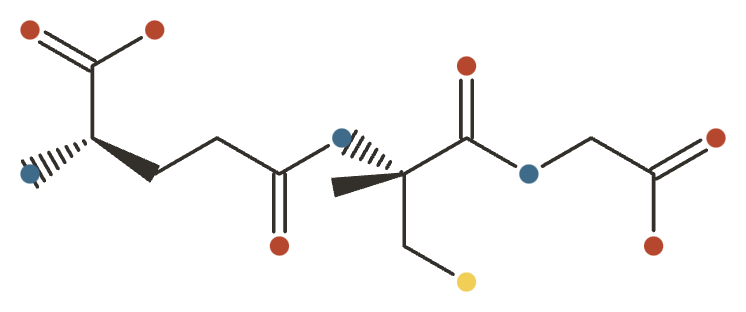
The body's main endogenous antioxidant — a tripeptide of glutamate, cysteine and glycine — taken to raise antioxidant status and support liver detoxification.

Glutathione (reduced) at a Glance
Glutathione is the body’s own master antioxidant, and unlike almost everything else sold under that word it genuinely earns the title. It is a small tripeptide — glutamate, cysteine, glycine — present inside virtually every cell at millimolar concentrations, which makes it one of the most abundant molecules in the body that most people have never heard of. It is not a vitamin: nothing in the diet has to supply it, because cells build their own.
Its work is mostly invisible. Glutathione is the substrate that lets the peroxidase enzymes neutralise hydrogen peroxide and lipid peroxides, it is the molecule the liver hangs onto foreign compounds to make them water-soluble and excretable, and it is the reservoir that regenerates vitamins C and E after they have been spent. Falling glutathione is a well-documented feature of aging, of chronic disease and of oxidative stress — which is what makes topping it up such an appealing idea.
The catch is delivery. Glutathione is a peptide, and peptides are what digestion is for. For years the standard view was that swallowed glutathione is simply dismantled into its three amino acids in the gut, making oral supplementation pointless. That assumption has been directly tested and turns out to be too strong — sustained oral dosing does raise body stores — but “raises a biomarker” and “does something useful” are different claims, and only the first has been demonstrated.
What It’s Used For
- Raising body glutathione stores — the one claim with strong controlled backing, and it is a biomarker rather than an outcome.
- Skin brightening — a genuine but small, localised and reversible effect from oral dosing.
- Glycemic & oxidative control in type 2 diabetes — a subgroup finding in older, already-deficient patients.
- Liver / NAFLD — one uncontrolled pilot, and the honest kernel inside “liver detox” marketing.
- Peripheral arterial disease — one small intravenous trial with a surrogate endpoint.
Where the disease bet actually failed. Intranasal glutathione was not superior to placebo in Parkinson’s, and the largest inhaled-glutathione trial in cystic fibrosis was null on lung function. A rising blood level did not reliably translate into clinical outcomes.
And the marketed claim the evidence actively rejects: injectable glutathione for skin lightening is unsupported and regulator-flagged.
How It Works
Glutathione’s chemistry lives in one sulphur atom. The cysteine residue carries a free thiol (–SH) group that gives up a hydrogen readily, and everything glutathione does traces back to that.
As an antioxidant, it is the substrate glutathione peroxidase uses to convert hydrogen peroxide and lipid peroxides into water and harmless alcohols. Two glutathione molecules are consumed and joined into an oxidised dimer, which glutathione reductase then recycles back — so the pool is regenerated rather than used up, and the ratio of reduced to oxidised glutathione is a standard measure of a cell’s redox health.
As a detoxifier, glutathione S-transferases bolt it onto reactive electrophiles — drug metabolites, environmental toxins, heavy metals — making them water-soluble enough to excrete. This is phase-II conjugation, and it is the specific mechanism behind the paracetamol antidote: the overdose exhausts hepatic glutathione, and the unquenched metabolite kills liver cells.
The awkward part is getting it in. Cells synthesise glutathione internally in two ATP-dependent steps, and the first is rate-limited by cysteine availability — which is why cysteine donors work indirectly. Swallowed glutathione faces gut peptidases and first-pass metabolism, and the older assumption was that essentially none survives. The 2015 trial complicates that picture by showing stores can rise with sustained dosing 1Reference 1RCTRandomized controlled trial of oral glutathione supplementation on body stores of glutathione — randomised controlled trialView study →, but the route by which they rise (intact absorption, versus simply delivering cysteine in an expensive package) is not settled. Liposomal, sublingual and intravenous products are all sold on this problem; none had consistent head-to-head evidence in this pass.
The full trial record is in Pharmacology & Research below.
Pharmacology & Research
Glutathione (GSH) is the body’s principal endogenous antioxidant — a tripeptide of glutamate, cysteine and glycine present at millimolar concentrations inside nearly every cell — and unlike most compounds sold under the “antioxidant” label it genuinely occupies the central role. The evidence posture for supplementing it is dominated by one honest fact: the strongest data show that sustained oral dosing raises body glutathione stores, but “raises a biomarker” and “produces a clinical benefit” are separate claims, and the second is far thinner. Almost every scored benefit below is either deficiency-dependent (diabetics, the aged, HIV) or a small, localised, transient effect (skin brightening), and the disease-specific trials for Parkinson’s and cystic fibrosis are largely null. The load-bearing caveat throughout is delivery: glutathione is a peptide, digestion is built to dismantle peptides, and much of the marketed premium — liposomal, sublingual, intranasal, intravenous — rests on bioavailability claims that have rarely been compared head to head. For most people the rate-limiting question is not “how much glutathione” but “is cysteine available,” which is why the precursor route (NAC, glycine) is often the more defensible path to the same place.
Support is an experimental score I’m building — a composite weighted by study type (human > animal > in vitro > review) and study volume. It’s a beta: a fast way to rank strength of evidence at a glance, not a validated metric. Each application links down to its write-up.
This is the one claim with strong controlled backing. A 6-month randomised, double-blind, placebo-controlled trial in 54 healthy non-smoking adults (250 or 1,000 mg/day oral GSH) found blood glutathione rose at both doses; at 6 months the high-dose arm was up 30–35% in erythrocytes, plasma and lymphocytes and 260% in buccal cells, with a matching fall in the oxidised:reduced ratio and a more than twofold rise in natural-killer-cell cytotoxicity — but levels returned to baseline after a one-month washout 1Reference 1RCTRandomized controlled trial of oral glutathione supplementation on body stores of glutathione — randomised controlled trialView study →.
A 1-month liposomal pilot in 12 adults (500 or 1,000 mg/day) reproduced the direction: whole-blood GSH +40%, PBMCs +100%, 8-isoprostane −35% 2Reference 2Clinical trialOral supplementation with liposomal glutathione elevates body stores of glutathione and markers of immune function — clinical trialView study →.
Together these overturn the older blanket claim that swallowed glutathione is entirely wasted in digestion.
Gap: every one of these is a biomarker; neither trial measured a clinical health outcome, and the effect reverses when dosing stops.
Oral glutathione has a genuine but small dermatological signal. In a 4-week RCT (n=60, 500 mg/day) the melanin index fell at all six measured sites but reached significance at only two sun-exposed sites 3Reference 3RCTGlutathione as an oral whitening agent: a randomized, double-blind, placebo-controlled studyView study →.
A 12-week RCT (250 mg/day, reduced and oxidised forms) found melanin index and UV spots trending below placebo with some wrinkle improvement 4Reference 4RCTGlutathione and its antiaging and antimelanogenic effects — randomised controlled trialView study →.
A 2024 systematic review counted five RCTs showing significant melanin-index reduction versus placebo, and noted topical-plus-oral combinations outperform monotherapy 6,
An earlier review called the overall evidence “inconclusive” given small, inconsistent, mostly Asian-female cohorts 5Reference 5Systematic reviewThe clinical effect of glutathione on skin color and other related skin conditions — systematic reviewView study →.
Pairing glutathione with L-cystine also outperformed either alone in a separate RCT 8Reference 8RCTOral supplementation of L-cystine associated with reduced L-glutathione on skin pigmentation — randomised controlled trialView study →.
Effects are modest, localised to sun-exposed skin, and reverse on stopping.
Gap: short trials, small homogeneous cohorts, a transient localised effect, and a cosmetic endpoint — not a durable or generalisable benefit. The heavily-marketed injectable route is the one the evidence actively rejects.
Diabetics are relatively glutathione-deficient, which makes repletion a coherent target. In a 6-month trial, 125 diabetic patients already on anti-diabetic therapy received 500 mg/day oral GSH: blood GSH rose and the oxidative-DNA-damage marker 8-OHdG fell within 3 months across the group, and in a post-hoc subgroup analysis of those aged 55 and over, HbA1c improved and fasting insulin rose significantly 9Reference 9RCTRandomized clinical trial of how long-term glutathione supplementation offers protection from oxidative damage and improves HbA1c in elderly type 2 diabetic patientsView study →.
A companion analysis in the same cohort found the gut microbiome shifted toward beneficial genera and away from Proteobacteria 10Reference 10RCTEffect of long-term oral glutathione supplementation on gut microbiome of type 2 diabetic individuals — randomised controlled trialView study →.
Foundational work established that uncontrolled diabetics have severely impaired GSH synthesis from limited precursor availability 11Reference 11Clinical trialGlutathione synthesis is diminished in patients with uncontrolled diabetes and restored by dietary supplementation with cysteine and glycine — clinical trialView study →.
Gap: the glycemic benefit was a subgroup finding in older patients, layered on existing therapy — deficiency- and age-dependent rather than a general effect — and it was open-label add-on rather than blinded monotherapy.
Glutathione does the phase-II conjugation chemistry that neutralises reactive hepatic metabolites — the honest kernel inside “liver detox” marketing, and the reason NAC is the hospital antidote for paracetamol overdose. A single open-label, single-arm, multicentre pilot treated 34 NAFLD patients with 300 mg/day oral GSH for 4 months, after 3 months of diet and exercise; ALT fell significantly, along with triglycerides, non-esterified fatty acids and ferritin, with the clearest response in younger patients without severe diabetes 14Reference 14Efficacy of glutathione for the treatment of nonalcoholic fatty liver disease: an open-label, single-arm, multicenter, pilot studyView study →.
Gap: no placebo arm and only about 29 completers — an uncontrolled pilot that cannot separate the supplement from the preceding lifestyle intervention or from regression to the mean. The authors themselves call for controlled trials.
In a double-blind RCT, 40 patients with peripheral artery disease received intravenous glutathione or saline twice daily for 5 days; the glutathione group improved pain-free walking distance (196 against 143 m) and several macro- and microcirculatory flow measures 21Reference 21RCTEffect of glutathione infusion on leg arterial circulation, cutaneous microcirculation, and pain-free walking distance in patients with peripheral obstructive arterial disease — randomised controlled trialView study →.
Gap: a single small trial, an intravenous route irrelevant to oral supplements, a 5-day intervention and a surrogate endpoint — hypothesis-generating, not a basis for supplementation.
Mechanisms
| Target / pathway | Effect | Relevant to |
|---|---|---|
| Glutathione peroxidase (a selenoenzyme) | Substrate: reduces H₂O₂ and lipid peroxides to water and alcohols | Antioxidant defencestoresskin |
| Glutathione S-transferases | Conjugates electrophiles — drug metabolites, toxins, heavy metals — for excretion (phase-II detox) | Liver/NAFLD; the paracetamol-antidote logic |
| Glutathione reductase / GSH:GSSG cycle | Regenerates reduced GSH; the ratio indexes cellular redox status | All redox-linked outcomes |
| Vitamin C and vitamin E recycling | Regenerates spent antioxidant vitamins | The antioxidant network |
| Melanogenesis (tyrosinase; eumelanin → pheomelanin) | Shifts pigment toward lighter pheomelanin | Skin brightening |
| Mitochondrial fuel oxidation / insulin signalling | Repletion improves fatty-acid oxidation and insulin sensitivity in deficient states | Diabetes; ageing and metabolic disease (precursor-driven) |
Pharmacokinetics
Intravenous glutathione has a very short plasma half-life — on the order of minutes — so parenteral effects are transient. The oral picture is different and slow: body stores rise over weeks to months of sustained dosing, not acutely, and fall back to baseline within about a month of stopping 1Reference 1RCTRandomized controlled trial of oral glutathione supplementation on body stores of glutathione — randomised controlled trialView study →.
The long-standing assumption was that oral GSH is fully hydrolysed to its three amino acids in the
gut. The 2015 RCT and the 2018 liposomal pilot show stores can nonetheless rise 1,
Cells synthesise glutathione internally in two ATP-dependent steps, the first rate-limited by
cysteine — which is why cysteine donors like NAC and precursor
combinations (glycine + NAC, “GlyNAC”) raise GSH indirectly and carry the larger metabolic-outcome
literature 11,
Clinical trials
Glutathione is off-patent and endogenous, so there is little industry incentive for large registrational trials; most activity is investigator-initiated and small. ClinicalTrials.gov lists roughly 335 studies mentioning oral glutathione, of which about 66 are completed and 13 recruiting.
| Completed | Planned | Terminated | Preclinical |
|---|---|---|---|
| ~66 | ~13 | ~5 | Extensive |
Last checked: August 2026.
Dietary Sources
Glutathione is present in food — fresh fruit and vegetables, raw or lightly cooked meat, and particularly asparagus, avocado, spinach and okra — but it degrades with cooking, processing and storage, and it faces the same digestion problem as the supplement. Dietary glutathione is not considered a meaningful contributor to body stores.
What diet does usefully supply is the raw material. Sulphur-containing protein — eggs, poultry, whey, garlic, onions, cruciferous vegetables — provides the cysteine that limits synthesis, and adequate protein intake generally matters more to glutathione status than eating glutathione itself. Selenium is a related requirement, since glutathione peroxidase is a selenoenzyme and cannot function without it.
Dosage
These are doses studied in research, not a personal recommendation.
- Studied oral range: roughly 250–1,000 mg/day. The store increases in the controlled trial were clearest in the 1,000 mg/day arm, and took months rather than days to appear 1Reference 1RCTRandomized controlled trial of oral glutathione supplementation on body stores of glutathione — randomised controlled trialView study →.
- Duration matters more than a single dose — this is a sustained-supplementation effect, not an acute one.
- Alternative routes are marketed on bioavailability grounds — liposomal, sublingual, intranasal and intravenous — without consistent head-to-head evidence in this pass. Paying a premium for a delivery claim that has not been compared directly is a judgement call, not an established upgrade.
- The indirect route — NAC, and to a lesser extent glycine — sidesteps the absorption question by supplying substrate instead.
Safety
Glutathione is an endogenous molecule and its oral safety profile is unremarkable. The meaningful cautions attach to the injectable products, not the capsule.
- Well tolerated orally in trials. Including six months of continuous dosing at up to 1,000 mg/day 1Reference 1RCTRandomized controlled trial of oral glutathione supplementation on body stores of glutathione — randomised controlled trialView study →.
- Endogenous. The body already maintains millimolar concentrations of it in every cell.
- Bioavailability is the open question, not toxicity. Premium delivery formats are sold on claims that have not been tested head to head.
- Injectable and IV glutathione is a different risk category — regulators have warned about unapproved skin-lightening injections.
- Interactions and pregnancy safety not assessed in this pass — see the box below.
Full Safety & Interactions Detail
Oral glutathione was well tolerated in the controlled trial that ran longest, with no safety signal at 250 or 1,000 mg/day over six months 1Reference 1RCTRandomized controlled trial of oral glutathione supplementation on body stores of glutathione — randomised controlled trialView study →. Reported complaints elsewhere are mild and gastrointestinal.
- Formal drug-interaction data were not assessed in this pass. The theoretical concern common to all antioxidants — interference with treatments that work through oxidative stress, notably some chemotherapy and radiotherapy — is a question for an oncologist rather than a supplement label.
- Injectable products are the real risk. High-dose intravenous glutathione marketed for skin lightening has drawn regulatory warnings in several countries; it is unapproved for that use, and the products and clinics involved are often unregulated.
- Selenium dependency: glutathione peroxidase is a selenoenzyme, so glutathione cannot do its central antioxidant job without adequate selenium. That is a nutritional footnote rather than a caution.
Not assessed. Supplemental glutathione has not been evaluated for fetal or infant safety, and no adequate human data exist for either pregnancy or lactation. The body maintains its own glutathione throughout pregnancy; taking concentrated supplemental doses on top of that has no established record. Pregnant or breastfeeding people should discuss it with a qualified practitioner before use.
References
- Richie JP Jr, Nichenametla S, Neidig W, et al. (2015). Randomized controlled trial of oral glutathione supplementation on body stores of glutathione — randomised controlled trial. European Journal of Nutrition. https://pubmed.ncbi.nlm.nih.gov/24791752/
- Sinha R, Sinha I, Calcagnotto A, et al. (2018). Oral supplementation with liposomal glutathione elevates body stores of glutathione and markers of immune function — clinical trial. European Journal of Clinical Nutrition. https://pubmed.ncbi.nlm.nih.gov/28853742/
- Arjinpathana N, Asawanonda P (2012). Glutathione as an oral whitening agent: a randomized, double-blind, placebo-controlled study. Journal of Dermatological Treatment. https://pubmed.ncbi.nlm.nih.gov/20524875/
- Weschawalit S, Thongthip S, Phutrakool P, Asawanonda P (2017). Glutathione and its antiaging and antimelanogenic effects — randomised controlled trial. Clinical, Cosmetic and Investigational Dermatology. https://pubmed.ncbi.nlm.nih.gov/28490897/
- Dilokthornsakul W, Dhippayom T, Dilokthornsakul P, et al. (2019). The clinical effect of glutathione on skin color and other related skin conditions — systematic review. Journal of Cosmetic Dermatology. https://pubmed.ncbi.nlm.nih.gov/30895708/
- Sarkar R, et al. (2024). Glutathione as a skin-lightening agent and in melasma — systematic review. International Journal of Dermatology. https://pubmed.ncbi.nlm.nih.gov/39444151/
- Wahab S, et al. (2021). Combination of topical and oral glutathione as a skin-whitening agent — randomised controlled trial. International Journal of Dermatology. https://pubmed.ncbi.nlm.nih.gov/33871071/
- Duperray J, et al. (2021). Oral supplementation of L-cystine associated with reduced L-glutathione on skin pigmentation — randomised controlled trial. Journal of Cosmetic Dermatology. https://pubmed.ncbi.nlm.nih.gov/33834608/
- Kalamkar S, Acharya J, Kolappurath Madathil A, et al. (2022). Randomized clinical trial of how long-term glutathione supplementation offers protection from oxidative damage and improves HbA1c in elderly type 2 diabetic patients. Antioxidants (Basel). https://pubmed.ncbi.nlm.nih.gov/35624890/
- Gaike AH, Kalamkar SD, Gajjar V, et al. (2023). Effect of long-term oral glutathione supplementation on gut microbiome of type 2 diabetic individuals — randomised controlled trial. FEMS Microbiology Letters. https://pubmed.ncbi.nlm.nih.gov/37935462/
- Sekhar RV, McKay SV, Patel SG, et al. (2011). Glutathione synthesis is diminished in patients with uncontrolled diabetes and restored by dietary supplementation with cysteine and glycine — clinical trial. Diabetes Care. https://pubmed.ncbi.nlm.nih.gov/20929994/
- Kumar P, Liu C, Suliburk J, et al. (2023). Supplementing glycine and N-acetylcysteine (GlyNAC) in older adults improves glutathione deficiency, oxidative stress and mitochondrial dysfunction — randomised controlled trial. The Journals of Gerontology: Series A. https://pubmed.ncbi.nlm.nih.gov/35975308/
- Nguyen D, Hsu JW, Jahoor F, et al. (2014). Effect of increasing glutathione with cysteine and glycine supplementation on mitochondrial fuel oxidation and insulin sensitivity in older HIV-infected patients — clinical trial. Journal of Clinical Endocrinology & Metabolism. https://pubmed.ncbi.nlm.nih.gov/24081740/
- Honda Y, Kessoku T, Sumida Y, et al. (2017). Efficacy of glutathione for the treatment of nonalcoholic fatty liver disease: an open-label, single-arm, multicenter, pilot study. BMC Gastroenterology. https://pubmed.ncbi.nlm.nih.gov/28789631/
- Mischley LK, Leverenz JB, Lau RC, et al. (2015). A randomized, double-blind phase I/IIa study of intranasal glutathione in Parkinson’s disease — randomised controlled trial. Movement Disorders. https://pubmed.ncbi.nlm.nih.gov/26230671/
- Mischley LK, Lau RC, Shankland EG, et al. (2017). Phase IIb study of intranasal glutathione in Parkinson’s disease — randomised controlled trial. Journal of Parkinson’s Disease. https://pubmed.ncbi.nlm.nih.gov/28436395/
- Mohammed I, Nankya Y, Hong UT, et al. (2026). The role of N-acetylcysteine and glutathione in the management of Parkinson’s disease — systematic review. Amino Acids. https://pubmed.ncbi.nlm.nih.gov/41874704/
- Griese M, Kappler M, Eismann C, et al. (2013). Inhalation treatment with glutathione in patients with cystic fibrosis: a randomized clinical trial. American Journal of Respiratory and Critical Care Medicine. https://pubmed.ncbi.nlm.nih.gov/23631796/
- Calabrese C, Tosco A, Abete P, et al. (2015). Randomized, single blind, controlled trial of inhaled glutathione vs placebo in patients with cystic fibrosis. Journal of Cystic Fibrosis. https://pubmed.ncbi.nlm.nih.gov/25458463/
- Ciofu O, Lykkesfeldt J (2014). Antioxidant supplementation for lung disease in cystic fibrosis — Cochrane systematic review. Cochrane Database of Systematic Reviews. https://pubmed.ncbi.nlm.nih.gov/25102015/
- Arosio E, De Marchi S, Zannoni M, et al. (2002). Effect of glutathione infusion on leg arterial circulation, cutaneous microcirculation, and pain-free walking distance in patients with peripheral obstructive arterial disease — randomised controlled trial. Mayo Clinic Proceedings. https://pubmed.ncbi.nlm.nih.gov/12173710/