
Compound Monograph
Glycyrrhizin
Glycyrrhizin (glycyrrhizic acid) is the principal oleanane triterpenoid saponin of licorice and its sweet principle — roughly 50 times sweeter than sucrose. Gut bacteria strip its two sugars to release the aglycone glycyrrhetinic acid, which carries most of the systemic effects: antiviral and hepatoprotective activity on one side, and on the other the defining hazard — inhibition of 11β-HSD2 causing apparent mineralocorticoid excess (pseudoaldosteronism): hypertension, hypokalaemia, fluid retention, and in heavy or prolonged use, severe and occasionally fatal potassium-loss syndromes.

Sources · 4
Where Does It Come From?
Glycyrrhizin is a naturally occurring oleanane triterpenoid saponin (triterpene glycoside), found in Licorice, Chinese licorice, Glycyrrhiza inflata and 1 other source. It is flagged as moderately toxic.
Concentration
Content by Source
Reported concentrations across the plants that contain glycyrrhizin — the bar marks the typical level, the line shows the reported range.
Literature figures for varying plant parts and preparations. Read them as a comparative guide, not exact assays.
Glycyrrhizin at a Glance
Glycyrrhizin — also called glycyrrhizic or glycyrrhizinic acid — is the principal oleanane triterpenoid saponin of licorice (Glycyrrhiza) and its sweet principle, roughly 50 times sweeter than sucrose. Structurally it is a glycoside: the pentacyclic triterpene aglycone glycyrrhetinic acid carrying two glucuronic-acid sugars. It is the compound that makes licorice root taste sweet, and the compound behind licorice’s best-known medical effects and its best-known hazard 1,
The single most important fact about this molecule is that most of its systemic activity is not its own. Taken by mouth, glycyrrhizin is barely absorbed intact; gut bacteria hydrolyse off its two sugars to release glycyrrhetinic acid (18β-glycyrrhetinic acid), the aglycone that is actually absorbed and that drives the downstream endocrine effects 5,
That metabolite is what makes licorice risky. Glycyrrhetinic acid inhibits the enzyme 11β-hydroxysteroid dehydrogenase type 2 (11β-HSD2), producing apparent mineralocorticoid excess — a pseudoaldosteronism of high blood pressure, potassium loss and fluid retention that, in heavy or prolonged use, has caused severe hypokalaemia, rhabdomyolysis, dangerous arrhythmias and rare fatal cardiac arrest 1,
The Aglycone Connection: Why Most Effects Are Glycyrrhetinic Acid’s
Glycyrrhizin is best understood as a microbiome-activated prodrug. The intact saponin is large, highly polar (two ionised glucuronic acids) and poorly permeable, so little crosses the gut wall unchanged. In the colon, bacterial β-glucuronidases cleave the sugars to yield the lipophilic aglycone glycyrrhetinic acid, which is then absorbed, undergoes enterohepatic recycling, and reaches the systemic circulation 5,
The practical consequences are threefold and run through everything below:
- The active agent for endocrine effects is the aglycone, not the parent. 11β-HSD2 inhibition, and therefore the whole pseudoaldosteronism picture, is chiefly glycyrrhetinic acid’s doing 1,
2Reference 1Licorice: from pseudohyperaldosteronism to therapeutic usesView study →Reference 2Licorice abuse: time to send a warning messageView study → — see its dedicated page. - Effect depends on the gut flora. Because absorption requires bacterial hydrolysis, germ-free or antibiotic-suppressed conditions sharply reduce it, and individuals vary — part of why sensitivity to licorice differs so widely between people 5Reference 5AnimalBioavailability study of glycyrrhetic acid after oral administration of glycyrrhizin in rats; relevance to the intestinal bacterial hydrolysisView study →.
- The effective half-life is long and cumulative. Glycyrrhetinic acid clears slowly with enterohepatic cycling, so effects accumulate over days of repeated intake — the reason licorice toxicity is characteristically dose- and duration-dependent rather than a single-dose event 6Reference 6The pharmacokinetics of glycyrrhizic acid evaluated by physiologically based pharmacokinetic modelingView study →.
Apparent Mineralocorticoid Excess: The 11β-HSD2 Mechanism
This is the mechanistic hinge of the entire page — the same action that gives glycyrrhizin a legitimate glucocorticoid-potentiating, anti-inflammatory role at low exposure is what poisons at high exposure.
The enzyme 11β-hydroxysteroid dehydrogenase type 2 (11β-HSD2) sits in mineralocorticoid target tissues (kidney, colon) and continuously converts active cortisol into inactive cortisone. Its job is to protect the mineralocorticoid receptor — which binds cortisol and aldosterone with equal affinity — from being swamped by cortisol, which circulates at far higher concentrations than aldosterone. Glycyrrhetinic acid inhibits 11β-HSD2, so cortisol is no longer inactivated locally; it accumulates and illicitly activates the mineralocorticoid receptor exactly as aldosterone would, and glycyrrhetinic acid may also bind the receptor directly as a weak agonist 1,
The result is apparent mineralocorticoid excess with a suppressed renin–aldosterone axis (aldosterone is low precisely because the receptor is already being driven): renal sodium and water retention, potassium and hydrogen wasting, and expansion of plasma volume. Clinically that reads as hypertension, hypokalaemia, metabolic alkalosis and oedema 1,
What It's Used For
Glycyrrhizin’s therapeutic literature is broad but uneven: a genuine human hepatology use (intravenous, in Japan), a large in-vitro/animal antiviral base, and an anti-inflammatory action inseparable from the 11β-HSD2 mechanism above. The honest through-line is that oral bioavailability of the parent is poor, and the marquee human evidence uses the intravenous isolate, not the whole root.
Support is an experimental score — weighted by study type (human > animal > in vitro) and volume. A beta, not a validated metric. Only the hepatology use has controlled human isolate data; the rest is preclinical or mechanism, so scores stay measured.
Glycyrrhizin’s best human signal, and it is intravenous. In a double-blind, randomised, placebo-controlled phase I/II trial in European patients with chronic hepatitis C, IV glycyrrhizin significantly reduced serum ALT (a marker of hepatocellular injury), though it did not clear HCV-RNA 10Reference 10RCTIntravenous glycyrrhizin for the treatment of chronic hepatitis C: a double-blind, randomized, placebo-controlled phase I/II trialView study →.
This mirrors decades of Japanese use of the glycyrrhizin preparation Stronger Neo-Minophagen C (SNMC) to lower transaminases and blunt hepatocellular damage in chronic viral hepatitis, with reviews reporting reduced hepatocellular injury and, in some cohorts, lowered hepatocellular-carcinoma risk in HCV cirrhosis 9Reference 9Antiviral effects of Glycyrrhiza speciesView study →.
This is the intravenous isolate, chosen precisely because oral bioavailability of the parent is poor.
Gap: the robust data are IV, in hepatitis-C cohorts, and biochemical (ALT) rather than viral cure or hard clinical endpoints; oral glycyrrhizin does not reproduce these plasma exposures 9,
A wide but largely in-vitro antiviral profile. Glycyrrhizin inhibited replication of SARS-associated coronavirus in Vero cells and was the most active of the compounds Cinatl and colleagues tested during the 2003 SARS outbreak 7Reference 7Glycyrrhizin, an active component of liquorice roots, and replication of SARS-associated coronavirusView study →.
Two decades later it was shown to inhibit SARS-CoV-2 replication by blocking the viral main protease (Mpro) in cell culture 8Reference 8Glycyrrhizin effectively inhibits SARS-CoV-2 replication by inhibiting the viral main proteaseView study →.
A dedicated review documents activity across hepatitis B and C, herpes simplex, influenza A, HIV-1 and other viruses, with proposed mechanisms including interference with viral entry, replication and the high-mobility-group-box-1 (HMGB1) pathway 9Reference 9Antiviral effects of Glycyrrhiza speciesView study →.
Gap: almost entirely isolate cell-culture and animal work; the antiviral concentrations are not obviously achievable systemically from oral licorice, and human antiviral efficacy (outside the IV hepatology use) is unproven 7,
Mechanistically the richest, clinically the most double-edged. By inhibiting 11β-HSD isozymes, glycyrrhetinic acid spares cortisol from inactivation, effectively potentiating endogenous and applied corticosteroids — the basis of licorice’s traditional soothing, anti-inflammatory and mucosal-protective reputation, and of topical glycyrrhetinic acid in dermatology 1,
Reviews also credit glycyrrhizin with NF-κB / inflammatory-mediator modulation and HMGB1 antagonism 9Reference 9Antiviral effects of Glycyrrhiza speciesView study →.
The problem is that this is the pseudoaldosteronism mechanism: the same cortisol-sparing that soothes also drives sodium retention and potassium loss.
Gap: the anti-inflammatory benefit and the mineralocorticoid harm are inseparable at the enzyme level; there is no clean therapeutic window demonstrated for oral glycyrrhizin as a stand-alone anti-inflammatory, and human efficacy here is indirect 1,
The traditional pharmacy use. Licorice and glycyrrhizin have a long history as an expectorant and demulcent (cough and sore-throat preparations) and in peptic-ulcer care, where the effect is attributed largely to the aglycone glycyrrhetinic acid sparing mucosal prostaglandins and promoting mucus 1,
Deglycyrrhizinated licorice (DGL), which removes glycyrrhizin to avoid the mineralocorticoid effect, is the form usually chosen for gastric use — an implicit acknowledgement that the anti-ulcer benefit and the pressor hazard are linked.
Gap: mostly traditional and historical, with the mucosal/anti-ulcer effect entangled with the aglycone and with formulation (DGL vs whole root); little modern controlled isolate data 1,
Mechanisms
| Target / pathway | Effect | Relevant to |
|---|---|---|
| 11β-HSD2 (cortisol → cortisone) | inhibited by glycyrrhetinic acid → cortisol accumulates in mineralocorticoid tissues | glucocorticoid potentiation and pseudoaldosteronism |
| Mineralocorticoid receptor | illicitly activated by spared cortisol (± weak direct agonism) → Na⁺/H₂O retention, K⁺/H⁺ loss | hypertensionhypokalaemiaalkalosis (toxicity) |
| Renin–aldosterone axis | suppressed (low renin, low aldosterone) — the signature of apparent mineralocorticoid excess | diagnostic/toxicity |
| 11β-HSD1 | inhibited → altered tissue cortisol/cortisone balance (e.g. topical fat/skin effects) | anti-inflammatory / dermatological |
| Viral main protease (Mpro, SARS-CoV-2); coronavirus replication | inhibited in vitro | antiviral |
| HMGB1 / NF-κB inflammatory signalling | antagonised / modulated | anti-inflammatoryhepatoprotectiveantiviral |
| Hepatocellular injury (ALT) | reduced (IV glycyrrhizin) | hepatoprotective |
Pharmacokinetics
Glycyrrhizin is the compound-page’s clearest case of why the metabolite matters more than the molecule. The intact saponin is large and highly polar, so oral absorption of the parent is poor; systemic exposure depends on gut bacterial hydrolysis (β-glucuronidase) to the lipophilic aglycone glycyrrhetinic acid, which is the species actually absorbed — bacterial hydrolysis is indispensable to that absorption in rats 5Reference 5AnimalBioavailability study of glycyrrhetic acid after oral administration of glycyrrhizin in rats; relevance to the intestinal bacterial hydrolysisView study →. Glycyrrhizic acid then undergoes extensive presystemic metabolism and enterohepatic cycling, well described by physiologically-based pharmacokinetic modelling 6Reference 6The pharmacokinetics of glycyrrhizic acid evaluated by physiologically based pharmacokinetic modelingView study →. Two consequences dominate: (1) flora-dependence introduces wide inter-individual variability, and germ-free/antibiotic states blunt the effect 5Reference 5AnimalBioavailability study of glycyrrhetic acid after oral administration of glycyrrhizin in rats; relevance to the intestinal bacterial hydrolysisView study →; and (2) the aglycone’s slow clearance and recycling give a long effective half-life, so glycyrrhetinic acid accumulates with repeated dosing — the pharmacological reason licorice toxicity is dose- and duration-dependent, building over days to weeks rather than striking on first exposure 6Reference 6The pharmacokinetics of glycyrrhizic acid evaluated by physiologically based pharmacokinetic modelingView study →. This is also why the one robust efficacy use is intravenous (bypassing the absorption bottleneck) 10Reference 10RCTIntravenous glycyrrhizin for the treatment of chronic hepatitis C: a double-blind, randomized, placebo-controlled phase I/II trialView study →.
Clinical Trials
Human trials of the isolate are essentially the intravenous hepatology programme; oral licorice/glycyrrhizin sits mostly in observational, toxicological and traditional use.
| Completed | Planned | Terminated | Preclinical |
|---|---|---|---|
| IV glycyrrhizin (SNMC) in chronic hepatitis C — double-blind RCT (↓ALT) + long Japanese clinical record 9, | — | — | Antiviral(SARS-CoV/SARS-CoV-2, HBV/HCV/HSV/HIV) + hepatoprotective/anti-inflammatory mechanistic 7, |
Last checked: July 2026.
Sweetness & Non-Nutritive Use
Glycyrrhizin is a non-sugar sweetener, roughly 50 times sweeter than sucrose, with a slow onset and a lingering, slightly bitter–anise aftertaste characteristic of licorice 15Reference 15ReviewGlycyrrhiza glabra (Licorice): a comprehensive review on its phytochemistry, biological activities, clinical evidence and toxicologyView study →. It (and its ammonium salt) is used to flavour confectionery, tobacco, beverages and pharmaceuticals, and to mask bitterness. Crucially, it is not an inert sweetener: unlike sucralose or stevioside, the amount needed to sweeten also delivers a pharmacologically active dose of the 11β-HSD2-inhibiting aglycone, which is exactly why black-licorice confectionery is a recurrent cause of pseudoaldosteronism rather than a harmless sweet (see Toxicity) 3,
Isolate vs. Plant Studies
The evidence here splits unusually cleanly. The strongest human data are the isolate — intravenously — where SNMC/IV glycyrrhizin was studied as a defined drug in hepatitis C 9,
Prevalence in Nature
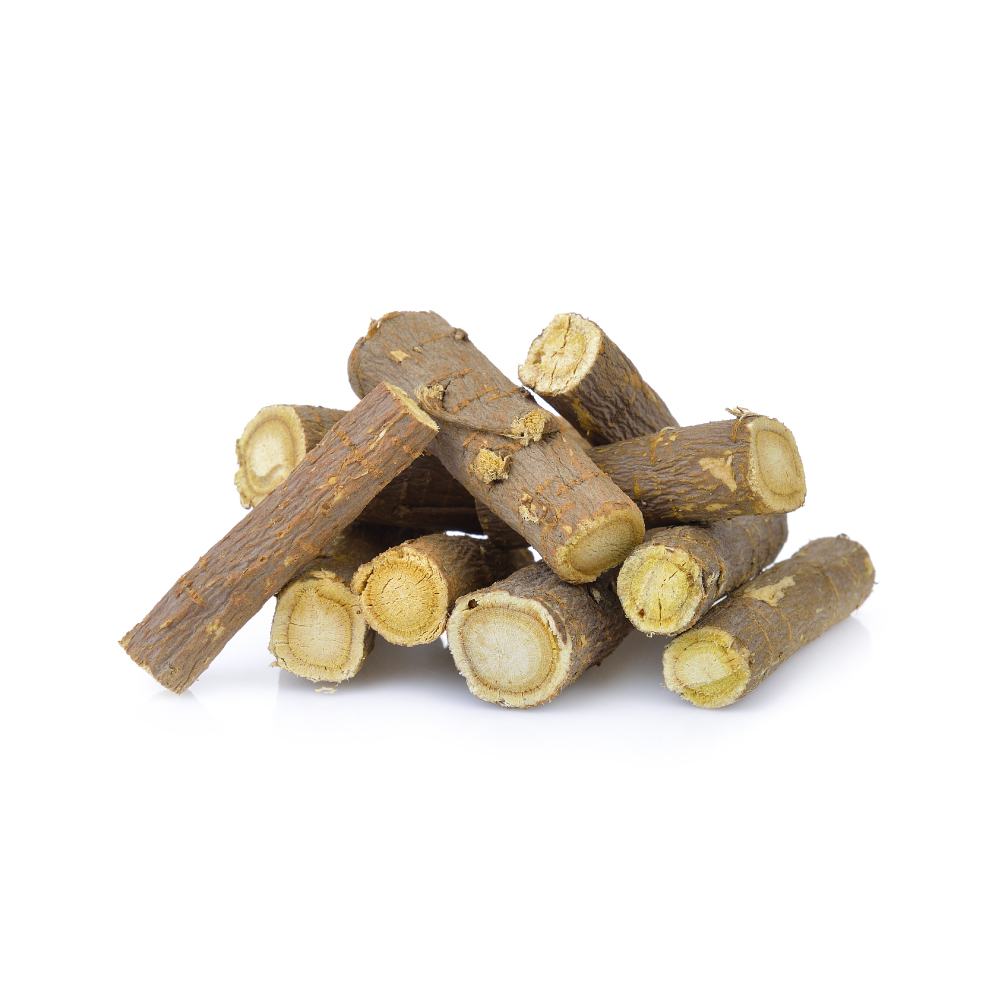
Glycyrrhizin is effectively licorice-specific — it is the defining saponin of the genus Glycyrrhiza (Fabaceae) and is not a widespread plant metabolite the way simple terpenes or phenolic acids are. It is concentrated in the root and stolons, where it typically accounts for ~2–6% of dry weight (with reports up to ~15% in some material), the fraction responsible for the root’s sweetness 15Reference 15ReviewGlycyrrhiza glabra (Licorice): a comprehensive review on its phytochemistry, biological activities, clinical evidence and toxicologyView study →. Content varies substantially with species — Glycyrrhiza glabra (European/Middle-Eastern licorice), G. uralensis (Chinese licorice / Gan Cao) and G. inflata differ in their saponin and flavonoid profiles — and with provenance, age and extraction 15Reference 15ReviewGlycyrrhiza glabra (Licorice): a comprehensive review on its phytochemistry, biological activities, clinical evidence and toxicologyView study →. It co-occurs in the root with the aglycone glycyrrhetinic acid and with licorice’s characteristic flavonoids such as glabridin and liquiritin.
Major Natural Sources
| Source | Plant part | Reported glycyrrhizin content |
|---|---|---|
| Licorice (Glycyrrhiza glabra) | dried root / stolon | ~2–6% dry wt (up to ~15% reported) |
| Chinese licorice (Glycyrrhiza uralensis) | dried root | variable; species-dependent saponin profile |
| Glycyrrhiza inflata | dried root | variable; species-dependent |
These are percentages of the dried root, and the ranges shift with species, provenance and extraction method 15Reference 15ReviewGlycyrrhiza glabra (Licorice): a comprehensive review on its phytochemistry, biological activities, clinical evidence and toxicologyView study →.
Discovery & Synthesis
Glycyrrhizin has been recognised as licorice’s sweet principle for centuries — the name traces to the botanical Glycyrrhiza, from the Greek glykys (“sweet”) and rhiza (“root”), the same root that gives “licorice” through Latin liquiritia. The crystalline saponin was characterised chemically in the nineteenth century, and the structure of its aglycone glycyrrhetinic acid and the two glucuronic-acid sugars was elucidated over the twentieth 15Reference 15ReviewGlycyrrhiza glabra (Licorice): a comprehensive review on its phytochemistry, biological activities, clinical evidence and toxicologyView study →.
Because glycyrrhizin is a large, complex pentacyclic triterpene glycoside, total synthesis has never been the commercial route — it is obtained by extraction and purification from licorice root, and the food/pharmaceutical article is usually supplied as the pure acid or as mono-ammonium glycyrrhizinate. The related intravenous drug Stronger Neo-Minophagen C (SNMC) is a formulated glycyrrhizin preparation (with cysteine and glycine) manufactured for clinical use in Japan 9Reference 9Antiviral effects of Glycyrrhiza speciesView study →.
Patents: not yet researched.
Toxicity & Safety
Glycyrrhizin earns a moderate flag — well above a typical dietary sweetener — because its aglycone is a bona-fide 11β-HSD2 inhibitor, and in enough quantity, for long enough, it reliably produces pseudoaldosteronism. This is the load-bearing safety point of the whole molecule.
Pseudoaldosteronism (Apparent Mineralocorticoid Excess)
Through the 11β-HSD2 mechanism above, glycyrrhizin/glycyrrhetinic acid causes a syndrome that mimics aldosterone excess while aldosterone and renin are actually suppressed: hypertension, hypokalaemia, sodium and water retention with oedema, and metabolic alkalosis 1,
Severe & Fatal Cases
At the heavy end this is not a nuisance effect. Case reports document severe hypokalaemia with rhabdomyolysis (muscle breakdown, dark urine, acute kidney injury) from chronic licorice or licorice-water intake 12Reference 12Case reportLiquorice-induced severe hypokalemic rhabdomyolysis with Gitelman syndrome and diabetes: a case reportView study →, and the syndrome can precipitate dangerous ventricular arrhythmias. A New England Journal of Medicine Case Record described a man who suffered sudden cardiac arrest linked to excessive black-licorice consumption, with the hypokalaemia and apparent mineralocorticoid excess of glycyrrhizin toxicity 11Reference 11Case 30-2020: a 54-year-old man with sudden cardiac arrestView study →. These are the reason “it’s only candy” is the wrong intuition.
Intake Guidance & Populations at Risk
Regulatory bodies have set conservative thresholds: the EU Scientific Committee on Food suggested a habitual upper intake of about 100 mg glycyrrhizic acid per day, above which adverse mineralocorticoid effects become likely, and reviews echo that regular intake beyond roughly this level — readily reached from confectionery, strong licorice tea or supplements — carries real risk 2,
Drug Interactions
The interactions follow from the mechanism and are potassium-centred 2,
- Potassium-wasting diuretics (thiazides, loop diuretics) — additive hypokalaemia.
- Cardiac glycosides (digoxin) — hypokalaemia potentiates digoxin toxicity/arrhythmia.
- Corticosteroids — glycyrrhizin potentiates corticosteroid action (cortisol-sparing via 11β-HSD), and can compound their sodium-retaining, potassium-losing effects.
- Antihypertensives — the pressor effect can oppose blood-pressure control.
- Drugs prolonging the QT interval / antiarrhythmics — via hypokalaemia, added arrhythmia risk.
Pregnancy (Prose Note)
Licorice/glycyrrhizin is linked to adverse pregnancy outcomes and is generally avoided in pregnancy. In a Finnish cohort, heavy maternal glycyrrhizin intake (≥500 mg/week) was associated with roughly double the risk of preterm (<37 weeks) delivery 13Reference 13ObservationalPreterm birth and licorice consumption during pregnancyView study →; follow-up of exposed offspring reported poorer cognitive performance and more psychiatric (including ADHD-type) problems, consistent with glycyrrhizin lowering placental 11β-HSD2 and increasing fetal glucocorticoid exposure 14Reference 14ObservationalMaternal licorice consumption and detrimental cognitive and psychiatric outcomes in childrenView study →. Per site policy, the pregnancy/lactation decision belongs on the herb and product pages where intake is chosen; the finding is stated here as a cited risk, not a molecule-level verdict.
- The sweetness itself is not the problem — the dose is. Trace culinary exposure in flavourings is not the same as habitual heavy licorice, and deglycyrrhizinated licorice (DGL) removes this molecule entirely.
- Pseudoaldosteronism is the defining hazard. Inhibiting 11β-HSD2 causes hypertension, hypokalaemia, fluid retention and metabolic alkalosis — dose- and duration-dependently 1,
2, .4Reference 1Licorice: from pseudohyperaldosteronism to therapeutic usesView study →Reference 2Licorice abuse: time to send a warning messageView study →Reference 4Meta-analysisThe association between consistent licorice ingestion, hypertension and hypokalaemia: a systematic review and meta-analysisView study → - Heavy or prolonged use can be severe or fatal. Documented severe hypokalaemia with rhabdomyolysis, and rare sudden cardiac arrest from excessive licorice 11,
12Reference 11Case 30-2020: a 54-year-old man with sudden cardiac arrestView study →Reference 12Case reportLiquorice-induced severe hypokalemic rhabdomyolysis with Gitelman syndrome and diabetes: a case reportView study → . - Avoid in pregnancy. Heavy intake is linked to preterm birth and adverse offspring neurodevelopment 13,
14Reference 13ObservationalPreterm birth and licorice consumption during pregnancyView study →Reference 14ObservationalMaternal licorice consumption and detrimental cognitive and psychiatric outcomes in childrenView study → . - Higher risk with hypertension, cardiac or renal disease, or existing low potassium — and with potassium-wasting diuretics, digoxin and corticosteroids 2,
3Reference 2Licorice abuse: time to send a warning messageView study →Reference 3ReviewLiquorice toxicity: a comprehensive narrative reviewView study → . - Effect accumulates over days. The active aglycone has a long effective half-life, so regular intake builds up rather than clearing between doses 6Reference 6The pharmacokinetics of glycyrrhizic acid evaluated by physiologically based pharmacokinetic modelingView study →.
Dosage
There is no general therapeutic oral dose for glycyrrhizin, and the safety framing dominates. Regulatory guidance (EU Scientific Committee on Food) places a habitual upper intake near 100 mg glycyrrhizic acid per day; regularly exceeding this — easily done with strong licorice confectionery, licorice tea or root extracts — makes dose- and duration-dependent pseudoaldosteronism likely 2,
References
- Sabbadin C, Bordin L, Donà G, Manso J, Avruscio G, Armanini D (2019). Licorice: from pseudohyperaldosteronism to therapeutic uses. Frontiers in Endocrinology. https://pubmed.ncbi.nlm.nih.gov/31379750/
- Omar HR, Komarova I, El-Ghonemi M, Fathy A, Rashad R, Abdelmalak HD, Yerramadha MR, Ali Y, Helal E, Camporesi EM (2012). Licorice abuse: time to send a warning message. Therapeutic Advances in Endocrinology and Metabolism. https://pubmed.ncbi.nlm.nih.gov/23185686/
- Ceccuzzi G, Rapino A, Perna B, Costanzini A, Farinelli A, Fiorica I, Marziani B, Cianci A, Rossin F, Cesaro AE, Spampinato MD, De Giorgio R, Guarino M (2023). Liquorice toxicity: a comprehensive narrative review. Nutrients. https://pubmed.ncbi.nlm.nih.gov/37764649/
- Penninkilampi R, Eslick EM, Eslick GD (2017). The association between consistent licorice ingestion, hypertension and hypokalaemia: a systematic review and meta-analysis. Journal of Human Hypertension. https://pubmed.ncbi.nlm.nih.gov/28660884/
- Takeda S, Ishthara K, Wakui Y, Amagaya S, Maruno M, Akao T, Kobashi K (1996). Bioavailability study of glycyrrhetic acid after oral administration of glycyrrhizin in rats; relevance to the intestinal bacterial hydrolysis. Journal of Pharmacy and Pharmacology. https://pubmed.ncbi.nlm.nih.gov/8910850/
- Ploeger B, Mensinga T, Sips A, Seinen W, Meulenbelt J, DeJongh J (2001). The pharmacokinetics of glycyrrhizic acid evaluated by physiologically based pharmacokinetic modeling. Drug Metabolism Reviews. https://pubmed.ncbi.nlm.nih.gov/11495500/
- Cinatl J, Morgenstern B, Bauer G, Chandra P, Rabenau H, Doerr HW (2003). Glycyrrhizin, an active component of liquorice roots, and replication of SARS-associated coronavirus. Lancet. https://pubmed.ncbi.nlm.nih.gov/12814717/
- van de Sand L, Bormann M, Alt M, Schipper L, Heilingloh CS, Steinmann E, Todt D, Dittmer U, Elsner C, Witzke O, Krawczyk A (2021). Glycyrrhizin effectively inhibits SARS-CoV-2 replication by inhibiting the viral main protease. Viruses. https://pubmed.ncbi.nlm.nih.gov/33918301/
- Fiore C, Eisenhut M, Krausse R, Ragazzi E, Pellati D, Armanini D, Bielenberg J (2008). Antiviral effects of Glycyrrhiza species. Phytotherapy Research. https://pubmed.ncbi.nlm.nih.gov/17886224/
- van Rossum TG, Vulto AG, Hop WC, Brouwer JT, Niesters HG, Schalm SW (1999). Intravenous glycyrrhizin for the treatment of chronic hepatitis C: a double-blind, randomized, placebo-controlled phase I/II trial. Journal of Gastroenterology and Hepatology. https://pubmed.ncbi.nlm.nih.gov/10574137/
- Edelman ER, Butala NM, Avery LL, Lundquist AL, Dighe AS (2020). Case 30-2020: a 54-year-old man with sudden cardiac arrest. New England Journal of Medicine. https://pubmed.ncbi.nlm.nih.gov/32966726/
- Yang LY, Yin JH, Yang J, Ren Y, Xiang CY, Wang CY (2019). Liquorice-induced severe hypokalemic rhabdomyolysis with Gitelman syndrome and diabetes: a case report. World Journal of Clinical Cases. https://pubmed.ncbi.nlm.nih.gov/31183353/
- Strandberg TE, Andersson S, Järvenpää AL, McKeigue PM (2002). Preterm birth and licorice consumption during pregnancy. American Journal of Epidemiology. https://pubmed.ncbi.nlm.nih.gov/12396997/
- Räikkönen K, Pesonen AK, Heinonen K, Lahti J, Komsi N, Eriksson JG, Seckl JR, Järvenpää AL, Strandberg TE (2009). Maternal licorice consumption and detrimental cognitive and psychiatric outcomes in children. American Journal of Epidemiology. https://pubmed.ncbi.nlm.nih.gov/19808634/
- Wahab S, Annadurai S, Abullais SS, Das G, Ahmad W, Ahmad MF, Kandasamy G, Vasudevan R, Ali MS, Amir M (2021). Glycyrrhiza glabra (Licorice): a comprehensive review on its phytochemistry, biological activities, clinical evidence and toxicology. Plants (Basel). https://pubmed.ncbi.nlm.nih.gov/34961221/



