
Compound Monograph
Nepetalic Acid
Nepetalic acid is a non-glycosidic iridoid monoterpene of catnip — the ring-opened acid relative of nepetalactone, catnip's dominant iridoid. It is a co-marker of the volatile oil with almost no isolate pharmacology of its own; catnip's famous cat-attractant and insect-repellent activity belongs to nepetalactone, not to this acid.

Sources · 2
Where Does It Come From?
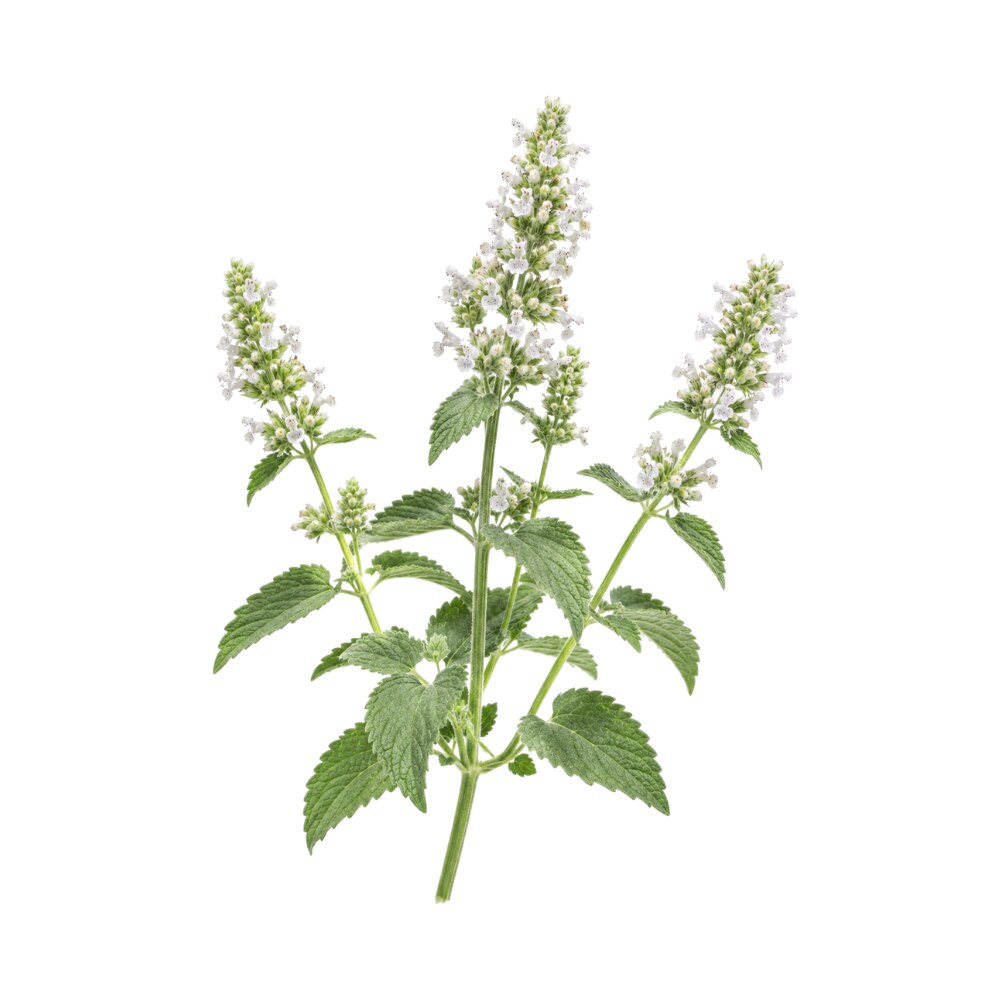
Nepetalic Acid is a naturally occurring iridoid monoterpene (non-glycosidic; monoterpenoid carboxylic acid), found in Catnip and 1 other source. It is well tolerated orally (low toxicity).
Concentration
Content by Source
Concentrations not reported. No percent-dry-weight or mg/g figures have been published for this compound in its source plants.
Nepetalic Acid at a Glance
Nepetalic acid is a small iridoid monoterpene from catnip (Nepeta cataria). Unlike the iridoid glycosides — such as aucubin, catalpol or asperuloside — it is non-glycosidic: a free monoterpenoid carboxylic acid, not a sugar-bound one. It occurs in the plant as a co-marker of the volatile oil alongside catnip’s dominant iridoid, nepetalactone, and is chemically the ring-opened acid relative of that lactone.
Its most important honest point comes first: catnip’s famous bioactivity is nepetalactone’s, not nepetalic acid’s. The cat-attractant “euphoria” response and the strong mosquito/tick repellency both belong to the lactone 4Reference 4The irritant receptor TRPA1 mediates the mosquito repellent effect of catnipView study →; nepetalic acid’s own documented pharmacology is minimal — a single old animal study in which it prolonged barbiturate sleeping time in mice 2Reference 2Behavioral and toxicological studies of cyclopentanoid monoterpenes from Nepeta catariaView study →. Treat it primarily as a chemistry and quality-control marker of catnip oil rather than as a bioactive in its own right.
Nepetalic Acid vs. Nepetalactone
This is the section the molecule exists for, and the distinction is easy to blur because the two compounds are close chemical relatives that co-occur in the same oil.
Nepetalactone is the lactone — a cyclic ester, and the defining iridoid of catnip (roughly 40–98% of the essential oil, chemotype-variable). Nepetalic acid is the corresponding acid — the ring-opened form, produced when the lactone is hydrolysed 1Reference 1The constituents of the volatile oil of catnipView study →. In the classic 1941 fractionation of catnip oil, the two came out together: nepetalactone ~40–50%, nepetalic acid ~33%, with a smaller neutral fraction 1Reference 1The constituents of the volatile oil of catnipView study →. Nepetalic acid also functions as a synthetic intermediate, since it interconverts with the lactone.
The honest note is that the pharmacology sits almost entirely with the lactone, and must not be borrowed onto the acid:
- Cat-attractant response — the sniff-lick-roll euphoria is triggered by volatile nepetalactone via the feline olfactory route. Nepetalic acid is not the established cat attractant.
- Insect / tick repellency — catnip’s repellent effect is driven by nepetalactone acting as an agonist of the insect irritant receptor TRPA1 (and, notably, it does not activate the human receptor) 4Reference 4The irritant receptor TRPA1 mediates the mosquito repellent effect of catnipView study →. This is nepetalactone’s mechanism, not a demonstrated property of nepetalic acid.
- Nepetalic acid’s own documented activity is minimal — see below. State it plainly: isolate data for nepetalic acid are thin.
What It's Used For
There is very little isolate pharmacology for nepetalic acid specifically. Essentially all of the “catnip does X” evidence rests on the whole essential oil or on nepetalactone; the acid appears in that literature as a co-constituent that is rarely tested on its own.
Support is an experimental score — weighted by study type (human > animal > in vitro) and volume. A beta, not a validated metric. For nepetalic acid there is essentially one thin, contradicted animal datapoint, so the single score stays very low by design.
The only isolate datapoint. In a 1978 behavioural/toxicological study of catnip’s cyclopentanoid monoterpenes, catnip oil (500 mg/kg) and nepetalic acid (62.5 mg/kg) both significantly increased hexobarbital sleeping time in mice — a barbiturate-potentiating, sedative-type signal 2Reference 2Behavioral and toxicological studies of cyclopentanoid monoterpenes from Nepeta catariaView study →.
This is the one positive CNS datapoint that has ever been attributed to the isolated molecule, and it is old, single-study, animal-only. It is directly complicated by a later study on whole catnip in which acute and long-term dosing increased locomotion and rearing and decreased pentobarbital sleeping time — an amphetamine-like stimulant profile — the opposite direction 3Reference 3AnimalBehavioral effects of acute and long-term administration of catnip (Nepeta cataria) in miceView study →.
Note the contradiction is not clean isolate-vs-isolate: the sedative datapoint is nepetalic acid, the stimulant datapoint is the whole herb.
Gap: no replication, no dose-response, no mechanism, and no human data; catnip’s own folk “sedative tea” reputation has no clean molecular anchor, and the human sleep/anxiety trials often cited for catnip were run on Nepeta menthoides, a different species 5Reference 5The genus Nepeta: traditional uses, phytochemicals and pharmacological propertiesView study →. Do not present nepetalic acid as a demonstrated sedative.
Mechanisms
No molecular target or pathway is established for nepetalic acid itself. The barbiturate-potentiation observation 2Reference 2Behavioral and toxicological studies of cyclopentanoid monoterpenes from Nepeta catariaView study → is a whole-animal behavioural readout, not a defined receptor mechanism, and no binding, enzyme or channel target has been characterised for the isolate. The insect-TRPA1 mechanism that explains catnip’s repellency belongs to nepetalactone, not to this acid 4Reference 4The irritant receptor TRPA1 mediates the mosquito repellent effect of catnipView study →.
Pharmacokinetics
There are no absorption, distribution, metabolism, half-life or excretion data for nepetalic acid in humans or animals. As a small, relatively polar monoterpenoid acid that interconverts with its lactone 1Reference 1The constituents of the volatile oil of catnipView study →, its ADME has simply not been studied — a gap that matters, since without it the single high-dose mouse behavioural finding 2Reference 2Behavioral and toxicological studies of cyclopentanoid monoterpenes from Nepeta catariaView study → cannot be related to any realistic human exposure.
Clinical Trials
None. No human trial has studied isolated nepetalic acid for any indication. The human data sometimes attached to “catnip” belong to whole-plant or different-species work, not to this molecule 5Reference 5The genus Nepeta: traditional uses, phytochemicals and pharmacological propertiesView study →.
| Completed | Planned | Terminated | Preclinical |
|---|---|---|---|
| —(none, isolate) | — | — | One 1978 mouse behavioural study 2Reference 2Behavioral and toxicological studies of cyclopentanoid monoterpenes from Nepeta catariaView study → |
Last checked: July 2026.
Prevalence in Nature
Nepetalic acid is essentially a catnip-genus compound. It occurs in the volatile oil of catnip (Nepeta cataria) as a co-marker of the dominant iridoid nepetalactone, and in related catmints (Nepeta spp.). In the foundational 1941 analysis of catnip oil it made up roughly a third of the oil (with nepetalactone ~40–50% and a smaller neutral fraction) 1Reference 1The constituents of the volatile oil of catnipView study →, though the proportion — like the nepetalactone content — varies with chemotype, cultivar and provenance. Its absolute concentration in the dried herb (as % dry weight) is not well documented; the figures that exist are proportions of the essential oil, not of the plant material people brew as tea.
Major Natural Sources
| Source (Botanical) | Part | Notes |
|---|---|---|
| Catnip (Nepeta cataria) | Aerial parts / volatile oil | Principal source; ~33% of the oil in the classic 1941 fractionation, co-occurring with nepetalactone 1Reference 1The constituents of the volatile oil of catnipView study → |
| Catmints (Nepeta spp.) | Aerial parts / volatile oil | Reported across the genus as a nepetalactone co-marker; content varies by species and chemotype |
Discovery & Synthesis
Nepetalic acid was first isolated and named in 1941 by S. M. McElvain, R. D. Bright and P. R. Johnson at the University of Wisconsin, in the opening paper of their series on the constituents of catnip volatile oil — the same landmark work that first characterised nepetalactone 1Reference 1The constituents of the volatile oil of catnipView study →. Their fractionation separated the oil into nepetalactone (~40–50%), nepetalic acid (~33%) and a neutral fraction (~14%), and established the lactone ↔ acid relationship: nepetalic acid is the ring-opened acid form obtained on hydrolysis of the lactone, and the pair were among the first fully characterised methylcyclopentane (iridoid) monoterpenoids 1Reference 1The constituents of the volatile oil of catnipView study →.
There is no established commercial production of nepetalic acid as an isolate — it is not a traded therapeutic. In practice it is obtained by extraction/fractionation of catnip oil or generated from nepetalactone by hydrolysis, and it serves mainly as a chemistry and quality-control marker and a synthetic intermediate in iridoid chemistry rather than as a manufactured product. A first total synthesis of the isolated acid is not clearly documented in the sources reviewed here.
Patents: not yet researched.
Toxicity & Safety
Nepetalic acid carries a low flag, consistent with catnip’s long record of safe culinary and medicinal use and the low apparent toxicity of catnip oil in animal studies. The caveat is that this is a low-data low, not a well-characterised one: there is no dedicated isolate toxicology package (no genotoxicity, carcinogenicity, repeat-dose or reproductive-toxicity dataset) for nepetalic acid specifically.
- Occurs in a low-toxicity herb. Catnip has a long history of safe use, and its oil shows low acute toxicity in animals; nepetalic acid is one of its normal iridoid constituents.
- Do not read catnip’s bioactivity onto this molecule. The cat-attractant and insect-repellent effects are nepetalactone’s; nepetalic acid’s only isolate datapoint is an old, contradicted animal sedative finding 2,
3Reference 2Behavioral and toxicological studies of cyclopentanoid monoterpenes from Nepeta catariaView study →Reference 3AnimalBehavioral effects of acute and long-term administration of catnip (Nepeta cataria) in miceView study → . - Isolate safety is essentially unstudied. No genotoxicity, organ-toxicity or reproductive-toxicity data exist for the pure compound; absence of findings is not evidence of safety.
- Pregnancy/lactation decisions belong to the herb. Catnip the herb is traditionally cautioned as an emmenagogue; that caution attaches to catnip use, not to this molecule-level page.
Dosage
There is no established human dose for nepetalic acid — it is a chemistry/marker compound, not a used therapeutic, and has no clinical use to dose for. The only quantitative figure in the literature is the 62.5 mg/kg dose given to mice in the 1978 barbiturate-sleeping-time study 2Reference 2Behavioral and toxicological studies of cyclopentanoid monoterpenes from Nepeta catariaView study →; that is an experimental animal dose behind a single, contradicted finding, not a human recommendation. Real-world human exposure is incidental — as a minor iridoid constituent of catnip preparations, chiefly the essential oil.
References
- McElvain SM, Bright RD, Johnson PR (1941). The constituents of the volatile oil of catnip. I. Nepetalic acid, nepetalactone and related compounds. Journal of the American Chemical Society, 63(6):1558–1563. https://doi.org/10.1021/ja01851a019
- Harney JW, Barofsky IM, Leary JD (1978). Behavioral and toxicological studies of cyclopentanoid monoterpenes from Nepeta cataria. Lloydia, 41(4):367–374. https://pubmed.ncbi.nlm.nih.gov/672466/
- Massoco CO, Silva MR, Gorniak SL, Spinosa MS, Bernardi MM (1995). Behavioral effects of acute and long-term administration of catnip (Nepeta cataria) in mice. Veterinary and Human Toxicology, 37(6):530–533. https://pubmed.ncbi.nlm.nih.gov/8588288/
- Melo N, Capek M, Arenas OM, et al. (2021). The irritant receptor TRPA1 mediates the mosquito repellent effect of catnip. Current Biology, 31(9):1988–1994. https://pubmed.ncbi.nlm.nih.gov/33667373/
- Sharma A, Cooper R, Bhardwaj G, Cannoo DS (2021). The genus Nepeta: traditional uses, phytochemicals and pharmacological properties. Journal of Ethnopharmacology, 268:113679. https://pubmed.ncbi.nlm.nih.gov/33307050/



