Vitamin D2 (Ergocalciferol)
The plant- and fungal-derived form of vitamin D, made by UV-B irradiation of ergosterol. It raises 25(OH)D and corrects deficiency, but most head-to-head trials find D3 does so more effectively — especially with bolus dosing.

Sources · 3
Where Does It Come From?
Concentration
Content by Source
Reported concentrations across the plants that contain vitamin D2 (Ergocalciferol) — the bar marks the typical level, the line shows the reported range.
Literature figures for varying plant parts and preparations. Read them as a comparative guide, not exact assays.
Vitamin D2 (Ergocalciferol) at a Glance
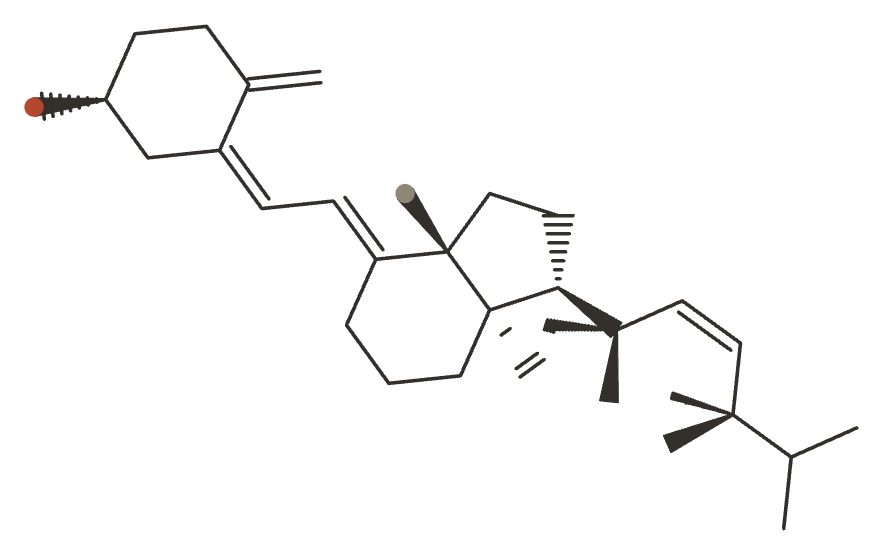
Vitamin D2 (ergocalciferol) is the plant and fungal form of vitamin D, made when UV light strikes ergosterol in yeast or mushrooms. It is the form used in most prescription high-dose vitamin D and in vegan supplements.
It differs from D3 by a single double bond and a methyl group, and that small difference is the whole subject of the page: D2 raises blood 25(OH)D, but not as durably as D3 does.
What It’s Used For
- Raising 25(OH)D / correcting deficiency — restores vitamin D status and treats deficiency.
- D2 vs D3 efficacy (the form question) — the comparison that decides which form to choose.
- UV-mushroom D2 as a food source — UV-exposed mushrooms as a dietary and vegan source.
How It Works
Both D2 and D3 are prohormones: the liver converts them to 25-hydroxyvitamin D, the form measured in a blood test, and the kidney activates that to calcitriol, which binds the vitamin D receptor and regulates gene transcription. The receptor does not distinguish between the two once they reach that point.
The difference is upstream. 25(OH)D2 binds vitamin D-binding protein less tightly than 25(OH)D3, so it clears from circulation faster — which is why an equal dose of D2 produces a lower and shorter-lived rise in blood levels, and why daily dosing narrows the gap while intermittent dosing widens it. D2 is fat-soluble and absorbed better with a meal containing fat.
The full trial record is in Pharmacology & Research below.
Pharmacology & Research
Vitamin D2 (ergocalciferol) is the plant- and fungal-derived vitamer of vitamin D. It is not made in human or animal skin; it is produced when UV-B light strikes ergosterol — the characteristic sterol of fungal and yeast cell membranes — which is why UV-exposed mushrooms and yeast are the dietary D2 source and why the vegan/vegetarian and prescription high-dose forms are usually D2 1Reference 1ReviewVitamin D — Fact Sheet for Health Professionals — [authoritative review]. https://ods.od.nih.gov/factsheets/VitaminD-HealthProfessional/View study →.
Historically it was the first “vitamin D”: Steenbock’s 1920s discovery that UV-irradiating food (and ergosterol specifically) conferred antirachitic activity gave rise to ergocalciferol, and the 50,000 IU ergocalciferol capsule is still a standard prescription repletion product. Downstream, D2 is metabolised by the identical pathway as D3 — hydroxylated in the liver to 25-hydroxyvitamin D2 (the status marker) and in the kidney to 1,25-dihydroxyvitamin D2, which acts on the vitamin D receptor (VDR) to drive calcium and phosphate homeostasis, bone mineralization, and immune modulation. Its cross-link to ergosterol is not incidental: ergosterol is the precursor from which dietary D2 is made.
The single most important thing to understand here is the D2-versus-D3 comparison, and it must be stated precisely in both directions. Both vitamers genuinely raise serum 25(OH)D and both correct deficiency. But the weight of head-to-head evidence finds that D3 (cholecalciferol) raises and — especially — sustains 25(OH)D more effectively than D2, a difference driven by faster clearance of 25(OH)D2, lower affinity of D2 metabolites for vitamin-D-binding protein, and differences in 24-hydroxylation. The gap is largest with single large (bolus) doses and narrows with low daily dosing, though it does not always vanish even then. This is the honest, evidence-led headline — neither “D2 doesn’t work” (it does) nor “the two are interchangeable” (on current data, they are not quite). For a fuller treatment of the shared clinical evidence — fractures, respiratory infection, the large null trials in replete adults — see the companion page on vitamin D3. Only what is specific to D2 is covered here.
Support is an experimental score — a composite weighted by study type (human > animal > in vitro > review) and study volume. It’s a beta: a fast way to rank strength of evidence at a glance, not a validated metric.
Ergocalciferol is a proven way to raise serum 25(OH)D and correct genuine deficiency. It follows the identical activation pathway as D3 (liver 25-hydroxylation → kidney 1α-hydroxylation → VDR), so once 1,25(OH)2D2 is formed its downstream action on calcium/phosphate handling and bone is the same. This is why high-dose ergocalciferol (classically 50,000 IU weekly for several weeks, then a maintenance dose) is a standard prescription repletion regimen, and why reference bodies count D2 and D3 together toward the RDA for vitamin D 1Reference 1ReviewVitamin D — Fact Sheet for Health Professionals — [authoritative review]. https://ods.od.nih.gov/factsheets/VitaminD-HealthProfessional/View study →.
As with D3, the benefit is a repletion effect: large in the deficient, absent in the already-replete.
Gap: the effect is deficiency-dependent, and — see below — D2 does not sustain 25(OH)D as durably as an equivalent amount of D3.
This is the reason the two vitamers get separate pages. The 2012 systematic review and meta-analysis by Tripkovic and colleagues pooled RCTs directly comparing the forms and concluded that vitamin D3 is more efficacious than D2 at raising serum 25(OH)D, with the difference most pronounced when given as single or intermittent large (bolus) doses and attenuated under daily dosing 2Reference 2Meta-analysisComparison of vitamin D2 and vitamin D3 supplementation in raising serum 25-hydroxyvitamin D status: a systematic review and meta-analysis — [systematic review & meta-analysis]View study →.
A well-powered 2017 daily food-fortification RCT (335 women given 15 mcg/day as D2 or D3 in juice or biscuit over winter) still found D3 produced a significantly greater rise in total 25(OH)D than D2 even at a modest daily dose 3Reference 3RCTDaily supplementation with 15 μg vitamin D2 compared with vitamin D3 to increase wintertime 25-hydroxyvitamin D status in healthy South Asian and white European women: a 12-wk randomized, placebo-controlled food-fortification trial — [RCT]View study →.
A 2024 meta-analysis restricted to daily-dosing trials refined the picture: the D3 advantage is smaller with daily dosing and is modified by body-mass index and baseline status, but a difference generally remains 4Reference 4Meta-analysisComparison of the effect of daily vitamin D2 and vitamin D3 supplementation on serum 25-hydroxyvitamin D concentration and importance of body mass index: a systematic review and meta-analysis — [meta-analysis of daily-dosing trials]View study →.
Mechanistically the gap reflects faster catabolism/clearance of 25(OH)D2, lower affinity of D2 metabolites for vitamin-D-binding protein, and — notably — D2 can lower circulating 25(OH)D3.
Gap: the difference is real but modest and dose-dependent; D2 is not ineffective, and daily low-dose narrows (without always closing) the gap. The practical rule: prefer D3 where available and acceptable, use D2 when a plant/fungal source is required or when it is the prescribed high-dose product.
Because ergosterol sits in fungal membranes, mushrooms exposed to UV-B accumulate vitamin D2 — often dramatically. In a randomized controlled trial in healthy adults deficient in 25(OH)D, a soup made from UV-B-irradiated button mushrooms (their D2 content raised from <1 to ~491 mcg/100 g) improved vitamin D status and was not different from a conventional D2 supplement over five weeks 5Reference 5RCTBioavailability of vitamin D2 from UV-B-irradiated button mushrooms in healthy adults deficient in serum 25-hydroxyvitamin D: a randomized controlled trial — [RCT]View study →.
This makes UV-exposed mushrooms a legitimate whole-food, vegan-compatible D2 source. The caveat is the same form caveat as above: it is D2, so it inherits D2’s somewhat less durable effect on 25(OH)D relative to D3.
Gap: the human evidence base is small (single RCT plus mechanism), and content varies enormously with UV exposure and mushroom type.
Mechanisms
| Target / pathway | Effect | Relevant to |
|---|---|---|
| UV-B photolysis of ergosterol → previtamin D2 → D2 | How ergocalciferol is formed (in fungi/yeast, not human skin) | Origin; UV-mushroom source |
| Hepatic 25-hydroxylase | D2 → 25(OH)D2 (status marker); turns over faster than 25(OH)D3 | Shorter functional persistence vs D3 |
| Renal 1α-hydroxylase | 25(OH)D2 → 1,25(OH)2D2 (active hormone) | Calcium/phosphate homeostasis |
| Vitamin D receptor (VDR), nuclear | Activated by 1,25(OH)2D2 → calcium-transport gene transcription | Bone mineralizationdeficiency correction |
| Vitamin-D-binding protein | Binds 25(OH)D2 with lower affinity than 25(OH)D3 | Part of why D2 is cleared faster |
Pharmacokinetics
Ergocalciferol is fat-soluble and absorbed in the small intestine with dietary fat, so it is best taken with a fat-containing meal. Once hydroxylated, its status metabolite 25(OH)D2 has a shorter functional persistence than 25(OH)D3 — it is cleared more quickly and its metabolites bind vitamin-D-binding protein with lower affinity — which is the core reason a bolus of D2 fades faster than the same dose of D3 2,
Dietary Sources
Vitamin D2 is the vitamin’s plant/fungal dietary form. It is essentially absent from animal foods (which supply D3) and is found in meaningful amounts only in fungi — and then mostly when they have seen UV light. Sun-dried or deliberately UV-exposed mushrooms can carry very high D2; supermarket mushrooms grown in the dark carry little. Yeast is the other fungal source, and prescription/OTC high-dose “vitamin D” for vegans is typically ergocalciferol.
| Food (typical serving) | Approx. vitamin D2 |
|---|---|
| UV-exposed / sun-dried mushrooms (½ cup) | Highly variable — from ~46 IU up to several hundred IU when UV-treated |
| Ordinary (dark-grown) mushrooms (½ cup) | Low (often <10 IU) |
| Fortified plant milks / cereals | Variable — check the label; may be D2 or D3 |
| Prescription ergocalciferol capsule | 50,000 IU (repletion product) |
Values approximate; mushroom content depends entirely on UV exposure 1,
The UV Effect, Measured
The oyster mushroom figures are the most instructive pair on record, because they are the same organism measured twice. Untreated fruiting bodies grown in the dark carry essentially none, around 0.16 µg/g dry weight 7Reference 7Vitamin D2 formation from post-harvest UV-B treatment of mushrooms and retention during storage — [controlled experimental study]View study →. After UV-B or direct sun exposure the same mushrooms reach 67 to 240 µg/g dry weight 6Reference 6Dose-response effect of sunlight on vitamin D2 production in Agaricus bisporus mushrooms — [controlled experimental study]View study → — a thousandfold difference driven entirely by light.
This is why “mushrooms contain vitamin D” means little without knowing how they were grown and dried. Commercially cultivated mushrooms are usually raised indoors and carry almost none; sun-dried material can be a serious source.
Dosage & Intake
These are intakes and doses studied in research and set by reference bodies, not a personal recommendation. Vitamin D reference values are expressed for the vitamin as a whole — D2 and D3 count together. The RDA is 600 IU/day (15 mcg) for adults 19–70 and 800 IU/day (20 mcg) over 70; the adult Tolerable Upper Intake Level is 4,000 IU/day (100 mcg), counting supplements and fortified food 1Reference 1ReviewVitamin D — Fact Sheet for Health Professionals — [authoritative review]. https://ods.od.nih.gov/factsheets/VitaminD-HealthProfessional/View study →.
- Form choice: where D3 is available and acceptable, it is generally preferred because it raises and sustains 25(OH)D somewhat more effectively 2,
3, . Reach for D2 when a plant/fungal source is required (some vegan/vegetarian preferences) or when it is the prescribed high-dose repletion product (50,000 IU ergocalciferol).4Reference 2Meta-analysisComparison of vitamin D2 and vitamin D3 supplementation in raising serum 25-hydroxyvitamin D status: a systematic review and meta-analysis — [systematic review & meta-analysis]View study →Reference 3RCTDaily supplementation with 15 μg vitamin D2 compared with vitamin D3 to increase wintertime 25-hydroxyvitamin D status in healthy South Asian and white European women: a 12-wk randomized, placebo-controlled food-fortification trial — [RCT]View study →Reference 4Meta-analysisComparison of the effect of daily vitamin D2 and vitamin D3 supplementation on serum 25-hydroxyvitamin D concentration and importance of body mass index: a systematic review and meta-analysis — [meta-analysis of daily-dosing trials]View study → - Repletion: for diagnosed deficiency, guidelines describe higher short-term loading (e.g. 50,000 IU ergocalciferol weekly for 6–8 weeks) followed by a maintenance dose, ideally monitored by blood test 1Reference 1ReviewVitamin D — Fact Sheet for Health Professionals — [authoritative review]. https://ods.od.nih.gov/factsheets/VitaminD-HealthProfessional/View study →.
- Timing & units: take with a fat-containing meal; 1 mcg = 40 IU. Daily dosing maintains steadier status than large intermittent boluses — a point that matters more for D2, whose 25(OH)D metabolite fades faster.
Safety
At recommended intakes ergocalciferol is safe. Its distinctive risk is the shared vitamin D one: it is fat-soluble and stored, so sustained intake well above the upper limit accumulates and can cause hypervitaminosis D and hypercalcemia. This risk is amplified for D2 specifically because the common prescription product is a very high-dose (50,000 IU) capsule — repeated dosing errors with high-dose ergocalciferol are a recognised route to toxicity.
- Safe at recommended intakes. Same 4,000 IU/day adult upper limit as all vitamin D (D2 + D3 combined).
- Sustained megadosing causes hypercalcemia. Nausea, vomiting, weakness, frequent urination, kidney stones, and in severe cases kidney injury and calcification — a real, stored-vitamin risk.
- High-dose prescription product. The 50,000 IU ergocalciferol capsule leaves little margin for a dosing error; follow the prescribed schedule.
- Exaggerated calcium responses in some conditions. Sarcoidosis and other granulomatous disease, primary hyperparathyroidism, lymphoma, and some kidney disease need medical supervision.
- Calcium-mediated drug interactions. Thiazide diuretics add hypercalcemia risk; raised calcium increases digoxin toxicity risk. Corticosteroids, orlistat/bile-acid sequestrants, and some anticonvulsants lower vitamin D status.
Full Safety & Interactions Detail
At recommended intakes ergocalciferol is safe, and it shares vitamin D’s overall favourable profile. Its distinctive risk comes from being fat-soluble and stored: unlike water-soluble vitamins, sustained intake well above the UL accumulates and can cause vitamin D toxicity (hypervitaminosis D) — hypercalcemia presenting as nausea, vomiting, weakness, frequent urination, kidney stones, and, in severe cases, kidney injury and calcification 1Reference 1ReviewVitamin D — Fact Sheet for Health Professionals — [authoritative review]. https://ods.od.nih.gov/factsheets/VitaminD-HealthProfessional/View study →. Because prescription ergocalciferol is dispensed as a 50,000 IU capsule, toxicity reports often involve high-dose products taken too frequently, so the schedule matters.
Interactions (drug classes):
- Thiazide diuretics + vitamin D + calcium → additive hypercalcemia risk.
- Corticosteroids (e.g. prednisone) can impair vitamin D metabolism and calcium absorption.
- Weight-loss / cholesterol agents — orlistat and bile-acid sequestrants (cholestyramine) reduce absorption of fat-soluble vitamins including D; separate dosing.
- Anticonvulsants (phenobarbital, phenytoin) and some antiretrovirals increase catabolism of vitamin D, lowering status.
- Digoxin — because vitamin D can raise calcium, hypercalcemia increases the risk of digoxin toxicity/arrhythmia.
Who should be cautious: people with sarcoidosis or other granulomatous disease, primary hyperparathyroidism, lymphoma, or some forms of kidney disease can experience exaggerated calcium responses and should supplement only under medical supervision 1Reference 1ReviewVitamin D — Fact Sheet for Health Professionals — [authoritative review]. https://ods.od.nih.gov/factsheets/VitaminD-HealthProfessional/View study →.
Verdict: routine maintenance intake at the RDA (600 IU/day, as D2 or D3) is recommended and safe; do not exceed the UL without medical advice. The evidence base on pregnancy outcomes is built largely on vitamin D generally rather than D2 specifically, and dosing in pregnancy — particularly any high-dose repletion — should be decided with a healthcare professional who has the full clinical picture. This is general information, not antenatal advice 1Reference 1ReviewVitamin D — Fact Sheet for Health Professionals — [authoritative review]. https://ods.od.nih.gov/factsheets/VitaminD-HealthProfessional/View study →.
References
- National Institutes of Health, Office of Dietary Supplements. (2024). Vitamin D — Fact Sheet for Health Professionals — [authoritative review]. https://ods.od.nih.gov/factsheets/VitaminD-HealthProfessional/
- Tripkovic, L., et al. (2012). Comparison of vitamin D2 and vitamin D3 supplementation in raising serum 25-hydroxyvitamin D status: a systematic review and meta-analysis — [systematic review & meta-analysis]. American Journal of Clinical Nutrition. https://pubmed.ncbi.nlm.nih.gov/22552031/
- Tripkovic, L., et al. (2017). Daily supplementation with 15 μg vitamin D2 compared with vitamin D3 to increase wintertime 25-hydroxyvitamin D status in healthy South Asian and white European women: a 12-wk randomized, placebo-controlled food-fortification trial — [RCT]. American Journal of Clinical Nutrition. https://pubmed.ncbi.nlm.nih.gov/28679555/
- van den Heuvel, E. G. H. M., et al. (2024). Comparison of the effect of daily vitamin D2 and vitamin D3 supplementation on serum 25-hydroxyvitamin D concentration and importance of body mass index: a systematic review and meta-analysis — [meta-analysis of daily-dosing trials]. Advances in Nutrition. https://pubmed.ncbi.nlm.nih.gov/37865222/
- Urbain, P., et al. (2011). Bioavailability of vitamin D2 from UV-B-irradiated button mushrooms in healthy adults deficient in serum 25-hydroxyvitamin D: a randomized controlled trial — [RCT]. European Journal of Clinical Nutrition. https://pubmed.ncbi.nlm.nih.gov/21540874/
- Urbain P, Jakobsen J (2015). Dose-response effect of sunlight on vitamin D2 production in Agaricus bisporus mushrooms — [controlled experimental study]. Journal of Agricultural and Food Chemistry. https://pubmed.ncbi.nlm.nih.gov/26314311/
- Roberts JS, Teichert A, McHugh TH (2008). Vitamin D2 formation from post-harvest UV-B treatment of mushrooms and retention during storage — [controlled experimental study]. Journal of Agricultural and Food Chemistry. https://pubmed.ncbi.nlm.nih.gov/18522400/