
Syrian Rue
Peganum harmala
Plant Family
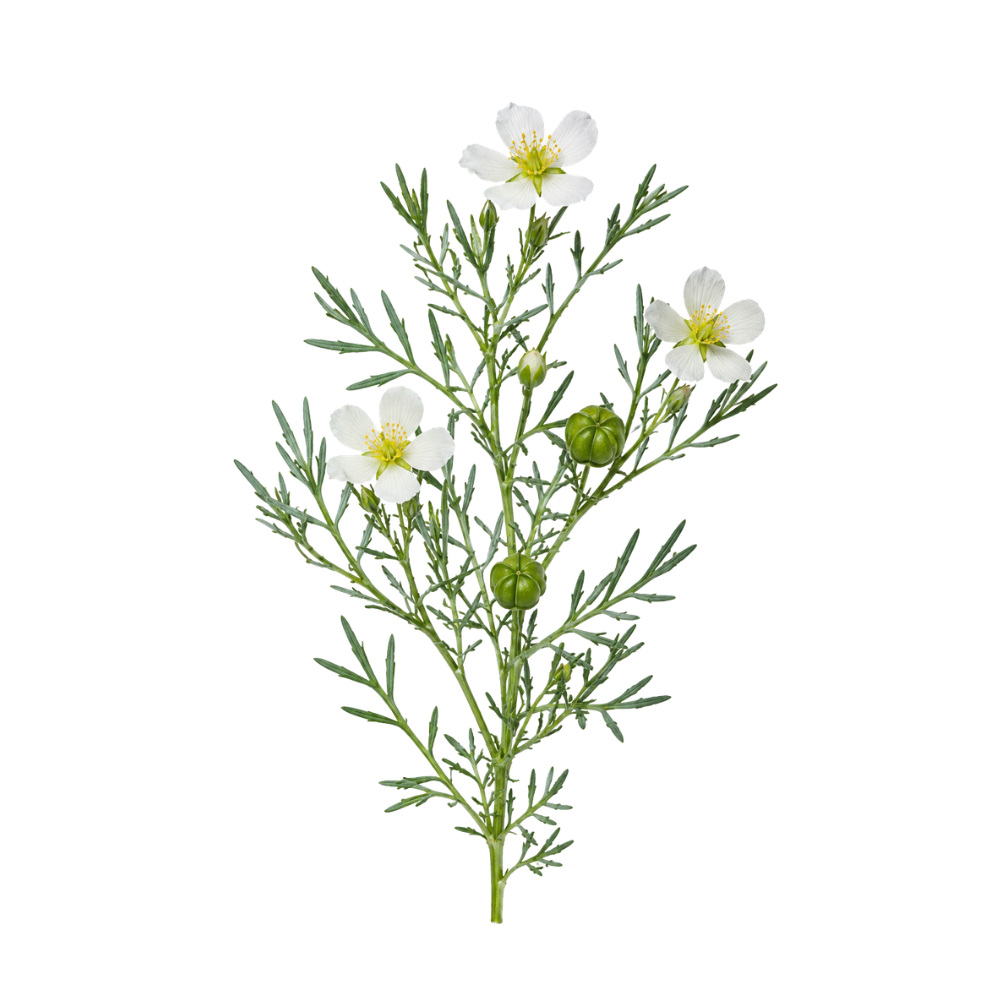
Pictured: Syrian Rue
Nitre bush family
A small family of salt-tolerant desert shrubs and herbs, medicinally dominated by one genus whose beta-carboline alkaloids are the Old World counterpart to the ayahuasca vine.
1 Herb // 9 Constituents // 4 Notable Members
Overview
A small family — four genera, perhaps 20 species — of shrubs and herbs adapted to deserts, salt steppe and saline flats from the Mediterranean across Central Asia to China, with Nitraria reaching Australia. Its circumscription is recent and still argued over: Peganum was long placed in Zygophyllaceae, and some treatments give it a family of its own (Peganaceae). The plants are unremarkable to look at. The chemistry is not.
Shared Traits
In Practice
Syrian rue (Peganum harmala) is the family’s one significant medicinal plant, and it matters for a specific pharmacological reason: its seeds are the Old World’s principal source of reversible MAO-A inhibitors.
The seed carries the beta-carbolines harmine, harmaline, harmalol, harman and tetrahydroharmine — the same alkaloid class that makes the ayahuasca vine work, arrived at independently on the other side of the world. Traditionally the seed is burned as an incense and fumigant across Iran, Turkey and Central Asia, taken as an anthelmintic and emmenagogue, and used as a dye source. In modern use it is most often encountered as an “ayahuasca analogue” — an MAOI paired with an oral tryptamine, which is a pharmacological manoeuvre rather than a traditional practice.
This is one of the highest-consequence interaction profiles on the site. MAO-A inhibition is not a subtle effect: it means tyramine-rich foods, SSRIs, SNRIs, tramadol, triptans, stimulants and many cold remedies all become genuinely dangerous, with hypertensive crisis and serotonin syndrome the named risks. Peganum also carries quinazoline alkaloids — vasicine and vasicinone — which are uterotonic, making the seed firmly contraindicated in pregnancy. Overdose reports describe vomiting, hallucinations, tremor, bradycardia and hepatotoxicity. It is a herb for informed use, not casual experimentation.
Materia Medica
The monograph in the database whose Nitrariaceae membership is recorded on the herb itself — so this list keeps itself current as new herbs land.
Peganum harmala
Phytochemistry
The family marker is the beta-carboline (harmala) alkaloid series concentrated in Peganum seed, accompanied by quinazoline alkaloids of the vasicine type. Nitraria species carry their own distinct alkaloid chemistry (the nitraria and sibirine alkaloids). Across the family, the salt-flat habitat brings the osmolyte and betaine chemistry typical of halophytes.
The compounds recorded for this family's single member, grouped by class.
Beyond the Database
Notable members without a monograph yet.
Keep Exploring