
Materia Medica
Amanita smithiana ☠️
Amanita smithiana
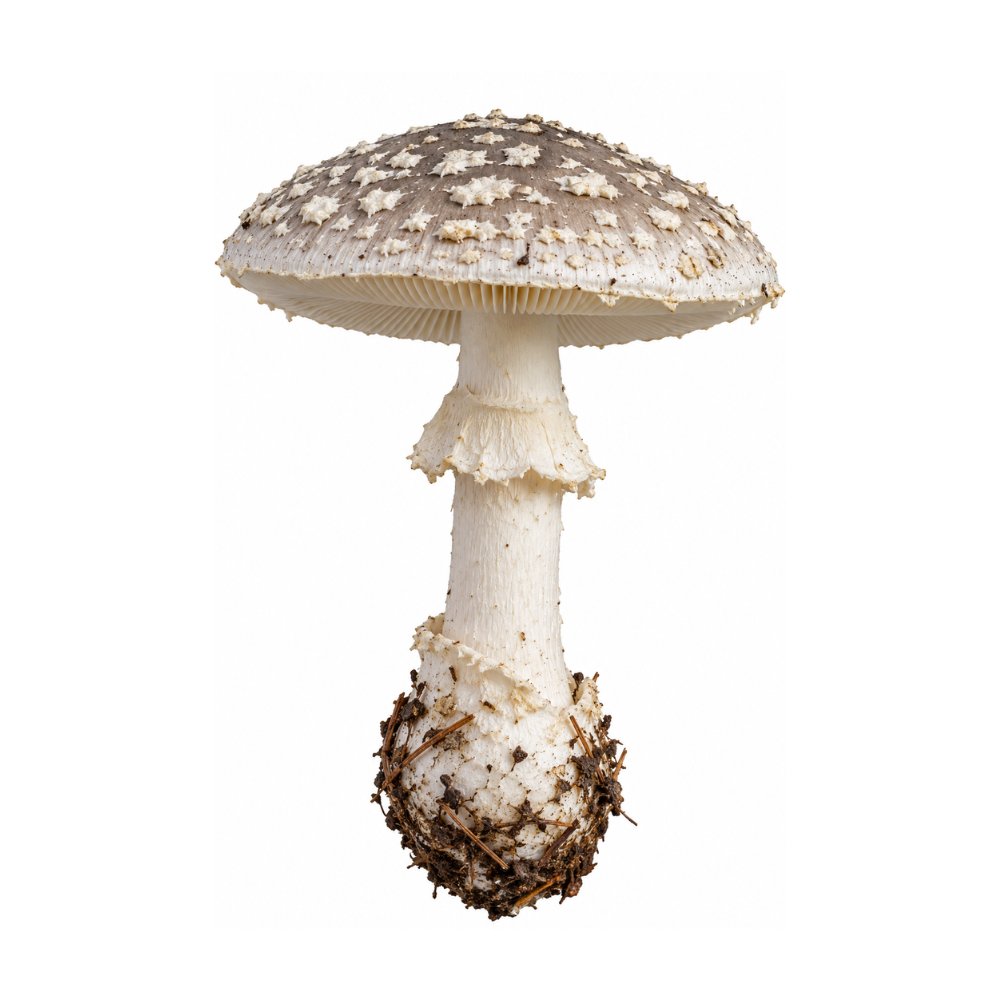
Amanita smithiana is a large white mushroom of Pacific Northwest conifer forest that is mistaken for the pine mushroom (matsutake). It damages the kidneys rather than the liver, and poisonings have been reported from British Columbia and the US Pacific Northwest.
What Is Amanita smithiana?
Amanita smithiana is a large white mushroom of Pacific Northwest conifer forest that poisons the kidneys. It is mistaken for the pine mushroom, or matsutake, which is highly prized and widely picked 6Reference 6Case reportLaboratory confirmation of Amanita smithiana mushroom poisoning — case reportView study →.
It grows with conifers, especially Douglas-fir, from the Pacific Northwest to central California, and fruits in autumn and winter 8Reference 8Amanita smithiana — species descriptionView study →.
Its poisoning is a different illness from death cap poisoning. The stomach symptoms come sooner, and the organ that fails is the kidney, not the liver 2Reference 2ReviewAmanita smithiana mushroom ingestion: a case of delayed renal failure and literature reviewView study →.
Identification & Lookalikes
The pine mushroom is the confusion, and smell is the most useful field character. The western pine mushroom is now named Tricholoma murrillianum; older reports call it T. magnivelare, a name now kept for the eastern species 9Reference 9Tricholoma murrillianum — species descriptionView study →.
| Amanita smithiana | Pine mushroom (T. murrillianum) | |
|---|---|---|
| Smell | Unpleasant in some collections, not distinctive in others, especially when young 8Reference 8Amanita smithiana — species descriptionView study → | Spicy but slightly foul; described as a mix of “red hots” and dirty socks 9Reference 9Tricholoma murrillianum — species descriptionView study → |
| Cap | 5–17 cm; whitish, covered in soft powdery veil material or whitish warts 8Reference 8Amanita smithiana — species descriptionView study → | 5–10 cm; white at first, often developing brown fibrils and small scales 9Reference 9Tricholoma murrillianum — species descriptionView study → |
| Gills | Free from the stem; whitish; crowded 8Reference 8Amanita smithiana — species descriptionView study → | Narrowly attached to the stem; white to ivory, sometimes staining reddish brown with age 9Reference 9Tricholoma murrillianum — species descriptionView study → |
| Stem base | Swollen into a bulb that extends into a root-like point, with veil fragments in rings at the top of the bulb 8Reference 8Amanita smithiana — species descriptionView study → | Roughly equal or slightly tapered 9Reference 9Tricholoma murrillianum — species descriptionView study → |
| Ring | Ragged, often torn or missing 8Reference 8Amanita smithiana — species descriptionView study → | Prominent and flaring 9Reference 9Tricholoma murrillianum — species descriptionView study → |
| Flesh | Not described as distinctive 8Reference 8Amanita smithiana — species descriptionView study → | White and firm 9Reference 9Tricholoma murrillianum — species descriptionView study → |
⚠ Smell the mushroom. The pine mushroom’s spicy smell is its most distinctive character. A white Amanita-like mushroom in conifer forest without that smell should not be in the basket.
Amanita smithiana grows in native conifer forest. In BC the death cap grows mainly in cities, under planted broadleaf trees.
Mycology
Amanita smithiana Bas belongs to the Amanitaceae, in section Lepidella, a group of white amanitas that is hard to sort out 8Reference 8Amanita smithiana — species descriptionView study →. It is ectomycorrhizal with conifers, especially Douglas-fir 8Reference 8Amanita smithiana — species descriptionView study →.
The spore print is white, and the spores are 8.5–12 × 6–8 µm, smooth, ellipsoid and amyloid 8Reference 8Amanita smithiana — species descriptionView study →.
Its toxin has been found in some other white amanitas. Thin-layer chromatography detected it in the European A. boudieri, A. gracilior and A. echinocephala, but not in A. proxima, which also damages the kidneys 7Reference 7Case reportAmanita poisonings resulting in acute, reversible renal failure: new cases, new toxic Amanita mushrooms — case series and toxin screenView study →.
Distribution
Amanita smithiana grows from the Pacific Northwest to central California 8Reference 8Amanita smithiana — species descriptionView study →. Almost all Canadian records in the GBIF biodiversity database are from British Columbia 11Reference 11Amanita smithiana Bas — occurrence records by provinceView study →.
Reviews place it among the kidney-damaging mushrooms of the United States and Canada 10Reference 10ObservationalNephrotoxic mushroom poisoning: global epidemiology, clinical manifestations, and management — reviewView study →.
Poisonings have been reported from both sides of the border. Four cases in southwestern British Columbia were reported in 1997 5Reference 5Case reportRenal failure caused by mushroom poisoning — case seriesView study →, and a laboratory-confirmed case was reported from the University of British Columbia in 2013 6Reference 6Case reportLaboratory confirmation of Amanita smithiana mushroom poisoning — case reportView study →. In the United States, a four-patient case series from Oregon Health Sciences University was published in 1998, and a case from the Oregon Poison Center in 2009 1,
Phytochemistry
The toxin most often named for A. smithiana is allenic norleucine (2-amino-4,5-hexadienoic acid), an unusual amino acid that is not used to build proteins. Chlorocrotylglycine is named with it.
The toxin’s identity is not settled. A 2013 case report stated that its chemical structure is unknown, though it shows as a characteristic spot on thin-layer chromatography and can be detected that way 6Reference 6Case reportLaboratory confirmation of Amanita smithiana mushroom poisoning — case reportView study →.
It is not an amatoxin. The chemistry, the target organ and the timing all differ from death cap poisoning 2,
Constituent Summary
The compounds named as the kidney toxins.
Amino Acid2 compounds2 with data
Toxicology
Class of poison. A kidney toxin.
Mechanism. The poisoning damages the kidney tubules. In related white-amanita poisonings, kidney biopsies showed acute interstitial nephritis and tubular necrosis 7Reference 7Case reportAmanita poisonings resulting in acute, reversible renal failure: new cases, new toxic Amanita mushrooms — case series and toxin screenView study →.
Course. Stomach symptoms come first: nausea, vomiting, abdominal pain and diarrhoea. They started from 20 minutes to 12 hours after eating in one case series 1Reference 1Case reportAcute renal failure associated with suspected Amanita smithiana mushroom ingestions: a case seriesView study →, five to eight hours after eating in the BC series 5Reference 5Case reportRenal failure caused by mushroom poisoning — case seriesView study →, and within six hours in the Oregon case 2Reference 2ReviewAmanita smithiana mushroom ingestion: a case of delayed renal failure and literature reviewView study →.
Kidney injury develops over the first one to four days 2Reference 2ReviewAmanita smithiana mushroom ingestion: a case of delayed renal failure and literature reviewView study →. Patients in the case series arrived in kidney failure 4 to 6 days after eating 1,
★ This is why the onset time alone cannot be used as a safety rule. The “under six hours is probably fine” rule is meant to separate amatoxin poisoning from simple stomach irritants, and A. smithiana causes early symptoms and a serious outcome.
Antidote. None. Treatment is supportive, with dialysis until the kidneys recover 6Reference 6Case reportLaboratory confirmation of Amanita smithiana mushroom poisoning — case reportView study →.
Outcome. Every patient in the published North American reports recovered kidney function 1,
Compared with the death cap:
| A. smithiana | A. phalloides | |
|---|---|---|
| Toxin | Kidney toxin, structure not settled | Amatoxins |
| Target organ | Kidney | Liver |
| First symptoms | 20 minutes to 12 hours | 6–24 hours |
| Course | Kidney failure, recovered in the reported cases | Liver failure, sometimes fatal |
| Mistaken for | Pine mushroom (matsutake) | Puffball, paddy straw mushroom |
Traditional & Historical Use
Amanita smithiana has no medicinal, culinary or ritual use.
Its toxic history is tied to the pine-mushroom harvest. In the 1997 BC series and the 1998 case series, every patient believed they were eating pine mushrooms 1,
Safety & Pregnancy
- Causes acute kidney failure, not liver failure 2,
6Reference 2ReviewAmanita smithiana mushroom ingestion: a case of delayed renal failure and literature reviewView study →Reference 6Case reportLaboratory confirmation of Amanita smithiana mushroom poisoning — case reportView study → . - Mistaken for the pine mushroom (matsutake), which is widely picked in BC 5,
6Reference 5Case reportRenal failure caused by mushroom poisoning — case seriesView study →Reference 6Case reportLaboratory confirmation of Amanita smithiana mushroom poisoning — case reportView study → . - Early onset, from 20 minutes to 12 hours after eating, so an early start does not rule out serious poisoning 1Reference 1Case reportAcute renal failure associated with suspected Amanita smithiana mushroom ingestions: a case seriesView study →.
- Patients in the published reports recovered kidney function, some after weeks of dialysis 1,
2, .5, 6Reference 1Case reportAcute renal failure associated with suspected Amanita smithiana mushroom ingestions: a case seriesView study →Reference 2ReviewAmanita smithiana mushroom ingestion: a case of delayed renal failure and literature reviewView study →Reference 5Case reportRenal failure caused by mushroom poisoning — case seriesView study →Reference 6Case reportLaboratory confirmation of Amanita smithiana mushroom poisoning — case reportView study → - Poisonings are on record in BC, as well as in the US Pacific Northwest 1,
2, .5, 6Reference 1Case reportAcute renal failure associated with suspected Amanita smithiana mushroom ingestions: a case seriesView study →Reference 2ReviewAmanita smithiana mushroom ingestion: a case of delayed renal failure and literature reviewView study →Reference 5Case reportRenal failure caused by mushroom poisoning — case seriesView study →Reference 6Case reportLaboratory confirmation of Amanita smithiana mushroom poisoning — case reportView study → - Smell is the best field character. The pine mushroom smells spicy; A. smithiana does not 8,
9Reference 8Amanita smithiana — species descriptionView study →Reference 9Tricholoma murrillianum — species descriptionView study → .
Full Safety Detail
The target organ. Someone told they ate an “amanita” may expect the death cap story. This poisoning differs in timing, treatment and outcome, and kidney function has recovered in the reported cases 1,
Onset time. Early stomach illness after a mushroom meal is usually from a simple irritant. This species causes early illness and then kidney failure. Anyone unwell after a wild mushroom meal should call a poison centre, however quickly the symptoms began.
Late presentation. Patients have arrived in hospital already in kidney failure, 4 to 6 days after eating 1,
Not applicable. Poisonous, with no dose and no use in any population.
References
- Warden CR, Benjamin DR (1998). Acute renal failure associated with suspected Amanita smithiana mushroom ingestions: a case series. Acad Emerg Med 5(8):808–812. https://pubmed.ncbi.nlm.nih.gov/9715243/
- West PL, Lindgren J, Horowitz BZ (2009). Amanita smithiana mushroom ingestion: a case of delayed renal failure and literature review. J Med Toxicol 5(1):32–38. https://pubmed.ncbi.nlm.nih.gov/19191214/
- Diaz JH (2005). Evolving global epidemiology, syndromic classification, general management, and prevention of unknown mushroom poisonings — review. Crit Care Med 33(2):419–426. https://pubmed.ncbi.nlm.nih.gov/15699848/
- Trudell S, Ammirati J. Mushrooms of the Pacific Northwest.
- Leathem AM, Purssell RA, Chan VR, Kroeger PD (1997). Renal failure caused by mushroom poisoning — case series. J Toxicol Clin Toxicol 35(1):67–75. https://pubmed.ncbi.nlm.nih.gov/9022655/
- Apperley S, Kroeger P, Kirchmair M, Kiaii M, Holmes DT, Garber I (2013). Laboratory confirmation of Amanita smithiana mushroom poisoning — case report. Clin Toxicol (Phila) 51(4):249–251. https://pubmed.ncbi.nlm.nih.gov/23506521/
- Kirchmair M, Carrilho P, Pfab R, et al. (2012). Amanita poisonings resulting in acute, reversible renal failure: new cases, new toxic Amanita mushrooms — case series and toxin screen. Nephrol Dial Transplant 27(4):1380–1386. https://pubmed.ncbi.nlm.nih.gov/21965588/
- Kuo M (2013). Amanita smithiana — species description. MushroomExpert.com. https://www.mushroomexpert.com/amanita_smithiana.html
- Kuo M (2023). Tricholoma murrillianum — species description. MushroomExpert.com. https://www.mushroomexpert.com/tricholoma_murrillianum.html
- Diaz JH (2021). Nephrotoxic mushroom poisoning: global epidemiology, clinical manifestations, and management — review. Wilderness Environ Med 32(4):537–544. https://pubmed.ncbi.nlm.nih.gov/34629291/
- GBIF Secretariat (accessed 2026). Amanita smithiana Bas — occurrence records by province. GBIF Backbone Taxonomy. https://www.gbif.org/species/5452160



