
Materia Medica
Deadly Galerina ☠️
Galerina marginata
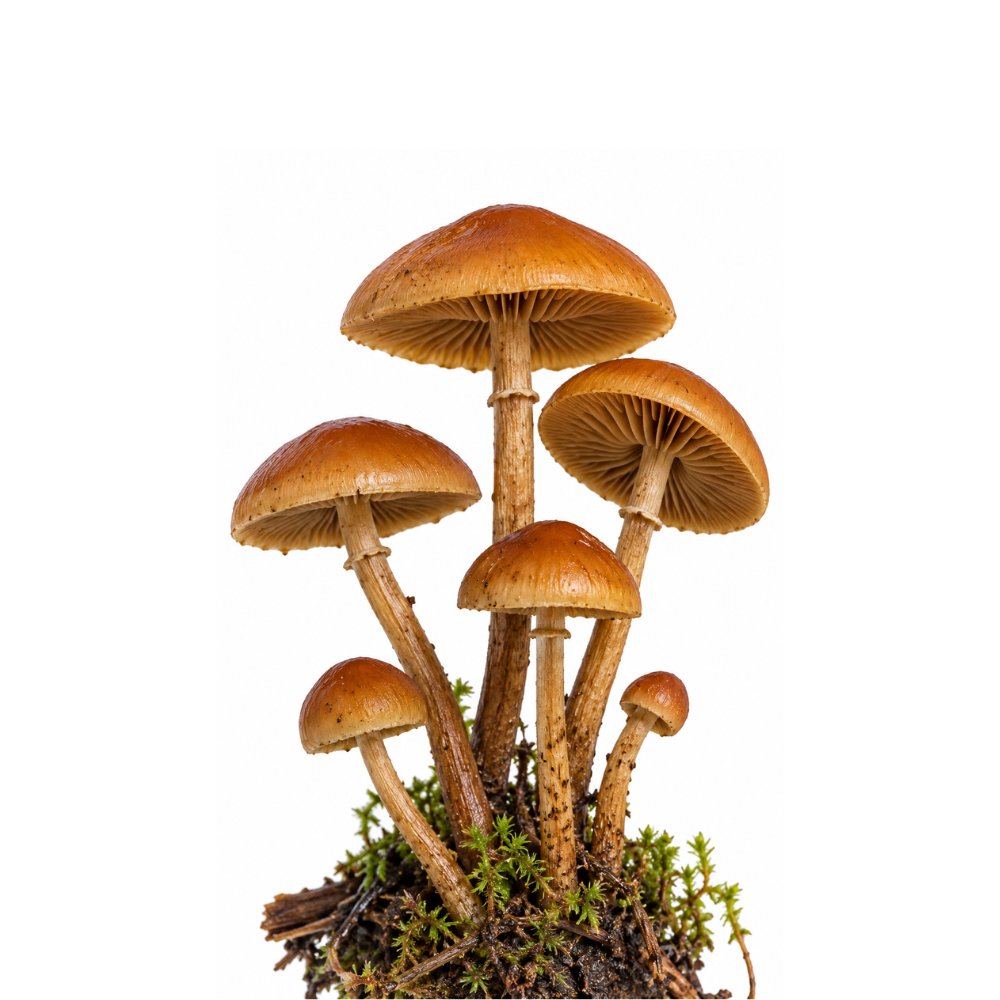
Deadly galerina (Galerina marginata) is a small brown mushroom that grows on rotting wood. It carries the same amatoxins as the death cap and is the Galerina most often mistaken for a hallucinogenic Psilocybe.
What Is Deadly Galerina?
Deadly galerina is a small brown mushroom of rotting wood that carries the same amatoxins as the death cap. In a BC study, every specimen tested from the G. marginata group held significant amounts of amatoxin 8Reference 8Phylogenetic analysis of the distribution of deadly amatoxins among the little brown mushrooms of the genus GalerinaView study →.
It grows in clusters on the rotting wood of both conifers and hardwoods, most often in spring and autumn, though it can be found all year 9Reference 9Galerina marginata — species descriptionView study →. The cap is 1.5–5 cm across and honey-yellow to cinnamon-brown 9Reference 9Galerina marginata — species descriptionView study →.
It is the most frequently reported Galerina mistaken for a hallucinogenic mushroom, and it most closely resembles Psilocybe cyanescens 1Reference 1ReviewAmatoxin-containing mushroom poisonings: species, toxidromes, treatments, and outcomes — reviewView study →. It has also been eaten in mistake for honey mushrooms 2,
Identification & Lookalikes
The spore print separates it from both of its main lookalikes.
| Mushroom | Spore print |
|---|---|
| Galerina marginata | Rusty brown 9Reference 9Galerina marginata — species descriptionView study → |
| Honey mushroom (Armillaria spp.) | White 9, |
| Psilocybe cyanescens | Dark purple-brown 10Reference 10Psilocybe cyanescens — species account and lookalikesView study → |
A rusty-brown or cinnamon-brown spore print means the mushroom is not a Psilocybe, and it may be a Galerina 10Reference 10Psilocybe cyanescens — species account and lookalikesView study →. To take a print, lay the cap gill-side down on paper or foil for an hour or two.
Characters that are not enough on their own:
- The ring. Galerina marginata has a thin, whitish to rusty-brown, collapsed ring 9Reference 9Galerina marginata — species descriptionView study →. It is more distinct and fibrous than the ring of P. cyanescens 10Reference 10Psilocybe cyanescens — species account and lookalikesView study →. Honey mushrooms have a thin but fairly persistent white ring, usually with a pale yellow edge 12Reference 12Armillaria mellea — species descriptionView study →.
- Habitat. Galerina marginata grows in clusters on rotting wood 9Reference 9Galerina marginata — species descriptionView study →. Honey mushrooms grow in large clusters on wood and spread by long black rhizomorphs, or “shoestrings” 12Reference 12Armillaria mellea — species descriptionView study →. P. cyanescens grows on wood chips and woody debris, especially in towns 10Reference 10Psilocybe cyanescens — species account and lookalikesView study →. All three can be found on wood.
- Colour change. P. cyanescens readily bruises blue when its gills and stem are handled 10Reference 10Psilocybe cyanescens — species account and lookalikesView study →. The stem of G. marginata darkens to blackish with age but never turns blue 10Reference 10Psilocybe cyanescens — species account and lookalikesView study →. Black is not blue.
- Cap shape. The cap of P. cyanescens becomes wavy as it opens; the cap of G. marginata usually does not 10Reference 10Psilocybe cyanescens — species account and lookalikesView study →.
⚠ No single field character is definitive. Galerina marginata overlaps in size, colour and wood habitat with both wood-loving Psilocybe and small honey mushrooms, and Galerina species are hard to identify by appearance alone 8Reference 8Phylogenetic analysis of the distribution of deadly amatoxins among the little brown mushrooms of the genus GalerinaView study →. A small brown mushroom on wood should never be eaten without expert spore-print and microscopic confirmation.
Mycology
Galerina marginata (Batsch) Kühner belongs to the Hymenogastraceae. A 2001 DNA study showed that G. autumnalis, G. oregonensis, G. unicolor and G. venenata are the same species, so field guides may list it under any of those names 9Reference 9Galerina marginata — species descriptionView study →.
It is a wood-rotting saprotroph, not a mycorrhizal species 9Reference 9Galerina marginata — species descriptionView study →. French collections showed it causing white rot in both hardwoods and softwoods 6Reference 6Amatoxins in wood-rotting Galerina marginata — toxin analysisView study →.
The gills are broadly attached to the stem and turn from yellowish to rusty brown as the spores ripen 9Reference 9Galerina marginata — species descriptionView study →. The stem is 2–7.5 cm long and 3–8 mm thick 9Reference 9Galerina marginata — species descriptionView study →.
In a BC study of 70 Galerina samples, amatoxins were found only in the G. marginata group, and in every sample from that group 8Reference 8Phylogenetic analysis of the distribution of deadly amatoxins among the little brown mushrooms of the genus GalerinaView study →. DNA barcoding confirmed that careful identification by appearance placed specimens in the G. marginata group accurately 8Reference 8Phylogenetic analysis of the distribution of deadly amatoxins among the little brown mushrooms of the genus GalerinaView study →.
Distribution
Deadly galerina is widely distributed across North America 9Reference 9Galerina marginata — species descriptionView study →. The GBIF biodiversity database holds records from every Canadian province, and many more from Europe 13Reference 13Galerina marginata (Batsch) Kühner — occurrence records by provinceView study →.
In western Canada it has been recorded in British Columbia, Alberta, Saskatchewan and Manitoba 13Reference 13Galerina marginata (Batsch) Kühner — occurrence records by provinceView study →. The BC study above analysed collections from western British Columbia 8Reference 8Phylogenetic analysis of the distribution of deadly amatoxins among the little brown mushrooms of the genus GalerinaView study →.
Phytochemistry
Deadly galerina carries the same amatoxins as the death cap. French specimens contained α-, β- and γ-amanitin, whether they grew on conifer or hardwood 6Reference 6Amatoxins in wood-rotting Galerina marginata — toxin analysisView study →.
Some Galerina specimens held more amanitin than some death caps 6Reference 6Amatoxins in wood-rotting Galerina marginata — toxin analysisView study →. Amatoxin content varied with the wood the mushroom grew on 6Reference 6Amatoxins in wood-rotting Galerina marginata — toxin analysisView study →.
In Turkish collections, β-amanitin levels were higher than α-amanitin, γ-amanitin was below the detection limit, and no phallotoxins were found 7Reference 7Toxin components and toxicological importance of Galerina marginata from Turkey — toxin analysisView study →. French specimens also contained no phallotoxins 6Reference 6Amatoxins in wood-rotting Galerina marginata — toxin analysisView study →.
The amatoxin LD₅₀ is about 0.1 mg/kg of body weight. By that measure, 10 mushrooms of a toxic Galerina would be enough to poison a 20 kg child 8Reference 8Phylogenetic analysis of the distribution of deadly amatoxins among the little brown mushrooms of the genus GalerinaView study →.
Deadly galerina makes α-amanitin on its ribosomes, by a route similar to the one Amanita uses 11Reference 11Ribosomal biosynthesis of α-amanitin in Galerina marginata — genome studyView study →.
Constituent Summary
The main toxins of deadly galerina.
Cyclic Peptide3 compounds3 with data
Toxicology
Class of poison. Bicyclic octapeptide; an inhibitor of RNA polymerase II. The poisoning is the same as death cap poisoning.
Mechanism. Amatoxins inhibit RNA polymerase II, which stops protein production. Liver and kidney cells fail first 4Reference 4Treatment of amatoxin poisoning: 20-year retrospective analysis.
Course.
- Symptoms begin after a delay of 6–24 hours, with a mean around 12 4Reference 4Treatment of amatoxin poisoning: 20-year retrospective analysis.
- Vomiting and diarrhoea come first. Serious liver injury appears 2 to 4 days after the meal 8Reference 8Phylogenetic analysis of the distribution of deadly amatoxins among the little brown mushrooms of the genus GalerinaView study →.
- A false recovery can come between the two 1Reference 1ReviewAmatoxin-containing mushroom poisonings: species, toxidromes, treatments, and outcomes — reviewView study →.
Treatment. Care is supportive, and patients with delayed gastrointestinal illness, with or without a false recovery, should be referred to a centre that can perform a liver transplant 1Reference 1ReviewAmatoxin-containing mushroom poisonings: species, toxidromes, treatments, and outcomes — reviewView study →. Silibinin, from milk thistle, is one of the treatments used for amatoxin poisoning, and in Canada the intravenous form is available only through Health Canada’s Special Access Programme.
Documented cases.
- Sweden. A 32-year-old woman sautéed and ate G. marginata she took for honey mushrooms. She was admitted 17 hours later with vomiting, diarrhoea and signs of liver damage, and recovered after nine days in hospital 2,
8Reference 2Amanitin poisoning from Galerina marginata — clinical and laboratory findings in the first Swedish caseReference 8Phylogenetic analysis of the distribution of deadly amatoxins among the little brown mushrooms of the genus GalerinaView study → . - Japan. A six-year-old boy developed severe liver failure after eating soup made with a Galerina, most likely G. fasciculata, possibly taken for wild enoki. He recovered after treatment 3,
8Reference 3Case reportAmatoxin poisoning from ingestion of Japanese Galerina mushrooms — case reportView study →Reference 8Phylogenetic analysis of the distribution of deadly amatoxins among the little brown mushrooms of the genus GalerinaView study → . - North America, 2011. Three Galerina poisonings were reported, one of them fatal 8Reference 8Phylogenetic analysis of the distribution of deadly amatoxins among the little brown mushrooms of the genus GalerinaView study →.
Galerina marginata is the Galerina most often reported in fatal poisonings 1Reference 1ReviewAmatoxin-containing mushroom poisonings: species, toxidromes, treatments, and outcomes — reviewView study →.
Traditional & Historical Use
Deadly galerina has no medicinal, culinary or ritual use.
Amatoxins in Galerina have been known since 1954, when two patients were poisoned by what was later identified as G. venenata, now included in G. marginata 8,
Safety & Pregnancy
- Contains the same lethal amatoxins as the death cap 6,
8Reference 6Amatoxins in wood-rotting Galerina marginata — toxin analysisView study →Reference 8Phylogenetic analysis of the distribution of deadly amatoxins among the little brown mushrooms of the genus GalerinaView study → . - Grows on rotting wood alongside honey mushrooms and wood-loving Psilocybe 9,
10, .12Reference 9Galerina marginata — species descriptionView study →Reference 10Psilocybe cyanescens — species account and lookalikesView study →Reference 12Armillaria mellea — species descriptionView study → - No single field character is definitive. The rusty-brown spore print is the most useful separator 9,
10Reference 9Galerina marginata — species descriptionView study →Reference 10Psilocybe cyanescens — species account and lookalikesView study → . - Symptoms are delayed 6–24 hours, then serious liver injury follows 2 to 4 days after eating 4,
8Reference 4Treatment of amatoxin poisoning: 20-year retrospective analysisReference 8Phylogenetic analysis of the distribution of deadly amatoxins among the little brown mushrooms of the genus GalerinaView study → . - No blue bruising proves nothing. Bluing is a sign of Psilocybe, not a safety test 10Reference 10Psilocybe cyanescens — species account and lookalikesView study →.
- Amatoxins are heat-stable. Cooking, drying and freezing do not destroy them.
Full Safety Detail
Small brown mushrooms on wood. Galerina has around 300 species that are hard to tell apart by eye 8Reference 8Phylogenetic analysis of the distribution of deadly amatoxins among the little brown mushrooms of the genus GalerinaView study →. Several names once treated as separate species are now one 9Reference 9Galerina marginata — species descriptionView study →. A small brown mushroom on wood should not be eaten without expert confirmation.
For anyone hunting Psilocybe. Check the spore print (purple-brown, not rusty), the bruising (blue, not black) and the substrate 10Reference 10Psilocybe cyanescens — species account and lookalikesView study →. A print takes an hour or two.
For anyone hunting honey mushrooms. Honey mushrooms grow in large clusters, give a white spore print and often have black rhizomorphs nearby 12Reference 12Armillaria mellea — species descriptionView study →. Scattered small brown mushrooms on a rotten log are not honey mushrooms.
Not applicable. Lethally poisonous, with no dose and no use in any population.
References
- Diaz JH (2018). Amatoxin-containing mushroom poisonings: species, toxidromes, treatments, and outcomes — review. Wilderness Environ Med 29(1):111–118. https://pubmed.ncbi.nlm.nih.gov/29325729/
- Hulting J, Green K, Persson H (1985). Amanitin poisoning from Galerina marginata — clinical and laboratory findings in the first Swedish case. J Toxicol Clin Toxicol 23(4–6):428–429.
- Kaneko H, Tomomasa T, Inoue Y, et al. (2001). Amatoxin poisoning from ingestion of Japanese Galerina mushrooms — case report. J Toxicol Clin Toxicol 39(4):413–416. https://pubmed.ncbi.nlm.nih.gov/11527238/
- Enjalbert F, et al. Treatment of amatoxin poisoning: 20-year retrospective analysis. Clin Toxicol. 2002.
- Trudell S, Ammirati J. Mushrooms of the Pacific Northwest.
- Enjalbert F, Cassanas G, Rapior S, Renault C, Chaumont JP (2004). Amatoxins in wood-rotting Galerina marginata — toxin analysis. Mycologia 96(4):720–729. https://pubmed.ncbi.nlm.nih.gov/21148893/
- Akata I, Yilmaz I, Kaya E, Coskun NC, Donmez M (2020). Toxin components and toxicological importance of Galerina marginata from Turkey — toxin analysis. Toxicon 187:29–34. https://pubmed.ncbi.nlm.nih.gov/32866473/
- Landry B, Whitton J, Bazzicalupo AL, Ceska O, Berbee ML (2021). Phylogenetic analysis of the distribution of deadly amatoxins among the little brown mushrooms of the genus Galerina. PLoS One 16(2):e0246575. https://pubmed.ncbi.nlm.nih.gov/33566818/
- Kuo M (2016). Galerina marginata — species description. MushroomExpert.com. https://www.mushroomexpert.com/galerina_marginata.html
- Beaty Biodiversity Museum (n.d.). Psilocybe cyanescens — species account and lookalikes. Mushrooms Up! Edible and Poisonous Species of Coastal BC and the Pacific Northwest. University of British Columbia. https://explore.beatymuseum.ubc.ca/mushroomsup/P_cyanescens.html
- Luo H, Hallen-Adams HE, Scott-Craig JS, Walton JD (2012). Ribosomal biosynthesis of α-amanitin in Galerina marginata — genome study. Fungal Genet Biol 49(2):123–129. https://pubmed.ncbi.nlm.nih.gov/22202811/
- Kuo M (2017). Armillaria mellea — species description. MushroomExpert.com. https://www.mushroomexpert.com/armillaria_mellea.html
- GBIF Secretariat (accessed 2026). Galerina marginata (Batsch) Kühner — occurrence records by province. GBIF Backbone Taxonomy. https://www.gbif.org/species/8118872



