
Compound Monograph
11-Methoxyquindoline
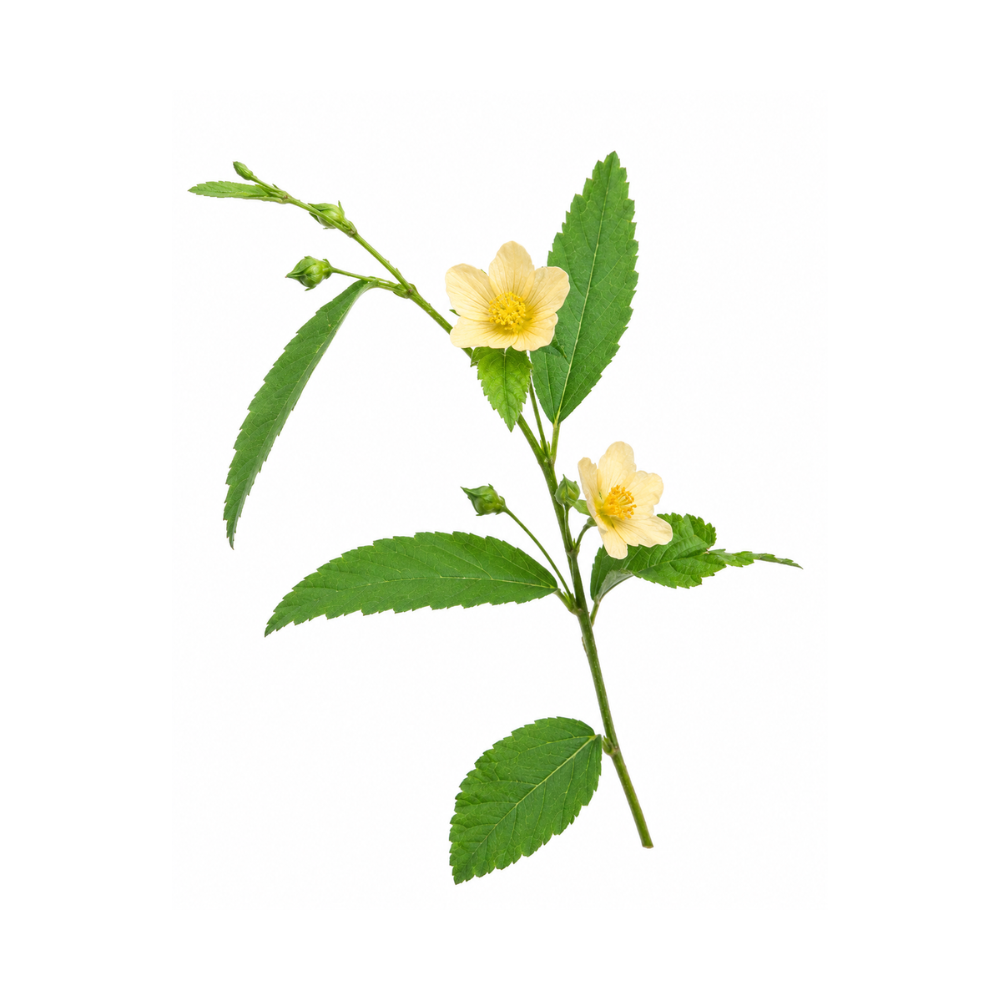
11-Methoxyquindoline is a minor indoloquinoline alkaloid of the quindoline series, reported from wireweed (Sida acuta), where it was isolated as a potent inducer of the detoxifying enzyme quinone reductase in a single cell-based cancer-chemoprevention screen.

Sources · 2
Where Does It Come From?
11-Methoxyquindoline is a naturally occurring indoloquinoline alkaloid (quindoline type), found in Wireweed and 1 other source. It is flagged as moderately toxic.
Concentration
Content by Source
Concentrations not reported. No percent-dry-weight or mg/g figures have been published for this compound in its source plants.
11-Methoxyquindoline at a Glance
11-Methoxyquindoline is a minor indoloquinoline alkaloid — a methoxy-substituted member of the quindoline series, the des-N-methyl scaffold that underlies the far better-studied cryptolepine. It was reported from wireweed (Sida acuta) during an activity-guided search for plant compounds that switch on quinone reductase, a phase-II detoxifying enzyme of interest in cancer chemoprevention 1Reference 1AnimalCompounds obtained from Sida acuta with the potential to induce quinone reductase and to inhibit 7,12-dimethylbenz[a]anthracene-induced preneoplastic lesions in a mouse mammary organ culture modelView study →.
The honest position on this molecule is that it is barely studied. A single paper isolates it and measures one property — potent quinone-reductase induction in cultured cells 1Reference 1AnimalCompounds obtained from Sida acuta with the potential to induce quinone reductase and to inhibit 7,12-dimethylbenz[a]anthracene-induced preneoplastic lesions in a mouse mammary organ culture modelView study → — and essentially nothing else has been published on its pharmacology, pharmacokinetics, or safety. This page is deliberately short: it records what is genuinely known and flags the very large gaps, rather than borrowing the pharmacology of its more famous relatives in the same alkaloid family.
What It's Used For
There is one measured biological activity for 11-methoxyquindoline, from one study, in vitro. Everything below is confined to that.
Support is an experimental score — weighted by study type (human > animal > in vitro) and volume. A beta, not a validated metric. Only one application has any primary data, and it is a single in-vitro enzyme assay, so the score is low by construction.
The molecule’s only reported activity. In an activity-guided fractionation of Sida acuta aimed at cancer-chemopreventive constituents, 11-methoxyquindoline (compound 3) was isolated alongside quindolinone and cryptolepinone and was among the three most potent quinone-reductase (QR) inducers, with CD values (the concentration doubling QR activity) reported across the set as 0.01–0.12 µg/mL in cultured Hepa 1c1c7 mouse hepatoma cells 1Reference 1AnimalCompounds obtained from Sida acuta with the potential to induce quinone reductase and to inhibit 7,12-dimethylbenz[a]anthracene-induced preneoplastic lesions in a mouse mammary organ culture modelView study →.
Inducing QR — a phase-II enzyme that detoxifies reactive quinones — is a recognised chemoprevention marker. This is isolate-on-cells data: the same study’s downstream anticancer read-out (inhibition of DMBA-induced pre-neoplastic lesions in mouse mammary organ culture) was a property of the active fraction/lead compounds collectively, not demonstrated for 11-methoxyquindoline on its own 1Reference 1AnimalCompounds obtained from Sida acuta with the potential to induce quinone reductase and to inhibit 7,12-dimethylbenz[a]anthracene-induced preneoplastic lesions in a mouse mammary organ culture modelView study →.
Gap: a single in-vitro assay from one paper; no dose-response beyond the CD value, no in-vivo confirmation for this compound, no comparison to a standard QR inducer, and no follow-up literature.
Mechanisms
| Target / pathway | Effect | Relevant to |
|---|---|---|
| Quinone reductase (NQO1) / Keap1–Nrf2 phase-II axis | induction of QR activity in cultured hepatoma cells (mechanistic detail beyond the phenotype not established) | chemoprevention screen |
The table has a single row because a single activity has been measured. The Keap1–Nrf2 attribution is the conventional pathway for QR induction; it was not directly demonstrated for this molecule and is offered as context, not a proven mechanism.
Pharmacokinetics
No pharmacokinetic data exist for 11-methoxyquindoline. Absorption, oral bioavailability, distribution, metabolism, active metabolites, and half-life are all uncharacterised. As a small, lipophilic, planar indoloquinoline it would be expected to cross membranes and interact with DNA in the manner of its scaffold relatives, but that is inference from structure, not measured data — and in-vitro potency figures like the CD value above cannot be translated to a human exposure without it.
Clinical Trials
There are no clinical trials of 11-methoxyquindoline, and none are registered or planned. It has never been administered to humans.
| Completed | Planned | Terminated | Preclinical |
|---|---|---|---|
| — | — | — | One in-vitro QR-induction assay 1Reference 1AnimalCompounds obtained from Sida acuta with the potential to induce quinone reductase and to inhibit 7,12-dimethylbenz[a]anthracene-induced preneoplastic lesions in a mouse mammary organ culture modelView study → |
Last checked: July 2026.
Isolate vs. Plant Studies
What little exists is isolate data — 11-methoxyquindoline was purified from Sida acuta and tested as a single compound in the QR assay 1Reference 1AnimalCompounds obtained from Sida acuta with the potential to induce quinone reductase and to inhibit 7,12-dimethylbenz[a]anthracene-induced preneoplastic lesions in a mouse mammary organ culture modelView study →. There is no whole-plant or extract study attributable to this molecule, and no human data of any kind. This is the opposite of the usual “plant-only, isolate-unknown” caveat: here the isolate was tested, but only once and only in cell culture, so the limiting factor is sheer scarcity of evidence rather than a mismatch between isolate and whole plant. Do not read across from the antiplasmodial, antibacterial, or anticancer record of cryptolepine and the other indoloquinolines 2,
Prevalence in Nature
11-Methoxyquindoline is a minor alkaloid. Its documented natural source is wireweed (Sida acuta), a pantropical Malvaceae weed, from which it was isolated as one of ten compounds in the chemoprevention-guided study 1Reference 1AnimalCompounds obtained from Sida acuta with the potential to induce quinone reductase and to inhibit 7,12-dimethylbenz[a]anthracene-induced preneoplastic lesions in a mouse mammary organ culture modelView study →. It belongs to the indoloquinoline alkaloid class characteristic of Sida acuta aerial parts and, more famously, of the West African root drug Cryptolepis sanguinolenta, whose alkaloid fraction is built on the same quindoline/cryptolepine scaffolds 3Reference 3ReviewPhytochemical and pharmacological review of Cryptolepis sanguinolenta (Lindl.) SchlechterView study →. Whether 11-methoxyquindoline itself occurs in Cryptolepis is not something the sources reviewed here establish — the quindoline series does, but this specific methoxy derivative is documented from Sida acuta.
No quantitative abundance has been published for 11-methoxyquindoline in any plant — no % dry weight, no plant-part breakdown, no chemotype or provenance data. As a minor constituent it is presumably present at very low levels, but that is not measured.
Discovery & Synthesis
The parent scaffold, quindoline, is a long-known indoloquinoline first characterised in the 1930s and later recognised as the des-N-methyl congener (and biosynthetic relative) of cryptolepine, the major alkaloid of Cryptolepis sanguinolenta first isolated in 1931 3Reference 3ReviewPhytochemical and pharmacological review of Cryptolepis sanguinolenta (Lindl.) SchlechterView study →. 11-Methoxyquindoline — a quindoline bearing a methoxy substituent — was reported as a Sida acuta constituent in the 2003 quinone-reductase-guided isolation of Jang and colleagues, which purified and structurally identified it alongside quindolinone and cryptolepinone 1Reference 1AnimalCompounds obtained from Sida acuta with the potential to induce quinone reductase and to inhibit 7,12-dimethylbenz[a]anthracene-induced preneoplastic lesions in a mouse mammary organ culture modelView study →. No dedicated total synthesis of 11-methoxyquindoline is documented in the sources reviewed here; the indoloquinoline nucleus itself is a well-worked synthetic target (multiple routes to cryptolepine, isocryptolepine, and neocryptolepine exist), but a named, verified first synthesis of this specific methoxy derivative was not established.
Patents: not yet researched.
Toxicity & Safety
No toxicity data exist for 11-methoxyquindoline. Its safety profile — acute toxicity, genotoxicity, cytotoxicity, drug interactions, reproductive effects — is entirely uncharacterised. It has never been given to an animal or a human as an isolated compound.
The moderate flag is therefore a conservative, data-absence call, not a measured hazard: this is an uncharacterised indoloquinoline alkaloid, a planar DNA-interacting scaffold whose best-studied relative, cryptolepine, is cytotoxic, genotoxic (micronucleus induction), and embryotoxic/teratogenic in animal and cell models 3Reference 3ReviewPhytochemical and pharmacological review of Cryptolepis sanguinolenta (Lindl.) SchlechterView study →. Substituent differences change indoloquinoline activity substantially, so cryptolepine’s toxicology does not transfer to this molecule — but it is the reason a bare “low” would understate the uncertainty for a scaffold of this kind. The badge should be revisited if isolate-specific data ever appear.
- No safety data at all. Acute, genotoxic, reproductive, and interaction profiles are entirely uncharacterised for the isolated molecule.
- Indoloquinoline scaffold caution. Related alkaloids in this family (notably cryptolepine) are DNA-interacting and genotoxic in vitro; whether this extends to 11-methoxyquindoline is unknown.
- Not an ingestible in any established form. Only ever handled as a research isolate; there is no basis for human intake.
Dosage
There is no established or studied dose. 11-Methoxyquindoline has only ever existed as a purified research isolate tested in a cell-based enzyme assay 1Reference 1AnimalCompounds obtained from Sida acuta with the potential to induce quinone reductase and to inhibit 7,12-dimethylbenz[a]anthracene-induced preneoplastic lesions in a mouse mammary organ culture modelView study →; it has never been dosed in an animal or a person. The only quantitative figure attached to it is the in-vitro CD value for quinone-reductase induction (0.01–0.12 µg/mL in cell culture) 1Reference 1AnimalCompounds obtained from Sida acuta with the potential to induce quinone reductase and to inhibit 7,12-dimethylbenz[a]anthracene-induced preneoplastic lesions in a mouse mammary organ culture modelView study →, which is an assay concentration, not a dose and not translatable to intake. No figure here is a recommendation.
References
- Jang DS, Park EJ, Kang YH, Su BN, Hawthorne ME, Vigo JS, Graham JG, Cabieses F, Fong HHS, Mehta RG, Pezzuto JM, Kinghorn AD (2003). Compounds obtained from Sida acuta with the potential to induce quinone reductase and to inhibit 7,12-dimethylbenz[a]anthracene-induced preneoplastic lesions in a mouse mammary organ culture model. Archives of Pharmacal Research. https://pubmed.ncbi.nlm.nih.gov/12967190/
- Cimanga K, De Bruyne T, Pieters L, Vlietinck AJ, Turger CA (1997). In vitro and in vivo antiplasmodial activity of cryptolepine and related alkaloids from Cryptolepis sanguinolenta. Journal of Natural Products. https://pubmed.ncbi.nlm.nih.gov/9249972/
- Osafo N, Mensah KB, Yeboah OK (2017). Phytochemical and pharmacological review of Cryptolepis sanguinolenta (Lindl.) Schlechter. Advances in Pharmacological Sciences. https://pubmed.ncbi.nlm.nih.gov/29750083/



