
Compound Monograph
Alpha-Truxilline
Alpha-truxilline (α-truxilline) is a dimeric tropane alkaloid of coca — two ecgonine units bridged by α-truxillic acid — best known not as a drug but as a forensic authenticity and origin marker in seized cocaine.

Sources · 2
Where Does It Come From?
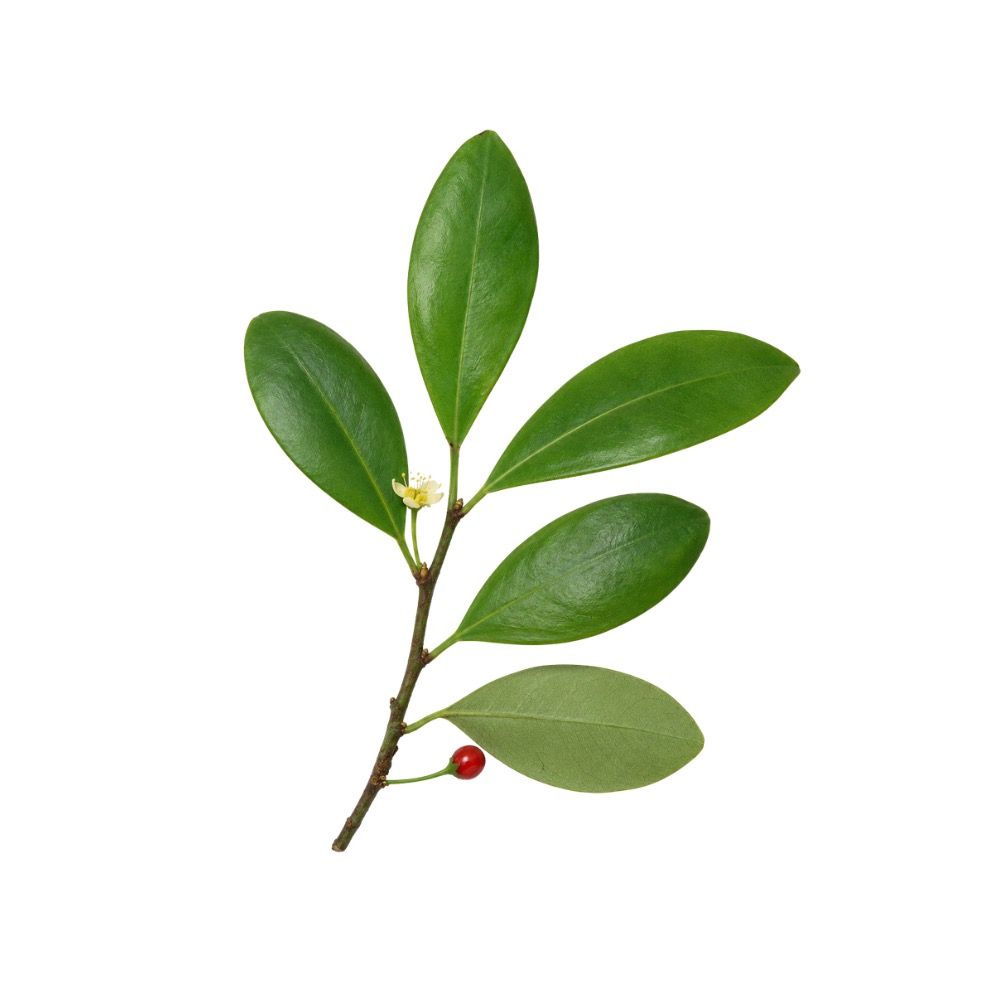
Alpha-Truxilline is a naturally occurring dimeric tropane alkaloid (truxillic-acid ecgonine diester), found in Coca and Coca. It is well tolerated orally (low toxicity).
Concentration
Content by Source
Concentrations not reported. No percent-dry-weight or mg/g figures have been published for this compound in its source plants.
Alpha-Truxilline at a Glance
Alpha-truxilline (α-truxilline) is a dimeric tropane alkaloid of the coca plant (Erythroxylum coca and E. novogranatense). Structurally it is two ecgonine units esterified by a single molecule of α-truxillic acid — a cyclobutane dicarboxylic acid formed when two cinnamic-acid units join through a [2+2] photodimerisation. It is one of roughly 18 alkaloids identified across cultivated coca varieties, with cocaine the dominant one 1Reference 1Biological activity of the alkaloids of Erythroxylum coca and Erythroxylum novogranatenseView study →.
Its significance is almost entirely chemical and forensic rather than pharmacological. The truxillines are hard to remove during coca processing, so they persist as impurities in refined product; their presence, isomer pattern and total amount are used by forensic chemists as authenticity and origin markers in seized cocaine 2,
A Dimeric Truxillic-Acid Ecgonine Ester — Cocaine’s Forensic Impurity Marker
The truxillines are the point of this molecule, so they get their own section. Where cocaine is a monoester of ecgonine (ecgonine + benzoic acid + a methyl group), α-truxilline is a diester: two ecgonine units bridged by one α-truxillic acid. α-Truxillic acid itself is a cyclobutane-1,3-dicarboxylic acid — the head-to-tail [2+2] photodimer of two trans-cinnamic acid molecules, the classic solid-state topochemical dimerisation. Because the bridging acid is a cinnamic-acid dimer rather than the single benzoic acid of cocaine, the truxillines are high-molecular-weight relative to the monomeric coca alkaloids, which is exactly why analytical methods separate them out as a distinct impurity class 3,
Alpha vs. beta. α- and β-truxilline are stereoisomers that differ in the configuration of their cyclobutane truxillic-acid core — the relative arrangement of the two phenyl and two carboxyl substituents around the four-membered ring. Cinnamic-acid photodimers fall into “truxillic” (head-to-tail, carboxyls 1,3 across the ring) versus “truxinic” (head-to-head, 1,2) families, and within them the individual isomers (α-, β-, and the further δ-, ε-, γ-, ω-, ζ-, peri-, neo-, epi- forms catalogued in illicit cocaine) are distinguished by ring stereochemistry 6Reference 6Rapid determination of the isomeric truxillines in illicit cocaine via capillary gas chromatography/flame ionization detection and their use and implication in the determination of cocaine origin and trafficking routesView study →. Forensic workflows quantify these isomers as a set because the isomer distribution — not any single compound — carries the origin information.
Why forensics cares. Truxillines survive the refining that strips most co-alkaloids, so they remain in finished illicit cocaine 2,
What It's Used For
The honest summary is short: there is no meaningful body of pharmacology on isolated α-truxilline. It appears in the literature as an analyte, not as a tested drug.
Support is an experimental score — weighted by study type (human > animal > in vitro) and volume. A beta, not a validated metric. Here the only genuine “application” is analytical/forensic; the pharmacology row is scored near zero by design, to make the absence of data explicit rather than implied.
The molecule’s one substantiated application. Because truxillines resist the processing that removes most co-alkaloids, they persist as manufacturing impurities in refined illicit cocaine, where they are isolated and quantified by capillary GC, HPLC and capillary electrophoresis 2,
Total isomeric truxilline content and the relative isomer distribution track coca variety and growing region, so the measurement gives a broad read on geographic origin and supports comparison of seizures along trafficking routes 6Reference 6Rapid determination of the isomeric truxillines in illicit cocaine via capillary gas chromatography/flame ionization detection and their use and implication in the determination of cocaine origin and trafficking routesView study →.
This is an analytical use of the compound as an analyte — the “isolate” here is a forensic reference standard, not a pharmacological test article.
Gap: this is chemistry, not biology — nothing about the forensic literature speaks to what (if anything) α-truxilline does in a body. The isomer-to-origin mapping is also a statistical/comparative tool, not an absolute fingerprint.
Effectively none. α-Truxilline is listed among the ~18 alkaloids of Erythroxylum coca and E. novogranatense in surveys of coca-alkaloid biological activity, but the pharmacological attention in those surveys is on cocaine; the dimeric truxillic-acid esters are catalogued rather than assayed 1Reference 1Biological activity of the alkaloids of Erythroxylum coca and Erythroxylum novogranatenseView study →. No receptor target, enzyme interaction, monoamine-transporter or sodium-channel activity, animal effect, or human observation has been established for the purified molecule.
Gap: the absence of a target here is an absence of data, not a demonstration of inertness — nobody appears to have run the isolate through a pharmacological screen. Do not read “no activity reported” as “shown to be inactive.”
Mechanisms
| Target / pathway | Effect | Relevant to |
|---|---|---|
| No characterised molecular target | not established — the isolated dimer has not been assayed pharmacologically | (data absent) |
| Cyclobutane truxillic-acid diester chemistry | high-molecular-weight, processing-resistant impurity separable by GC/HPLC/CE | forensic profiling of illicit cocaine |
The only “mechanism” with evidence behind it is analytical: the truxillic-acid bridge makes the molecule a large, persistent impurity that chromatography can resolve and quantify. There is no established pharmacological mechanism.
Pharmacokinetics
No pharmacokinetic data exist for isolated α-truxilline — no absorption, oral bioavailability, metabolism, or half-life has been measured. Any expectation (for instance, that a large, twice-esterified dimer would be poorly absorbed and liable to ester hydrolysis toward ecgonine-type fragments) is structural inference, not measurement, and is flagged as such. This absence is itself part of why the compound is a PARK-tier entry.
Clinical Trials
There are no clinical trials, and no preclinical pharmacology trials, of α-truxilline as a therapeutic or investigational agent. Its entire research footprint is analytical/forensic chemistry.
| Completed | Planned | Terminated | Preclinical |
|---|---|---|---|
| —(forensic-analytical literature only) | — | — | —(none) |
Last checked: July 2026.
Isolate vs. Plant Studies
α-Truxilline is one of the rare cases where the “isolate” is a forensic reference standard, not a pharmacological test article. It has been detected and characterised both in the whole coca leaf — Moore and colleagues determined it among the alkaloids of South American and greenhouse-cultivated coca leaves 4Reference 4Determination and in-depth chromatographic analyses of alkaloids in South American and greenhouse-cultivated coca leavesView study → — and as an impurity isolated from refined illicit cocaine 2,
Prevalence in Nature
α-Truxilline occurs as a trace dimeric alkaloid of Erythroxylum leaf, one of roughly 18 alkaloids catalogued across cultivated coca varieties, with cocaine dominant and the truxillines minor 1Reference 1Biological activity of the alkaloids of Erythroxylum coca and Erythroxylum novogranatenseView study →. Its concentration in leaf is not well quantified in the accessible literature — it is reported qualitatively as present rather than measured as a percentage of dry weight, and levels vary with species and variety (E. coca var. coca / var. ipadu vs. E. novogranatense var. novogranatense / truxillense), which is part of why total truxilline content is informative for chemotaxonomy 4,
Discovery & Synthesis
The truxillines entered the record through 20th-century Erythroxylum alkaloid chemistry, appearing in surveys of coca alkaloids as the dimeric truxillic-acid ecgonine esters 1Reference 1Biological activity of the alkaloids of Erythroxylum coca and Erythroxylum novogranatenseView study →. Their detailed isolation, structural identification and isomer profiling came from forensic drug-chemistry laboratories — Moore, Lurie, Casale and colleagues developing GC, HPLC and capillary-electrophoresis methods to separate and quantify the isomeric truxillines in coca leaf and in seized cocaine from the 1980s onward 2,
Patents: not yet researched.
Toxicity & Safety
α-Truxilline carries a [low] flag, but that badge reflects an absence of toxicological data, not a positive safety record: the isolated molecule has not been through any adverse-effect, genotoxicity, or repeat-dose characterisation. It should be read as “no toxicity established for the isolate,” not “shown to be safe.” Its practical relevance is analytical, and human exposure to it is incidental (trace leaf alkaloid; minor impurity in illicit cocaine).
- No toxicity signal for the isolate. No adverse-effect, genotoxicity, or organ-toxicity findings are attributed to purified α-truxilline in the accessible literature.
- Cocaine-alkaloid family. α-Truxilline is a coca tropane structurally kin to cocaine and, like other coca alkaloids, falls within the controlled-substance framework by association; it is not a benign nutraceutical.
- Absence of data ≠ safety. No pharmacokinetics and no toxicology exist for the pure compound, so no safety claim can be made either way; this is a PARK-tier, data-absent entry.
- Interactions and pregnancy/lactation not assessed. No drug-interaction or reproductive data exist for the isolated molecule; those decisions belong to the herb or product level, not to this phytochemistry page.
Dosage
There is no dose. α-Truxilline is not a therapeutic agent and has no medicinal use, dosing form, or studied intake. It reaches people only incidentally — as a trace dimeric alkaloid of the coca leaf and as a minor impurity in illicit cocaine — and its documented role is forensic-analytical. Nothing here is a personal recommendation.
References
- Novák M, Salemink CA, Khan I (1984). Biological activity of the alkaloids of Erythroxylum coca and Erythroxylum novogranatense. Journal of Ethnopharmacology. https://pubmed.ncbi.nlm.nih.gov/6379304/
- Moore JM, et al. (1987). Capillary gas chromatographic-electron capture detection of coca-leaf-related impurities in illicit cocaine: 2,4- and 2,6-diphenylcyclobutane-1,3-dicarboxylic acids, 1,4-diphenylcyclobutane-2,3-dicarboxylic acids and their alkaloidal precursors, the truxillines. Journal of Chromatography. https://pubmed.ncbi.nlm.nih.gov/3443607/
- Lurie IS, et al. (1987). Analysis of manufacturing by-products and impurities in illicit cocaine via high-performance liquid chromatography and photodiode array detection. Journal of Chromatography. https://pubmed.ncbi.nlm.nih.gov/3693467/
- Moore JM, et al. (1994). Determination and in-depth chromatographic analyses of alkaloids in South American and greenhouse-cultivated coca leaves. Journal of Chromatography A. https://pubmed.ncbi.nlm.nih.gov/8118557/
- Lurie IS, et al. (1998). Capillary electrophoresis analysis of isomeric truxillines and other high molecular weight impurities in illicit cocaine. Electrophoresis. https://pubmed.ncbi.nlm.nih.gov/9511862/
- Mallette JR, et al. (2014). Rapid determination of the isomeric truxillines in illicit cocaine via capillary gas chromatography/flame ionization detection and their use and implication in the determination of cocaine origin and trafficking routes. Journal of Chromatography A. https://pubmed.ncbi.nlm.nih.gov/25219521/



