
Compound Monograph
β-Truxilline
β-Truxilline is a dimeric tropane alkaloid of coca — two ecgonine units esterified by β-truxinic acid — with essentially no standalone pharmacology; its documented role is as one of the isomeric truxillines used to forensically fingerprint the origin of illicit cocaine.

Sources · 3
Where Does It Come From?
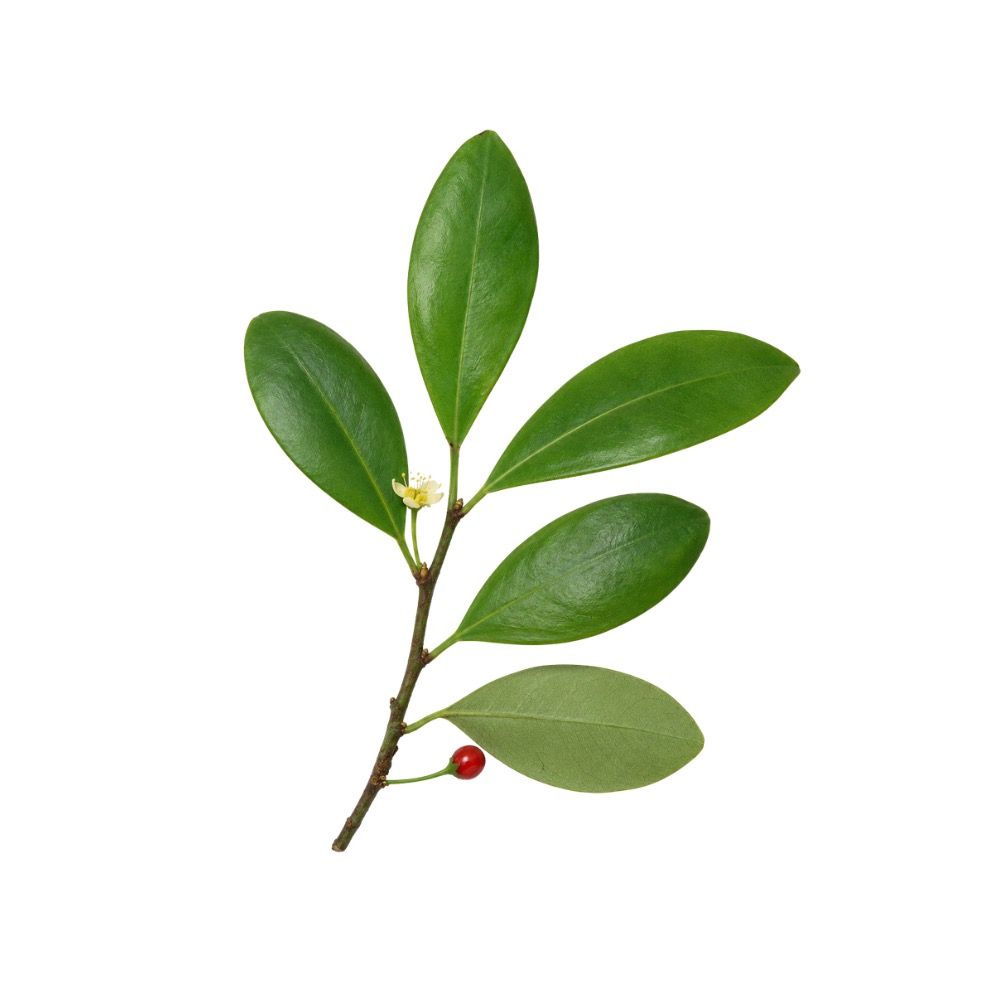
β-Truxilline is a naturally occurring dimeric tropane alkaloid (truxilline; ecgonine diester of β-truxinic acid), found in Coca, Erythroxylum novogranatense and 1 other source. It is well tolerated orally (low toxicity).
Concentration
Content by Source
Concentrations not reported. No percent-dry-weight or mg/g figures have been published for this compound in its source plants.
β-Truxilline at a Glance
β-Truxilline is a dimeric tropane alkaloid of the coca plant (Erythroxylum). Structurally it is two ecgonine units — the same tropane core that sits inside cocaine — bridged and esterified by β-truxinic acid, a cyclobutane dicarboxylic acid. It is one of roughly eighteen alkaloids identified across cultivated coca varieties 1Reference 1Biological activity of the alkaloids of Erythroxylum coca and Erythroxylum novogranatenseView study →.
Its significance is almost entirely analytical, not pharmacological. Together with its stereoisomer α-truxilline and the other isomeric truxillines, β-truxilline is a minor impurity present in effectively all illicit cocaine, and forensic laboratories quantify the truxilline profile to infer the coca variety, geographic origin and trafficking history of a seizure 2,
The Truxinic-Acid Ecgonine Dimer — a Cocaine Forensic Marker
What defines β-truxilline — and separates it from α-truxilline — is the cyclobutane diacid at its centre. The truxillines are formed when two cinnamoyl units (carried on cinnamoylcocaine) undergo a UV-driven [2+2] photodimerization, welding their double bonds into a four-membered cyclobutane ring bearing two phenyl groups and two carboxyl groups; each carboxyl is esterified to an ecgonine 4,
- α-Truxilline is built on α-truxillic acid — a 2,4-diphenylcyclobutane-1,3-dicarboxylic acid (a head-to-tail “truxillate”) 2Reference 2Capillary gas chromatographic-electron capture detection of coca-leaf-related impurities in illicit cocaine: 2,4-diphenylcyclobutane-1,3-dicarboxylic acids, 1,4-diphenylcyclobutane-2,3-dicarboxylic acids and their alkaloidal precursors, the truxillinesView study →.
- β-Truxilline is built on β-truxinic acid — a 1,4-diphenylcyclobutane-2,3-dicarboxylic acid (a head-to-head “truxinate”) 2Reference 2Capillary gas chromatographic-electron capture detection of coca-leaf-related impurities in illicit cocaine: 2,4-diphenylcyclobutane-1,3-dicarboxylic acids, 1,4-diphenylcyclobutane-2,3-dicarboxylic acids and their alkaloidal precursors, the truxillinesView study →.
So the two are not the same molecule with a trivial label swap: they belong to the two distinct constitutional families of the diphenylcyclobutane diacids. A 2024 stereochemical re-analysis corrected the long-repeated claim of “eleven truxillines,” showing that fifteen exist — five mutually diastereomeric truxillates and ten mutually diastereomeric truxinates — with β-truxilline sitting in the truxinate group 4Reference 4Counting the truxillines — 11 or more, the question is nowView study →.
This diversity is exactly why the family is useful forensically: the proportions of the individual truxilline isomers in a batch of cocaine act as a fingerprint of the coca that made it and the conditions it saw 3,
What It's Used For
There is little to review here, and saying so plainly is the point. β-Truxilline has no characterised bioactivity; the literature that names it is analytical chemistry and forensic science, measuring the molecule in situ in coca leaf and in seized cocaine rather than administering it.
Support is an experimental score normally weighted toward human > animal > in-vitro bioactivity data. β-Truxilline has essentially none — so the scores below instead track how well each role is documented, and that documentation is analytical/forensic, not pharmacological. A beta, not a validated metric.
The molecule’s real-world significance, and the isolate-vs-plant question inverted: β-truxilline is studied only in seized material, never administered. The isomeric truxillines — β- among them — are minor alkaloids found in effectively all illicit cocaine 3Reference 3Rapid determination of the isomeric truxillines in illicit cocaine via capillary gas chromatography/flame ionization detection and their use and implication in the determination of cocaine origin and trafficking routesView study →.
Because their relative proportions vary with the coca variety and cultivation, forensic laboratories (notably the U.S. DEA Special Testing and Research Laboratory) quantify the truxilline profile to infer the geographic origin and trafficking route of a cocaine seizure — a method validated across tens of thousands of samples 3Reference 3Rapid determination of the isomeric truxillines in illicit cocaine via capillary gas chromatography/flame ionization detection and their use and implication in the determination of cocaine origin and trafficking routesView study →.
A companion capillary-electrophoresis method resolves the isomeric truxillines and other high-molecular-weight impurities 5Reference 5Capillary electrophoresis analysis of isomeric truxillines and other high molecular weight impurities in illicit cocaineView study →, and the impurity profile can tie separate seizures to a common batch in casework 8Reference 8The anatomy of a cocaine comparison case: a prosecutorial and chemistry perspectiveView study →.
Gap: this is analytical utility, not pharmacology; β-truxilline is quantified as a marker, and no study administers the isolated compound or measures a biological effect 3,
β-Truxilline is one of the ~18 alkaloids identified across cultivated Erythroxylum (E. coca, E. novogranatense) 1Reference 1Biological activity of the alkaloids of Erythroxylum coca and Erythroxylum novogranatenseView study →, detected in South American and greenhouse-grown coca leaf by in-depth chromatography 7Reference 7Determination and in-depth chromatographic analyses of alkaloids in South American and greenhouse-cultivated coca leavesView study →. Because the truxillines form from the UV-driven photodimerization of cinnamoylcocaine, leaf truxilline levels — and the truxilline-to-cinnamoylcocaine ratio — rise with sun exposure, giving a chemotaxonomic and environmental signal that also feeds the forensic fingerprint 6Reference 6The effects of ambient solar UV radiation on alkaloid production by Erythroxylum novogranatense var. novogranatenseView study →.
Gap: reported qualitatively or as relative profiles; the absolute β-truxilline content per plant part and variety is not well quantified in the accessible literature 1,
Included for honesty: there is none characterised. Unlike cocaine, no stimulant, local-anaesthetic, receptor or enzyme activity has been demonstrated for isolated β-truxilline, and the survey of coca-alkaloid biological activity by Novák and colleagues does not credit the truxillines with cocaine-like effects 1Reference 1Biological activity of the alkaloids of Erythroxylum coca and Erythroxylum novogranatenseView study →.
As a large, dipolar bis-ecgonine diester it would not be expected to behave like the parent monomer — but this is structural inference, not measured data.
Gap: no in-vitro, animal, pharmacokinetic or human study of the isolated molecule exists; this row marks an absence of evidence, not weak positive evidence 1Reference 1Biological activity of the alkaloids of Erythroxylum coca and Erythroxylum novogranatenseView study →.
Mechanisms
| Target / pathway | Effect | Relevant to |
|---|---|---|
| No established pharmacodynamic target | none demonstrated — the isolated molecule is untested for receptor, transporter or channel activity | direct pharmacology |
| Ester linkages to two ecgonine units | in principle hydrolysable toward ecgonine-type fragments, but not experimentally characterised | hypothetical metabolism only |
| UV [2+2] photodimerization of cinnamoylcocaine | forms the diphenylcyclobutane core in planta and post-harvest; sets the truxilline profile | occurrence & forensic fingerprint |
There is no mechanism of action to report in the pharmacological sense. The only well-supported “mechanism” attached to this molecule is its formation — the photochemical dimerization that makes the truxillines — which is why they encode a plant’s light and processing history rather than a drug effect 4,
Pharmacokinetics
No pharmacokinetic data exist for isolated β-truxilline. There are no reported absorption, distribution, metabolism or excretion studies, no oral bioavailability figure, and no half-life — the molecule has never been administered as a defined compound. On structure alone it is a large, dipolar bis-ecgonine diester, a shape that would not be expected to cross membranes or behave like the small, lipophilic parent alkaloid cocaine; whether it is meaningfully absorbed or hydrolysed in vivo is simply unknown. Any pharmacokinetic statement beyond “uncharacterised” would be speculation.
Clinical Trials
There are no clinical trials of β-truxilline, and none would be expected — it is a forensic marker, not a candidate therapeutic. The human-facing literature is analytical (identifying and quantifying the molecule in seized cocaine), not interventional.
| Completed | Planned | Terminated | Preclinical |
|---|---|---|---|
| — | — | — | —(analytical/forensic literature only; no pharmacology) |
Last checked: July 2026.
Isolate vs. Plant Studies
The usual isolate-vs-plant tension collapses here, because neither kind of pharmacology study exists. Every mention of β-truxilline in the literature is a measurement of the molecule where it naturally occurs — in coca leaf 1,
Prevalence in Nature
β-Truxilline occurs in the leaves of cultivated coca — Erythroxylum coca and Erythroxylum novogranatense — as one of roughly eighteen alkaloids characterised across the two species and their varieties 1,
Its abundance is not fixed by genetics alone. The truxillines are photochemical products: they arise from a UV-driven [2+2] dimerization of cinnamoylcocaine, so field plants exposed to more solar ultraviolet accumulate higher truxilline levels and a higher truxilline-to-cinnamoylcocaine ratio 6Reference 6The effects of ambient solar UV radiation on alkaloid production by Erythroxylum novogranatense var. novogranatenseView study →. This is why the truxilline profile encodes not just which coca was used but the light and post-harvest conditions it experienced — and why every batch of illicit cocaine, concentrated from that leaf, carries the truxillines forward as a source fingerprint 3Reference 3Rapid determination of the isomeric truxillines in illicit cocaine via capillary gas chromatography/flame ionization detection and their use and implication in the determination of cocaine origin and trafficking routesView study →.
Discovery & Synthesis
The diphenylcyclobutane diacids underlying the truxillines — the truxillic and truxinic acid families — are classical products of nineteenth- and twentieth-century alkaloid chemistry, but β-truxilline’s modern characterisation is a forensic-chemistry story. Working at the U.S. DEA’s Special Testing and Research Laboratory, Moore and colleagues developed capillary gas chromatography with electron-capture detection that resolved the eleven then-recognised stereoisomers of diphenylcyclobutanedicarboxylic acid in illicit cocaine and detected them as the ester moieties of alkaloidal impurities — including α- and β-truxilline — in South American coca leaf and seized cocaine 2Reference 2Capillary gas chromatographic-electron capture detection of coca-leaf-related impurities in illicit cocaine: 2,4-diphenylcyclobutane-1,3-dicarboxylic acids, 1,4-diphenylcyclobutane-2,3-dicarboxylic acids and their alkaloidal precursors, the truxillinesView study →. Later work quantified the isomeric truxillines by capillary electrophoresis 5Reference 5Capillary electrophoresis analysis of isomeric truxillines and other high molecular weight impurities in illicit cocaineView study → and by gas chromatography/flame-ionization detection across large sample sets to map cocaine origin 3Reference 3Rapid determination of the isomeric truxillines in illicit cocaine via capillary gas chromatography/flame ionization detection and their use and implication in the determination of cocaine origin and trafficking routesView study →. In 2024, Portada and Brkljača revisited the stereochemistry itself, showing that fifteen truxillines exist (five truxillates and ten truxinates), superseding the long-cited count of eleven and placing β-truxilline firmly in the truxinate group 4Reference 4Counting the truxillines — 11 or more, the question is nowView study →.
There is no deliberate total synthesis of β-truxilline to report: it is not manufactured, and it forms naturally through the photochemical dimerization of cinnamoylcocaine in the living or harvested plant rather than by design 4,
Patents: not yet researched.
Toxicity & Safety
β-Truxilline carries a [low] flag, and the badge needs an explicit caveat: it reflects the molecule’s trace natural abundance and the complete absence of any reported toxicity for the isolate, not a positive demonstration of safety. No toxicology, genotoxicity, reproductive or repeat-dose data exist for the pure compound — silence here is missing data, not reassurance.
The practical points are contextual rather than pharmacological. Unlike cocaine, β-truxilline is not a known bioactive stimulant or anaesthetic; it appears only in trace amounts and has no therapeutic, dietary or supplemental role. It is, however, a coca alkaloid — found in coca leaf and in seized cocaine — so the material it is embedded in is legally controlled (cocaine is a Schedule II substance in the United States), independent of the molecule’s own inert pharmacology.
- Not a known bioactive. No stimulant, local-anaesthetic or other pharmacological activity has been demonstrated for β-truxilline; it occurs only in trace amounts.
- Not for human use. It has no therapeutic, dietary or supplemental role and appears here purely as a chemistry/forensic reference — no dose exists.
- No toxicology on the isolate. The absence of adverse-effect data is not evidence of safety; the pure molecule has never been tested.
- Controlled-substance context. As an alkaloid of coca and a constituent of seized cocaine, the source material is legally restricted (Schedule II lineage), regardless of this molecule’s own lack of activity.
References
- Novák M, Salemink CA, Khan I (1984). Biological activity of the alkaloids of Erythroxylum coca and Erythroxylum novogranatense. Journal of Ethnopharmacology. https://pubmed.ncbi.nlm.nih.gov/6379304/
- Moore JM, Cooper DA, Lurie IS, Kram TC, Carr S, Harper C, Yeh J (1987). Capillary gas chromatographic-electron capture detection of coca-leaf-related impurities in illicit cocaine: 2,4-diphenylcyclobutane-1,3-dicarboxylic acids, 1,4-diphenylcyclobutane-2,3-dicarboxylic acids and their alkaloidal precursors, the truxillines. Journal of Chromatography. https://pubmed.ncbi.nlm.nih.gov/3443607/
- Mallette JR, Casale JF (2014). Rapid determination of the isomeric truxillines in illicit cocaine via capillary gas chromatography/flame ionization detection and their use and implication in the determination of cocaine origin and trafficking routes. Journal of Chromatography A. https://pubmed.ncbi.nlm.nih.gov/25219521/
- Portada T, Brkljača Z (2024). Counting the truxillines — 11 or more, the question is now. Chirality. https://pubmed.ncbi.nlm.nih.gov/38771563/
- Lurie IS, Hays PA, Casale JF, Moore JM, Castell DM, Chan KC, Issaq HJ (1998). Capillary electrophoresis analysis of isomeric truxillines and other high molecular weight impurities in illicit cocaine. Electrophoresis. https://pubmed.ncbi.nlm.nih.gov/9511862/
- Lydon J, Casale JF, Kong H, Sullivan JH, Daughtry CS, Bailey B (2009). The effects of ambient solar UV radiation on alkaloid production by Erythroxylum novogranatense var. novogranatense. Photochemistry and Photobiology. https://pubmed.ncbi.nlm.nih.gov/19453388/
- Moore JM, Casale JF, Klein RF, Cooper DA, Lydon J (1994). Determination and in-depth chromatographic analyses of alkaloids in South American and greenhouse-cultivated coca leaves. Journal of Chromatography A. https://pubmed.ncbi.nlm.nih.gov/8118557/
- Moore JM, Meyers RP, Jimenez MD (1993). The anatomy of a cocaine comparison case: a prosecutorial and chemistry perspective. Journal of Forensic Sciences. https://pubmed.ncbi.nlm.nih.gov/8263476/



