
Materia Medica
Coca
Erythroxylum coca
Coca is an Andean shrub whose leaf has been chewed for thousands of years against fatigue, hunger, cold and the effects of altitude. The leaf contains cocaine at under 1% of its dry weight, released slowly when it is chewed or drunk as tea.
What Is Coca?
Coca is an Andean shrub whose leaf has been chewed for thousands of years to ease fatigue, hunger, cold and the effects of altitude. The leaf is chewed with lime or plant ash, or drunk as a tea, mate de coca.
Erythroxylum coca is cultivated on the eastern slopes of the Andes in Peru and Bolivia and in the western Amazon 21Reference 21ReviewErythroxylum in focus: an interdisciplinary review of an overlooked genus — reviewView study →. Evidence of coca use in South America goes back at least 8,000 years 21Reference 21ReviewErythroxylum in focus: an interdisciplinary review of an overlooked genus — reviewView study →.
The leaf’s main alkaloid is cocaine, at about 0.1–0.8% of the dry leaf depending on the variety 21Reference 21ReviewErythroxylum in focus: an interdisciplinary review of an overlooked genus — reviewView study →. Controlled studies in Andean volunteers have found changes in fuel metabolism and hormones after chewing, but no gain in maximal exercise capacity 2,
Coca leaf is the plant from which cocaine is extracted, and the two are often confused. Chewing the leaf delivers a small dose of cocaine slowly, along with the leaf’s other alkaloids, which is a different exposure from the purified drug 2,
How Is Coca Used?
- Chewed leaf (acullico) — a quid of 8–15 g of dried leaf is held in the cheek and chewed slowly with lime or a plant-ash cake called llipta 1,
2, .4Reference 1Clinical trialDoes chewing coca leaves influence physiology at high altitude? — clinical studyView study →Reference 2Clinical trialEffects of coca chewing on metabolic and hormonal changes during graded incremental exercise to maximum — controlled clinical trialView study →Reference 4Clinical trialCoca chewing for exercise: hormonal and metabolic responses of nonhabitual chewers — controlled clinical trialView study → - Coca tea (mate de coca) — a tea bag holds about 1 g of leaf, and a cup contains about 4 mg of cocaine 6Reference 6Identification and quantitation of alkaloids in coca teaView study →.
- Amazonian powder — Amazonian coca leaves are lightly roasted, powdered, sieved and mixed with the ash of Cecropia leaves 21Reference 21ReviewErythroxylum in focus: an interdisciplinary review of an overlooked genus — reviewView study →.
Coca leaf is a controlled substance in most of the world. Its traditional use is legal in Bolivia and Peru, while possession, import and cultivation are illegal in most other countries, including tea bags carried home from a trip.
Traditional Uses
Andean Traditional Medicine
In the Andean highlands coca is chewed to blunt hunger and cold, to sustain long working days at altitude, and against soroche, altitude sickness 11,
It is also used for mouth pain, digestive complaints, muscle and bone aches, sadness and sexual impotence 21Reference 21ReviewErythroxylum in focus: an interdisciplinary review of an overlooked genus — reviewView study →.
Coca tea is offered to newcomers arriving in high-altitude cities.
Chewing has left its mark on archaeological remains: prehistoric skeletons from coastal Peru and northern Chile show decay at the roots of the back teeth, where the quid was held 17,
Amazonian Traditional Use
In the Amazon lowlands of Colombia, Brazil and Peru, where Amazonian coca (E. coca var. ipadu) is grown, the leaves are prepared more elaborately. They are lightly roasted, powdered, sieved through fine mesh or cloth and mixed with the ash of Cecropia leaves before use 21Reference 21ReviewErythroxylum in focus: an interdisciplinary review of an overlooked genus — reviewView study →.
Western Medical History
Coca entered European and North American medicine in the nineteenth century as a tonic against fatigue. Its isolated alkaloid, cocaine, became the first surgical local anaesthetic and the ancestor of the “-caine” class of drugs 23Reference 23ReviewCocaine: an updated overview on chemistry, detection, biokinetics, and pharmacotoxicological aspects — reviewView study →.
Legal hurdles, stigma and confusion with cocaine have since held back research on the whole leaf and its other constituents 21Reference 21ReviewErythroxylum in focus: an interdisciplinary review of an overlooked genus — reviewView study →.
Indications
- Fatigue during sustained physical work [leaf, chewed; Andean] Caution: Controlled exercise studies found changes in fuel use and hormones, but no gain in maximal exercise capacity or work efficiency 2,
4, .8 - Hunger during long working days [leaf, chewed; Andean]
- Altitude sickness (soroche) [leaf, chewed or as tea; Andean] Caution: No trial has tested coca for preventing or treating altitude sickness. One exercise study found lower blood oxygen saturation in chewers, and two found no change 1,
2, .8 - Cold [leaf, chewed; Andean]
- Mouth pain and local pain [leaf, chewed or as a poultice; Andean]
- Digestive complaints and nausea [leaf tea; Andean]
- Muscle and joint aches [leaf; Andean]
- Low mood [leaf; Andean]
Botany
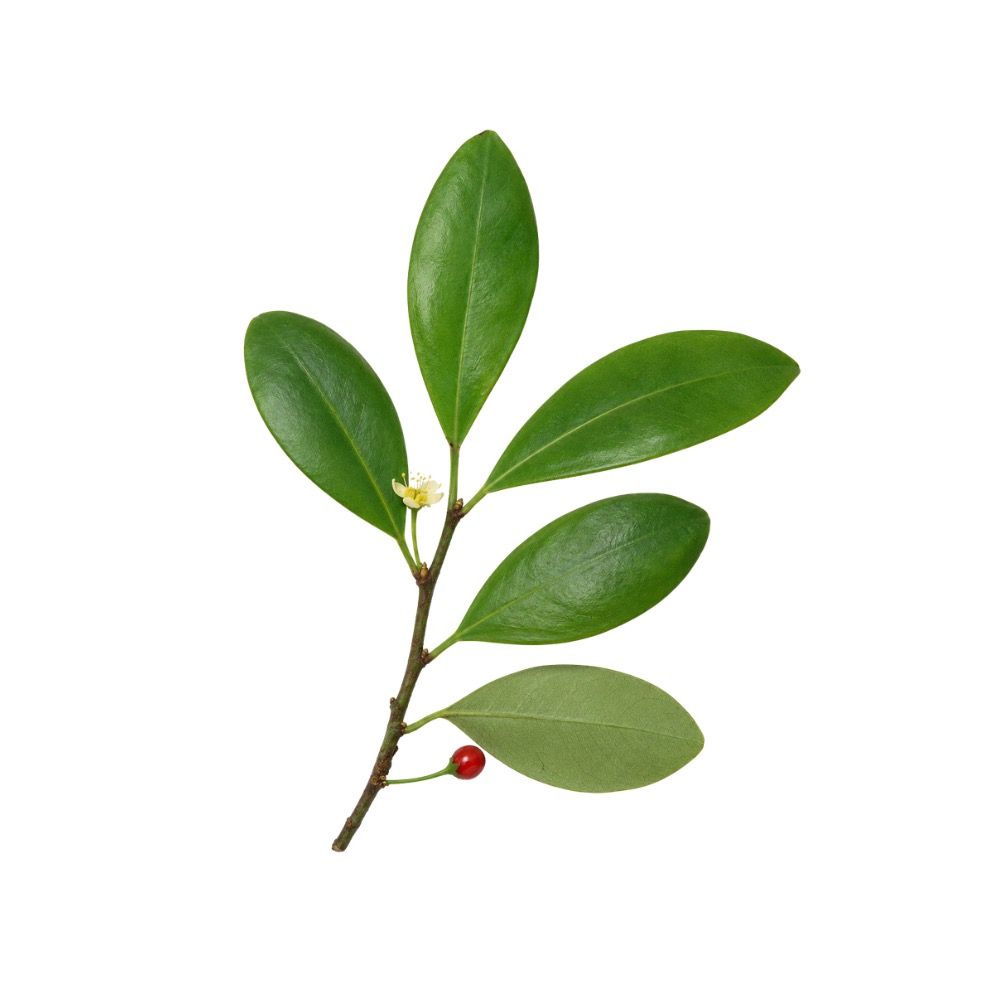
Coca is an evergreen shrub or small tree, most often 1–2 m tall, in the family Erythroxylaceae 24,
The leaves cluster near the ends of the twigs. They are broadly elliptic, 3–8 cm long and 2–4 cm wide, with a pointed or rounded tip ending in a small point 24Reference 24Chung, R. C. K., & Brink, M. (n.d.). Erythroxylum coca Lamk — species description and distribution — botanical reference. In Plant Resources of South-East Asia (PROSEA), via Pl@ntUse. https://uses.plantnet-project.org/en/Erythroxylum_coca_(PROSEA)View study →.
The small flowers grow in clusters of six to twelve in the leaf axils, with yellow or yellowish-green petals 24Reference 24Chung, R. C. K., & Brink, M. (n.d.). Erythroxylum coca Lamk — species description and distribution — botanical reference. In Plant Resources of South-East Asia (PROSEA), via Pl@ntUse. https://uses.plantnet-project.org/en/Erythroxylum_coca_(PROSEA)View study →. Each plant bears flowers of one of two forms, with either long or short styles, as in most of the genus 21,
The genus Erythroxylum has about 230 species across the tropics 21Reference 21ReviewErythroxylum in focus: an interdisciplinary review of an overlooked genus — reviewView study →. Two of them are cultivated as coca, E. coca and E. novogranatense, and each has two varieties: E. coca var. coca (Bolivian or Huánuco coca), E. coca var. ipadu (Amazonian coca), E. novogranatense var. novogranatense (Colombian coca) and var. truxillense (Trujillo coca) 21Reference 21ReviewErythroxylum in focus: an interdisciplinary review of an overlooked genus — reviewView study →.
The varieties differ in their alkaloid profiles, and minor tropanes such as cinnamoylcocaine are used to tell them apart 14,
Distribution
Bolivian coca (var. coca) probably originated on the eastern Andean slopes of Peru and Bolivia, especially the Huallaga Valley, where wild plants are still found. It is typically grown at 500–1,500 m, reaching 2,000 m in places 21Reference 21ReviewErythroxylum in focus: an interdisciplinary review of an overlooked genus — reviewView study →.
Amazonian coca (var. ipadu) is known only in cultivation, in the lowland rainforest of Colombia, Brazil and Peru 21,
Outside South America, coca has been grown in the tropical mountains of Africa, and in Southeast Asia it is kept only in botanical gardens 24,
Growing Conditions
Cultivation snapshot for Coca
Coca grows best where daytime temperatures stay within 17–23 °C and yearly rainfall is 1,000–2,100 mm. A frost of −1 °C damages young growth, and −5 °C kills mature plants 25Reference 25Erythroxylum coca LamView study →.
Coca is a scheduled plant under the 1961 UN Single Convention on Narcotic Drugs, and growing it is illegal in most countries. Bolivia and Peru protect traditional cultivation.
Grow it yourself
Farm Wiki is our cultivation-focused sister site, also run by Justin Cooke.
Pharmacology & Research
Research on coca leaf centres on a small set of controlled studies from the 1990s, in which Andean volunteers chewed leaf before exercise or a glucose test 2,
The studies found changes in fuel metabolism and stress hormones. They did not find a gain in maximal exercise capacity 2,
There are no registered clinical trials of coca leaf as a treatment. The antioxidant and nutritional findings come from laboratory analysis of the leaf 7,
-
Best-supported: coca is a mild stimulant that raises blood glucose and free fatty acids, lowers insulin, and prevents the drop in blood sugar during exercise 3,
4, ; these metabolic effects are replicated across several controlled human studies.5Reference 3Clinical trialEffects of coca chewing on hormonal and metabolic responses during prolonged submaximal exercise — controlled clinical trialView study →Reference 4Clinical trialCoca chewing for exercise: hormonal and metabolic responses of nonhabitual chewers — controlled clinical trialView study →Reference 5Clinical trialEffects of coca chewing on the glucose tolerance test — clinical studyView study → - Emerging, worth watching: a glucose-sparing, insulin-opposing effect that its authors suggest could help at altitude 5Reference 5Clinical trialEffects of coca chewing on the glucose tolerance test — clinical studyView study →, and a 2026 field study of lower cortisol in Andean miners who chew 16Reference 16Traditional coca chewing and cortisol modulation in Andean miners — quasi-experimental studyView study →.
-
Mechanistically thin: antioxidant and “superfood” nutritional claims — polyphenol assays and mineral analyses that do not add up to a meaningful intake at realistic amounts 7,
13Reference 7Can coca leaves contribute to improving the nutritional status of the Andean population? Food and Nutrition Bulletin. https://pubmed.ncbi.nlm.nih.gov/19927600/View study →Reference 13In vitroFrom tradition to science: chemical, nutritional, and cytotoxic characterization of Erythroxylum coca — in vitro studyView study → . -
The caveat: the leaf’s activity is dominated by its cocaine content, which varies widely by variety, region and preparation 7,
9, .14, 21Reference 7Can coca leaves contribute to improving the nutritional status of the Andean population? Food and Nutrition Bulletin. https://pubmed.ncbi.nlm.nih.gov/19927600/View study →Reference 9ReviewBiological activity of the alkaloids of Erythroxylum coca and Erythroxylum novogranatense — reviewView study →Reference 14Chemosystematic identification of fifteen new cocaine-bearing Erythroxylum cultigensView study →Reference 21ReviewErythroxylum in focus: an interdisciplinary review of an overlooked genus — reviewView study →
Cocaine content varies with the variety. It ranges from about 0.1% to 0.8% of the dry leaf 21Reference 21ReviewErythroxylum in focus: an interdisciplinary review of an overlooked genus — reviewView study →, so the amount a chewer or tea drinker receives depends on which coca is used.
1. Stimulant & Anti-Fatigue
In eight traditional chewers, chewing about 12 g of leaf for an hour produced blood cocaine of about 72 ng/mL 2Reference 2Clinical trialEffects of coca chewing on metabolic and hormonal changes during graded incremental exercise to maximum — controlled clinical trialView study →. In habitual chewers at rest, an hour of chewing raised blood glucose, free fatty acids and noradrenaline and lowered insulin 3Reference 3Clinical trialEffects of coca chewing on hormonal and metabolic responses during prolonged submaximal exercise — controlled clinical trialView study →.
During an hour of moderate exercise, habitual chewers showed higher adrenaline, used more fat and had a smaller gradual rise in oxygen uptake than non-chewers 3Reference 3Clinical trialEffects of coca chewing on hormonal and metabolic responses during prolonged submaximal exercise — controlled clinical trialView study →. The authors suggest this could explain chewers’ reported ability to sustain hard work.
Maximal performance did not improve. In a crossover study of 23 non-habitual chewers, coca produced no change in VO₂max or maximal work output, and a higher heart rate at most workloads; work efficiency differed only at low workloads 8Reference 8Clinical trialCoca chewing among high altitude natives: work and muscular efficiencies of nonhabitual chewers — clinical studyView study →. In 12 non-habitual chewers, 15 g of leaf raised oxygen uptake, heart rate and the respiratory exchange ratio during exercise, and gave no sign of better exercise tolerance 4Reference 4Clinical trialCoca chewing for exercise: hormonal and metabolic responses of nonhabitual chewers — controlled clinical trialView study →. In traditional chewers, maximal oxygen uptake and work efficiency matched those of non-chewers 2Reference 2Clinical trialEffects of coca chewing on metabolic and hormonal changes during graded incremental exercise to maximum — controlled clinical trialView study →.
In 10 local men at 2,700 m, chewing 8 g of leaf raised blood glucose, glycerol, lactate and pyruvate during exercise, with no change in blood pressure, oxygen saturation or pulse 1Reference 1Clinical trialDoes chewing coca leaves influence physiology at high altitude? — clinical studyView study →.
In 20 miners working at 4,000 m, habitual chewers had lower serum cortisol than non-chewers 16Reference 16Traditional coca chewing and cortisol modulation in Andean miners — quasi-experimental studyView study →.
Gap: the studies measure hormonal and metabolic responses across a single exercise session. Nothing tests real-world endurance, sustained work output, or habitual chewers over time against a placebo.
2. Glucometabolic Regulation
During a 3½-hour glucose tolerance test in 14 habitual chewers and 14 non-chewers of Aymara ancestry, the non-chewers developed low blood sugar at 120 minutes and the chewers did not 5Reference 5Clinical trialEffects of coca chewing on the glucose tolerance test — clinical studyView study →. The authors attribute this to coca metabolites opposing insulin, and suggest it could help at altitude, where hypoxia favours low blood sugar 5Reference 5Clinical trialEffects of coca chewing on the glucose tolerance test — clinical studyView study →.
This fits the exercise data. Chewing at rest raised blood glucose and free fatty acids and lowered plasma insulin 3Reference 3Clinical trialEffects of coca chewing on hormonal and metabolic responses during prolonged submaximal exercise — controlled clinical trialView study →, and in non-habitual chewers it prevented the usual drop in glucose and insulin during exercise 4Reference 4Clinical trialCoca chewing for exercise: hormonal and metabolic responses of nonhabitual chewers — controlled clinical trialView study →.
The data are small, old and confined to short-term metabolic markers. Nothing follows glycaemic control, diabetes risk or any hard outcome, and habitual chewers differ from controls in ways beyond the coca.
3. Altitude Sickness
Coca’s reputation as the Andean remedy for altitude features in most review articles 11,
The physiological data are mixed. In traditional chewers, arterial oxygen saturation during incremental exercise was lower than in non-chewers, even though their breathing was greater 2Reference 2Clinical trialEffects of coca chewing on metabolic and hormonal changes during graded incremental exercise to maximum — controlled clinical trialView study →. Two other exercise studies found no difference in oxygen saturation 1,
No controlled trial has tested whether coca prevents or treats acute mountain sickness.
Gap: no randomised trial has tested coca against established altitude-sickness endpoints.
4. Local Anaesthetic / Analgesic
Cocaine blocks voltage-gated sodium channels and halts nerve impulses, the property that made purified cocaine the first surgical local anaesthetic 23Reference 23ReviewCocaine: an updated overview on chemistry, detection, biokinetics, and pharmacotoxicological aspects — reviewView study →. The leaf itself is locally anaesthetic when chewed 25Reference 25Erythroxylum coca LamView study →.
Gap: the anaesthetic literature belongs to purified cocaine and the synthetic local anaesthetics derived from it — a different agent at a different dose by a different route. No study has evaluated a whole-leaf preparation for pain.
5. Antioxidant
A 2025 analysis of coca leaves from Colombian indigenous communities measured polyphenols and flavonoids with radical-scavenging capacity in vitro, alongside sugars, organic acids (mainly succinic acid) and over 50% dietary fibre 13Reference 13In vitroFrom tradition to science: chemical, nutritional, and cytotoxic characterization of Erythroxylum coca — in vitro studyView study →. A Peruvian nutritional analysis also found a polyphenol fraction 7Reference 7Can coca leaves contribute to improving the nutritional status of the Andean population? Food and Nutrition Bulletin. https://pubmed.ncbi.nlm.nih.gov/19927600/View study →.
There is no cellular, animal or human work showing that chewing or drinking coca has a systemic antioxidant effect.
6. Appetite Suppression
Suppressing hunger is one of the oldest traditional uses of coca, and cocaine blocks the reuptake of dopamine and other monoamines 23Reference 23ReviewCocaine: an updated overview on chemistry, detection, biokinetics, and pharmacotoxicological aspects — reviewView study →.
The lower insulin and higher free fatty acids seen with chewing fit a shift in fuel use 3Reference 3Clinical trialEffects of coca chewing on hormonal and metabolic responses during prolonged submaximal exercise — controlled clinical trialView study →.
No human study has directly measured appetite, food intake or body weight in response to coca leaf.
Mechanisms
Cocaine, a tropane alkaloid, blocks the reuptake of monoamines, particularly dopamine, and blocks voltage-gated sodium channels 23Reference 23ReviewCocaine: an updated overview on chemistry, detection, biokinetics, and pharmacotoxicological aspects — reviewView study →. Chewed leaf delivers it slowly, reaching about 72 ng/mL in the blood over an hour 2Reference 2Clinical trialEffects of coca chewing on metabolic and hormonal changes during graded incremental exercise to maximum — controlled clinical trialView study →. In chewers, this was accompanied by higher noradrenaline, glucose and free fatty acids and lower insulin 3Reference 3Clinical trialEffects of coca chewing on hormonal and metabolic responses during prolonged submaximal exercise — controlled clinical trialView study →.
The leaf’s other alkaloids have little known pharmacology of their own 9Reference 9ReviewBiological activity of the alkaloids of Erythroxylum coca and Erythroxylum novogranatense — reviewView study →. Its polyphenols show radical-scavenging activity in the test tube 13Reference 13In vitroFrom tradition to science: chemical, nutritional, and cytotoxic characterization of Erythroxylum coca — in vitro studyView study →.
| Mechanism | Drives | Key compounds |
|---|---|---|
| Monoamine (dopamine / norepinephrine) reuptake inhibition | stimulantanti-fatigueappetite suppression | cocaine |
| Voltage-gated Na⁺ channel block | local anaesthesia / analgesia | cocaine |
| Sympathoadrenergic activation → ↑free fatty acids, ↓insulin | glucose-sparingfat oxidation | cocaine |
| Polyphenol / flavonoid radical scavenging (in vitro) | antioxidant | flavonoids, polyphenols |
Clinical Trials
There are no registered clinical trials of coca leaf as a treatment. The human evidence is a small set of controlled physiology studies from the 1990s to the 2020s; the rest is chemistry, in-vitro and animal work.
| Completed | Planned | Terminated | Preclinical |
|---|---|---|---|
| 0 | 0 | 0 | ~15(incl. ~6 controlled human physiology studies) |
Last checked: July 2026.
Phytochemistry
Cocaine is the leaf’s main alkaloid. Its content varies with the variety: about 0.63% of dry weight in Bolivian coca, 0.11–0.41% in Amazonian coca, and 0.72–0.77% in the two E. novogranatense varieties 21Reference 21ReviewErythroxylum in focus: an interdisciplinary review of an overlooked genus — reviewView study →. Peruvian leaf samples contained 0.56% 7Reference 7Can coca leaves contribute to improving the nutritional status of the Andean population? Food and Nutrition Bulletin. https://pubmed.ncbi.nlm.nih.gov/19927600/View study →.
The cultivated varieties contain 18 identified alkaloids, from the tropane, pyrrolidine and pyridine groups 9Reference 9ReviewBiological activity of the alkaloids of Erythroxylum coca and Erythroxylum novogranatense — reviewView study →. Besides cocaine, they include the tropanes cinnamoylcocaine (in cis and trans forms), benzoylecgonine, ecgonine methyl ester, methylecgonidine, tropacocaine, tropine and ecgonine; the truxillic-acid esters α-truxilline and β-truxilline; the pyrrolidine alkaloids hygrine and cuscohygrine, precursors in the tropane pathway; and trace nicotine 9,
The minor tropane profile differs between the varieties and is used to tell them apart 14,
Beyond the alkaloids, the leaf is more than half dietary fibre and contains sugars, organic acids (mainly succinic acid) and polyphenols 13Reference 13In vitroFrom tradition to science: chemical, nutritional, and cytotoxic characterization of Erythroxylum coca — in vitro studyView study →. Per 100 g of dry leaf it holds about 20 g of protein, 990–1,030 mg of calcium and 29 mg of iron 7Reference 7Can coca leaves contribute to improving the nutritional status of the Andean population? Food and Nutrition Bulletin. https://pubmed.ncbi.nlm.nih.gov/19927600/View study →. Two spoonfuls of coca leaf flour would supply less than 10% of daily needs for these nutrients, and the authors concluded the leaf cannot be recommended as a food 7Reference 7Can coca leaves contribute to improving the nutritional status of the Andean population? Food and Nutrition Bulletin. https://pubmed.ncbi.nlm.nih.gov/19927600/View study →.
Constituent Summary
Figures are percentages of dried leaf. † marks the compounds used to tell the cultivated varieties apart.
Tropane Alkaloid9 compounds1 with data
Alkaloid3 compounds1 with data
Dosage
The human studies gave whole dried leaf, chewed as a quid, and measured physiology rather than treating a condition.
Research doses
| Indication | Preparation | Dose | Est. dried-herb equivalent | Source |
|---|---|---|---|---|
| Stimulant / exercise (metabolic response) | Chewed leaf quid + lime | 8 g chewed, single session | 8 g dried leaf (as reported) | 1Reference 1Clinical trialDoes chewing coca leaves influence physiology at high altitude? — clinical studyView study → |
| Stimulant / exercise (metabolic response) | Chewed leaf quid | ~12 g over 1 h (→ ~72 ng/mL blood cocaine) | 12 g dried leaf | 2Reference 2Clinical trialEffects of coca chewing on metabolic and hormonal changes during graded incremental exercise to maximum — controlled clinical trialView study → |
| Stimulant / exercise (metabolic response) | Chewed leaf quid | 15 g, 1 h before exercise | 15 g dried leaf | 4Reference 4Clinical trialCoca chewing for exercise: hormonal and metabolic responses of nonhabitual chewers — controlled clinical trialView study → |
| Glucometabolic (glucose tolerance) | Chewed leaf quid | chewed over 3.5 h | — (leaf mass not reported) | 5Reference 5Clinical trialEffects of coca chewing on the glucose tolerance test — clinical studyView study → |
| Alkaloid content (coca tea) | Infusion / tea bag | ~1 g leaf per tea bag (~4 mg cocaine per cup) | 1 g dried leaf | 6Reference 6Identification and quantitation of alkaloids in coca teaView study → |
At the 0.56% measured in Peruvian leaf 7Reference 7Can coca leaves contribute to improving the nutritional status of the Andean population? Food and Nutrition Bulletin. https://pubmed.ncbi.nlm.nih.gov/19927600/View study →, an 8–15 g quid contains roughly 45–85 mg of cocaine.
Traditional Dosage
| System | Preparation | Dose |
|---|---|---|
| Andean traditional (acullico / chewing) | Dried leaf quid chewed with alkaline lime or ash (llipta) | ~8–15 g leaf per session, repeated through a working day |
| Andean traditional (mate de coca) | Infusion of dried leaf | ~1 g dried leaf (one tea bag) per cup |
Safety & Pregnancy
Coca leaf’s effects and its risks both come from its cocaine content, which the leaf delivers in small amounts and slowly. In most of the world it is a controlled substance.
- Controlled substance. Coca leaf is listed in Schedule I of the 1961 UN Single Convention on Narcotic Drugs and in Schedule II of the US Controlled Substances Act. Traditional use is legal in Bolivia and Peru; possession, import and cultivation are illegal in most other countries.
- Positive drug test. Chewing the leaf or drinking coca tea produces a positive urine test for benzoylecgonine, the standard cocaine screen 6Reference 6Identification and quantitation of alkaloids in coca teaView study →.
- Heart and blood vessels. Chewing raises heart rate during exercise 4,
8Reference 4Clinical trialCoca chewing for exercise: hormonal and metabolic responses of nonhabitual chewers — controlled clinical trialView study →Reference 8Clinical trialCoca chewing among high altitude natives: work and muscular efficiencies of nonhabitual chewers — clinical studyView study → ; a 2025 case report describes reversible narrowing of the brain’s arteries after coca tea and high-altitude exposure 19Reference 19Case reportReversible cerebral vasoconstriction syndrome after high-altitude exposure and coca leaf tea — case reportView study →. - Teeth. Prehistoric chewers show decay at the roots of the back teeth, where the quid was held 17,
18Reference 17ObservationalCoca chewing in prehistoric coastal Peru: dental evidence — observational (archaeological)View study →Reference 18ObservationalDental effects of diet and coca-leaf chewing on two prehistoric cultures — observational (archaeological)View study → . - Not a food. At realistic intakes coca supplies under 10% of daily needs for the nutrients it is promoted for 7Reference 7Can coca leaves contribute to improving the nutritional status of the Andean population? Food and Nutrition Bulletin. https://pubmed.ncbi.nlm.nih.gov/19927600/View study →.
- Interactions not assessed. No coca-leaf interaction study exists; risk is inferred from cocaine pharmacology.
Full Safety & Interactions Detail
Drug tests. A single cup of coca tea delivers enough cocaine to produce a positive urine test for benzoylecgonine, the metabolite targeted by standard cocaine screens 6Reference 6Identification and quantitation of alkaloids in coca teaView study →.
Heart and blood vessels. Chewing raises heart rate during exercise 4,
Teeth. In prehistoric populations from coastal Peru and northern Chile, habitual chewing is linked to decay at the roots of the back teeth, where the quid was held, and to tooth loss 17,
Toxicity. By weight, a crude leaf extract injected into mice was about 36 times less lethal than cocaine hydrochloride (LD50 3,450 mg/kg against 95 mg/kg). Relative to its cocaine content, though, the extract was about three times more lethal, which the authors attributed to other constituents of the leaf 10Reference 10AnimalComparative lethality of coca and cocaine — animal model (mouse)View study →.
Dependence. Whether habitual chewing amounts to dependence has long been debated. A 1977 review of Quechua chewers in southern Peru rejected a simple equation of coca use with cocaine addiction 20Reference 20ReviewUse of coca leaf in southern Peru: adaptation or addiction — reviewView study →.
Nutrition. At realistic intakes coca supplies under 10% of daily needs for the nutrients it is promoted for, while still delivering alkaloids, and the authors of the main nutritional analysis concluded it cannot be recommended as a food 7Reference 7Can coca leaves contribute to improving the nutritional status of the Andean population? Food and Nutrition Bulletin. https://pubmed.ncbi.nlm.nih.gov/19927600/View study →.
Interactions. No drug-interaction or CYP450 study of coca leaf exists. From cocaine’s pharmacology, the likely risks are additive effects with stimulants and decongestants, reactions with MAO inhibitors, and a lower seizure threshold alongside drugs that also lower it.
Legal status. Coca leaf is listed in Schedule I of the 1961 UN Single Convention on Narcotic Drugs and in Schedule II of the US Controlled Substances Act. Traditional chewing is legal in Bolivia and Peru. In most other countries possession, import and cultivation are criminal offences, and this includes coca tea bags brought home from the Andes.
Avoid. Coca leaf and coca tea deliver cocaine into the body, and its metabolites appear in the urine after a single cup 6Reference 6Identification and quantitation of alkaloids in coca teaView study →. The effects of coca leaf in pregnancy and breastfeeding have not been studied.
Cocaine crosses the placenta and passes into breast milk, so coca is best avoided during both.
References
- Casikar, V., et al. (2010). Does chewing coca leaves influence physiology at high altitude? — clinical study. Indian Journal of Clinical Biochemistry. https://pubmed.ncbi.nlm.nih.gov/21731204/
- Spielvogel, H., Caceres, E., Koubi, H., et al. (1996). Effects of coca chewing on metabolic and hormonal changes during graded incremental exercise to maximum — controlled clinical trial. Journal of Applied Physiology. https://pubmed.ncbi.nlm.nih.gov/8929610/
- Favier, R., et al. (1996). Effects of coca chewing on hormonal and metabolic responses during prolonged submaximal exercise — controlled clinical trial. Journal of Applied Physiology. https://pubmed.ncbi.nlm.nih.gov/8929611/
- Favier, R., Caceres, E., Guillon, L., et al. (1996). Coca chewing for exercise: hormonal and metabolic responses of nonhabitual chewers — controlled clinical trial. Journal of Applied Physiology. https://pubmed.ncbi.nlm.nih.gov/8941507/
- Galarza Guzmán, M., et al. (1997). Effects of coca chewing on the glucose tolerance test — clinical study. Medicina (B Aires). https://pubmed.ncbi.nlm.nih.gov/9640756/
- Jenkins, A. J., et al. (1996). Identification and quantitation of alkaloids in coca tea. Forensic Science International. https://pubmed.ncbi.nlm.nih.gov/8819993/
- Penny, M. E., et al. (2009). Can coca leaves contribute to improving the nutritional status of the Andean population? Food and Nutrition Bulletin. https://pubmed.ncbi.nlm.nih.gov/19927600/
- Brutsaert, T., Milotich, M., Frisancho, A. R., et al. (1995). Coca chewing among high altitude natives: work and muscular efficiencies of nonhabitual chewers — clinical study. American Journal of Human Biology. https://pubmed.ncbi.nlm.nih.gov/28557123/
- Novák, M., et al. (1984). Biological activity of the alkaloids of Erythroxylum coca and Erythroxylum novogranatense — review. Journal of Ethnopharmacology. https://pubmed.ncbi.nlm.nih.gov/6379304/
- Bedford, J. A., et al. (1982). Comparative lethality of coca and cocaine — animal model (mouse). Pharmacology, Biochemistry, and Behavior. https://pubmed.ncbi.nlm.nih.gov/7178201/
- Biondich, A. S., & Joslin, J. D. (2015). Coca: high altitude remedy of the ancient Incas — review. Wilderness & Environmental Medicine. https://pubmed.ncbi.nlm.nih.gov/26507611/
- Biondich, A. S., & Joslin, J. D. (2016). Coca: the history and medical significance of an ancient Andean tradition — review. Emergency Medicine International. https://pubmed.ncbi.nlm.nih.gov/27144028/
- Marentes-Culma, R., Orduz-Díaz, L. L., Lozano-Garzón, K., et al. (2025). From tradition to science: chemical, nutritional, and cytotoxic characterization of Erythroxylum coca — in vitro study. ACS Omega. https://pubmed.ncbi.nlm.nih.gov/40290928/
- Casale, J. F., et al. (2014). Chemosystematic identification of fifteen new cocaine-bearing Erythroxylum cultigens. Forensic Science International. https://pubmed.ncbi.nlm.nih.gov/24561557/
- Hegnauer, R. (1981). Chemotaxonomy of Erythroxylaceae (including some ethnobotanical notes on Old World species). Journal of Ethnopharmacology. https://pubmed.ncbi.nlm.nih.gov/7242111/
- Lopez-Chau, L. A., Pastor-Goyzueta, A., Llosa, T., et al. (2026). Traditional coca chewing and cortisol modulation in Andean miners — quasi-experimental study. Journal of Ethnopharmacology. https://pubmed.ncbi.nlm.nih.gov/41005469/
- Indriati, E., Buikstra, J. E., et al. (2001). Coca chewing in prehistoric coastal Peru: dental evidence — observational (archaeological). American Journal of Physical Anthropology. https://pubmed.ncbi.nlm.nih.gov/11241189/
- Langsjoen, O. M. (1996). Dental effects of diet and coca-leaf chewing on two prehistoric cultures — observational (archaeological). American Journal of Physical Anthropology. https://pubmed.ncbi.nlm.nih.gov/9016362/
- Del Brutto, O. H., Guzmán, E. J., Caputi, R., et al. (2025). Reversible cerebral vasoconstriction syndrome after high-altitude exposure and coca leaf tea — case report. Journal of Stroke and Cerebrovascular Diseases. https://pubmed.ncbi.nlm.nih.gov/41297570/
- Hanna, J. M., Hornick, C. A. (1977). Use of coca leaf in southern Peru: adaptation or addiction — review. Bulletin on Narcotics. https://pubmed.ncbi.nlm.nih.gov/585582/
- Restrepo, D. A., Saenz, E., Jara-Muñoz, O. A., et al. (2019). Erythroxylum in focus: an interdisciplinary review of an overlooked genus — review. Molecules. https://pubmed.ncbi.nlm.nih.gov/31640255/
- Bauer, I., et al. (2019). Travel medicine, coca and cocaine: demystifying and rehabilitating Erythroxylum — review. Tropical Diseases, Travel Medicine and Vaccines. https://pubmed.ncbi.nlm.nih.gov/31798934/
- Roque Bravo R, Faria AC, Brito-da-Costa AM, et al. (2022). Cocaine: an updated overview on chemistry, detection, biokinetics, and pharmacotoxicological aspects — review. Toxins. https://pubmed.ncbi.nlm.nih.gov/35448887/
- Chung, R. C. K., & Brink, M. (n.d.). Erythroxylum coca Lamk — species description and distribution — botanical reference. In Plant Resources of South-East Asia (PROSEA), via Pl@ntUse. https://uses.plantnet-project.org/en/Erythroxylum_coca_(PROSEA)
- Useful Tropical Plants Database (n.d.). Erythroxylum coca Lam. — habit, range and cultivation conditions — species database. https://tropical.theferns.info/viewtropical.php?id=Erythroxylum+coca



