
Compound Monograph
Licocoumarone
Licocoumarone is a minor prenylated 2-arylbenzofuran from licorice root (Glycyrrhiza), studied only in the laboratory as a monoamine-oxidase inhibitor and an antioxidant/antimicrobial constituent — despite its name, it is a benzofuran, not a coumarin, and there is no human data on the isolated molecule.

Sources · 2
Where Does It Come From?
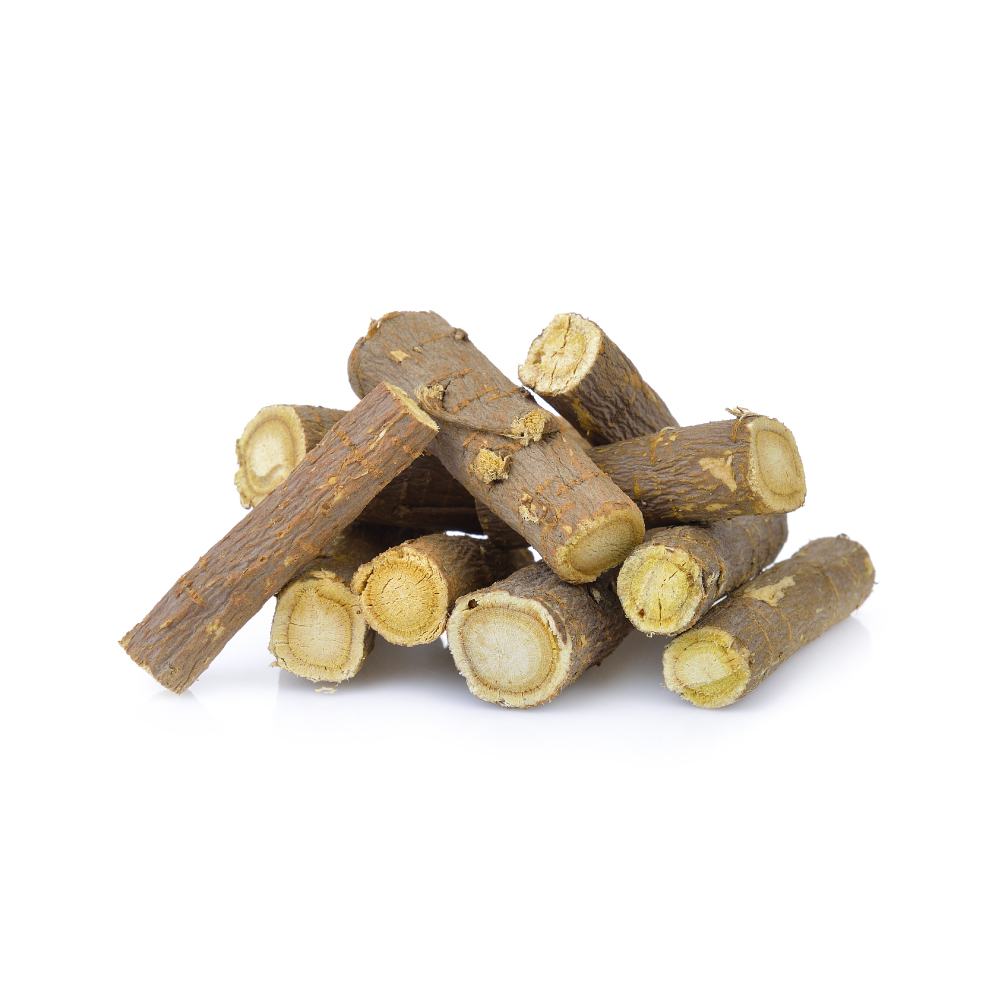
Licocoumarone is a naturally occurring 2-arylbenzofuran (prenylated benzofuran), found in Chinese licorice and Licorice. It is well tolerated orally (low toxicity).
Concentration
Content by Source
Concentrations not reported. No percent-dry-weight or mg/g figures have been published for this compound in its source plants.
Licocoumarone at a Glance
Licocoumarone is a minor prenylated benzofuran found in the root of licorice (Glycyrrhiza). It belongs to the same broad flavonoid/benzofuran chemistry that gives licorice its yellow-pigmented, antioxidant-rich phenolic fraction — a fraction distinct from the sweet-tasting saponin glycyrrhizin that drives most of the herb’s well-known effects.
Its name is misleading. Despite the “-coumarone” ending, licocoumarone is a 2-arylbenzofuran, not a coumarin — “coumarone” is an old name for benzofuran. Structurally it is 2-(2,4-dihydroxyphenyl)-6-hydroxy-4-methoxy-5-(3-methyl-2-butenyl)benzofuran 1Reference 1Antioxidant and antimicrobial constituents of licorice: isolation and structure elucidation of a new benzofuran derivativeView study →.
Interest in the molecule is entirely preclinical. In isolated-compound assays it inhibits monoamine oxidase 2Reference 2Phenolic constituents of licoriceView study →, shows antioxidant and antimicrobial activity 1Reference 1Antioxidant and antimicrobial constituents of licorice: isolation and structure elucidation of a new benzofuran derivativeView study →, and — in a single recent study — kills pancreatic-cancer cells by inhibiting the kinase DYRK1A 3Reference 3Licocoumarone induces BxPC-3 pancreatic adenocarcinoma cell death by inhibiting DYRK1AView study →. All of this is laboratory work at micromolar concentrations; there are no human studies, no pharmacokinetic data, and no established use for the isolated compound.
Benzofuran, Not Coumarin — A Note on the Name
The name suggests a coumarin, and licocoumarone is filed under “coumarins” in this site’s phytochemistry taxonomy, but the chemistry says otherwise. “Coumarone” is the archaic name for benzofuran, and licocoumarone’s structure is a 2-arylbenzofuran carrying a prenyl (3-methyl-2-butenyl) side chain and three oxygenated positions 1Reference 1Antioxidant and antimicrobial constituents of licorice: isolation and structure elucidation of a new benzofuran derivativeView study →. It is not a benzo-α-pyrone (the coumarin scaffold). This matters when reading the licorice literature: licorice separately contains true coumarins such as licopyranocoumarin and glycycoumarin, which are different molecules with different scaffolds. Treat “licocoumarone” as a benzofuran when comparing structures and mechanisms.
A Licorice Benzofuran With MAO-Inhibitory & Antioxidant Interest
Within licorice’s large phenolic fraction, licocoumarone is one of a handful of constituents flagged for monoamine-oxidase (MAO) inhibition — the property that underlies the herb’s (purely mechanistic) reputation in mood-related traditional use. In a systematic Japanese survey of licorice constituents, licocoumarone was one of six compounds — alongside glycyrrhisoflavone, genistein, licopyranocoumarin, glicoricone and licofuranone — that inhibited MAO, with IC50 values in the 6×10⁻⁵–1.4×10⁻⁴ M range 2Reference 2Phenolic constituents of licoriceView study →.
Separately, it is one of the licorice phenolics that carries genuine antioxidant and antimicrobial activity as an isolated compound — the study that first elucidated its structure was explicitly a search for the herb’s antioxidant/antimicrobial constituents 1Reference 1Antioxidant and antimicrobial constituents of licorice: isolation and structure elucidation of a new benzofuran derivativeView study →. This is the compound’s most defensible non-CNS property, though still in-vitro.
The molecule is best understood as a minor bioactive marker of the licorice benzofuran/flavonoid fraction, not a driver of any established effect. Everything below is preclinical.
What It's Used For
Licocoumarone’s evidence is thin and uniformly preclinical. Its value here is that, unusually for a minor licorice constituent, several activities were measured on the isolated compound rather than only inferred from whole extract.
Support is an experimental score — weighted by study type (human > animal > in vitro) and volume. A beta, not a validated metric. Every row here is isolated-compound in-vitro work with no human or animal follow-up, so all scores are low by design.
The most-cited property. In a survey of twelve licorice constituents, the isolated compound inhibited monoamine oxidase — one of six actives (with genistein, licopyranocoumarin, glicoricone, licofuranone and glycyrrhisoflavone) at IC50 values of 6.0×10⁻⁵–1.4×10⁻⁴ M 2Reference 2Phenolic constituents of licoriceView study →.
Note the enzyme source in that study was not resolved to the MAO-A vs. MAO-B isoform. The popular “MAO-B inhibitor” label comes largely from a later high-throughput screen in which whole licorice root extract ranked among the most potent natural MAO-B inhibitors (IC50 <0.07 mg/mL) — but that study screened extracts, not the purified molecule 4Reference 4High throughput screening to identify natural human monoamine oxidase B inhibitorsView study →.
Gap: isolate-level MAO data exist 2Reference 2Phenolic constituents of licoriceView study →, but the isoform was not specified, the potency is micromolar, and there is no cellular, animal or human confirmation that this translates to a CNS effect — nor any pharmacokinetic evidence the compound reaches the brain.
Licocoumarone was first isolated as an antioxidant/antimicrobial constituent of licorice: the 1988 study that elucidated its benzofuran structure was a targeted hunt for the herb’s radical-scavenging and antimicrobial actives, and reported the isolated compound active on both counts 1Reference 1Antioxidant and antimicrobial constituents of licorice: isolation and structure elucidation of a new benzofuran derivativeView study →. This fits its chemistry — a poly-hydroxylated prenylated benzofuran is a plausible phenolic antioxidant.
Gap: the assays are in-vitro whole-compound tests from a single structural study 1Reference 1Antioxidant and antimicrobial constituents of licorice: isolation and structure elucidation of a new benzofuran derivativeView study →; there is no quantified potency comparison against reference antioxidants, no spectrum data for the antimicrobial claim, and no in-vivo work.
The newest thread. In a 2020 study, the isolated compound inhibited the kinase DYRK1A (IC50 12.56 μM) and induced death of DYRK1A-overexpressing BxPC-3 pancreatic adenocarcinoma cells (IC50 50.77 μM), reducing c-MET protein levels downstream of DYRK1A suppression 3Reference 3Licocoumarone induces BxPC-3 pancreatic adenocarcinoma cell death by inhibiting DYRK1AView study →.
Gap: this is a single cell-line study with supporting biochemical binding assays but no animal model and no clinical data; the cytotoxic concentration (~51 μM) is high and its in-vivo achievability is unknown 3Reference 3Licocoumarone induces BxPC-3 pancreatic adenocarcinoma cell death by inhibiting DYRK1AView study →.
Mechanisms
| Target / pathway | Effect | Relevant to |
|---|---|---|
| Monoamine oxidase (MAO) | enzyme inhibition, IC50 ~6×10⁻⁵–1.4×10⁻⁴ M (isoform not resolved) | MAO inhibition / antidepressant mechanism |
| Phenolic / benzofuran radical scavenging | antioxidant activity in vitro | antioxidant |
| Microbial targets (undefined) | antimicrobial activity in vitro | antimicrobial |
| DYRK1A kinase → c-MET | kinase inhibition (IC50 12.56 μM) → ↓ c-MET → cancer-cell death | anticancer (cell line) |
Every mechanism here is measured on the isolated compound in cell-free or cell-line assays. None has been tied to an outcome in an animal or a person, and the concentrations are micromolar.
Pharmacokinetics
None characterised. There are no absorption, distribution, metabolism, oral-bioavailability or half-life data for licocoumarone. As a lipophilic, poly-hydroxylated prenylated benzofuran it would be expected to have poor aqueous solubility, and human exposure occurs only incidentally as a minor constituent of whole licorice root — but this is inference, not measurement. The absence of pharmacokinetic data is the single largest caveat on every in-vitro finding above: it is unknown whether the micromolar concentrations used in the assays are achievable in any tissue in vivo.
Clinical Trials
There are no clinical trials of licocoumarone, and none are registered. All evidence is preclinical and in-vitro.
| Completed | Planned | Terminated | Preclinical |
|---|---|---|---|
| — | — | — | MAO inhibition 2Reference 2Phenolic constituents of licoriceView study →; antioxidant/antimicrobial 1Reference 1Antioxidant and antimicrobial constituents of licorice: isolation and structure elucidation of a new benzofuran derivativeView study →; DYRK1A/anticancer 3Reference 3Licocoumarone induces BxPC-3 pancreatic adenocarcinoma cell death by inhibiting DYRK1AView study → |
Last checked: July 2026.
Isolate vs. Plant Studies
Unusually for a minor licorice constituent, the reported activities were measured on the purified molecule — the MAO 2Reference 2Phenolic constituents of licoriceView study →, antioxidant/antimicrobial 1Reference 1Antioxidant and antimicrobial constituents of licorice: isolation and structure elucidation of a new benzofuran derivativeView study → and DYRK1A/anticancer 3Reference 3Licocoumarone induces BxPC-3 pancreatic adenocarcinoma cell death by inhibiting DYRK1AView study → data all used isolated licocoumarone, which is a genuine (if narrow) strength. The important exception is the widely-repeated “MAO-B inhibitor” framing: that stronger, isoform-specific label comes from a high-throughput screen of whole licorice root extract, where the compound was never isolated and its individual contribution was not established 4Reference 4High throughput screening to identify natural human monoamine oxidase B inhibitorsView study →. So the honest split is: isolate data exist and are the basis of the mechanistic claims, but they are all in-vitro, and the herb-level “MAO-B” story should not be read back onto the pure molecule without that caveat.
Prevalence in Nature
Licocoumarone is a licorice-specific benzofuran, reported from the roots and rhizomes of Glycyrrhiza — chiefly Chinese licorice (G. uralensis) and G. glabra 1,
Discovery & Synthesis
Licocoumarone was isolated and structurally characterised in 1988 by S. Demizu, T. Kinoshita and co-workers (Chemical & Pharmaceutical Bulletin), in a study explicitly searching for the antioxidant and antimicrobial constituents of licorice; they assigned it as a new benzofuran derivative — 2-(2,4-dihydroxyphenyl)-6-hydroxy-4-methoxy-5-(3-methyl-2-butenyl)benzofuran 1Reference 1Antioxidant and antimicrobial constituents of licorice: isolation and structure elucidation of a new benzofuran derivativeView study →. Its MAO-inhibitory activity was reported soon after in the Phenolic Constituents of Licorice series 2Reference 2Phenolic constituents of licoriceView study →. Total synthesis of licocoumarone is not well documented in the accessible literature; the compound is obtained by extraction and chromatographic isolation from licorice root, and is used essentially only as a research reference standard. There is no commercial-scale production.
Patents: not yet researched.
Toxicity & Safety
There is very little to report, because there is very little data. Licocoumarone is a minor licorice constituent and is not the component behind licorice’s well-known safety issues — the pseudoaldosteronism, raised blood pressure and potassium loss all come from glycyrrhizin, not the benzofuran fraction. No specific toxicity, genotoxicity, reproductive or interaction data exist for the isolated molecule. Its “low” flag reflects the absence of any reported hazard signal plus its minor status in a widely-consumed herb — not a clean toxicology package.
- Not the risky part of licorice. Blood-pressure/potassium effects come from glycyrrhizin; licocoumarone is a minor benzofuran with no reported toxicity signal.
- Essentially no safety data on the isolate. No genotoxicity, reproductive, repeat-dose or drug-interaction studies exist for the pure compound.
- All activity is in-vitro at micromolar levels. Whether any effect — or any risk — occurs at real dietary/herbal exposure is unknown, because pharmacokinetics are uncharacterised.
Dosage
There is no dose. Licocoumarone has never been administered to people as an isolated compound, and no therapeutic use is established. The only quantitative figures in the literature are in-vitro potencies — MAO IC50 ~6×10⁻⁵–1.4×10⁻⁴ M 2Reference 2Phenolic constituents of licoriceView study → and DYRK1A IC50 12.56 μM 3Reference 3Licocoumarone induces BxPC-3 pancreatic adenocarcinoma cell death by inhibiting DYRK1AView study → — which are laboratory concentrations, not doses. Real-world human exposure is incidental, as a minor benzofuran within whole licorice root, and is not standardised or measured. These are research figures, not a personal recommendation.
References
- Demizu S, Kajiyama K, Takahashi K, Hiraga Y, Yamamoto S, Tamura Y, Okada K, Kinoshita T (1988). Antioxidant and antimicrobial constituents of licorice: isolation and structure elucidation of a new benzofuran derivative. Chemical & Pharmaceutical Bulletin (Tokyo). https://pubmed.ncbi.nlm.nih.gov/3240542/
- Hatano T, Fukuda T, Miyase T, Noro T, Okuda T (1991). Phenolic constituents of licorice. III. Structures of glicoricone and licofuranone, and inhibitory effects of licorice constituents on monoamine oxidase. Chemical & Pharmaceutical Bulletin (Tokyo). https://pubmed.ncbi.nlm.nih.gov/1913999/
- Zhao C, Wang D, Gao Z, Kan H, Qiu F, Chen L, Li H (2020). Licocoumarone induces BxPC-3 pancreatic adenocarcinoma cell death by inhibiting DYRK1A. Chemico-Biological Interactions. https://pubmed.ncbi.nlm.nih.gov/31838052/
- Mazzio E, Deiab S, Park K, Soliman KFA (2013). High throughput screening to identify natural human monoamine oxidase B inhibitors. Phytotherapy Research. https://pubmed.ncbi.nlm.nih.gov/22887993/



