
Compound Monograph
Glycyrrhizol A
Glycyrrhizol A is a prenylated isoflavonoid (a pterocarpene) from Chinese licorice, Glycyrrhiza uralensis — the antibacterial component behind licorice-extract anti-cavity lollipops, with potent laboratory activity against the tooth-decay bacterium Streptococcus mutans.

Sources · 2
Where Does It Come From?
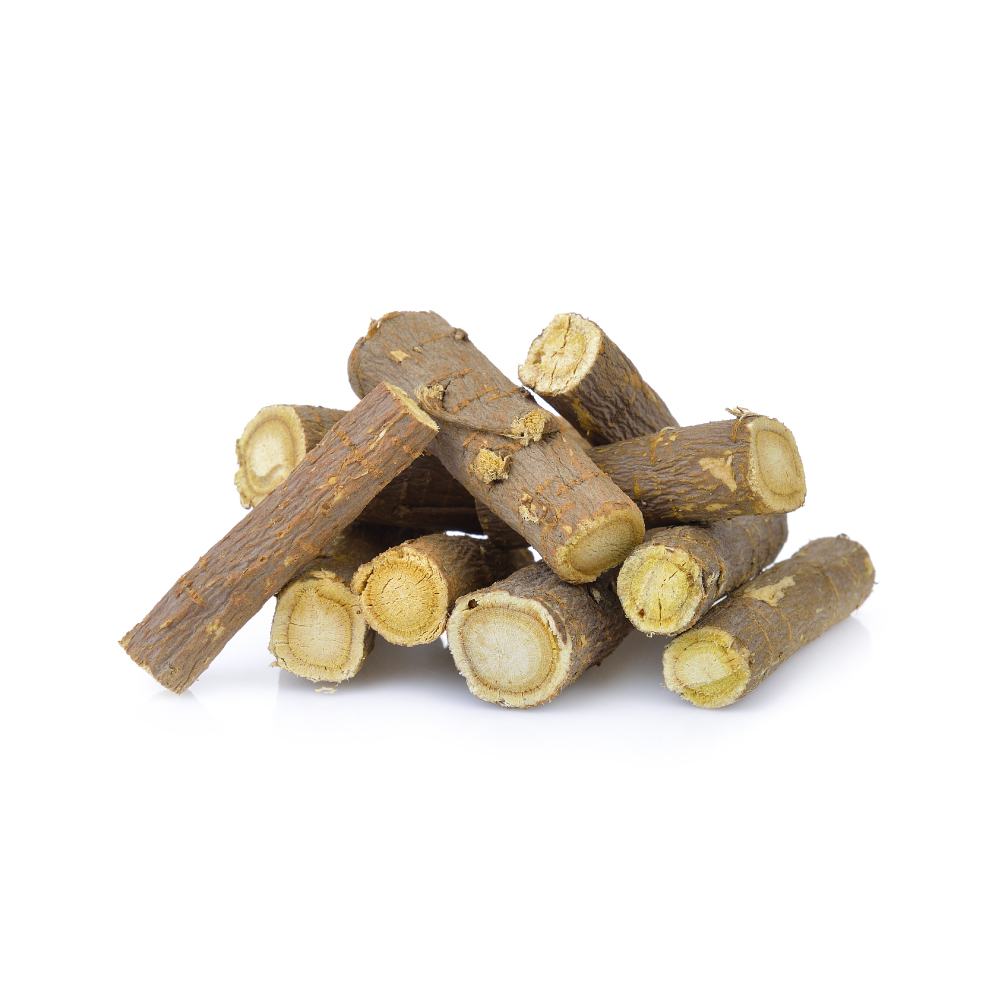
Glycyrrhizol A is a naturally occurring prenylated isoflavonoid (pterocarpene), found in Chinese licorice and 1 other source. It is well tolerated orally (low toxicity).
Concentration
Content by Source
Concentrations not reported. No percent-dry-weight or mg/g figures have been published for this compound in its source plants.
Glycyrrhizol A at a Glance
Glycyrrhizol A is a prenylated isoflavonoid — structurally a pterocarpene — first isolated from the roots of Chinese licorice (Glycyrrhiza uralensis) in 2006 1Reference 1Antibacterial compounds from Glycyrrhiza uralensisView study →. Chemically it belongs to the licorice isoflavonoid family alongside glabridin, glycyrrhisoflavone and licochalcone A, but it is a chemotype-specific molecule: it marks G. uralensis and is not a characteristic constituent of the European/Persian G. glabra that yields glabridin.
Its single claim to interest is antibacterial — specifically, potent activity against Streptococcus mutans, the main acid-producing bacterium behind dental caries. That finding is the basis for licorice-extract “anti-cavity” lollipops and oral-care products, which are the only form in which the compound has reached human testing 2,
The Anti-Caries Antibacterial Licorice Isoflavonoid
This is the point of the page. Glycyrrhizol A is one of two new pterocarpenes (with glycyrrhizol B) that a UCLA dentistry group isolated from G. uralensis roots using bioassay-guided fractionation — i.e. they chased the anti-Streptococcus mutans activity of the crude extract to the molecules responsible 1Reference 1Antibacterial compounds from Glycyrrhiza uralensisView study →. Of the compounds recovered, glycyrrhizol A was the standout, inhibiting S. mutans at a minimum inhibitory concentration of ~1 µg/mL — potent for a plant secondary metabolite 1Reference 1Antibacterial compounds from Glycyrrhiza uralensisView study →.
Because S. mutans converts dietary sugars into the acids that dissolve tooth mineral, killing it is a recognized route to preventing tooth decay. The same UCLA group therefore scaled up production of a glycyrrhizol-A-bearing G. uralensis extract and built it into a sugar-free lollipop designed to deliver the antibacterial to the mouth; the product was reported to be safe and its antimicrobial activity stable, and two small pilot human studies (a brief regimen twice daily for about ten days) showed a marked drop in oral cariogenic bacteria 2Reference 2Development and evaluation of a safe and effective sugar-free herbal lollipop that kills cavity-causing bacteriaView study →. Independent and follow-up clinical testing in high-caries-risk preschool children reproduced the salivary S. mutans reduction 3,
The honest boundary: the potent MIC belongs to the purified molecule, but every human study used the whole G. uralensis extract lollipop standardized to contain glycyrrhizol A — not the isolated compound — and the endpoints are bacterial counts, a surrogate, rather than verified long-term reductions in actual cavities.
What It's Used For
The evidence base is small and one-dimensional: strong in-vitro antibacterial potency for the isolate, plus a handful of small oral-care human studies of the extract vehicle.
Support is an experimental score — weighted by study type (human > animal > in vitro) and volume. A beta, not a validated metric. Scores mix genuinely potent isolate in-vitro data with small whole-extract human oral-care studies, so read the per-row basis.
The marquee application. Purified glycyrrhizol A inhibits Streptococcus mutans at an MIC of ~1 µg/mL in vitro 1Reference 1Antibacterial compounds from Glycyrrhiza uralensisView study → — the strongest of the licorice pterocarpenes/isoflavonoids screened, alongside the co-isolated 6,8-diisoprenyl-5,7,4′-trihydroxyisoflavone. That potency was carried into an oral-care product: a sugar-free lollipop made from a scaled G. uralensis extract standardized to contain glycyrrhizol A, reported safe and stable, which cut oral cariogenic bacteria in two pilot human studies 2Reference 2Development and evaluation of a safe and effective sugar-free herbal lollipop that kills cavity-causing bacteriaView study →.
A proof-of-principle pilot in preschool children found twice-daily lollipop use significantly reduced salivary S. mutans in high-caries-risk children, an effect that persisted about three weeks after stopping before rebounding 3Reference 3Clinical reduction of S. mutans in pre-school children using a novel liquorice root extract lollipop: a pilot studyView study →.
A 2019 clinical study reproduced the salivary S. mutans reduction and showed the extract killed S. mutans selectively while preserving oral microbiome diversity 4Reference 4Lollipop containing Glycyrrhiza uralensis extract reduces Streptococcus mutans colonization and maintains oral microbial diversity in Chinese preschool childrenView study →.
Gap: the MIC is the isolate’s but every human study used the whole extract vehicle, so the clinical effect cannot be attributed to glycyrrhizol A alone; endpoints are S. mutans counts (a surrogate), trials are small and short, and the reduction rebounds once the lollipops stop 3,
Glycyrrhizol A emerged from bioassay-guided fractionation for antibacterial activity, so its antibacterial character is intrinsic to how it was found rather than an incidental observation 1Reference 1Antibacterial compounds from Glycyrrhiza uralensisView study →.
Reviews of food-derived anticaries agents place the licorice pterocarpenes among natural compounds with activity against oral bacteria 5Reference 5Food components with anticaries activityView study →.
In practice, though, the documented testing centres almost entirely on S. mutans; there is little published characterization of its spectrum against other pathogens.
Gap: beyond the S. mutans MIC, the antibacterial spectrum, mechanism of bacterial killing, and any activity against non-oral pathogens are largely uncharacterized for the isolate 1,
Mechanisms
| Target / pathway | Effect | Relevant to |
|---|---|---|
| Streptococcus mutans (growth/viability) | potent inhibition/killing, MIC ~1 µg/mL | anti-caries / antibacterial |
| Cariogenic acid production | reducing S. mutans load lowers the acidogenic pressure that demineralizes enamel (rationale, not directly measured) | caries prevention |
| Oral microbial community | targeted killing of S. mutans that spares commensals and preserves diversity (whole-extract observation) | anti-caries without dysbiosis |
| 11β-hydroxysteroid dehydrogenase | not an inhibitor — unlike licorice’s saponin glycyrrhizin, glycyrrhizol A is not implicated in the herb’s blood-pressure/potassium effects | safety contrast |
The load-bearing point is the first row: a low-µg/mL MIC against the main caries organism is what makes this molecule worth a page. The microbiome-sparing selectivity 4Reference 4Lollipop containing Glycyrrhiza uralensis extract reduces Streptococcus mutans colonization and maintains oral microbial diversity in Chinese preschool childrenView study → is an extract-level observation, and the 11β-HSD contrast matters because it distinguishes glycyrrhizol A from the saponin that drives licorice’s dose-limiting toxicity.
Pharmacokinetics
Essentially uncharacterized — and, for the one use that exists, largely beside the point. Glycyrrhizol A has been deployed locally in the mouth (a lollipop delivering antibacterial contact to saliva and tooth surfaces), so no oral absorption, systemic bioavailability, distribution, metabolism or half-life data have been established for the isolated molecule 2Reference 2Development and evaluation of a safe and effective sugar-free herbal lollipop that kills cavity-causing bacteriaView study →. There is no published ADME package for pure glycyrrhizol A. This is a genuine hole rather than a claim of favourable kinetics: any future systemic application would need the pharmacokinetics worked out from scratch.
Clinical Trials
Small human evidence exists only for the extract vehicle, not the isolate. Pilot lollipop studies and a follow-up clinical study in preschool children have reported reduced salivary S. mutans 2,
| Completed | Planned | Terminated | Preclinical |
|---|---|---|---|
| Small oral-care human studies of the G. uralensis extract lollipop (salivary S. mutans endpoints) | — | — | Isolation + anti-S. mutans MIC (in vitro, isolate) |
Last checked: July 2026.
Isolate vs. Plant Studies
This molecule shows the isolate-vs-plant split cleanly. The potency is the isolate’s: purified glycyrrhizol A was tested as a pure compound and inhibits S. mutans at ~1 µg/mL 1Reference 1Antibacterial compounds from Glycyrrhiza uralensisView study →. The human data are the plant extract’s: every oral-care study used a G. uralensis root extract standardized to contain glycyrrhizol A, formulated into a lollipop — not the purified molecule 2,
Prevalence in Nature
Glycyrrhizol A is a minor, chemotype-specific constituent of Glycyrrhiza uralensis (Chinese licorice) root, from which it was isolated by bioassay-guided fractionation 1Reference 1Antibacterial compounds from Glycyrrhiza uralensisView study →. It is a marker of the uralensis chemotype: the three commercial licorice species (G. uralensis, G. glabra, G. inflata) differ chemically, and glycyrrhizol A tracks the Chinese species rather than the glabridin-rich European/Persian G. glabra. No quantified per-cent-of-root figure is documented in the retrieved literature, so its abundance is best described qualitatively as low/minor — the reason a scaled extraction and concentration step was needed to build enough into a lollipop 2Reference 2Development and evaluation of a safe and effective sugar-free herbal lollipop that kills cavity-causing bacteriaView study →. No non-licorice natural source is reported.
Discovery & Synthesis
Glycyrrhizol A was first isolated in 2006 by Jian He, Lu Chen, David Heber, Wenyuan Shi and Qing-Yi Lu at the UCLA School of Dentistry, who fractionated G. uralensis root by chasing its antibacterial activity and characterized two new pterocarpenes — glycyrrhizol A and glycyrrhizol B — plus four known isoflavonoids by spectroscopic analysis 1Reference 1Antibacterial compounds from Glycyrrhiza uralensisView study →. The names derive from the Glycyrrhiza genus. Glycyrrhizol A and one co-isolated isoflavone were the potent anti-S. mutans actives (MIC 1 and 2 µg/mL respectively) 1Reference 1Antibacterial compounds from Glycyrrhiza uralensisView study →.
No total synthesis of glycyrrhizol A is documented in the retrieved literature; it is not well described. Manufacture today is by extraction of G. uralensis root — the oral-care products use a scaled, standardized licorice extract enriched for the antibacterial isoflavonoid fraction rather than a purified single compound 2Reference 2Development and evaluation of a safe and effective sugar-free herbal lollipop that kills cavity-causing bacteriaView study →.
Patents: not yet researched.
Toxicity & Safety
Glycyrrhizol A carries a low flag. Two points support it. First, unlike licorice’s saponin glycyrrhizin, glycyrrhizol A is a prenylated isoflavonoid that does not inhibit 11β-hydroxysteroid dehydrogenase — so it is not the component responsible for licorice’s blood-pressure rise and potassium loss (pseudo-aldosteronism). Second, the G. uralensis extract lollipops built around it were reported safe and stable in their development and pilot human use 2Reference 2Development and evaluation of a safe and effective sugar-free herbal lollipop that kills cavity-causing bacteriaView study →. The honest caveat is that there is no dedicated toxicology package for the purified molecule — no repeat-dose, genotoxicity or reproductive dataset for the isolate — so “low” reflects its minor, food-adjacent exposure and the absence of red flags rather than a completed safety characterization.
- Not the pseudo-aldosteronism component. Glycyrrhizol A does not inhibit 11β-HSD; licorice’s blood-pressure/potassium effects are driven by the saponin glycyrrhizin, not this isoflavonoid.
- Extract lollipops reported safe & stable. The G. uralensis products delivering glycyrrhizol A were characterized as safe in development and small human studies.
- No isolate safety dataset. No repeat-dose, genotoxicity or reproductive-toxicity data exist for the purified compound; “low” is inferred, not fully established.
- Human exposure is via whole licorice extract. Anyone consuming meaningful amounts of G. uralensis extract is also exposed to glycyrrhizin and its known dose-limiting effects — those cautions belong to the whole-root preparation, decided on the licorice monograph, not to this molecule.
Dosage
There is no established dose of the isolated molecule — purified glycyrrhizol A has never been dosed in people. Its only human use has been local and indirect: sugar-free lollipops made from a G. uralensis root extract standardized to contain glycyrrhizol A, used in these research regimens:
| Application | Form | Regimen studied |
|---|---|---|
| Lower salivary S. mutans (children) | G. uralensis extract lollipop | Twice daily, ~10 days to 3 weeks 2, |
The antibacterial effect faded over the weeks after the lollipops stopped, before the bacteria rebounded 3Reference 3Clinical reduction of S. mutans in pre-school children using a novel liquorice root extract lollipop: a pilot studyView study →. Whole-licorice cautions (glycyrrhizin) apply to any extract-based exposure. These are regimens studied in research and are not a personal recommendation.
References
- He J, Chen L, Heber D, Shi W, Lu QY (2006). Antibacterial compounds from Glycyrrhiza uralensis. Journal of Natural Products. https://pubmed.ncbi.nlm.nih.gov/16441081/
- Hu CH, He J, Eckert R, Wu XY, et al. (2011). Development and evaluation of a safe and effective sugar-free herbal lollipop that kills cavity-causing bacteria. International Journal of Oral Science. https://pubmed.ncbi.nlm.nih.gov/21449211/
- Peters MC, Tallman JA, Braun TM, Jacobson JJ (2010). Clinical reduction of S. mutans in pre-school children using a novel liquorice root extract lollipop: a pilot study. European Archives of Paediatric Dentistry. https://pubmed.ncbi.nlm.nih.gov/21108917/
- Chen Y, Agnello M, Dinis M, et al. (2019). Lollipop containing Glycyrrhiza uralensis extract reduces Streptococcus mutans colonization and maintains oral microbial diversity in Chinese preschool children. PLoS One. https://pubmed.ncbi.nlm.nih.gov/31442287/
- Gazzani G, Daglia M, Papetti A (2012). Food components with anticaries activity. Current Opinion in Biotechnology. https://pubmed.ncbi.nlm.nih.gov/22030309/



