
Compound Monograph
Majdine
Majdine is a spiro-oxindole monoterpene indole alkaloid of the periwinkles, first reported from Vinca major in 1965 and structurally settled by 1973. Its chemistry is unusually well established for a minor alkaloid; its pharmacology is almost entirely unstudied — one in-vitro isolate paper, no dose, no toxicology and no trials.

Sources · 2
Where Does It Come From?
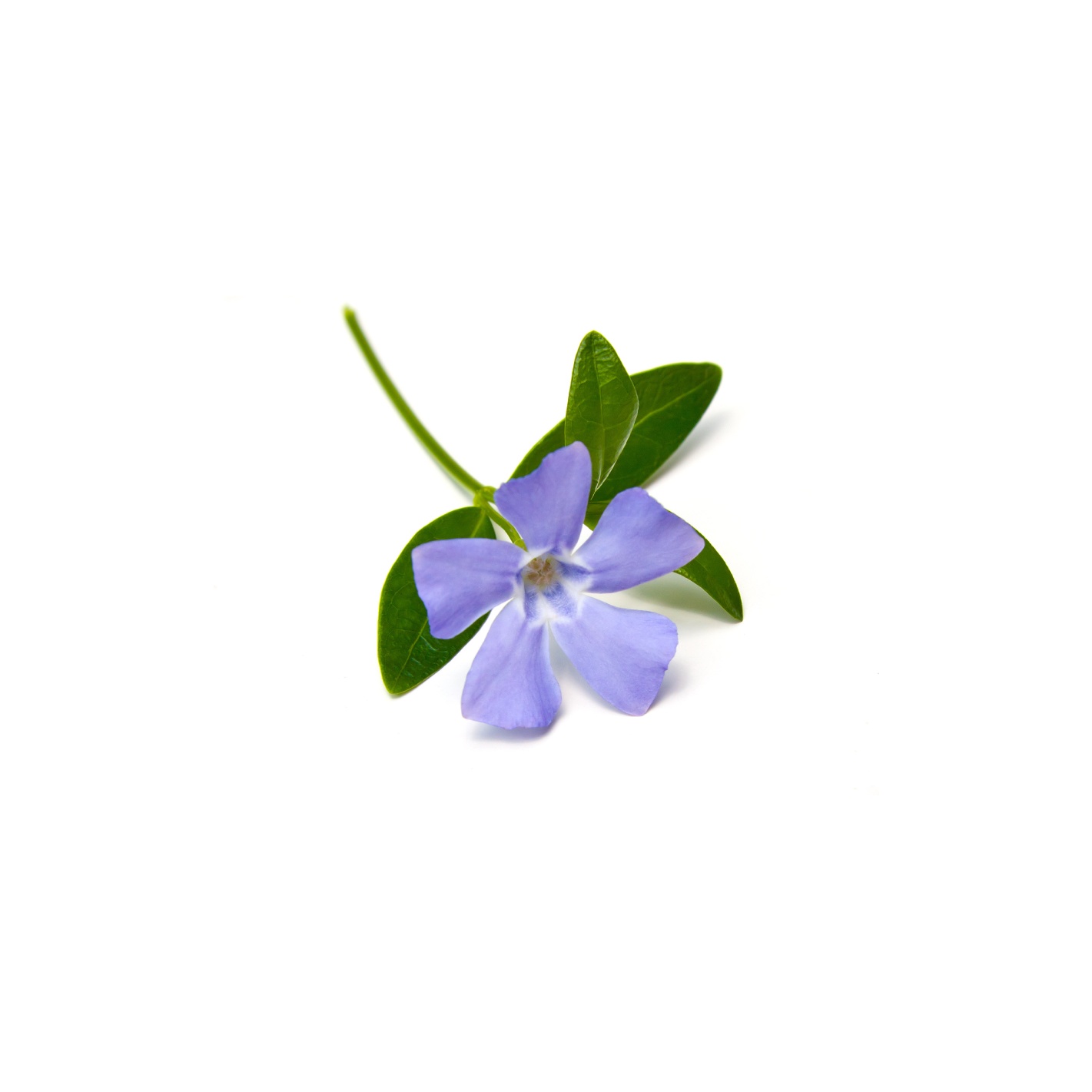
Majdine is a naturally occurring monoterpene indole alkaloid — spiro-oxindole of the heteroyohimbine (pyrano-indolizine) type, found in Greater periwinkle and 1 other source. Its toxicity is not yet characterized.
Concentration
Content by Source
Concentrations not reported. No percent-dry-weight or mg/g figures have been published for this compound in its source plants.
Majdine at a Glance
Majdine is a spiro-oxindole monoterpene indole alkaloid of the periwinkles — one of the minor alkaloids that sit behind vincamine in the Vinca chemical profile. It was reported from Vinca major by Yunusov’s Tashkent group in 1965 1Reference 1Investigation of the alkaloids of Vinca major, V. pubescens, and V. roseaView study →, and its structure was worked out over the following decade by that group and, independently, by Ognyanov’s Bulgarian group studying Vinca herbacea 2,
That gives majdine an unusual shape for a data-poor molecule: the chemistry is settled and the pharmacology is not. Three structure papers and a dedicated nuclear-Overhauser study fixed the skeleton, the stereochemistry and even the placement of the two aromatic methoxy groups 3,majdine OR isomajdine returns five records in total; Europe PMC returns nine, four of which mention it only in passing; ClinicalTrials.gov returns zero (all checked 31 July 2026).
The one paper that tested the isolated molecule ran antioxidant and DNA-fragmentation assays on majdine and its companion isomer isomajdine 10Reference 10Apoptotic, antioxidant and antiradical effects of majdine and isomajdine from Vinca herbacea Waldst. and KitView study →. Its published abstract lists the assay panel but not a single result, and the full text is paywalled — so even that study’s findings could not be verified. The absence is the finding. Nothing here should be read across from vincamine’s cerebral-circulation literature, and nothing at all should be read across from vincristine or vinblastine (see below).
Not a Vinca Chemotherapy Alkaloid
The phrase “Vinca alkaloid” in a clinical setting means vincristine and vinblastine — bisindole cytotoxic chemotherapy drugs. Majdine is none of that, and the distinction matters more here than usual because three unrelated plants share the common name periwinkle:
- Catharanthus roseus (Madagascar periwinkle) — a different genus, and the source of the bisindole cytotoxics vincristine and vinblastine. Majdine has no structural or pharmacological relationship to them.
- Vinca minor (lesser periwinkle) — the practical source of vincamine, the eburnane alkaloid behind the semi-synthetic nootropic vinpocetine.
- Vinca major and V. herbacea — where majdine actually lives.
Majdine is a single-indole (monomeric) oxindole, not a dimer, and belongs to the heteroyohimbine structural family rather than the eburnane one. It has never been screened for tubulin binding, cytotoxicity or any anticancer endpoint as an isolate.
Identity & Skeleton
Majdine is C23H28N2O6, molecular weight 428.5, CAS 20497-42-1 15Reference 15National Center for Biotechnology InformationView study →. Structurally it is a spiro-oxindole: an oxindole carbonyl ring spiro-fused to a pyrano[3,4-f]indolizine core carrying a methyl group and a methyl ester — the classic heteroyohimbine arrangement seen in the ajmalicine/reserpiline series, but in the spiro-oxindole rather than the plain indole form. Two methoxy groups sit on the oxindole’s benzo ring.
Where those methoxyls sit was the last open question, and it was settled deliberately: Yagudaev, Malikov and Yunusov published a dedicated study in 1973 using the intramolecular nuclear Overhauser effect to prove their position in both majdine and isomajdine 6Reference 6Proof of the position of the methoxy groups in the aromatic nucleus of majdine and isomajdine by means of the intramolecular nuclear Overhauser effectView study →. PubChem’s current record places them on adjacent aromatic carbons corresponding to biogenetic C-11/C-12 15Reference 15National Center for Biotechnology InformationView study → — which distinguishes majdine from carapanaubine, a 10,11-dimethoxy oxindole of the same molecular formula that also occurs in Vinca.
Majdine and isomajdine are treated as a pair throughout the literature, and should be here too. They share the same connectivity and differ in stereochemistry; the 1968 papers that settled majdine settled isomajdine in the same breath, with matching titles in Tetrahedron and Zeitschrift für Naturforschung 3,
One loose end: PubChem lists “Herboxine (Elegantissine)” among majdine’s synonyms 15Reference 15National Center for Biotechnology InformationView study → — implying that alkaloids named separately from V. herbacea and V. elegantissima were later shown identical to it. No primary paper establishing that identity could be located, and neither name returns a PubMed record, so the synonymy is noted rather than relied on.
What It's Used For
There is almost nothing to report, and what exists cannot be read.
There is no “Evidence by application” table here. A ranked support score requires more than one study and a readable result; majdine has neither. Presenting a bar for a single paper whose findings are inaccessible would manufacture confidence that does not exist.
1. Antioxidant & Radical Scavenging (In Vitro, Isolate)
The single application anyone has tested on the isolated molecule. Gülçin and colleagues put majdine and isomajdine, obtained from Vinca herbacea, through a standard antioxidant battery — ABTS•+ and DMPD•+ radical scavenging, Fe³⁺ and Cu²⁺ reducing ability, and Fe²⁺ chelation — alongside a DNA-fragmentation assay and a mitochondrial-activity assay on rat brain cortical tissue homogenates, with BHA, BHT, α-tocopherol and Trolox as reference antioxidants 10Reference 10Apoptotic, antioxidant and antiradical effects of majdine and isomajdine from Vinca herbacea Waldst. and KitView study →.
A later paper citing it summarises the outcome as free-radical scavenging plus cupric-reducing and ferrous-chelating ability 13Reference 13AnimalProtective effects of Vinca herbaceous extract against scopolamine-induced behavioral disturbances and brain oxidative stress in ratsView study → — but that is a secondary characterisation, not a figure read from the source.
Gap: the primary results are not retrievable. Without them there is no potency comparison against the reference standards, no concentration-response, no indication whether the DNA-fragmentation result was protective or damaging, and no basis for any claim beyond “this assay panel was run”. Chemical antioxidant assays also do not predict activity in a living system; nothing here has been shown in a cell line, an animal or a person.
Mechanisms
None characterised. No molecular target, receptor, enzyme or signalling pathway has been reported for majdine. No mechanism table is given because there is nothing to put in one.
The obvious temptation — reasoning from the skeleton — is not available either. Heteroyohimbine and oxindole alkaloids as a class cover α-adrenoceptor antagonists, calcium-channel modulators and sedatives with little consistency between close relatives, and majdine’s own regioisomers have not been profiled in a way that would let anything be inferred.
Pharmacokinetics
No data. Absorption, oral bioavailability, distribution, metabolism, half-life and active metabolites are all unstudied for majdine.
The nearest thing in the record is a 2011 method-development paper from the Tbilisi group describing an HPLC method for the metabolites of isomajdine 9Reference 9Development of the HPLC method to determine the metabolites of isomajdine isolated from Vinca herbacea Waldst. et Kit. growing in GeorgiaView study →. It is a chromatography method paper in a low-visibility, non-PubMed-indexed journal, it concerns the isomer rather than majdine itself, and no pharmacokinetic parameter has been published from it or anywhere else.
Clinical Trials
None, and none preclinical. Majdine has never entered a clinical trial in any indication, and ClinicalTrials.gov returns zero records for the compound name.
| Completed | Planned | Terminated | Preclinical |
|---|---|---|---|
| — | — | — | — |
Last checked: July 2026.
Isolate vs. Plant Studies
This is the sharpest divide on the page. Exactly one study has tested the isolated molecule 10Reference 10Apoptotic, antioxidant and antiradical effects of majdine and isomajdine from Vinca herbacea Waldst. and KitView study →, and its results are inaccessible. Every other pharmacological result associated with these plants belongs to an extract or a crude alkaloid fraction:
- A rat study of Vinca herbacea extract in the scopolamine model of cognitive impairment reported effects on learning, memory and brain oxidative-stress markers — for the extract, while naming majdine and isomajdine only as characteristic constituents assumed to contribute 13Reference 13AnimalProtective effects of Vinca herbaceous extract against scopolamine-induced behavioral disturbances and brain oxidative stress in ratsView study →.
- The Tbilisi/Georgian group’s work on V. herbacea rhizomes and roots reported accelerated recovery of granulocyte production in irradiated and drug-induced leucopenic mice — again for crude “substance I and II” fractions obtained by liquid–liquid extraction, in which majdine was one of five dominant alkaloids detected by TLC 14Reference 14Biologically active alkaloids from rhizomes with roots of Vinca herbacea Waldst. et Kit, growing in GeorgiaView study →.
- A four-species comparison of Vinca leaf extracts found species-dependent antioxidant, antibacterial and antitumour effects — and notably, V. major had the lowest antioxidant activity of the four, with V. herbacea the highest 12Reference 12The phytochemical analysis of Vinca L. species leaf extracts is correlated with the antioxidant, antibacterial, and antitumor effectsView study →.
That last point is a useful brake. Almost all of majdine’s antioxidant billing comes from V. herbacea, the species where the whole extract also scores highest — and it does not transfer to V. major, the species this database’s periwinkle monograph covers, whose extract performed worst on the same assays 12Reference 12The phytochemical analysis of Vinca L. species leaf extracts is correlated with the antioxidant, antibacterial, and antitumor effectsView study →. No result here has been shown for majdine as a contributor to any plant-level effect.
Prevalence in Nature
Majdine’s occurrence is confirmed but entirely unquantified.
In Vinca major. The 1965 Tashkent report that introduced the compound came out of a survey of the alkaloids of V. major, V. pubescens and V. rosea 1Reference 1Investigation of the alkaloids of Vinca major, V. pubescens, and V. roseaView study →. Independent confirmation in V. major came in 1982, when Balsevich, Constabel and Kurz isolated seven alkaloids from the leaves of Vinca major cv. Variegata — reserpinine, majdine, akuammicine, strictosidine lactam, pseudoakuammigine, akuammine and a tentatively assigned 10-hydroxycathofoline — and reported that the yellowish and green sections of the variegated leaf did not differ in alkaloid profile 7Reference 7Alkaloids of Vinca major cvView study →. That paper is the anchor for majdine’s presence on this database’s periwinkle page, alongside vincamajine, reserpinine, eburnamenine and 11-hydroxypolyneuridine.
In Vinca herbacea. This is where most of the work happened. Ognyanov’s Bulgarian group ran a long series on V. herbacea alkaloids through the 1960s, of which the majdine/isomajdine structure paper is part X 3Reference 3Alkaloids from Vinca herbacea W.KView study →. Majdine is treated as the plant’s marker alkaloid by the Georgian pharmacognosy group, who developed and validated a dedicated HPLC–DAD assay for it and applied it to individual plant parts collected in April and May 8Reference 8HPLC determination of majdine in Vinca herbaceaView study →, and who also detect it (transliterated “maidine”) among the dominant alkaloids of the rhizomes and roots 14Reference 14Biologically active alkaloids from rhizomes with roots of Vinca herbacea Waldst. et Kit, growing in GeorgiaView study →.
No concentration figures are given here. The only quantitative work — the 2011 HPLC assay — is paywalled and its measured values could not be retrieved 8Reference 8HPLC determination of majdine in Vinca herbaceaView study →; nothing at all has been published for V. major. That is why there is no “Content by Source” chart here. It is a retrieval gap rather than a true void, and it is logged as the highest-value item to chase.
Wider genus. The alkaloids of Vinca are compiled in a 2025 review covering the genus’s structural and biological literature, which places majdine and isomajdine among the V. herbacea oxindoles 11Reference 11ReviewAlkaloids from the genus Vinca L. (Apocynaceae): a comprehensive biological and structural reviewView study →.
Discovery & Synthesis
First reported (1965). Abdurakhimova, Yuldashev and Yunusov, at the Institute of the Chemistry of Plant Substances in Tashkent, published “Investigation of the alkaloids of Vinca major, V. pubescens, and V. rosea. The structure of majdine” in Khimiya Prirodnykh Soedinenii (Chemistry of Natural Compounds) 1Reference 1Investigation of the alkaloids of Vinca major, V. pubescens, and V. roseaView study →. The name evidently tracks the source species — major → majdine — though no source consulted states the etymology explicitly.
Structure (1967–1973). The same Tashkent group refined the structure across two further papers 2,
Total synthesis. None located. Searches of PubMed, Europe PMC and Crossref for majdine return no synthesis paper of any kind (checked July 2026); the eight Crossref records carrying the name are the isolation, structure, HPLC and bioassay papers cited here plus two encyclopaedia entries.
Manufacture today. None. Majdine is not produced commercially, not sold as a supplement or drug, and is obtained only by extraction from Vinca plant material in a research setting. The 2011 HPLC assay exists precisely because standardising V. herbacea extracts to majdine is a laboratory quality-control exercise, not a commercial supply chain 8Reference 8HPLC determination of majdine in Vinca herbaceaView study →.
Patents: not yet researched.
Toxicity & Safety
Majdine’s toxicity is not established, and the unknown grading here means exactly that — no toxicology, no genotoxicity assay, no repeat-dose study, no LD50, no reproductive or developmental data, and no human exposure data of any kind. There is nothing to grade.
Do not read safety from silence. A compound that has never been tested is unassessed, not benign. Majdine is an alkaloid from a plant with a genuine cardiovascular and cytotoxic pharmacology at the extract level, and that is a reason for caution about the unknown, not comfort.
Do not read the chemotherapy drugs’ toxicity onto it either. The severe neurotoxicity, myelosuppression and vesicant injury associated with vincristine and vinblastine belong to bisindole alkaloids from a different genus and have no bearing on this molecule. Importing them here would be as unfounded as importing benefits.
The real safety decisions for anyone considering the plant belong on the periwinkle monograph, where intake is actually decided — not on a molecule page with no exposure data.
- Toxicity genuinely unknown. No toxicology, genotoxicity, reproductive or human-exposure data exist for isolated majdine. Absence of reported harm is not evidence of safety.
- No interaction data. No CYP, P-glycoprotein or transporter work has been done, so drug-interaction potential is entirely uncharacterised.
- Do not transfer vincristine/vinblastine risks — or reassurance — to this molecule. Those are bisindole cytotoxics from Catharanthus roseus, a different genus and a different chemical class.
- Structurally well characterised. Unlike many orphan alkaloids, majdine has a settled structure, stereochemistry and CAS number — so if it is ever studied properly, there is a defined molecule to study.
Dosage
There is no dose, and no basis for one. Majdine has never been administered to an animal or a person in any published study, has no bioavailability, half-life or exposure data, and is not sold in any form. No study anywhere reports a quantity of it taken by anyone.
The one place a majdine figure exists at all is as a plant-material assay target — the amount present in Vinca herbacea tissue, measured for quality-control purposes 8Reference 8HPLC determination of majdine in Vinca herbaceaView study →. That is a content measurement, not a dose, and the values could not be retrieved in any case. Nothing here is dosing guidance.
References
- Abdurakhimova N, Yuldashev PKh, Yunusov SYu (1965). Investigation of the alkaloids of Vinca major, V. pubescens, and V. rosea. The structure of majdine. Chemistry of Natural Compounds 1(3):172–173. https://doi.org/10.1007/BF00568358
- Abdurakhimova N, Yuldashev PKh, Yunusov SYu (1967). The structure of majdine, pseudokopsinine, and vinervinine. Chemistry of Natural Compounds 3(5):263–266. https://doi.org/10.1007/BF00574630
- Ognyanov I, Pyuskyulev B, Kompiš I, Sticzay T, Spiteller G, Shamma M, Shine RJ (1968). Alkaloids from Vinca herbacea W.K. X. The structures and stereochemistry of majdine and isomajdine. Tetrahedron 24(13):4641–4648. https://pubmed.ncbi.nlm.nih.gov/5657073/
- Ognyanov I, Pyuskyulev B, Kompiš I, Sticzay T, Spiteller G, Shamma M, Shine RJ (1968). The structures and stereochemistry of majdine and isomaydine. Zeitschrift für Naturforschung B 23(2):282–283. https://pubmed.ncbi.nlm.nih.gov/4385987/
- Yagudaev MR, Abdurakhimova N, Yunusov SYu (1968). The structure of majdine. Chemistry of Natural Compounds 4(3):170–171. https://doi.org/10.1007/BF00565763
- Yagudaev MR, Malikov VM, Yunusov SYu (1973). Proof of the position of the methoxy groups in the aromatic nucleus of majdine and isomajdine by means of the intramolecular nuclear Overhauser effect. Chemistry of Natural Compounds 9(1):62–63. https://doi.org/10.1007/BF00580894
- Balsevich J, Constabel F, Kurz WGW (1982). Alkaloids of Vinca major cv. Variegata. Planta Medica 44(2):91–93. https://pubmed.ncbi.nlm.nih.gov/17402086/
- Gagua N, Baghdikian B, Mabrouki F, Elias R, Vachnadze V, Bakuridze A, Ollivier E (2011). HPLC determination of majdine in Vinca herbacea. Natural Product Communications 6(12):1831–1834. https://pubmed.ncbi.nlm.nih.gov/22312718/
- Gagua N, Vachnadze V, Aubert C, Bakuridze A (2011). Development of the HPLC method to determine the metabolites of isomajdine isolated from Vinca herbacea Waldst. et Kit. growing in Georgia. Journal of Natural Pharmaceuticals 2(3):163. https://doi.org/10.4103/2229-5119.86269
- Gülçin İ, Beydemir Ş, Topal F, Gagua N, Bakuridze A, Bayram R, Gepdiremen A (2012). Apoptotic, antioxidant and antiradical effects of majdine and isomajdine from Vinca herbacea Waldst. and Kit. Journal of Enzyme Inhibition and Medicinal Chemistry 27(4):587–594. https://pubmed.ncbi.nlm.nih.gov/21883037/
- Vrabec R, Drašar P, Opletal L, Kosturko Š, Blunden G, Cahlíková L (2025). Alkaloids from the genus Vinca L. (Apocynaceae): a comprehensive biological and structural review. Phytochemistry Reviews 24:3665–3735. https://doi.org/10.1007/s11101-025-10102-z
- Ciorîță A, Zăgrean-Tuza C, Moț AC, Carpa R, Pârvu M (2021). The phytochemical analysis of Vinca L. species leaf extracts is correlated with the antioxidant, antibacterial, and antitumor effects. Molecules 26(10):3040. https://pubmed.ncbi.nlm.nih.gov/34069720/
- Hosseini MJ, Mahmoodi N, Eskandari J, Bijani S, Yazdinezhad AR, Anoush M (2022). Protective effects of Vinca herbaceous extract against scopolamine-induced behavioral disturbances and brain oxidative stress in rats. Heliyon 8(4):e09295. https://pubmed.ncbi.nlm.nih.gov/35520614/
- Vachnadze V, Vachnadze N, Gogitidze N, Mushkiashvili N, Mchedlidze K (2017). Biologically active alkaloids from rhizomes with roots of Vinca herbacea Waldst. et Kit, growing in Georgia. Georgian Medical News (271):122–127. https://pubmed.ncbi.nlm.nih.gov/29099714/
- PubChem CID 21627963 — Majdine (CAS 20497-42-1). National Center for Biotechnology Information. https://pubchem.ncbi.nlm.nih.gov/compound/21627963



