
Compound Monograph
Phenethylamine
Phenethylamine (2-phenylethylamine, PEA) is an endogenous trace amine and TAAR1 agonist with real CNS pharmacology — and the molecule behind the myth that chocolate is a love drug. Dietary PEA is almost entirely destroyed by monoamine oxidase before it reaches the brain, so a systemic effect from the amount in cocoa is very unlikely.

Sources · 6
Where Does It Come From?
Phenethylamine is a naturally occurring (and made in the body) phenethylamine (trace amine / protoalkaloid), found in Cacao and 5 other sources. It is flagged as moderately toxic.
Concentration
Content by Source
Reported concentrations across the plants that contain phenethylamine — the bar marks the typical level, the line shows the reported range.
Literature figures for varying plant parts and preparations. Read them as a comparative guide, not exact assays.
Phenethylamine at a Glance
Phenethylamine — 2-phenylethylamine, usually shortened to PEA — is the simplest aromatic amine in the biogenic-amine family and one of a handful of compounds classed as trace amines: molecules the mammalian nervous system makes in tiny amounts, structurally close to dopamine and noradrenaline, long treated as metabolic by-products 1Reference 1Mammalian central nervous system trace aminesView study →. That view changed in 2001, when a family of trace amine-associated receptors (TAARs) was cloned and PEA turned out to be one of their most potent endogenous ligands 2,
So the pharmacology is real. The problem is getting the molecule anywhere near a receptor. PEA is the preferred substrate of monoamine oxidase B, and it is degraded so fast that its measured half-life in rat brain is under four minutes 7,
It doesn’t. Finished dark chocolate carries 0–1.1 mg/kg of PEA 16Reference 16ReviewThe health impact of cocoa from cultivation to the formation of biogenic amines: an updated reviewView study → — a few hundredths of a milligram in a bar — and what little survives digestion meets an enzyme built to destroy it. The best experimental test of the idea gave chocolate cravers the full pharmacological content of cocoa in capsules and found no effect at all 11Reference 11Pharmacological versus sensory factors in the satiation of chocolate cravingView study →. Phenethylamine is a genuinely interesting endogenous neuromodulator. It is not what chocolate does to you.
The “Chocolate Is a Love Drug” Claim, Examined
The claim runs like this: PEA is “the love molecule,” released in the brain during infatuation; chocolate contains PEA; therefore chocolate reproduces the feeling. Every link in that chain is either weak or broken.
The amount is trivial. Across the published surveys, dark chocolate contains 0–1.1 mg/kg of PEA, milk and white chocolate essentially none, and cocoa-based products up to ~2 mg/kg; only unprocessed cocoa mass reaches ~10–72 mg/kg 16Reference 16ReviewThe health impact of cocoa from cultivation to the formation of biogenic amines: an updated reviewView study →. In one careful ion-chromatographic study of real chocolate samples, PEA was not detectable at all above a 3 mg/kg limit — only dopamine, histamine and serotonin were found 15Reference 15Determination of biogenic amines in chocolate by ion chromatographic separation and pulsed integrated amperometric detectionView study →. A 50 g bar of dark chocolate therefore delivers on the order of 0.05 mg. The only human protocol that ever produced an antidepressant response used 10–60 mg/day, and needed a monoamine-oxidase-B inhibitor alongside it to work at all 22Reference 22Sustained antidepressant effect of PEA replacementView study →.
The route destroys it. Dietary amines are metabolised in the intestinal wall and liver before reaching the systemic circulation, which is why oral doses of pressor amines are far less active than injected ones 10Reference 10The effect of monoamine oxidase inhibitors on ‘first-pass’ metabolism of tyramine in dog intestineView study →. PEA is specifically a MAO-B substrate 7Reference 7Phenethylamine is a substrate of monoamine oxidase B in the paraventricular thalamic nucleusView study →, and the enzyme that clears it is present in gut, liver, platelets and brain.
The direct experiment was negative. Michener and Rozin gave chocolate cravers, at the moment of craving, either a chocolate bar, a caloric-equivalent white chocolate (no cocoa pharmacology), cocoa capsules containing the pharmacological components, placebo, or nothing. White chocolate partially satisfied the craving; adding all the pharmacological factors of cocoa changed nothing 11Reference 11Pharmacological versus sensory factors in the satiation of chocolate cravingView study →. The satisfying part of chocolate is aroma, fat, sugar and texture — not its amines. Reviews of the chocolate-craving literature reach the same conclusion: the hedonic/sensory properties dominate, with hormonal and psychological factors layered on top 12Reference 12Chocolate: food or drug? Journal of the American Dietetic Association. https://pubmed.ncbi.nlm.nih.gov/10524390/View study →.
The parallel migraine claim fell too. PEA in chocolate was for decades blamed for migraine; it was already being “re-examined” in Nature in 1975 14Reference 14Chocolate, beta-phenethylamine and migraine re-examinedView study →, and a systematic review of oral-challenge studies found that the one methodologically conclusive trial showed no relation between the amount of phenethylamine in chocolate and headache attacks 13Reference 13ReviewIntolerance to dietary biogenic amines: a reviewView study →.
What is left is a molecule that is genuinely psychoactive at pharmacological doses in animals, present in chocolate at a dose four orders of magnitude below that, delivered by the one route that eliminates it. The romance is folklore.
Trace Amines & TAAR1
Phenethylamine is one of a small set of endogenous trace amines — with p-tyramine, m-tyramine, octopamine and tryptamine — present in mammalian brain at concentrations perhaps a hundredth to a thousandth those of dopamine or serotonin 1Reference 1Mammalian central nervous system trace aminesView study →. It is formed by decarboxylation of the amino acid phenylalanine by aromatic L-amino acid decarboxylase, and cleared almost entirely by monoamine oxidase B to phenylacetic acid, its principal metabolite 1,
For decades this looked like a dead end: pronounced pharmacological effects, tight statistical links to depression and schizophrenia, but no receptor 5Reference 5A renaissance in trace amines inspired by a novel GPCR familyView study →. The 2001 cloning of the trace amine-associated receptor family resolved it. Borowsky and colleagues identified 15 GPCRs forming a subfamily related to but distinct from the classical biogenic-amine receptors, two of which are bound and activated by trace amines 2Reference 2Trace amines: identification of a family of mammalian G protein-coupled receptorsView study →; in parallel, Bunzow’s group showed that β-phenethylamine, p-tyramine, tryptamine and octopamine all stimulate cAMP production at rat trace amine receptor 1 — and, strikingly, so do amphetamine and MDMA 3Reference 3AnimalAmphetamine, 3,4-methylenedioxymethamphetamine, lysergic acid diethylamide, and metabolites of the catecholamine neurotransmitters are agonists of a rat trace amine receptorView study →.
TAAR1 is now understood as a Gs-coupled, largely intracellular receptor that raises cAMP, modulates PKA/PKC signalling and engages β-arrestin2-dependent pathways, and that sits in a position to directly restrain dopamine and serotonin neuronal firing and release 4Reference 4Trace amines and the trace amine-associated receptor 1: pharmacology, neurochemistry, and clinical implicationsView study →. Berry’s synthesis of the physiological data argues the trace amines are best read as endogenous neuromodulators — altering neuronal sensitivity to the classical monoamines rather than acting as transmitters in their own right — and makes the crucial quantitative point that the amphetamine-like responses PEA produces occur “only at concentrations multiple orders of magnitude above normal physiological levels” 1Reference 1Mammalian central nervous system trace aminesView study →.
The system’s legitimacy is no longer in doubt: ulotaront, a TAAR1/5-HT1A agonist, completed phase 2 trials in schizophrenia with a significant improvement in PANSS total score and received FDA Breakthrough Therapy Designation 28Reference 28ReviewUlotaront: review of preliminary evidence for the efficacy and safety of a TAAR1 agonist in schizophreniaView study →. That is a drug developed against PEA’s receptor — not evidence that eating PEA does anything.
Phenethylamine the Molecule vs. Phenethylamine the Backbone
One word is doing two jobs, and conflating them is the second-most-common error about this compound.
- Phenethylamine, the molecule — the specific endogenous trace amine described here, C₈H₁₁N, a benzene ring joined to an ethylamine chain.
- Phenethylamine, the structural class — every compound built on that same two-carbon-plus-amine scaffold. That family includes the endogenous catecholamines (dopamine, noradrenaline, adrenaline), the plant protoalkaloids tyramine, hordenine, N-methylphenethylamine and N,N-dimethylphenethylamine, the psychedelic mescaline, and the amphetamines and cathinones 3,
6Reference 3AnimalAmphetamine, 3,4-methylenedioxymethamphetamine, lysergic acid diethylamide, and metabolites of the catecholamine neurotransmitters are agonists of a rat trace amine receptorView study →Reference 6The vascular effects of trace amines and amphetaminesView study → .
Sharing a backbone is not sharing an effect. A methyl group here, a methoxy there, or an α-methyl on the side chain changes MAO susceptibility, receptor selectivity and duration of action completely — which is exactly why amphetamine (α-methylated, MAO-resistant, orally active for hours) behaves nothing like PEA (unsubstituted, MAO-B’s preferred substrate, gone in minutes). Descriptions of PEA as “endogenous amphetamine” are a statement about chemical shape, not about what happens when you eat it. This page is about the parent amine; the psychedelic and stimulant members of the class have their own pages.
What It's Used For
PEA’s pharmacology is unusually well-characterised at the receptor and enzyme level and unusually thin at the outcome level. Almost every behavioural finding comes from injected rodents at milligram-per-kilogram doses, and the only human efficacy signal required a MAO-B inhibitor to exist at all.
Support is an experimental score — weighted by study type (human > animal > in vitro) and volume. A beta, not a validated metric. Note that the top-ranked row is a physiological role, not a therapeutic use, and that the lowest row scores low because it was tested and contradicted, not merely unstudied.
The best-founded thing PEA does, and it is physiology rather than a therapeutic application. This is the endogenous molecule, not a plant isolate: PEA is one of the ligands that led to the discovery of the trace amine-associated receptor family 2Reference 2Trace amines: identification of a family of mammalian G protein-coupled receptorsView study →, and it stimulates cAMP production at rat TAAR1 alongside p-tyramine, tryptamine and octopamine 3Reference 3AnimalAmphetamine, 3,4-methylenedioxymethamphetamine, lysergic acid diethylamide, and metabolites of the catecholamine neurotransmitters are agonists of a rat trace amine receptorView study →.
TAAR1 signals through cAMP/PKA/PKC and β-arrestin2 pathways and is positioned to exert direct control over dopamine and serotonin neuronal firing and release 4Reference 4Trace amines and the trace amine-associated receptor 1: pharmacology, neurochemistry, and clinical implicationsView study →.
Berry’s review of physiologically-relevant-concentration studies concludes the trace amines act as neuromodulators that alter neuronal sensitivity to the classical monoamines, with amphetamine-like responses appearing only at concentrations orders of magnitude above physiological 1Reference 1Mammalian central nervous system trace aminesView study →.
Knockout work confirms the housekeeping: in Maob-null mice, PEA is the only one of five candidate substrates markedly elevated in the paraventricular thalamic nucleus 7Reference 7Phenethylamine is a substrate of monoamine oxidase B in the paraventricular thalamic nucleusView study →.
Rodent microdialysis adds a dopaminergic fingerprint — locally applied PEA decreases striatal acetylcholine release through a dopamine D2 mechanism, while systemic PEA at 25–50 mg/kg raises it 27Reference 27AnimalBeta-phenylethylamine modulates acetylcholine release in the rat striatum: involvement of a dopamine D2 receptor mechanismView study →.
Gap: the receptor pharmacology is largely rat TAAR1 in transfected cells, the behavioural work is injected rodents at mg/kg doses, and none of it establishes a role for ingested PEA — the endogenous pool is made in situ and destroyed locally 1,
The application with the clearest safety relevance. Trace amines including β-PEA are vasoactive: on the vascular system they cause vasoconstriction and a rise in blood pressure, an effect long attributed to indirect noradrenaline release from sympathetic neurones but now understood to include direct action at TAARs expressed in blood vessels 6Reference 6The vascular effects of trace amines and amphetaminesView study →.
This is the isolated molecule, and it is also the pharmacological basis on which dietary amines matter clinically — the MAOI diet literature treats PEA as one of the pressor amines to be counted alongside tyramine, since inhibiting monoamine oxidase removes the enzyme barrier that normally destroys them 20,
Gap: the quantitative human dose-response is worked out for tyramine, not PEA — there is no established milligram threshold for a PEA pressor response in people, and the older MAOI amine tables are themselves acknowledged to be imprecise 20,
The only human efficacy signal on record, and it is instructive precisely because of what it required. Sabelli’s group reported that oral PEA at 10–60 mg/day, given with 10 mg/day selegiline “to prevent rapid PEA destruction,” relieved depression, and that in 14 responders re-examined 20–50 weeks later the effect had been maintained in 12, with no change in effective dose and no apparent side effects 22Reference 22Sustained antidepressant effect of PEA replacementView study →.
An earlier report framed the same finding as PEA relieving depression after selective MAO-B inhibition 23Reference 23Phenylethylamine relieves depression after selective MAO-B inhibitionView study →.
Read carefully, this is not evidence that PEA is orally active — it is evidence that PEA is orally inactive unless the enzyme that destroys it is blocked first.
Gap: small, open-label, uncontrolled, from a single group, with an active MAO-B inhibitor co-administered — selegiline is itself an established antidepressant, so the design cannot separate PEA’s contribution from the inhibitor’s. No randomised controlled trial of PEA has been published 22,
A widely repeated claim resting on one small pilot. Szabo and colleagues had 20 healthy men provide 24-hour urine on two consecutive days — sedentary, then after 30 minutes of treadmill running at 70% of maximal heart-rate reserve — and found mean urinary phenylacetic acid rose 77% after exercise. Because phenylacetic acid is PEA’s MAO metabolite, the authors proposed PEA as a possible link to exercise’s antidepressant effect 24Reference 24Phenylethylamine, a possible link to the antidepressant effects of exercise? British Journal of Sports Medicine. https://pubmed.ncbi.nlm.nih.gov/11579070/View study →.
Gap: the inference depends on urinary phenylacetic acid tracking PEA, and that assumption is directly contested — Karoum’s isotope and inhibitor studies concluded that urinary phenylacetic acid derives primarily from phenylalanine transamination or from pathways not involving monoamine oxidase, and that measuring urinary PAA “is not expected to be useful in assessing phenylethylamine abnormalities” 25Reference 25Phenylacetic acid excretion in schizophrenia and depression: the origins of PAA in manView study →. Twenty subjects, one exercise bout, a surrogate of a surrogate, and no mood outcome measured.
The famous application, and the one that has actually been falsified rather than merely under-studied. This is whole-food PEA, not an isolate. Content first: dark chocolate 0–1.1 mg/kg, milk and white chocolate effectively zero, cocoa-based products up to ~2 mg/kg, with only unprocessed cocoa mass reaching 9.6–71.7 mg/kg 16Reference 16ReviewThe health impact of cocoa from cultivation to the formation of biogenic amines: an updated reviewView study →; in one real-sample chromatographic survey PEA was below a 3 mg/kg detection limit entirely 15Reference 15Determination of biogenic amines in chocolate by ion chromatographic separation and pulsed integrated amperometric detectionView study →.
Then the experiment: giving chocolate cravers cocoa capsules containing all the pharmacological components of chocolate produced no craving satisfaction, whereas caloric/sensory white chocolate did 11Reference 11Pharmacological versus sensory factors in the satiation of chocolate cravingView study → — a result reviews of chocolate craving have absorbed as the sensory-dominance conclusion 12Reference 12Chocolate: food or drug? Journal of the American Dietetic Association. https://pubmed.ncbi.nlm.nih.gov/10524390/View study →.
And the associated migraine claim, re-examined as early as 1975 14Reference 14Chocolate, beta-phenethylamine and migraine re-examinedView study →, failed its only methodologically conclusive oral-challenge test 13Reference 13ReviewIntolerance to dietary biogenic amines: a reviewView study →.
Gap: none needed on the negative side — the honest summary is that the effect was looked for and not found. What remains unstudied is whether the amines in genuinely high-PEA foods (fermented soy pastes, aged sausage) do anything measurable in people not on an MAOI; that is an open question, not a chocolate one 17Reference 17ReviewA review of biogenic amines in fermented foods: occurrence and health effectsView study →.
Mechanisms
| Target / pathway | Effect | Relevant to |
|---|---|---|
| Trace amine-associated receptor 1 (TAAR1) | Gs-coupled agonism → ↑ cAMP, PKA/PKC signalling, β-arrestin2 pathways; restrains dopamine/serotonin neuronal firing and release | endogenous neuromodulation; the whole trace-amine field |
| Monoamine oxidase B (MAO-B) | substrate, not inhibitor — PEA is MAO-B’s preferred substrate and is oxidised to phenylacetic acid | pharmacokinetics; the bioavailability ceiling on every other effect |
| Aromatic L-amino acid decarboxylase (AADC) | decarboxylates phenylalanine → PEA; the biosynthetic step | endogenous synthesis |
| Monoamine transporters / vesicular stores | amphetamine-like transmitter efflux and reuptake interference — but only at supraphysiological concentrations | why “endogenous amphetamine” overstates it |
| Dopamine D2 receptor (indirect) | locally applied PEA lowers striatal acetylcholine release via a D2 mechanism; systemic PEA raises it | rodent neurochemistry |
| Vascular TAARs + sympathetic noradrenaline release | vasoconstriction and rise in blood pressure | pressor effect; the MAOI interaction |
| Gut-wall and hepatic monoamine oxidase | first-pass destruction of ingested amine | why dietary PEA is inert and why MAOIs change that |
The load-bearing row is the second one. PEA is not a molecule that acts on MAO — it is a molecule that MAO acts on, faster than almost anything else, and that single asymmetry is why an unquestionably active compound has no dietary effect.
Pharmacokinetics
This section is not an appendix for phenethylamine — it is the page.
Absorption and first pass. Ingested PEA must cross the intestinal wall and pass the liver, both rich in monoamine oxidase. The general principle is established for this class: oral doses of dietary pressor amines are dramatically less active than parenteral ones because of intestinal first-pass metabolism by monoamine oxidase, and inhibiting that enzyme is what abolishes the difference 10Reference 10The effect of monoamine oxidase inhibitors on ‘first-pass’ metabolism of tyramine in dog intestineView study →. Human intestinal mucosa contains predominantly the A form of the enzyme 9Reference 9Deprenyl administration in man: a selective monoamine oxidase B inhibitor without the ‘cheese effect’View study → — relevant because it means gut MAO-A provides a second barrier beyond the MAO-B that PEA prefers. No absolute oral bioavailability figure for PEA in humans is established; the honest statement is that it is low and has never been formally measured.
Distribution. PEA is small and lipophilic enough to cross the blood-brain barrier — in Maob knockout mice, brain PEA accumulation tracked the rise in plasma PEA, and brain-specific knockouts showed a smaller increase than global ones, indicating peripheral PEA contributes to the central pool 7Reference 7Phenethylamine is a substrate of monoamine oxidase B in the paraventricular thalamic nucleusView study →. So the molecule does get into the brain when it is present in plasma; the difficulty is ever getting it into plasma.
Metabolism and half-life. PEA is oxidatively deaminated by monoamine oxidase B, its preferred and near-exclusive route, to phenylacetic acid 1,
Active metabolite? Phenylacetic acid is not usefully treated as an active metabolite. It is also not a reliable marker of PEA turnover: urinary PAA appears to derive primarily from phenylalanine transamination or from pathways not involving monoamine oxidase, which undercuts a whole literature that used urinary PAA as a PEA proxy 25Reference 25Phenylacetic acid excretion in schizophrenia and depression: the origins of PAA in manView study →.
The practical consequence. Two human observations bracket the picture. Under selective MAO-B inhibition, oral PEA challenge “in amounts greater than those known to be present in a normal diet” produced no adverse reaction in treated subjects 9Reference 9Deprenyl administration in man: a selective monoamine oxidase B inhibitor without the ‘cheese effect’View study → — dietary-scale PEA is undramatic even with MAO-B blocked. And in the one protocol where oral PEA appeared to do something clinically, selegiline had to be given with it, explicitly to prevent rapid PEA destruction 22Reference 22Sustained antidepressant effect of PEA replacementView study →. Both point the same way: without enzyme inhibition, oral PEA is a molecule that is gone before it arrives.
Food-matrix caveat. In-vitro digestion of 70% cocoa dark chocolate found the bioactive amines it contains to be highly bioaccessible, with several rising several-fold across gastrointestinal digestion 18Reference 18In vitroIn vitro bioaccessibility of amino acids and bioactive amines in 70% cocoa dark chocolate: what you eat and what you getView study →. Bioaccessibility (released from the matrix) is not bioavailability (reaching the circulation intact) — the MAO barrier sits downstream of release.
Clinical Trials
There are no randomised controlled trials of phenethylamine for any indication. The human record consists of: a small open-label depression series using PEA 10–60 mg/day plus selegiline, with 20–50-week follow-up in 14 responders 22,
| Completed | Planned | Terminated | Preclinical |
|---|---|---|---|
| None for the isolate as a registered trial; small open-label + challenge studies only | — | — | Extensive: TAAR1 pharmacology, MAO-B knockout, rodent neurochemistry & vascular work |
Last checked: July 2026.
Isolate vs. Plant Studies
This molecule inverts the usual framing twice over.
First, most of the “isolate” evidence is not about a plant compound at all — it is about an endogenous human/rodent metabolite studied in transfected cells, knockout mice and injected animals 2,
Second, the plant-material evidence is the strongest evidence against an effect. Where the whole food has been tested — cocoa capsules against chocolate craving 11Reference 11Pharmacological versus sensory factors in the satiation of chocolate cravingView study →, chocolate against headache in migraineurs 13Reference 13ReviewIntolerance to dietary biogenic amines: a reviewView study → — the results were null. That is an unusually clean situation: normally a compound page has to caution that in-vitro isolate findings may not survive the food matrix; here the food-matrix experiments have already been run and reported negative.
The one place isolate and food converge is safety: the isolated amine is a pressor 6Reference 6The vascular effects of trace amines and amphetaminesView study →, and it is the food content of pressor amines that matters to someone on a monoamine-oxidase inhibitor 20,
Prevalence in Nature
Phenethylamine occurs as a trace nitrogenous constituent rather than a bulk phytochemical. Its natural occurrence has two quite different origins: it is present at low levels in some plant tissues as a decarboxylation product of phenylalanine, and it is generated by microbial decarboxylase activity during fermentation, which is where the highest food concentrations by far are found 17Reference 17ReviewA review of biogenic amines in fermented foods: occurrence and health effectsView study →.
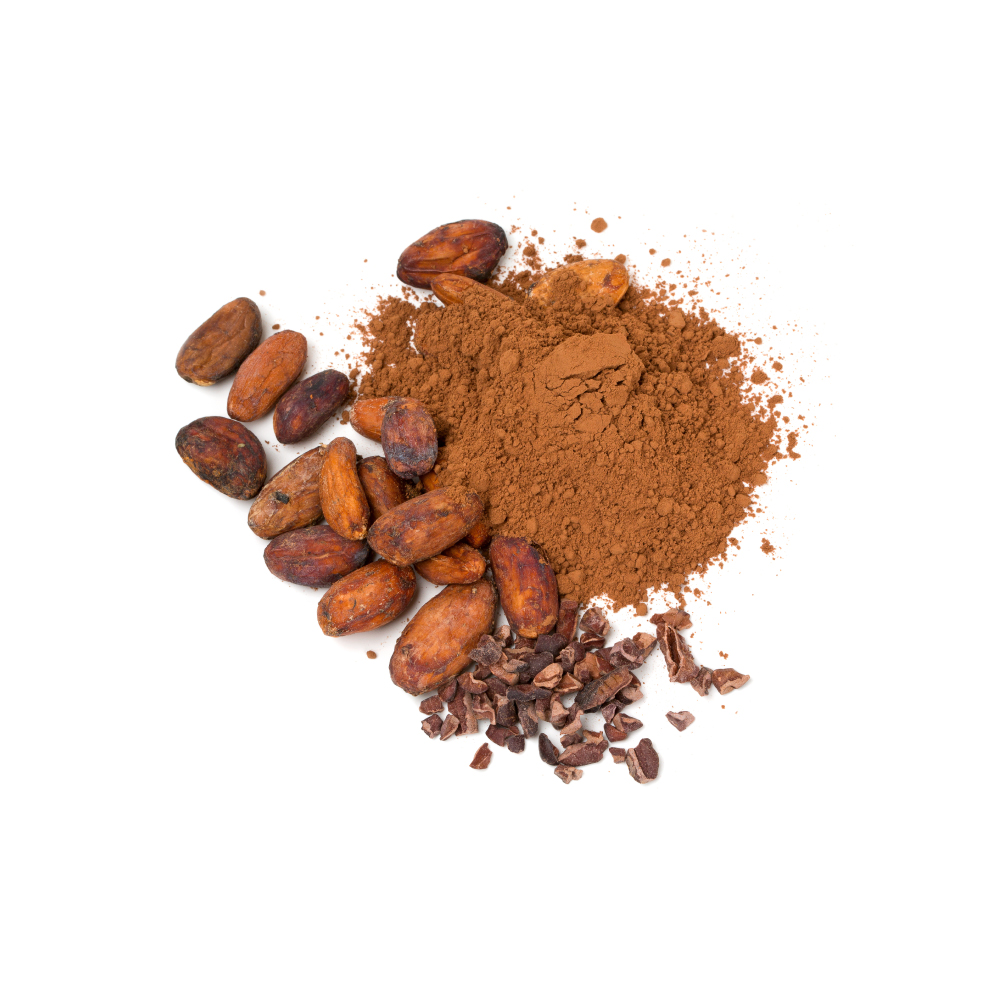
In cacao. Cacao is the source that made the molecule famous, and it is not a rich one. Reported figures span grated cocoa mass at 9.6–71.7 mg/kg, roasted cocoa beans at roughly 6–26 mg/kg, fermented-and-roasted beans down at 0–2.1 mg/kg, and finished products far lower: cocoa-based products 0–2.0 mg/kg, dark chocolate 0–1.1 mg/kg, and milk and white chocolate effectively zero 16Reference 16ReviewThe health impact of cocoa from cultivation to the formation of biogenic amines: an updated reviewView study →. Processing matters in both directions — PEA accumulates during fermentation and roasted beans carry more than raw 16Reference 16ReviewThe health impact of cocoa from cultivation to the formation of biogenic amines: an updated reviewView study → — while alkalisation (“dutching”) reduces the potentially mood-active phytochemical fraction of cocoa powder overall 19Reference 19The effect of cocoa alkalization on the non-volatile and volatile mood-enhancing compoundsView study →. In some analytical surveys of real chocolate, PEA simply falls below the detection limit 15Reference 15Determination of biogenic amines in chocolate by ion chromatographic separation and pulsed integrated amperometric detectionView study →. It sits alongside theobromine, caffeine and the flavanols epicatechin and catechin as a genuine but quantitatively negligible cacao constituent.
In fermented foods. This is where PEA is actually abundant. Reported levels include:
| Food | Reported phenethylamine |
|---|---|
| Fermented soybean paste (doenjang) | up to ~8,700 mg/kg |
| Douchi (fermented black soybean) | ~737 mg/kg |
| Cheonggukjang | ~562 mg/kg |
| Salami | ~376 mg/kg |
| Sufu | ~239 mg/kg |
| Doubanjiang | ~186 mg/kg |
| Fermented fish paste | ~152 mg/kg |
| Soy sauce | ~122 mg/kg |
| Mish cheese | ~120 mg/kg |
| Dried sausage | ~109 mg/kg |
| Blue cheese | ~60 mg/kg |
| Natto | ~52 mg/kg |
| Miso | ~42 mg/kg |
| Kimchi | ~24 mg/kg |
Figures are the reported values compiled in a review of biogenic amines in fermented foods, which also notes a suggested toxic threshold of 30 mg/kg for phenethylamine in food and that levels vary enormously with the fermenting microflora 17Reference 17ReviewA review of biogenic amines in fermented foods: occurrence and health effectsView study →. The comparison worth holding onto: a fermented soybean paste can carry thousands of times the PEA of dark chocolate.
In plants beyond cacao. Phenethylamines as a class are widely distributed in plants — the trace-amine literature notes their occurrence in the diet and in herbal plants generally 6Reference 6The vascular effects of trace amines and amphetaminesView study → — and chemical analysis has unequivocally demonstrated phenethylamines (alongside tryptamines, β-carbolines and histamines) in Australian Acacia species, while comparable records for the southern African Vachellia/Senegalia genera were not found in reliable published data and remain a rumour needing exploratory work 26Reference 26Rumors of psychedelics, psychotropics and related derivatives in Vachellia and Senegalia in contrast with verified records in Australian AcaciaView study →. Most plant occurrences of the parent amine are reported as minor bases accompanying the better-characterised protoalkaloids tyramine, hordenine and N-methylphenethylamine.
In animals, including us. PEA is an ordinary endogenous constituent of the mammalian nervous system and body fluids 1,
Discovery & Synthesis
Phenethylamine is a structurally trivial molecule — benzene plus an ethylamine — and its first preparation is not well documented in the indexed biomedical literature; it was a known laboratory amine well before its biology was of interest. The scientifically meaningful milestones are later. Its presence in the mammalian central nervous system, along with the other trace amines, had been established for several decades before the modern era of interest 1Reference 1Mammalian central nervous system trace aminesView study →, during which time it was largely dismissed as a metabolic by-product with “pronounced pharmacological effects” but no identifiable receptor 5Reference 5A renaissance in trace amines inspired by a novel GPCR familyView study →. That impasse ended in 2001, when two groups independently reported a novel GPCR family responsive to trace amines: Borowsky and colleagues cloned 15 receptors from human and rodent tissue and showed two were activated by trace amines 2Reference 2Trace amines: identification of a family of mammalian G protein-coupled receptorsView study →, while Bunzow’s group characterised rat trace amine receptor 1 and demonstrated that β-phenethylamine, p-tyramine, tryptamine and octopamine — plus amphetamine, MDMA and LSD — are agonists at it 3Reference 3AnimalAmphetamine, 3,4-methylenedioxymethamphetamine, lysergic acid diethylamide, and metabolites of the catecholamine neurotransmitters are agonists of a rat trace amine receptorView study →. The field’s own summary called the result a “renaissance in trace amines” 5Reference 5A renaissance in trace amines inspired by a novel GPCR familyView study →.
Manufacture today is by chemical synthesis, not extraction — PEA is a bulk fine chemical and a standard synthetic intermediate, and no plant or food source is remotely economical as a supply. It is not obtained from cocoa.
Patents: not yet researched.
Toxicity & Safety
Phenethylamine carries a moderate flag. Not because ordinary dietary exposure is dangerous — it is not, and it is also barely bioavailable — but because the isolated amine is a pressor, and because there is a specific, serious, well-documented pharmacological context in which the enzyme barrier that makes it harmless is removed.
The Monoamine-Oxidase-Inhibitor Interaction
This is the one that matters. Classic monoamine oxidase inhibitors (phenelzine, tranylcypromine, isocarboxazid, and high-dose selegiline) remove the body’s capacity to metabolise dietary monoamines, producing dose-related blood-pressure elevations — the “cheese reaction” 21Reference 21The prescriber’s guide to the MAOI diet — thinking through tyramine troublesView study →. PEA appears in the dietary-amine reviews for MAOI regimens as one of the pressor amines to be counted alongside tyramine 20Reference 20ReviewDietary tyramine and other pressor amines in MAOI regimens: a reviewView study →, and the same amine-rich fermented foods drive both 17,
A nuance worth stating: selective MAO-B inhibition alone does not reproduce the cheese effect. In volunteers given (−)-deprenyl at doses sufficient for complete platelet-enzyme inhibition, oral tyramine — and oral phenylethylamine — in amounts greater than dietary produced no adverse pressor reaction, because human intestinal mucosa contains predominantly the deprenyl-insensitive A form of the enzyme, which continued to degrade the ingested amine 9Reference 9Deprenyl administration in man: a selective monoamine oxidase B inhibitor without the ‘cheese effect’View study →. The interaction is a non-selective / MAO-A problem, not a MAO-B one.
Concentrated & Supplemental Forms
PEA is sold as a stand-alone supplement, sometimes stacked with putative MAO-B inhibitors specifically to defeat the metabolism described above. That combination deliberately recreates the conditions under which the amine becomes systemically active and pressor-capable, and it has no controlled human safety data. Nothing here should be read as support for it.
Fermented-Food Amine Load
Reviews of biogenic amines in fermented foods report levels of histamine, tyramine and phenylethylamine that exceed suggested toxic thresholds in some products, with associated reports of migraine, elevated blood pressure and tachycardia, and note that sensitivity varies widely and can be modified by alcohol and by certain medications 17Reference 17ReviewA review of biogenic amines in fermented foods: occurrence and health effectsView study →. Against that, a systematic review restricted to oral-challenge studies concluded that the conclusive trials were negative — including for chocolate PEA and headache — and found no scientific basis for general dietary biogenic-amine restriction in people without a specific pharmacological reason 13Reference 13ReviewIntolerance to dietary biogenic amines: a reviewView study →. Both statements are true at once: amine-rich foods carry real amine loads, and in unmedicated people the intolerance claims have not held up under blinded testing.
Pregnancy and lactation are a per-herb / per-product decision and are not adjudicated on this molecule page; no reproductive-toxicity dataset for isolated phenethylamine is characterised here.
- Ordinary dietary exposure is negligible. Dark chocolate carries 0–1.1 mg/kg, and what is swallowed meets gut and hepatic monoamine oxidase 9,
10, .16Reference 9Deprenyl administration in man: a selective monoamine oxidase B inhibitor without the ‘cheese effect’View study →Reference 10The effect of monoamine oxidase inhibitors on ‘first-pass’ metabolism of tyramine in dog intestineView study →Reference 16ReviewThe health impact of cocoa from cultivation to the formation of biogenic amines: an updated reviewView study → - An endogenous, normal human metabolite made continuously from phenylalanine and cleared by MAO-B 1,
7Reference 1Mammalian central nervous system trace aminesView study →Reference 7Phenethylamine is a substrate of monoamine oxidase B in the paraventricular thalamic nucleusView study → . - Monoamine oxidase inhibitors change everything. With a non-selective MAOI, dietary pressor amines including phenethylamine can raise blood pressure sharply — treat the standard MAOI diet as covering PEA 6,
20, .21Reference 6The vascular effects of trace amines and amphetaminesView study →Reference 20ReviewDietary tyramine and other pressor amines in MAOI regimens: a reviewView study →Reference 21The prescriber’s guide to the MAOI diet — thinking through tyramine troublesView study → - Concentrated supplements, especially stacked with MAO-B inhibitors, deliberately bypass the metabolism that makes this molecule inert, and have no controlled human safety data.
- Fermented soy pastes, aged sausage and blue cheese carry hundreds to thousands of times the phenethylamine of chocolate, with a suggested food threshold of 30 mg/kg 17Reference 17ReviewA review of biogenic amines in fermented foods: occurrence and health effectsView study →.
- No formal toxicology for the isolate. No repeat-dose, genotoxicity or drug-interaction package exists for purified phenethylamine; the cautions above are class and mechanism reasoning, not a characterised dataset.
Dosage
There is no established dose of phenethylamine, and none is recommended here. The figures below are what has been studied, recorded so the numbers here can be compared honestly.
| Context | Route / form | Amount studied |
|---|---|---|
| Open-label depression series 22Reference 22Sustained antidepressant effect of PEA replacementView study → | oral PEA plus 10 mg/day selegiline | 10–60 mg/day |
| Pressor-challenge study in deprenyl-treated volunteers 9Reference 9Deprenyl administration in man: a selective monoamine oxidase B inhibitor without the ‘cheese effect’View study → | oral PEA challenge | stated as greater than normal dietary amounts; no reaction |
| Rodent neurochemistry 27Reference 27AnimalBeta-phenylethylamine modulates acetylcholine release in the rat striatum: involvement of a dopamine D2 receptor mechanismView study → | intraperitoneal, rat | 12.5 mg/kg (no effect) to 25–50 mg/kg (active) |
| Everyday dietary exposure 16Reference 16ReviewThe health impact of cocoa from cultivation to the formation of biogenic amines: an updated reviewView study → | 50 g dark chocolate | roughly 0.05 mg |
| Everyday dietary exposure 17Reference 17ReviewA review of biogenic amines in fermented foods: occurrence and health effectsView study → | 50 g salami | roughly 19 mg |
Two things fall out of that table. First, the gap between the smallest amount ever associated with a human effect and the amount in a chocolate bar is three orders of magnitude — and the human figure still required a MAO-B inhibitor to be given alongside. Second, if anyone were to worry about dietary phenethylamine, chocolate would be close to the bottom of the list.
These are doses used in research, not a personal recommendation, and no guidance is given on taking phenethylamine for an effect.
References
- Berry MD (2004). Mammalian central nervous system trace amines. Pharmacologic amphetamines, physiologic neuromodulators. Journal of Neurochemistry. https://pubmed.ncbi.nlm.nih.gov/15228583/
- Borowsky B, et al. (2001). Trace amines: identification of a family of mammalian G protein-coupled receptors. Proceedings of the National Academy of Sciences USA. https://pubmed.ncbi.nlm.nih.gov/11459929/
- Bunzow JR, et al. (2001). Amphetamine, 3,4-methylenedioxymethamphetamine, lysergic acid diethylamide, and metabolites of the catecholamine neurotransmitters are agonists of a rat trace amine receptor. Molecular Pharmacology. https://pubmed.ncbi.nlm.nih.gov/11723224/
- Pei Y, Asif-Malik A, Canales JJ (2016). Trace amines and the trace amine-associated receptor 1: pharmacology, neurochemistry, and clinical implications. Frontiers in Neuroscience. https://pubmed.ncbi.nlm.nih.gov/27092049/
- Lindemann L, Hoener MC (2005). A renaissance in trace amines inspired by a novel GPCR family. Trends in Pharmacological Sciences. https://pubmed.ncbi.nlm.nih.gov/15860375/
- Broadley KJ (2010). The vascular effects of trace amines and amphetamines. Pharmacology & Therapeutics. https://pubmed.ncbi.nlm.nih.gov/19948186/
- Obata Y, et al. (2022). Phenethylamine is a substrate of monoamine oxidase B in the paraventricular thalamic nucleus. Scientific Reports. https://pubmed.ncbi.nlm.nih.gov/34996979/
- Durden DA, Nguyen TV, Boulton AA (1988). Kinetics of intraventricularly injected trace amines and their deuterated isotopomers. Neurochemical Research. https://pubmed.ncbi.nlm.nih.gov/3216952/
- Elsworth JD, et al. (1978). Deprenyl administration in man: a selective monoamine oxidase B inhibitor without the ‘cheese effect’. Psychopharmacology. https://pubmed.ncbi.nlm.nih.gov/96466/
- Ilett KF, George CF, Davies DS (1980). The effect of monoamine oxidase inhibitors on ‘first-pass’ metabolism of tyramine in dog intestine. Biochemical Pharmacology. https://pubmed.ncbi.nlm.nih.gov/7426061/
- Michener W, Rozin P (1994). Pharmacological versus sensory factors in the satiation of chocolate craving. Physiology & Behavior. https://pubmed.ncbi.nlm.nih.gov/7972390/
- Bruinsma K, Taren DL (1999). Chocolate: food or drug? Journal of the American Dietetic Association. https://pubmed.ncbi.nlm.nih.gov/10524390/
- Jansen SC, et al. (2003). Intolerance to dietary biogenic amines: a review. Annals of Allergy, Asthma & Immunology. https://pubmed.ncbi.nlm.nih.gov/14533654/
- Schweitzer JW, Friedhoff AJ, Schwartz R (1975). Chocolate, beta-phenethylamine and migraine re-examined. Nature. https://pubmed.ncbi.nlm.nih.gov/1167288/
- Pastore P, et al. (2005). Determination of biogenic amines in chocolate by ion chromatographic separation and pulsed integrated amperometric detection. Journal of Chromatography A. https://pubmed.ncbi.nlm.nih.gov/16314166/
- Paparella A, Schirone M, López CC (2025). The health impact of cocoa from cultivation to the formation of biogenic amines: an updated review. Foods. https://pubmed.ncbi.nlm.nih.gov/39856922/
- Saha Turna N, Chung R, McIntyre L (2024). A review of biogenic amines in fermented foods: occurrence and health effects. Heliyon. https://pubmed.ncbi.nlm.nih.gov/38304783/
- Dala-Paula BM, et al. (2021). In vitro bioaccessibility of amino acids and bioactive amines in 70% cocoa dark chocolate: what you eat and what you get. Food Chemistry. https://pubmed.ncbi.nlm.nih.gov/33406569/
- Sioriki E, et al. (2022). The effect of cocoa alkalization on the non-volatile and volatile mood-enhancing compounds. Food Chemistry. https://pubmed.ncbi.nlm.nih.gov/35114618/
- McCabe BJ (1986). Dietary tyramine and other pressor amines in MAOI regimens: a review. Journal of the American Dietetic Association. https://pubmed.ncbi.nlm.nih.gov/3525654/
- Van den Eynde V, Gillman PK, Blackwell BB (2022). The prescriber’s guide to the MAOI diet — thinking through tyramine troubles. Psychopharmacology Bulletin. https://pubmed.ncbi.nlm.nih.gov/35721816/
- Sabelli H, et al. (1996). Sustained antidepressant effect of PEA replacement. Journal of Neuropsychiatry and Clinical Neurosciences. https://pubmed.ncbi.nlm.nih.gov/9081552/
- Sabelli H, et al. (1994). Phenylethylamine relieves depression after selective MAO-B inhibition. Journal of Neuropsychiatry and Clinical Neurosciences. https://pubmed.ncbi.nlm.nih.gov/8044048/
- Szabo A, Billett E, Turner J (2001). Phenylethylamine, a possible link to the antidepressant effects of exercise? British Journal of Sports Medicine. https://pubmed.ncbi.nlm.nih.gov/11579070/
- Karoum F, et al. (1984). Phenylacetic acid excretion in schizophrenia and depression: the origins of PAA in man. Biological Psychiatry. https://pubmed.ncbi.nlm.nih.gov/6713036/
- Sadgrove NJ (2022). Rumors of psychedelics, psychotropics and related derivatives in Vachellia and Senegalia in contrast with verified records in Australian Acacia. Plants. https://pubmed.ncbi.nlm.nih.gov/36501395/
- Kato M, et al. (2001). Beta-phenylethylamine modulates acetylcholine release in the rat striatum: involvement of a dopamine D2 receptor mechanism. European Journal of Pharmacology. https://pubmed.ncbi.nlm.nih.gov/11334866/
- Achtyes ED, et al. (2023). Ulotaront: review of preliminary evidence for the efficacy and safety of a TAAR1 agonist in schizophrenia. European Archives of Psychiatry and Clinical Neuroscience. https://pubmed.ncbi.nlm.nih.gov/37165101/



