
Compound Monograph
Rosarin
Rosarin is a minor cinnamyl alcohol glycoside of Rhodiola rosea and one of the three rosavins-group co-markers (with rosavin and rosin) used to authenticate the herb. It is rosavin's isomer — the arabinofuranosyl form — and has almost no isolate-specific data of its own; nearly all evidence belongs to the standardised whole extract.

Sources · 3
Where Does It Come From?
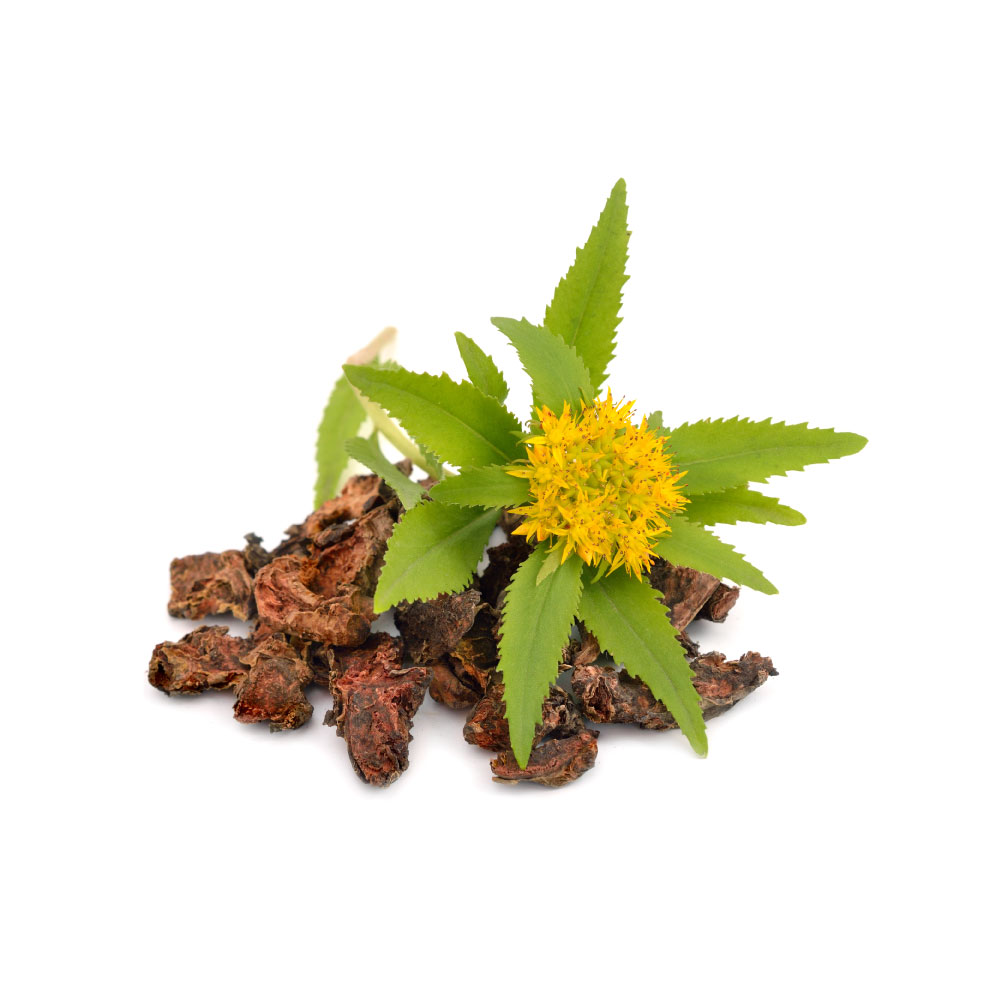
Rosarin is a naturally occurring cinnamyl alcohol glycoside (rosavins-group phenylpropanoid), found in Roseroot / golden root rhizome and root and 2 other sources. It is well tolerated orally (low toxicity).
Concentration
Content by Source
Concentrations not reported. No percent-dry-weight or mg/g figures have been published for this compound in its source plants.
Rosarin at a Glance
Rosarin is a cinnamyl alcohol glycoside of Rhodiola rosea (roseroot) and one of the three “rosavins” — the co-marker set (with rosavin and rosin) that is characteristic of R. rosea and used to authenticate the herb against cheaper Rhodiola species 1,
This is a deliberately lean page, because rosarin is a genuinely thin molecule. Almost no work has tested purified rosarin on its own — its documented role is analytical (a standardisation and authentication marker), and the adaptogenic, anti-fatigue and antioxidant reputation attached to “the rosavins” belongs to the whole standardised extract, driven mainly by salidroside and the rosavins fraction together 2,
Rosarin, Rosavin & the Rhodiola Rosavins
The “rosavins” are a small family of cinnamyl alcohol glycosides that are largely unique to Rhodiola rosea, which is why the genus is standardised on them: their presence — and the roughly 3:1 rosavins-to-salidroside ratio — distinguishes authentic R. rosea from cheaper species such as R. crenulata that carry salidroside but little of the rosavins 1,
The three co-markers are built one sugar at a time from the same starting point 4Reference 4Biosynthesis of a rosavin natural product in Escherichia coli by glycosyltransferase rational design and artificial pathway constructionView study →:
| Marker | Structure | Relationship |
|---|---|---|
| Rosin | Cinnamyl alcohol + one glucose (the simplest cinnamyl monoglucoside) | The shared parent |
| Rosavin | Rosin + an arabinopyranose | The principal, most abundant rosavin |
| Rosarin | Rosin + an arabinofuranose | Rosavin’s isomer — same sugars, different ring form |
So rosarin differs from rosavin by a single detail: the added arabinose closes as a five-membered furanose ring in rosarin versus a six-membered pyranose ring in rosavin 1,
What It's Used For
Rosarin has essentially no isolate-specific pharmacology of its own. Its documented function is as a marker; its presumed bioactivity is inferred from the rosavins group and the whole extract.
Support is an experimental score — weighted by study type (human > animal > in vitro) and volume. A beta, not a validated metric. This molecule is thin and mostly studied as part of a group, so scores are low by design; read the per-row basis.
The one role that is genuinely rosarin-specific and well-documented — though it is an analytical, not a clinical, application. A validated reversed-phase HPLC method resolves rosarin alongside salidroside, rosavin, rosin and rosiridin, detecting each down to sub-microgram/mL levels and assigning them in both plant material and commercial products 1Reference 1Analysis of the marker compounds of Rhodiola rosea L. (golden root) by reversed phase high performance liquid chromatographyView study →.
Because the rosavins are largely confined to R. rosea, quantifying rosarin (with rosavin and rosin) is part of how the genuine species is distinguished from adulterants and standardised for the market 1,
Gap: this is quality-control chemistry, not evidence of a health effect — a compound can be a good species marker without being a driver of activity.
The adaptogenic, anti-fatigue and stress-protective reputation of R. rosea is attributed to the combined action of salidroside and the rosavins, and human clinical work uses standardised whole extract rather than any single rosavin 2,
Gap: every positive adaptogenic/anti-fatigue result here is an extract result — none isolates rosarin, so its individual contribution is unknown and should not be assumed from the group 2,
Phenylpropanoid glycosides such as rosarin, rosavin and rosin are described as antioxidant contributors within R. rosea, but the measured antioxidant activity is that of the rosavins fraction or the whole extract in vitro, where rosarin is one phenylpropanoid among several 3Reference 3Rosavin: research advances in extraction and synthesis, pharmacological activities and therapeutic effects on diseases of the characteristic active ingredients of Rhodiola rosea LView study →.
Gap: no antioxidant outcome rests on purified rosarin specifically, and there is no in-vivo or human antioxidant endpoint for the isolate 3Reference 3Rosavin: research advances in extraction and synthesis, pharmacological activities and therapeutic effects on diseases of the characteristic active ingredients of Rhodiola rosea LView study →.
Mechanisms
| Target / pathway | Effect | Relevant to |
|---|---|---|
| Species-marker chemistry | one of the R. rosea rosavins used for authentication/standardisation | analytical marker (the solid role) |
| Adaptogenic stress-response signalling (extract) | attributed to salidroside + rosavins as a group — see the extract pages | adaptogenic / anti-fatigue |
| Radical scavenging (phenylpropanoid) | contributes to the antioxidant capacity of the fraction it occurs in | antioxidant (in vitro) |
| Cinnamyl-alcohol glycosylation (biosynthesis) | rosin → (+ arabinofuranose) → rosarin; the pathway that builds the marker | prevalence / biosynthesis |
The load-bearing point is honesty: only the marker role is demonstrated for rosarin itself. The signalling row is a pointer to the extract’s pharmacology, not a claim that purified rosarin drives it.
Pharmacokinetics
There are no rosarin-specific human pharmacokinetic data. As a polar cinnamyl diglycoside, rosarin would be expected to be poorly absorbed intact and subject to gut-microbial deglycosylation — the general pattern for glycosidic rosavins — but this has not been characterised for rosarin as an isolate. Pharmacokinetic study in R. rosea has centred on salidroside (and its aglycone tyrosol) and on rosavin; rosarin is measured analytically for content, not tracked in plasma 1Reference 1Analysis of the marker compounds of Rhodiola rosea L. (golden root) by reversed phase high performance liquid chromatographyView study →. The practical implication: any systemic activity attributed to rosarin is unverified, and the compound is consumed only as a minor part of a whole extract.
Clinical Trials
There are no clinical trials of isolated rosarin. Human evidence in this area is for standardised R. rosea extract (dosed by salidroside/rosavins content), reviewed at the herb and rosavin pages 2Reference 2Rosenroot (Rhodiola rosea): traditional use, chemical composition, pharmacology and clinical efficacyView study →.
| Completed | Planned | Terminated | Preclinical |
|---|---|---|---|
| —(none, isolate) | — | — | Thin — group/extract only |
Last checked: July 2026.
Isolate vs. Plant Studies
Rosarin sits almost entirely on the plant/extract side of this divide. The only thing consistently done with purified rosarin is to detect and quantify it as a marker 1Reference 1Analysis of the marker compounds of Rhodiola rosea L. (golden root) by reversed phase high performance liquid chromatographyView study →; it has not been the subject of a controlled bioactivity study on its own. Every adaptogenic, anti-fatigue or antioxidant claim in its vicinity comes from whole standardised R. rosea extract or the rosavins fraction, where salidroside and rosavin are the better-characterised actives and rosarin is a minor co-occurring glycoside 2,
Prevalence in Nature
Rosarin is a minor cinnamyl glycoside of Rhodiola rosea rhizome and root, one of the “rosavins” that are largely restricted to this species and therefore used to authenticate it 1,
Biosynthetically, the rosavins are phenylpropanoid products of L-phenylalanine: rosin is formed by glucosylating cinnamyl alcohol (the simplest cinnamyl monoglucoside), and rosarin and rosavin arise from rosin by adding an arabinose — as the furanose form in rosarin and the pyranose form in rosavin 4Reference 4Biosynthesis of a rosavin natural product in Escherichia coli by glycosyltransferase rational design and artificial pathway constructionView study →. The full R. rosea rosavin pathway has not been completely elucidated, though the glucosylation step and the rosin intermediate are established, including in engineered systems 4Reference 4Biosynthesis of a rosavin natural product in Escherichia coli by glycosyltransferase rational design and artificial pathway constructionView study →.
Discovery & Synthesis
Rosarin was not the subject of a single discovery paper so much as it emerged from the mid-to-late twentieth-century phytochemical mapping of Rhodiola rosea, and it was placed firmly into routine quality control by the HPLC marker methods of the early 2000s that resolved salidroside, rosavin, rosin, rosarin and rosiridin together 1Reference 1Analysis of the marker compounds of Rhodiola rosea L. (golden root) by reversed phase high performance liquid chromatographyView study →. Chemically it is defined by its structure — the arabinofuranosyl isomer of rosavin — rather than by an isolation milestone.
There is no established stand-alone synthesis or commercial manufacture of rosarin: it is not sold as an isolated ingredient but obtained (and standardised) only within R. rosea extract. The related biosynthetic chemistry — glucosylation of cinnamyl alcohol to rosin, then arabinosylation to the rosavin isomers — has been reconstructed in engineered microbes for the rosavin branch, and the same logic applies to the arabinofuranosyl (rosarin) branch 4Reference 4Biosynthesis of a rosavin natural product in Escherichia coli by glycosyltransferase rational design and artificial pathway constructionView study →.
Patents: not yet researched.
Toxicity & Safety
Rosarin carries a low flag. There is no isolate-specific toxicology for it — no genotoxicity, repeat-dose or reproductive dataset for the purified compound — and its only meaningful human exposure is as a minor constituent of standardised R. rosea extract, a preparation with a long record of human use and a generally favourable safety profile at customary doses 2Reference 2Rosenroot (Rhodiola rosea): traditional use, chemical composition, pharmacology and clinical efficacyView study →. As a simple cinnamyl diglycoside present at low levels, it has no specific hazard signal of its own; the honest position is that safety here is inherited from the extract, not demonstrated for the isolate.
- Low isolate-toxicity signal. No organ-, geno- or reproductive-toxicity finding specific to purified rosarin; consumed only within R. rosea extract.
- Favourable extract record. Standardised R. rosea extract has a long history of human use with good tolerability at customary doses 2Reference 2Rosenroot (Rhodiola rosea): traditional use, chemical composition, pharmacology and clinical efficacyView study →.
- Safety is inherited, not proven for the isolate. No dedicated toxicology exists for pure rosarin — absence of a hazard signal is not the same as tested safety.
- Species discipline matters. Adaptogenic/safety data belong to authentic R. rosea (rosavins-bearing); other Rhodiola species have different profiles and should not be pooled 1Reference 1Analysis of the marker compounds of Rhodiola rosea L. (golden root) by reversed phase high performance liquid chromatographyView study →.
- Pregnancy/lactation is decided at the herb level. No isolate reproductive data; those decisions belong on the Rhodiola herb and product pages, not this molecule page.
Dosage
There is no isolated rosarin dose — it is not sold or used as a stand-alone ingredient. Human exposure is entirely as a minor component of standardised R. rosea extract, which is dosed by its salidroside and rosavins content, not by rosarin. Typical research and commercial preparations are standardised to roughly ~3% rosavins and ~1% salidroside (the ~3:1 target that mirrors the root), at extract doses commonly in the range of a few hundred milligrams per day 2Reference 2Rosenroot (Rhodiola rosea): traditional use, chemical composition, pharmacology and clinical efficacyView study →. These are extract-standardisation figures, not a recommendation for the isolate — for dosing detail, see the Rhodiola herb page and the rosavin and salidroside pages.
References
- Ganzera M, Yayla Y, Khan IA (2001). Analysis of the marker compounds of Rhodiola rosea L. (golden root) by reversed phase high performance liquid chromatography. Chemical & Pharmaceutical Bulletin (Tokyo). https://pubmed.ncbi.nlm.nih.gov/11310675/
- Panossian A, Wikman G, Sarris J (2010). Rosenroot (Rhodiola rosea): traditional use, chemical composition, pharmacology and clinical efficacy. Phytomedicine. https://pubmed.ncbi.nlm.nih.gov/20378318/
- Wang S, Feng Y, Zheng L, He P, Tan J, Cai J, Wu M, Ye X (2023). Rosavin: research advances in extraction and synthesis, pharmacological activities and therapeutic effects on diseases of the characteristic active ingredients of Rhodiola rosea L. Molecules. https://pubmed.ncbi.nlm.nih.gov/37959831/
- Bi H, Qu G, Wang S, Zhuang Y, Sun Z, Liu T, Ma Y (2022). Biosynthesis of a rosavin natural product in Escherichia coli by glycosyltransferase rational design and artificial pathway construction. Metabolic Engineering. https://pubmed.ncbi.nlm.nih.gov/34715353/



