
Compound Monograph
Salidroside
Salidroside (rhodioloside) is the marquee marker glycoside of the adaptogen Rhodiola rosea — the beta-D-glucoside of tyrosol. Its anti-fatigue, neuroprotective, cardioprotective and anti-hypoxia signals are genuine but mostly preclinical or belong to the whole standardised extract (SHR-5); only one small exercise RCT has tested the pure isolated molecule.

Sources · 6
Where Does It Come From?
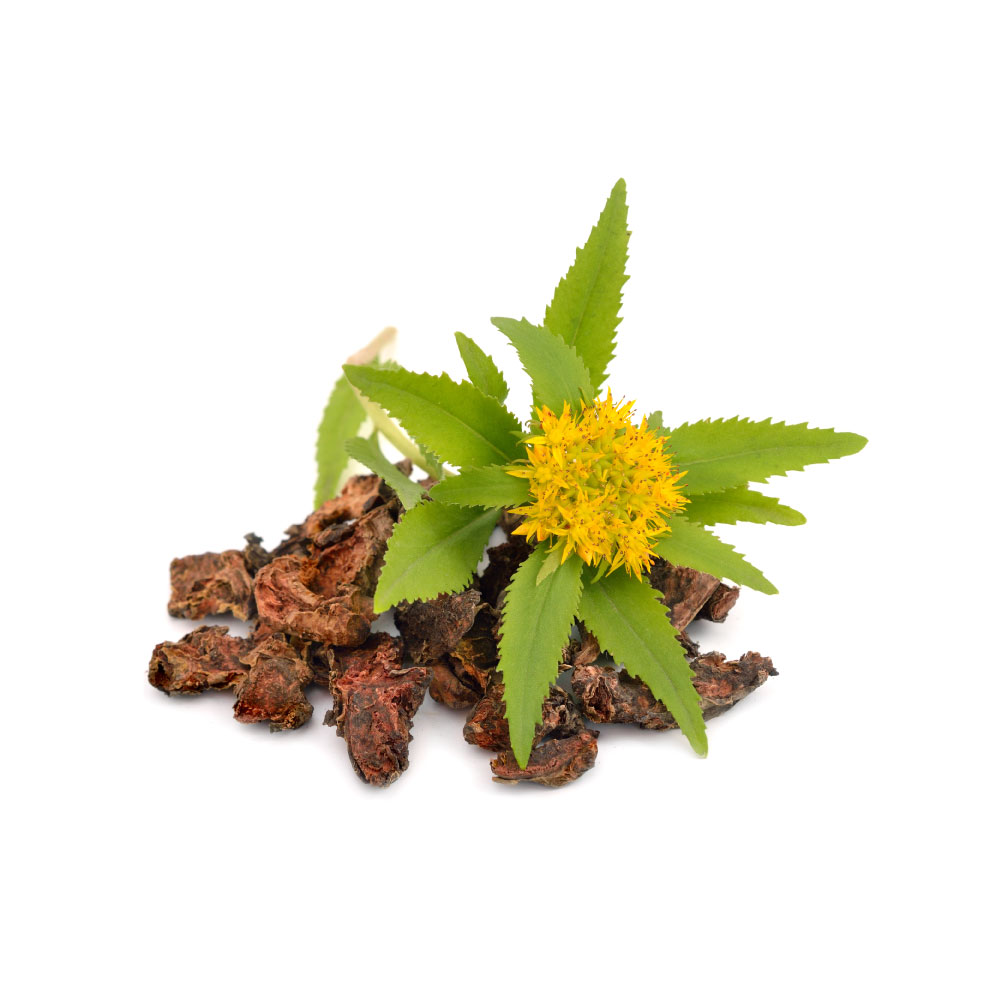
Salidroside is a synthetic phenylethanoid glycoside (beta-d-glucoside of tyrosol), found in Rhodiola rosea, Rhodiola crenulata, Other Rhodiola species and 3 other sources. It is well tolerated orally (low toxicity).
Concentration
Content by Source
Reported concentrations across the plants that contain salidroside — the bar marks the typical level, the line shows the reported range.
Literature figures for varying plant parts and preparations. Read them as a comparative guide, not exact assays.
Salidroside at a Glance
Salidroside — also called rhodioloside — is the marker glycoside of rhodiola (Rhodiola rosea), the arctic-alpine adaptogen whose extracts are measured and priced by their salidroside content. Chemically it is the beta-D-glucoside of tyrosol: a simple phenylethanoid alcohol carried on a sugar. That glycoside identity is the whole story of the page — salidroside is what rhodiola extracts are standardised to, and tyrosol is what salidroside becomes once the sugar is cleaved.
It is a genuinely well-studied molecule by phytochemical standards, with a broad preclinical signal across anti-fatigue/adaptogen, neuroprotection, cardioprotection, anti-hypoxia and antidepressant-like effects 4,
Its safety profile is reassuringly clean at the molecule level 16Reference 16ReviewPharmacological activities, mechanisms of action, and safety of salidroside in the central nervous systemView study →; the drug-interaction caution that attaches to rhodiola belongs to other constituents of the plant (CYP2D6-inhibiting flavonoids), not to salidroside 8Reference 8Two potent cytochrome P450 2D6 inhibitors found in Rhodiola roseaView study →.
Salidroside & Tyrosol
The single most useful fact about this molecule is its relationship to its aglycone. Salidroside is tyrosol plus a glucose — p-tyrosol-8-O-beta-D-glucoside — so the two are a prodrug/aglycone pair: cleave the sugar and you get tyrosol, the same simple phenol found in olive oil and wine. Tyrosol is in turn the milder, single-hydroxyl cousin of hydroxytyrosol.
This matters for interpretation. In rat pharmacokinetics, tyrosol was recovered as the deglycosylation metabolite of salidroside after intravenous dosing, confirming the pair chemically 9Reference 9AnimalSimultaneous determination of salidroside and its aglycone metabolite p-tyrosol in rat plasma by liquid chromatography-tandem mass spectrometryView study →. But — importantly — free tyrosol was not detected in plasma after oral salidroside in the same study, which argues that the intact glucoside itself is what circulates after an oral dose rather than being fully stripped to tyrosol in the gut 9Reference 9AnimalSimultaneous determination of salidroside and its aglycone metabolite p-tyrosol in rat plasma by liquid chromatography-tandem mass spectrometryView study →. So salidroside is not simply a tyrosol delivery vehicle: the glycoside has its own absorption behaviour, and some of its reported activity (e.g. hypoxia protection) is shared with tyrosol as a distinct co-active, not merely inherited from it 7Reference 7Rhodiola crenulata and its bioactive components, salidroside and tyrosol, reverse the hypoxia-induced reduction of plasma-membrane-associated Na,K-ATPase expression via inhibition of ROS-AMPK-PKCξ pathwayView study →.
The practical read: treat salidroside and tyrosol as related but non-interchangeable — same phenolic core, different pharmacokinetics, overlapping but not identical evidence.
The Rhodiola Standardisation Story
Salidroside is the reason rhodiola labels carry two percentages. Commercial R. rosea extract is conventionally standardised to ~1% salidroside and ~3% rosavins, and that ~3:1 rosavin:salidroside ratio mirrors the authentic root 4Reference 4ReviewRosenroot (Rhodiola rosea): traditional use, chemical composition, pharmacology and clinical efficacyView study →. The classic HPLC authentication method resolves five markers together — salidroside plus the cinnamyl (rosavin-type) glycosides rosavin, rosarin and rosin 5Reference 5Analysis of the marker compounds of Rhodiola rosea L. (golden root) by reversed phase high performance liquid chromatographyView study →.
The subtlety — and a recurring source of confusion in the literature — is that salidroside alone does not authenticate the species. It is a genus-wide marker, shared across Rhodiola species, whereas the rosavins are largely unique to R. rosea 5,
What It's Used For
Salidroside carries a broad, mechanistically coherent preclinical profile; the load-bearing caveat is that the human evidence is the standardised extract, not the isolate 4,
Support is an experimental score — weighted by study type (human > animal > in vitro) and volume. A beta, not a validated metric. Human efficacy data are largely the extract (SHR-5), not the isolate, so isolate scores stay modest by design.
The flagship, and the sharpest isolate-vs-plant line on the page. The human evidence is for the standardised extract SHR-5. It improved mental performance and reduced fatigue in physicians on night duty 15Reference 15RCTRhodiola rosea in stress induced fatigue — a double blind cross-over study of a standardized extract SHR-5 with a repeated low-dose regimen on the mental performance of healthy physicians during night dutyView study → and in students during exams 12Reference 12RCTA double-blind, placebo-controlled pilot study of the stimulating and adaptogenic effect of Rhodiola rosea SHR-5 extract on the fatigue of students caused by stress during an examination period with a repeated low-dose regimenView study →, and a parallel-group RCT found benefit on fatigue, attention and the salivary-cortisol awakening response in stress-related fatigue 13Reference 13RCTA randomised, double-blind, placebo-controlled, parallel-group study of the standardised extract SHR-5 of the roots of Rhodiola rosea in the treatment of subjects with stress-related fatigueView study →.
The review literature frames SHR-5’s anti-fatigue effect as rhodiola’s best-supported use 4Reference 4ReviewRosenroot (Rhodiola rosea): traditional use, chemical composition, pharmacology and clinical efficacyView study →.
Salidroside is the marker these extracts are dosed by, but only one trial has tested the pure molecule — an exploratory RCT in which 60 mg/day of biosynthetic salidroside for 16 days improved percent-predicted oxygen uptake during high-intensity exercise and reduced exercise-induced muscle damage in healthy young adults 1Reference 1RCTSalidroside and exercise performance in healthy active young adults — an exploratory, randomized, double-blind, placebo-controlled studyView study →.
Gap: the robust human anti-fatigue record is the whole extract, where salidroside travels with rosavins and ~140 other compounds 4Reference 4ReviewRosenroot (Rhodiola rosea): traditional use, chemical composition, pharmacology and clinical efficacyView study →; the isolate rests on a single small exercise RCT 1Reference 1RCTSalidroside and exercise performance in healthy active young adults — an exploratory, randomized, double-blind, placebo-controlled studyView study →. Extract efficacy cannot be assigned to salidroside alone.
A broad, mechanistically consistent preclinical signal for the isolated molecule. A systematic review and meta-analysis of 20 preclinical Alzheimer’s-model studies found salidroside significantly improved behavioural deficits and reduced amyloid-beta and oxidative/inflammatory markers 2Reference 2Meta-analysisNeuroprotective Mechanisms of Salidroside in Alzheimer’s Disease: A Systematic Review and Meta-analysis of Preclinical StudiesView study →, and a dedicated CNS pharmacology review compiles salidroside activity across Alzheimer’s, Parkinson’s, stroke, traumatic brain injury and cognition, working through oxidative-stress, anti-inflammatory, anti-apoptotic and neurogenesis pathways 16Reference 16ReviewPharmacological activities, mechanisms of action, and safety of salidroside in the central nervous systemView study →.
Gap: entirely animal and cell work — there are no human neuroprotection trials of salidroside, and its poor oral bioavailability as a phenylethanoid glycoside 6Reference 6Systematic reviewTherapeutic potential of phenylethanoid glycosides: A systematic reviewView study → complicates translation of the in-vitro concentrations.
A rodent isolate signal plus an extract-level neurochemical hook. Reviews of salidroside’s antidepressant mechanism describe SIRT1/PGC-1alpha-driven hippocampal neurogenesis, BDNF upregulation, suppression of NLRP3-mediated neuroinflammation (P2X7/NF-kB) and reduced IL-6/TNF-alpha, with antidepressant-type behaviour in chronic-stress and LPS models 11,
Separately, R. rosea root extract inhibits monoamine oxidase in vitro — though the potent activity there is attributable to rosiridin, not salidroside — a plausible contributor to the extract’s mood effects 3Reference 3Monoamine oxidase inhibition by Rhodiola rosea L. rootsView study →.
Gap: the behavioural work is rodent isolate; the human mood signal belongs to the extract (and its MAO inhibition to a different constituent), not to isolated salidroside 3,
A focused preclinical story around anthracycline chemotherapy toxicity. In cardiomyocyte and rodent models, salidroside protected the heart against doxorubicin-induced dysfunction by suppressing excessive oxidative stress and apoptosis — lowering ROS (partly via NOX1 inhibition), boosting catalase and manganese-SOD, and activating Bcl-2-mediated survival signalling 10Reference 10Salidroside improves doxorubicin-induced cardiac dysfunction by suppression of excessive oxidative stress and cardiomyocyte apoptosisView study →; the CNS/pharmacology reviews echo a general antioxidant cardioprotective profile 16Reference 16ReviewPharmacological activities, mechanisms of action, and safety of salidroside in the central nervous systemView study →.
Gap: animal and cell only — no human cardioprotection trials, and the anthracycline-cotreatment question (whether an antioxidant blunts tumour kill) is untested clinically 10Reference 10Salidroside improves doxorubicin-induced cardiac dysfunction by suppression of excessive oxidative stress and cardiomyocyte apoptosisView study →.
A mechanistically attractive activity where the human trial disappoints. Salidroside (with tyrosol) reverses hypoxia-induced loss of plasma-membrane Na,K-ATPase via inhibition of the ROS-AMPK-PKC-zeta pathway in cell and rodent hypoxia models 7Reference 7Rhodiola crenulata and its bioactive components, salidroside and tyrosol, reverse the hypoxia-induced reduction of plasma-membrane-associated Na,K-ATPase expression via inhibition of ROS-AMPK-PKCξ pathwayView study →, and reviews list anti-hypoxia among its antioxidant/mitochondrial-protective actions 16Reference 16ReviewPharmacological activities, mechanisms of action, and safety of salidroside in the central nervous systemView study →.
But the one randomised human altitude trial — testing a rhodiola extract for acute mountain sickness — was negative, finding no reduction in AMS incidence versus placebo, and it used R. crenulata, not R. rosea 14Reference 14RCTRhodiola crenulata extract for prevention of acute mountain sickness: a randomized, double-blind, placebo-controlled, crossover trialView study →.
Gap: the supportive data are in-vitro/rodent mechanism; the only human altitude RCT was negative and a different species/whole extract 14Reference 14RCTRhodiola crenulata extract for prevention of acute mountain sickness: a randomized, double-blind, placebo-controlled, crossover trialView study →, so anti-altitude use is not supported for isolated salidroside.
Mechanisms
| Target / pathway | Effect | Relevant to |
|---|---|---|
| Nrf2 / antioxidant enzymes (SOD, catalase) | ↑ endogenous antioxidant defence, ↓ ROS | neuroprotectioncardioprotection |
| NADPH oxidase (NOX1) | ↓ ROS generation | cardioprotection |
| Bcl-2 / Bax / caspase-3 | shifts balance toward cell survival (anti-apoptotic) | neuro/cardioprotection |
| AMPK / mitochondrial function / ferroptosis | preserves mitochondrial energy, limits ferroptotic death | anti-hypoxiacardioprotection |
| ROS-AMPK-PKC-zeta → Na,K-ATPase | prevents hypoxia-induced Na,K-ATPase endocytosis | anti-hypoxia |
| NLRP3 inflammasome / P2X7 / NF-kB (↓ IL-6, TNF-alpha) | ↓ neuroinflammation | antidepressantneuroprotection |
| SIRT1 / PGC-1alpha, BDNF | ↑ hippocampal neurogenesis / synaptic plasticity | antidepressant-like |
| HPA axis / cortisol | normalises the stress cortisol response | adaptogen / anti-fatigue (extract) |
| Monoamine oxidase (MAO-A/B) | extract inhibits MAO — but the potent activity is rosiridin, not salidroside | mood (the extractnot the isolate) |
The throughline is an antioxidant, anti-apoptotic, anti-inflammatory cytoprotection that plays out in neurons and cardiomyocytes alike; the adaptogenic HPA/cortisol normalisation and the MAO inhibition are properties of the whole extract, and MAO specifically maps to a different constituent 3,
Pharmacokinetics
Salidroside is a polar phenolic glucoside, and its pharmacokinetics are the quiet caveat behind the impressive in-vitro numbers. In a rat LC-MS/MS study it was rapidly absorbed after oral dosing (Tmax ~0.3 h) with a short oral half-life (~1.3 h) and an oral bioavailability of roughly 52%; its aglycone tyrosol was detected as a metabolite after intravenous but not oral dosing, implying the intact glucoside is what circulates orally 9Reference 9AnimalSimultaneous determination of salidroside and its aglycone metabolite p-tyrosol in rat plasma by liquid chromatography-tandem mass spectrometryView study →. Intestinal uptake appears to involve the sodium-dependent glucose transporter SGLT1 (active, saturable transport). Set against that single moderate-bioavailability figure, the broader phenylethanoid-glycoside class is repeatedly flagged for poor oral bioavailability, which limits therapeutic translation 6Reference 6Systematic reviewTherapeutic potential of phenylethanoid glycosides: A systematic reviewView study →. Human ADME for isolated salidroside — Cmax, half-life, bioavailability — is not well established; the human dosing that exists is the SHR-5 extract, not the pure molecule 1,
Clinical Trials
Human trials cluster on the whole extract, not the isolate. The randomised anti-fatigue/mental-performance evidence is all SHR-5 12,
| Completed | Planned | Terminated | Preclinical |
|---|---|---|---|
| Extract(SHR-5) anti-fatigue/mental RCTs 12, | — | — | Neuroprotection (AD meta-analysis), cardioprotection, antidepressant, anti-hypoxia mechanistic 2, |
Last checked: July 2026.
Isolate vs. Plant Studies
This file leans hard toward the plant/extract on the human axis and toward the isolate on the mechanistic axis. The mechanistic and disease-model work is overwhelmingly isolated salidroside in cells and rodents — the Alzheimer’s-model meta-analysis 2Reference 2Meta-analysisNeuroprotective Mechanisms of Salidroside in Alzheimer’s Disease: A Systematic Review and Meta-analysis of Preclinical StudiesView study →, the doxorubicin cardioprotection series 10Reference 10Salidroside improves doxorubicin-induced cardiac dysfunction by suppression of excessive oxidative stress and cardiomyocyte apoptosisView study →, the antidepressant-mechanism studies 11Reference 11ReviewResearch progress on the mechanism of antidepressant effect of salidrosideView study → and the Na,K-ATPase hypoxia work 7Reference 7Rhodiola crenulata and its bioactive components, salidroside and tyrosol, reverse the hypoxia-induced reduction of plasma-membrane-associated Na,K-ATPase expression via inhibition of ROS-AMPK-PKCξ pathwayView study → all test the molecule directly, which is a genuine preclinical strength. The human efficacy evidence, by contrast, is the standardised extract: SHR-5’s stress-related-fatigue and mental-performance RCTs are extract results in which salidroside is one marker among rosavins and ~140 other compounds 4,
Its Role in Plants
In Rhodiola, salidroside and its rosavin co-markers accumulate in the roots and rhizomes of these cold-adapted, high-altitude and arctic plants, and are understood as stress-protective antioxidant metabolites — consistent with the genus’s habitat of high UV, cold and low oxygen. Biosynthetically salidroside is a glucoside of tyrosol, itself derived from the aromatic amino acid tyrosine via the phenylethanoid pathway, with a final glucosylation step attaching the sugar. The molecule’s antioxidant/cytoprotective chemistry in the lab is a plausible echo of its in-planta role buffering environmental oxidative stress — though, as always, a stress metabolite’s plant function does not by itself predict a human medicine.
Prevalence in Nature
Salidroside is a genus-wide Rhodiola marker, present across the roots and rhizomes of R. rosea, R. crenulata, R. sachalinensis and other Rhodiola species 4,
Discovery & Synthesis
Salidroside has long been recognised as the principal phenylethanoid marker glycoside of Rhodiola rosea, where it is also known as rhodioloside; the standard analytical identity comes from the reversed-phase HPLC authentication work that resolves it alongside the rosavin markers 5Reference 5Analysis of the marker compounds of Rhodiola rosea L. (golden root) by reversed phase high performance liquid chromatographyView study →. No single dated first isolation is well documented in the sources reviewed here. What is notable for a plant glycoside is that salidroside is now produced biosynthetically at usable scale — the one human RCT of the pure molecule explicitly used biosynthetic salidroside, reflecting engineered enzymatic/microbial production rather than extraction from root 1Reference 1RCTSalidroside and exercise performance in healthy active young adults — an exploratory, randomized, double-blind, placebo-controlled studyView study →. That makes the isolate available for study independent of the whole extract, which is exactly why the isolate-vs-extract distinction is now testable.
Patents: not yet researched.
Toxicity & Safety
Salidroside carries a low toxicity flag at the molecule level: the dedicated CNS pharmacology review describes a favourable safety profile with few reported side effects, which is part of what makes it an attractive drug candidate 16Reference 16ReviewPharmacological activities, mechanisms of action, and safety of salidroside in the central nervous systemView study →. The meaningful caution is not the molecule but the whole plant’s drug-interaction potential — and even that traces to other constituents.
- Low-toxicity isolate. Salidroside itself shows a favourable safety profile with few reported adverse effects in the pharmacology literature 16Reference 16ReviewPharmacological activities, mechanisms of action, and safety of salidroside in the central nervous systemView study →.
- The interaction risk is at the herb level, not the molecule. R. rosea contains the flavonoids rhodiosin and rhodionin, potent in-vitro CYP2D6 inhibitors 8Reference 8Two potent cytochrome P450 2D6 inhibitors found in Rhodiola roseaView study → — so the whole extract (not isolated salidroside) could in principle raise levels of CYP2D6-metabolised drugs. This is a rhodiola caution, flagged here for context.
- Human isolate safety data are thin. Most human exposure and dosing evidence is the standardised extract, not pure salidroside 1,
4Reference 1RCTSalidroside and exercise performance in healthy active young adults — an exploratory, randomized, double-blind, placebo-controlled studyView study →Reference 4ReviewRosenroot (Rhodiola rosea): traditional use, chemical composition, pharmacology and clinical efficacyView study → . - Species discipline. R. crenulata and R. kirilowii are different plants — the negative altitude data and the animal pregnancy work used those species, and do not transfer to R. rosea salidroside 14Reference 14RCTRhodiola crenulata extract for prevention of acute mountain sickness: a randomized, double-blind, placebo-controlled, crossover trialView study →.
Full Safety & Interactions Detail
Molecule-level tolerability. Across its preclinical record salidroside is well tolerated, and reviews single out its clean safety profile as a development advantage 16Reference 16ReviewPharmacological activities, mechanisms of action, and safety of salidroside in the central nervous systemView study →. There is no isolate-specific signal of organ toxicity in the sources reviewed here.
CYP2D6 — a herb interaction, not a salidroside one. The most cited rhodiola interaction concern is potent, non-competitive CYP2D6 inhibition in vitro (IC50 in the sub-micromolar range), but this is attributable to the herbacetin flavonoids rhodiosin and rhodionin, not to salidroside 8Reference 8Two potent cytochrome P450 2D6 inhibitors found in Rhodiola roseaView study →. It is included here only because consumers meet salidroside inside the whole extract; the flag belongs to the rhodiola monograph, where intake is decided.
Reproductive note (prose only). The animal reproductive work in the rhodiola literature used R. kirilowii, a different species, and does not speak to isolated salidroside or to R. rosea; no dedicated reproductive-toxicity dataset exists for the pure molecule. Per site policy, pregnancy/lactation is adjudicated on the herb and product pages where intake is decided, not on this molecule page. No comprehensive isolate genotoxicity/repeat-dose package is characterised here beyond the tolerability above.
Dosage
There is no established therapeutic dose for isolated salidroside. The figures below are research doses — and they split cleanly into isolate and extract:
| Application | Form | Dose (research) |
|---|---|---|
| Exercise / oxygen utilisation (isolate) | biosynthetic salidroside | 60 mg/day for 16 days 1Reference 1RCTSalidroside and exercise performance in healthy active young adults — an exploratory, randomized, double-blind, placebo-controlled studyView study → |
| Stress-related fatigue (extract) | SHR-5 standardised extract | 576 mg/day, standardised to ~1% salidroside 13Reference 13RCTA randomised, double-blind, placebo-controlled, parallel-group study of the standardised extract SHR-5 of the roots of Rhodiola rosea in the treatment of subjects with stress-related fatigueView study → |
| Mental fatigue / night duty (extract) | SHR-5, repeated low-dose regimen | studied in physicians and students 12, |
The critical framing: only the first row is pure salidroside 1Reference 1RCTSalidroside and exercise performance in healthy active young adults — an exploratory, randomized, double-blind, placebo-controlled studyView study →; the extract rows deliver salidroside as ~1% of a multi-compound preparation dosed by extract weight 4,
References
- Schwarz NA, et al. (2024). Salidroside and exercise performance in healthy active young adults — an exploratory, randomized, double-blind, placebo-controlled study. Journal of the International Society of Sports Nutrition. https://pubmed.ncbi.nlm.nih.gov/39601362/
- Zhang N, et al. (2023). Neuroprotective Mechanisms of Salidroside in Alzheimer’s Disease: A Systematic Review and Meta-analysis of Preclinical Studies. Journal of Agricultural and Food Chemistry. https://pubmed.ncbi.nlm.nih.gov/37934032/
- van Diermen D, et al. (2009). Monoamine oxidase inhibition by Rhodiola rosea L. roots. Journal of Ethnopharmacology. https://pubmed.ncbi.nlm.nih.gov/19168123/
- Panossian A, Wikman G, Sarris J (2010). Rosenroot (Rhodiola rosea): traditional use, chemical composition, pharmacology and clinical efficacy. Phytomedicine (review). https://pubmed.ncbi.nlm.nih.gov/20378318/
- Ganzera M, Yayla Y, Khan IA (2001). Analysis of the marker compounds of Rhodiola rosea L. (golden root) by reversed phase high performance liquid chromatography. Chemical & Pharmaceutical Bulletin. https://pubmed.ncbi.nlm.nih.gov/11310675/
- Wu L, et al. (2020). Therapeutic potential of phenylethanoid glycosides: A systematic review. Medicinal Research Reviews. https://pubmed.ncbi.nlm.nih.gov/32779240/
- Lee SY, et al. (2013). Rhodiola crenulata and its bioactive components, salidroside and tyrosol, reverse the hypoxia-induced reduction of plasma-membrane-associated Na,K-ATPase expression via inhibition of ROS-AMPK-PKCξ pathway. Evidence-Based Complementary and Alternative Medicine. https://pubmed.ncbi.nlm.nih.gov/23840253/
- Xu W, et al. (2013). Two potent cytochrome P450 2D6 inhibitors found in Rhodiola rosea. Pharmazie. https://pubmed.ncbi.nlm.nih.gov/24400445/
- Guo N, et al. (2012). Simultaneous determination of salidroside and its aglycone metabolite p-tyrosol in rat plasma by liquid chromatography-tandem mass spectrometry. Molecules. https://pubmed.ncbi.nlm.nih.gov/22525439/
- Wang XL, et al. (2013). Salidroside improves doxorubicin-induced cardiac dysfunction by suppression of excessive oxidative stress and cardiomyocyte apoptosis. Journal of Cardiovascular Pharmacology. https://pubmed.ncbi.nlm.nih.gov/24072175/
- Ao W, et al. (2025). Research progress on the mechanism of antidepressant effect of salidroside. International Immunopharmacology (review). https://pubmed.ncbi.nlm.nih.gov/40651432/
- Spasov AA, et al. (2000). A double-blind, placebo-controlled pilot study of the stimulating and adaptogenic effect of Rhodiola rosea SHR-5 extract on the fatigue of students caused by stress during an examination period with a repeated low-dose regimen. Phytomedicine (clinical trial). https://pubmed.ncbi.nlm.nih.gov/10839209/
- Olsson EM, von Schéele B, Panossian AG (2009). A randomised, double-blind, placebo-controlled, parallel-group study of the standardised extract SHR-5 of the roots of Rhodiola rosea in the treatment of subjects with stress-related fatigue. Planta Medica (randomized controlled trial). https://pubmed.ncbi.nlm.nih.gov/19016404/
- Chiu TF, et al. (2013). Rhodiola crenulata extract for prevention of acute mountain sickness: a randomized, double-blind, placebo-controlled, crossover trial. BMC Complementary and Alternative Medicine (randomized controlled trial). https://pubmed.ncbi.nlm.nih.gov/24176010/
- Darbinyan V, et al. (2000). Rhodiola rosea in stress induced fatigue — a double blind cross-over study of a standardized extract SHR-5 with a repeated low-dose regimen on the mental performance of healthy physicians during night duty. Phytomedicine (clinical trial). https://pubmed.ncbi.nlm.nih.gov/11081987/
- Zhong Z, et al. (2018). Pharmacological activities, mechanisms of action, and safety of salidroside in the central nervous system. Drug Design, Development and Therapy (review). https://pubmed.ncbi.nlm.nih.gov/29872270/



