
Compound Monograph
Safranal
Safranal is the monoterpene aldehyde behind saffron's hay-like aroma — formed from picrocrocin as the stigmas dry — with a genuine but almost entirely preclinical CNS profile (anxiolytic, sedative-hypnotic, anticonvulsant, antioxidant) and a proposed serotonergic hand in saffron's antidepressant effect. The human mood evidence belongs to whole saffron and standardised extracts, not the isolate.

Sources · 2
Where Does It Come From?
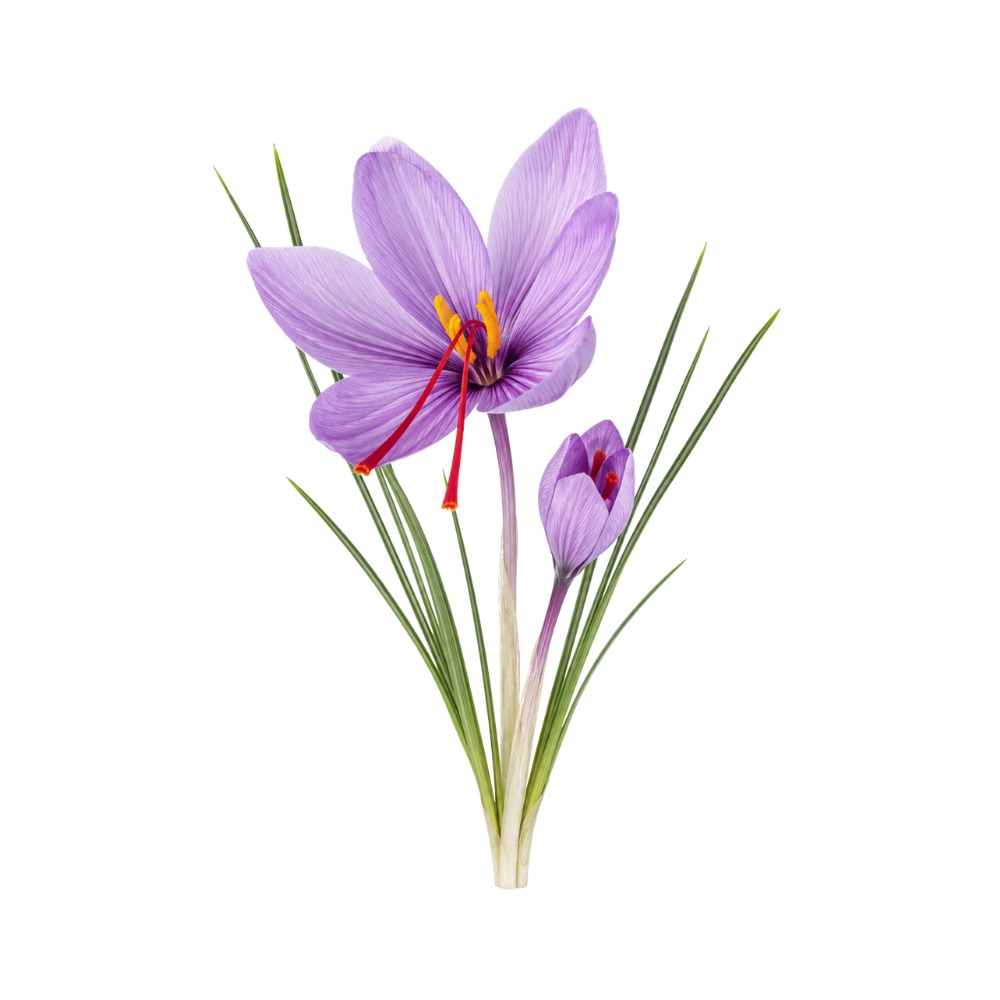
Safranal is a naturally occurring monoterpene aldehyde (cyclohexadiene apocarotenoid volatile), found in Saffron and 1 other source. It is flagged as moderately toxic.
Concentration
Content by Source
Reported concentrations across the plants that contain safranal — the bar marks the typical level, the line shows the reported range.
Literature figures for varying plant parts and preparations. Read them as a comparative guide, not exact assays.
Safranal at a Glance
Safranal is a monoterpene aldehyde and the molecule most responsible for the distinctive hay-like, warm aroma of saffron (Crocus sativus). It is the principal component of saffron’s volatile oil and, alongside the red pigment crocin and the bitter glycoside picrocrocin, one of the three apocarotenoids that define the spice’s quality under the ISO 3632 grading standard 1,
Its most-studied biological activity is in the central nervous system: in rodents the isolated aldehyde is anxiolytic, sedative-hypnotic, anticonvulsant and antioxidant, and it is one of the saffron constituents proposed to contribute a serotonergic hand to the plant’s antidepressant effect 1,
As a reactive aldehyde it also carries a more cautious safety note than a typical fragrant monoterpene: high doses were teratogenic in mice, and safranal is one of the constituents behind saffron’s traditional high-dose reputation as a uterine stimulant 13Reference 13AnimalEvaluation of teratogenic effects of crocin and safranal, active ingredients of saffron, in miceView study →.
Safranal’s Signature
Safranal is unusual among aroma molecules because it is largely a product of processing, not of the living plant. In the fresh stigma the dominant compound is the tasteless-to-bitter monoterpene glycoside picrocrocin. As the stigmas are dried and stored, picrocrocin is hydrolysed and dehydrated — enzymatically and thermally — releasing safranal, which is why properly dried and aged saffron smells the way it does and why the aroma develops during post-harvest handling 1,
The second half of safranal’s signature is its CNS profile. The anxiolytic, sedative-hypnotic and anticonvulsant effects of the isolate in rodents run largely through the GABA-A–benzodiazepine receptor complex — its anticonvulsant protection is abolished by the benzodiazepine-site antagonist flumazenil 3Reference 3AnimalProtective effect of safranal on pentylenetetrazol-induced seizures in the rat: involvement of GABAergic and opioids systemsView study → — a mechanism distinct from the serotonergic route of the fellow fragrant monoterpene linalool 2,
What It's Used For
Safranal’s preclinical signal is real and reasonably coherent, but the load-bearing caveat repeats throughout: it is almost entirely rodent and in-vitro work on the isolated aldehyde, and the marquee human evidence for saffron’s mood effects is the plant/extract, not this molecule 1,
Support is an experimental score — weighted by study type (human > animal > in vitro) and volume. A beta, not a validated metric. Human efficacy data are the plant/extract, not the isolate, so isolate scores stay modest by design.
Safranal’s best-characterised signal. In mice, saffron aqueous extract and isolated safranal (0.15 and 0.35 mL/kg i.p.) increased time on the open arms of the elevated plus maze (anxiolytic) and safranal prolonged pentobarbital-induced sleep dose-dependently, while crocin produced no anxiolytic or hypnotic effect — pinning the sedative activity of saffron on safranal rather than the pigment 2Reference 2AnimalAnxiolytic and hypnotic effect of Crocus sativus aqueous extract and its constituents, crocin and safranal, in miceView study →. The mechanism is shared with its anticonvulsant action: potentiation of the GABA-A–benzodiazepine complex 3Reference 3AnimalProtective effect of safranal on pentylenetetrazol-induced seizures in the rat: involvement of GABAergic and opioids systemsView study →.
Gap: all rodent, all the isolated molecule, largely intraperitoneal at doses far above culinary exposure; there are no controlled human trials of isolated safranal for anxiety or insomnia 2Reference 2AnimalAnxiolytic and hypnotic effect of Crocus sativus aqueous extract and its constituents, crocin and safranal, in miceView study →.
A mechanistically clean isolate signal. Peripherally administered safranal (72.75–291 mg/kg i.p.) produced a dose-dependent reduction in pentylenetetrazol (PTZ) seizures in rats — cutting the incidence of clonic and generalized tonic-clonic seizures and increasing seizure latency, with 100% protection at the higher doses — and this protection was abolished by the benzodiazepine-site antagonist flumazenil, implicating the GABA-A–benzodiazepine receptor complex (with only a minor, non-significant opioid contribution) 3Reference 3AnimalProtective effect of safranal on pentylenetetrazol-induced seizures in the rat: involvement of GABAergic and opioids systemsView study →. Safranal also showed antiabsence effects in acute experimental seizure models on EEG 4Reference 4Antiabsence effects of safranal in acute experimental seizure models: EEG and autoradiographyView study →.
Gap: rat isolate only, at high (hundreds of mg/kg) doses, with no human epilepsy data 3,
Safranal reduced ischaemia–reperfusion oxidative damage in rat hippocampus — lowering lipid peroxidation and preserving antioxidant defences after cerebral ischaemic insult 5Reference 5AnimalSafranal, a constituent of Crocus sativus (saffron), attenuated cerebral ischemia induced oxidative damage in rat hippocampusView study → — and, as one arm of a combination study, helped prevent hyperthyroidism-induced brain damage in rats 7Reference 7AnimalN-Acetylcysteine and Safranal prevented the brain damage induced by hyperthyroidism in adult male ratsView study →. A systematic review compiles safranal’s radical-scavenging and antioxidant activity across oxidative-stress models 6Reference 6Systematic reviewThe role of Safranal and saffron stigma extracts in oxidative stress, diseases and photoaging: A systematic reviewView study →.
Gap: rodent and in-vitro antioxidant endpoints (biomarkers, tissue damage) rather than clinical outcomes; no human antioxidant trial rests on isolated safranal 5,
The application most often attributed to saffron and, by extension, to safranal — but where the isolate line is weakest. Safranal is one of several Crocus sativus constituents proposed to underlie saffron’s antidepressant effect through serotonergic (and dopaminergic) modulation 8Reference 8Current Knowledge of the Antidepressant Activity of Chemical Compounds from Crocus sativus LView study →.
The demonstrated human effect, however, is the whole plant’s: saffron stigma at ~30 mg/day matched placebo-beating and comparator antidepressant responses in randomised trials 10Reference 10RCTCrocus sativus L. in the treatment of mild to moderate depression: a double-blind, randomized and placebo-controlled trialView study →, and a standardised extract (affron, defined by combined safranal + crocin content) showed antianhedonic/antidepressant effects in a rodent social-isolation model 9Reference 9Antianhedonic and Antidepressant Effects of Affron, a Standardized Saffron (Crocus sativus L.) ExtractView study →.
Gap: the serotonergic antidepressant role for safranal itself is inferential; the controlled efficacy data are whole saffron and standardised multi-constituent extracts, not the isolated aldehyde 8,
Mechanisms
| Target / pathway | Effect | Relevant to |
|---|---|---|
| GABA-A–benzodiazepine receptor complex | flumazenil-reversible potentiation → raised seizure threshold, anxiolysis, sedation | anticonvulsant / anxiolytic (the load-bearing mechanism) |
| Opioid system | minor, non-significant contribution to anticonvulsant protection (partial naloxone attenuation) | anticonvulsant |
| Free-radical scavenging / lipid-peroxidation ↓ | reduced hippocampal oxidative damage after ischaemia; preserved antioxidant defences | antioxidant / neuroprotective |
| Serotonergic (and dopaminergic) neurotransmission | proposed contributor to saffron’s antidepressant effect — demonstrated at the extract level, not the isolate | antidepressant |
| NF-κB / pro-inflammatory signalling | anti-inflammatory activity reported for the saffron apocarotenoids in preclinical models | antioxidant / anti-inflammatory |
The GABAergic finding is the anchor: flumazenil abolishes safranal’s anticonvulsant protection, and the same mechanism plausibly underlies its anxiolytic and sedative effects 3Reference 3AnimalProtective effect of safranal on pentylenetetrazol-induced seizures in the rat: involvement of GABAergic and opioids systemsView study →. The serotonergic antidepressant story is real biology for saffron, but sits off the safranal-isolate axis 8Reference 8Current Knowledge of the Antidepressant Activity of Chemical Compounds from Crocus sativus LView study →.
Pharmacokinetics
Dedicated human pharmacokinetics for isolated safranal are not established. As a small, lipophilic, volatile aldehyde it is expected to be readily absorbed and to cross the blood–brain barrier — consistent with its central effects after peripheral dosing in rodents 3,
Clinical Trials
There are no controlled efficacy trials of isolated safranal. The human evidence is for whole saffron (e.g. depression RCTs at ~30 mg/day) and standardised extracts standardised to combined safranal + crocin content, not the purified aldehyde 9,
| Completed | Planned | Terminated | Preclinical |
|---|---|---|---|
| Whole saffron / standardised extract (mood) — the isolate has none | — | — | Anxiolytic, anticonvulsant, antioxidant/neuroprotective (rodent isolate) |
Last checked: July 2026.
Isolate vs. Plant Studies
This molecule shows the split cleanly. The mechanistic and behavioural work is the isolated aldehyde in rodents: the anxiolytic/hypnotic study that singled out safranal over crocin 2Reference 2AnimalAnxiolytic and hypnotic effect of Crocus sativus aqueous extract and its constituents, crocin and safranal, in miceView study →, the PTZ and absence-seizure anticonvulsant work 3,
Prevalence in Nature
Safranal is, for practical purposes, saffron-specific. It is the principal volatile of dried Crocus sativus stigma and commonly the single largest component of its essential oil (reported roughly 30–70% of the volatile fraction, varying with provenance, drying and storage) 1,
Discovery & Synthesis
Safranal was identified in the early twentieth century as the compound responsible for saffron’s characteristic odour, and it has been studied as a distinct pharmacological agent for roughly the eight decades since its structure was established as the essential oil’s main component 1Reference 1Safranal: from an aromatic natural product to a rewarding pharmacological agentView study →. Its origin in the plant material is a degradation reaction, not primary biosynthesis: safranal is generated from the monoterpene glycoside picrocrocin — itself derived from the carotenoid zeaxanthin via apocarotenoid cleavage — through hydrolysis and dehydration during drying and storage 11Reference 11The Relation between Drying Conditions and the Development of Volatile Compounds in Saffron (Crocus sativus)View study →. Manufacture today is chiefly by isolation from saffron volatile oil (and as a defined marker in standardised saffron extracts); safranal is also accessible synthetically as a defined aroma chemical, but commercial interest is dominated by saffron-derived material because its value is tied to the spice.
Patents: not yet researched.
Toxicity & Safety
Safranal carries a moderate flag — higher than a typical fragrant monoterpene — because it is a reactive aldehyde with dose-dependent toxicity and a documented reproductive-toxicity signal, and because it is one of the constituents behind saffron’s traditional high-dose caution. At culinary and ordinary dietary exposure the risk is low; the concern is concentrated, high-dose intake.
The clearest specific finding is reproductive: in mice, high doses of safranal (and crocin) were teratogenic, producing developmental effects at the top of the range tested 13Reference 13AnimalEvaluation of teratogenic effects of crocin and safranal, active ingredients of saffron, in miceView study →. This aligns with saffron’s long-documented reputation as a uterine stimulant/emmenagogue at medicinal-to-gram doses — a whole-herb caution that is adjudicated on the saffron monograph, where intake is decided, not on this molecule page. As a general point, “natural aroma compound” does not mean “harmless at any dose”: the concentrated aldehyde is a different exposure from a culinary pinch of saffron.
- Low risk at culinary/dietary exposure. As saffron’s principal aroma volatile it has a long history of use in food at trace amounts.
- High-dose reproductive toxicity. Isolated safranal was teratogenic in mice at high doses, and safranal is part of saffron’s high-dose uterine-stimulant reputation — concentrated intake is not established as safe 13Reference 13AnimalEvaluation of teratogenic effects of crocin and safranal, active ingredients of saffron, in miceView study →.
- Reactive aldehyde. Dose-dependent toxicity at concentrations far above dietary levels; the isolate’s full genotoxicity/repeat-dose toxicology is not comprehensively characterised here.
- Pregnancy is a herb/product-level decision. Human reproductive data for the isolate are limited; pregnancy and lactation caution is set on the saffron monograph, not on this molecule page.
- Additive sedation, in principle. As a GABAergic sedative-anticonvulsant it could in theory compound other CNS depressants; a plausible, poorly-quantified interaction more relevant to concentrated extracts than to dietary saffron 2,
3Reference 2AnimalAnxiolytic and hypnotic effect of Crocus sativus aqueous extract and its constituents, crocin and safranal, in miceView study →Reference 3AnimalProtective effect of safranal on pentylenetetrazol-induced seizures in the rat: involvement of GABAergic and opioids systemsView study → .
Dosage
There is no established or recommended human dose for isolated safranal. The figures in the literature are preclinical rodent research doses and are not convertible to human self-dosing:
| Application (preclinical) | Model | Dose |
|---|---|---|
| Anxiolytic | Mouse, elevated plus maze | 0.15–0.35 mL/kg i.p. 2Reference 2AnimalAnxiolytic and hypnotic effect of Crocus sativus aqueous extract and its constituents, crocin and safranal, in miceView study → |
| Sedative-hypnotic | Mouse, pentobarbital sleep | dose-dependent, i.p. 2Reference 2AnimalAnxiolytic and hypnotic effect of Crocus sativus aqueous extract and its constituents, crocin and safranal, in miceView study → |
| Anticonvulsant | Rat, PTZ seizures | 72.75–291 mg/kg i.p. 3Reference 3AnimalProtective effect of safranal on pentylenetetrazol-induced seizures in the rat: involvement of GABAergic and opioids systemsView study → |
Human exposure to safranal is dietary (as a saffron volatile) and via standardised saffron extracts — for example affron, dosed at low mg amounts and defined by combined safranal + crocin content rather than isolated safranal — and via whole saffron in mood trials at roughly 30 mg/day 9,
References
- Rezaee R, Hosseinzadeh H (2013). Safranal: from an aromatic natural product to a rewarding pharmacological agent. Iranian Journal of Basic Medical Sciences. https://pubmed.ncbi.nlm.nih.gov/23638289/
- Hosseinzadeh H, Noraei NB (2009). Anxiolytic and hypnotic effect of Crocus sativus aqueous extract and its constituents, crocin and safranal, in mice. Phytotherapy Research. https://pubmed.ncbi.nlm.nih.gov/19142981/
- Hosseinzadeh H, Sadeghnia HR (2007). Protective effect of safranal on pentylenetetrazol-induced seizures in the rat: involvement of GABAergic and opioids systems. Phytomedicine. https://pubmed.ncbi.nlm.nih.gov/16707256/
- Sadeghnia HR, Cortez MA, Liu D, Hosseinzadeh H, Snead OC 3rd (2008). Antiabsence effects of safranal in acute experimental seizure models: EEG and autoradiography. Journal of Pharmacy & Pharmaceutical Sciences. https://pubmed.ncbi.nlm.nih.gov/18801302/
- Hosseinzadeh H, Sadeghnia HR (2005). Safranal, a constituent of Crocus sativus (saffron), attenuated cerebral ischemia induced oxidative damage in rat hippocampus. Journal of Pharmacy & Pharmaceutical Sciences. https://pubmed.ncbi.nlm.nih.gov/16401389/
- Nanda S, Madan K (2021). The role of Safranal and saffron stigma extracts in oxidative stress, diseases and photoaging: A systematic review. Heliyon. https://pubmed.ncbi.nlm.nih.gov/33615006/
- Shahat AS, Hassan WA, El-Sayed WM (2022). N-Acetylcysteine and Safranal prevented the brain damage induced by hyperthyroidism in adult male rats. Nutritional Neuroscience. https://pubmed.ncbi.nlm.nih.gov/32264788/
- Matraszek-Gawron R, Chwil M, Terlecki K, Skoczylas MM (2022). Current Knowledge of the Antidepressant Activity of Chemical Compounds from Crocus sativus L. Pharmaceuticals (Basel). https://pubmed.ncbi.nlm.nih.gov/36678554/
- Orio L, Alen F, Ballesta A, Martin R, Gomez de Heras R (2020). Antianhedonic and Antidepressant Effects of Affron, a Standardized Saffron (Crocus sativus L.) Extract. Molecules. https://pubmed.ncbi.nlm.nih.gov/32679643/
- Akhondzadeh S, Tahmacebi-Pour N, Noorbala AA, Amini H, Fallah-Pour H, Jamshidi AH, Khani M (2005). Crocus sativus L. in the treatment of mild to moderate depression: a double-blind, randomized and placebo-controlled trial. Phytotherapy Research. https://pubmed.ncbi.nlm.nih.gov/15852492/
- Cid-Pérez TS, Nevárez-Moorillón GV, Ochoa-Velasco CE, Navarro-Cruz AR, Hernández-Carranza P, Avila-Sosa R (2021). The Relation between Drying Conditions and the Development of Volatile Compounds in Saffron (Crocus sativus). Molecules. https://pubmed.ncbi.nlm.nih.gov/34834046/
- García-Rodríguez MV, López-Córcoles H, Alonso GL, Pappas CS, Polissiou MG, Tarantilis PA (2017). Comparative evaluation of an ISO 3632 method and an HPLC-DAD method for safranal quantity determination in saffron. Food Chemistry. https://pubmed.ncbi.nlm.nih.gov/27979282/
- Moallem SA, Afshar M, Etemad L, Razavi BM, Hosseinzadeh H (2016). Evaluation of teratogenic effects of crocin and safranal, active ingredients of saffron, in mice. Toxicology and Industrial Health. https://pubmed.ncbi.nlm.nih.gov/24097366/



