
Compound Monograph
Valerenol
Valerenol is the alcohol counterpart of valerenic acid — the same valerian sesquiterpene with its carboxylic acid reduced to a –CH2OH group. It binds the same nanomolar GABA-A site, enhances GABA responses and is anxiolytic in mice, yet it is far less studied than its acid sibling and is not what valerian extracts are standardised to.

Sources · 5
Where Does It Come From?
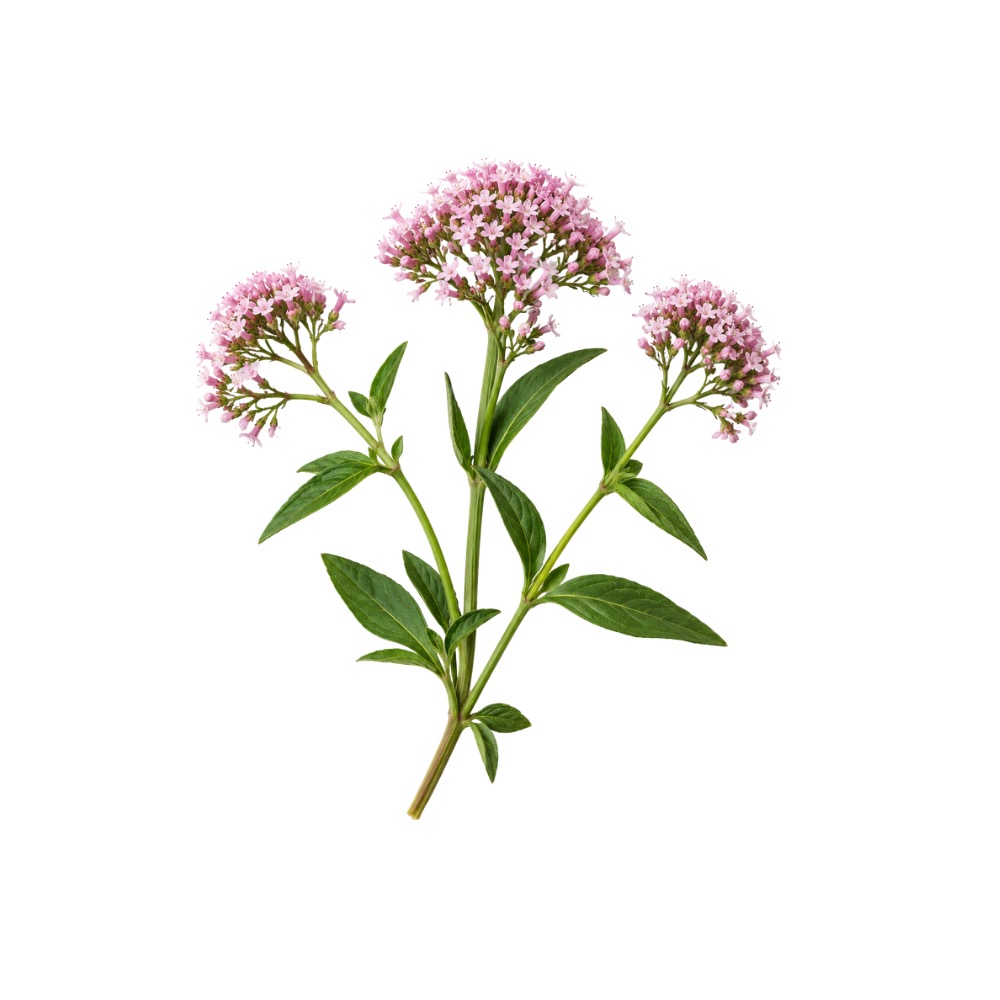
Valerenol is a naturally occurring sesquiterpenoid (valerenane sesquiterpene alcohol), found in Valerian and 4 other sources. It is well tolerated orally (low toxicity).
Concentration
Content by Source
Reported concentrations across the plants that contain valerenol — the bar marks the typical level, the line shows the reported range.
Literature figures for varying plant parts and preparations. Read them as a comparative guide, not exact assays.
Valerenol at a Glance
Valerenol is a valerenane sesquiterpene alcohol from valerian root — structurally, valerenic acid with its carboxylic acid reduced to a primary alcohol (C15H22O2 → C15H24O). That single change is the whole story of the molecule.
It matters because of one paper. In 2009 Benke and colleagues described a binding site on GABA-A receptors with nanomolar affinity for both valerenic acid and valerenol; both compounds enhanced GABA responses at multiple recombinant receptor subtypes, both lost most of that activity when the β2 or β3 subunit carried the N265M point mutation, and both were anxiolytic in wild-type mice in the elevated plus maze and light/dark choice test 1Reference 1AnimalGABA-A receptors as in vivo substrate for the anxiolytic action of valerenic acid, a major constituent of valerian root extractsView study →. Valerenol is therefore not a passenger — it is a second, independently active ligand at the site that explains valerian’s anxiolytic effect.
It is also almost entirely unstudied since. Valerenic acid has accumulated a receptor-mapping literature, a derivative-chemistry programme and a place in every valerian standardisation method; valerenol has essentially one pharmacology paper. This page is deliberately short, because inflating it would mean borrowing valerenic acid’s evidence and implying it transfers.
Valerenol vs. Valerenic Acid
The two molecules differ at a single functional group, and that group is the one doing the work in every structure–activity study of this scaffold.
| Valerenic acid | Valerenol | |
|---|---|---|
| Functional group | carboxylic acid (–COOH) | primary alcohol (–CH2OH) |
| Formula | C15H22O2 | C15H24O |
| Charge at physiological pH | anionic (ionised carboxylate) | neutral |
| GABA-A site | β2/β3-dependent, β(+)/α(−) interface near β3N265 2, | same nanomolar site; same β2/β3-N265M sensitivity 1Reference 1AnimalGABA-A receptors as in vivo substrate for the anxiolytic action of valerenic acid, a major constituent of valerian root extractsView study → |
| Anxiolytic in mice | yes 1, | yes 1Reference 1AnimalGABA-A receptors as in vivo substrate for the anxiolytic action of valerenic acid, a major constituent of valerian root extractsView study → |
| Causal β3 test (N265M knock-in mice) | done — effect abolished 1Reference 1AnimalGABA-A receptors as in vivo substrate for the anxiolytic action of valerenic acid, a major constituent of valerian root extractsView study → | not reported 1Reference 1AnimalGABA-A receptors as in vivo substrate for the anxiolytic action of valerenic acid, a major constituent of valerian root extractsView study → |
| Used for standardisation | yes 9, | no |
The carboxylate is not required for activity — and removing it tends to help. Khom and colleagues replaced valerenic acid’s carboxyl group with uncharged amides and found the amide derivative had higher potency and more than twice the efficacy at α1β3 receptors, with correspondingly stronger anxiolysis in mice 5Reference 5In vitroValerenic acid derivatives as novel subunit-selective GABAA receptor ligands — in vitro and in vivo characterizationView study →; a later derivative library reproduced this, with the amide, methylamide and tetrazole analogues all outperforming the parent acid on GABA-current enhancement and seizure threshold 6Reference 6Analysis of β-subunit-dependent GABAA receptor modulation and behavioral effects of valerenic acid derivativesView study →. The generalisation has limits, though: bulky esters of valerenic acid reduced direct receptor modulation in vitro and worked in vivo only as prodrugs that hydrolyse back to the acid 7Reference 7Esters of valerenic acid as potential prodrugsView study →. So the rule is “the acid group can be swapped for a small neutral group without loss, and often with gain” — not “anything neutral is better”.
Valerenol is exactly that swap occurring in nature. It is neutral and non-ionisable where valerenic acid is an anion at blood pH, which on first principles should make it the more lipophilic and more freely membrane-permeant of the pair — relevant given that valerenic acid and its acidic derivatives all crossed a blood–brain-barrier cell model far more slowly than diazepam, with the free acid slowest of the three tested 8Reference 8Essential oil composition of Valeriana officinalis L. roots cultivated in IranView study →. Valerenol was not in that experiment, and no measured logP, permeability or brain-uptake figure for it has been published, so this remains a mechanistic expectation rather than a finding.
What Benke 2009 Actually Reported
This page’s premise deserves a precise statement, because valerenol is often described second-hand as “more potent than valerenic acid” and that ranking is not something the accessible record supports.
What the paper’s own summary states is that the GABA-A site has nanomolar affinity for valerenic acid and valerenol, that both enhanced GABA responses, and that both “exerted anxiolytic activity with high potencies” in wild-type mice 1Reference 1AnimalGABA-A receptors as in vivo substrate for the anxiolytic action of valerenic acid, a major constituent of valerian root extractsView study →. It does not rank them. Two further details are worth holding:
- The β3(N265M) knock-in mouse experiment — the causal step that proved β3-containing receptors mediate the behaviour — was reported for valerenic acid, whose anxiolytic effect was absent in the mutants. The equivalent test for valerenol is not described 1Reference 1AnimalGABA-A receptors as in vivo substrate for the anxiolytic action of valerenic acid, a major constituent of valerian root extractsView study →.
- The recombinant-receptor mutation result (β2 or β3 N265M strongly reducing the drug response) applies to both agents, so valerenol’s molecular site assignment is solid even though its in vivo causal chain is one experiment shorter 1Reference 1AnimalGABA-A receptors as in vivo substrate for the anxiolytic action of valerenic acid, a major constituent of valerian root extractsView study →.
Treat “valerenol is at least as active as valerenic acid at the same site” as supported, and any specific potency ratio as unverified.
The Standardisation Blind Spot
Valerian products are standardised — when they are standardised at all — to valerenic acid. That marker choice is well founded: valerenic acid distinguishes true Valeriana officinalis from other species and correlates with the extract’s anxiolytic activity 4,
Nothing measures valerenol. An HPLC survey of 31 Australian valerian products found valerenic acid and its derivatives ranging from under 0.01 to 6.32 mg/g, with the five valerenic-acid-standardised products averaging four times the content of the 26 unstandardised ones 9Reference 9Valepotriates and valerenic acids in commercial preparations of valerian available in AustraliaView study → — a useful demonstration that standardisation works, and equally a demonstration that it works on one analyte. A systematic review of 60 valerian studies concluded that inconsistent clinical outcomes were driven substantially by variable extract quality, and explicitly called for revised quality-control and standardisation methods 10Reference 10Meta-analysisValerian root in treating sleep problems and associated disorders — a systematic review and meta-analysisView study →.
Two practical points follow:
- A product’s valerenol content is unmeasured and uncontrolled. Extraction method changes it sharply: in Iranian V. officinalis root, supercritical-CO2 extraction gave an oil with 3.7–5.2% valerenol, while hydrodistillation of the same material did not yield it among the major components at all 8Reference 8Essential oil composition of Valeriana officinalis L. roots cultivated in IranView study →. Two extracts matched on valerenic acid can differ substantially in valerenol.
- This is a real confounder, not a curiosity. If a second nanomolar ligand at the same receptor site varies freely between preparations, then “standardised to X mg valerenic acid” is a weaker guarantee of pharmacological equivalence than it appears — a mechanism for batch-to-batch variation that sits alongside the better-known one, acetoxyvalerenic acid, which occupies the site without potentiating and cancels valerenic acid’s anxiolytic effect 4Reference 4The anxiolytic effects of a Valerian extract is based on valerenic acidView study →.
The Three-Way Relationship
Valerian carries at least three ligands for the same GABA-A site, pulling in different directions:
| Compound | At the valerenic-acid site | Net effect |
|---|---|---|
| Valerenic acid | binds; positive allosteric modulation, β2/β3-selective 2Reference 2Valerenic acid potentiates and inhibits GABA(A) receptors: molecular mechanism and subunit specificityView study → | anxiolytic, sedative at higher exposure 1, |
| Valerenol | binds (nanomolar); enhances GABA responses 1Reference 1AnimalGABA-A receptors as in vivo substrate for the anxiolytic action of valerenic acid, a major constituent of valerian root extractsView study → | anxiolytic in mice 1Reference 1AnimalGABA-A receptors as in vivo substrate for the anxiolytic action of valerenic acid, a major constituent of valerian root extractsView study → |
| Acetoxyvalerenic acid | binds but does not potentiate; inhibitory at high concentration 2Reference 2Valerenic acid potentiates and inhibits GABA(A) receptors: molecular mechanism and subunit specificityView study → | abolishes valerenic acid’s anxiolysis 4Reference 4The anxiolytic effects of a Valerian extract is based on valerenic acidView study → |
The ratio of these three, not the valerenic-acid figure alone, is what a valerian preparation actually delivers to the receptor.
What It's Used For
The isolated-compound literature on valerenol is one pharmacology paper plus a handful of GC-MS occurrence reports. What follows is scaled to that.
Support is an experimental score — weighted by study type (human > animal > in vitro) and volume. A beta, not a validated metric. Every row here is preclinical; nothing here has been tested in a person.
The only application with direct evidence for the isolate. Valerenol bound a specific GABA-A site with nanomolar affinity, enhanced GABA responses at multiple recombinant receptor types, lost most of that effect when β2 or β3 carried the N265M mutation, and produced anxiolytic activity with high potency in wild-type mice on both the elevated plus maze and the light/dark choice test 1Reference 1AnimalGABA-A receptors as in vivo substrate for the anxiolytic action of valerenic acid, a major constituent of valerian root extractsView study →.
That is a complete in-vitro-to-behaviour chain for a molecule with almost no other literature.
Gap: it is one paper. Valerenol was not run in the β3(N265M) knock-in mice that supplied the causal proof for valerenic acid, no EC50/Ki figure for it is recoverable from the accessible record, and it has never been replicated by an independent group 1Reference 1AnimalGABA-A receptors as in vivo substrate for the anxiolytic action of valerenic acid, a major constituent of valerian root extractsView study →.
Valerian’s use is chiefly for sleep, and the receptor valerenol acts on is the one that plausibly mediates it — but this application is inference, not measurement. No study has tested isolated valerenol on sleep architecture, sleep latency or sedation in any species. The human sleep evidence is for whole valerian root and its extracts, is modest and inconsistent, and a 60-study systematic review attributed much of that inconsistency to extract-quality variation rather than to any single molecule 10Reference 10Meta-analysisValerian root in treating sleep problems and associated disorders — a systematic review and meta-analysisView study →.
Gap: there is no isolate sleep data at all. Attributing any part of valerian’s hypnotic effect specifically to valerenol would be unsupported; the honest claim is that it is present, active at the relevant receptor, and unquantified in the products people take 9,
Valerenol turns up in GC-MS profiles of several bioactive root and resin oils — 18.48% of a CO2-expanded-ethanol vetiver root oil with antimicrobial and antioxidant activity 11Reference 11Chemical composition, antioxidant, and antimicrobial activities of Vetiveria zizanioides (L.) Nash essential oil extracted by carbon dioxide expanded ethanolView study →, 4.20% of a Himalayan Saussurea costus root oil 12Reference 12Volatile constituents of Saussurea costus roots cultivated in Uttarakhand Himalayas, IndiaView study →, and 3.54% of an agarwood oil that was cytotoxic to tumour cell lines and pro-apoptotic in HepG2 cells 13Reference 13Chemical profiling and cytotoxicity screening of agarwood essential oil (Aquilaria sinensis) in brine shrimp nauplii and cancer cell linesView study →. It also appears at 4.08% of an Anabasis setifera leaf-extract GC-MS profile with antimicrobial and antioxidant activity 14Reference 14Anabasis setifera leaf extract from arid habitat: a treasure trove of bioactive phytochemicals with potent antimicrobial, anticancer, and antioxidant propertiesView study →, among propolis terpenoids 15Reference 15Investigation of chemical composition of propolis extractView study →, and among Eucalyptus camaldulensis leaf volatiles docked to an insect odorant-binding protein 16Reference 16Highlights on the mechanism of Eucalyptus camaldulensis Dehnh. psyllid infestation: insight from its relationship with the chemical composition of essential oil through computational studyView study →.
Gap: in every one of these, the tested article is the whole oil or extract, valerenol is one of dozens of components, and it was never assayed alone — so none of this is evidence about the molecule. These are also GC-MS library identifications in taxa unrelated to Valeriana, which is precisely the situation in which C15H24O sesquiterpene alcohols are most easily misassigned; treat the non-valerian occurrences as provisional 11,
Mechanisms
| Target / pathway | Effect | Relevant to |
|---|---|---|
| GABA-A receptor, valerenic-acid site (β(+)/α(−) interface, near β3N265) | binds with nanomolar affinity; positive allosteric enhancement of the GABA response across multiple subtypes | anxiolysis |
| GABA-A β2/β3 subunit residue N265 | N265M mutation strongly reduces the response — the subunit dependence that defines this ligand class | subunit selectivity |
| Benzodiazepine site | not involved — this class is flumazenil-insensitive and acts at a distinct pocket near the loreclezole/etomidate site | mechanism boundary |
| Uncharged C11 substituent (alcohol vs. carboxylate) | removal of the anionic group is tolerated and, in synthetic amide/tetrazole analogues, increases potency and efficacy | structure–activity |
The load-bearing point is that valerenol is not a weaker echo of valerenic acid at some related target — it is a ligand at the same pocket, mapped by the same mutation, in the same experiment.
Pharmacokinetics
Nothing is published. There is no absorption, distribution, metabolism, half-life or oral-bioavailability data for valerenol in any species, and no measured logP or brain-penetration figure. The closest available anchor is a blood–brain-barrier cell model in which valerenic acid, acetoxyvalerenic acid and hydroxyvalerenic acid all permeated far more slowly than diazepam — valerenic acid slowest, at roughly 3% of the diazepam rate 8Reference 8Essential oil composition of Valeriana officinalis L. roots cultivated in IranView study →. Valerenol was not tested. Because it is neutral rather than anionic at physiological pH, it would be expected to permeate more readily than the acids, and it would be metabolised by the usual routes for a sesquiterpene alcohol (oxidation and glucuronidation) — but both statements are chemistry-based expectation, not measurement. This is the single largest hole in the page.
Clinical Trials
None. Isolated valerenol has never entered a human study of any phase, and no clinical trial of a valerian product reports its content. The human record consists entirely of trials of whole valerian root or extracts standardised to a different molecule 9,
| Completed | Planned | Terminated | Preclinical |
|---|---|---|---|
| — | — | — | One receptor + rodent-behaviour study 1Reference 1AnimalGABA-A receptors as in vivo substrate for the anxiolytic action of valerenic acid, a major constituent of valerian root extractsView study →; whole-oil assays 11, |
Last checked: July 2026.
Isolate vs. Plant Studies
The split here is unusually clean. All of the meaningful pharmacology is isolate work — Benke’s study used purified valerenol on recombinant receptors and dosed it into mice 1Reference 1AnimalGABA-A receptors as in vivo substrate for the anxiolytic action of valerenic acid, a major constituent of valerian root extractsView study → — which is a genuine strength: the anxiolytic result cannot be blamed on co-constituents.
All of the human evidence is whole-plant, and belongs to valerian, not to this molecule 10Reference 10Meta-analysisValerian root in treating sleep problems and associated disorders — a systematic review and meta-analysisView study →. There is no bridge between the two. The isolate data establish that valerenol can do something; nothing establishes that the valerenol in a valerian capsule does anything, because nobody has measured how much is there 9Reference 9Valepotriates and valerenic acids in commercial preparations of valerian available in AustraliaView study →.
The GC-MS occurrence reports from vetiver, agarwood, costus and propolis sit in a third category — whole-extract bioassays where valerenol is a named component of an active mixture and was never tested separately 11,
Prevalence in Nature
Valerenol is a valerian molecule first. The valerenane skeleton it shares with valerenic acid is characteristic of Valeriana officinalis, and valerenic acid is the marker used to distinguish true officinalis material from other commercial “valerians” 10Reference 10Meta-analysisValerian root in treating sleep problems and associated disorders — a systematic review and meta-analysisView study →.
Within valerian, valerenol is a minor and extraction-dependent component of the root’s volatile fraction. In supercritical-CO2 extracts of Iranian V. officinalis root it made up 3.7–5.2% of the oil, against 8.2–11.8% for valerenic acid in the same extracts — roughly two to three times less abundant than its acid sibling. Hydrodistillation of the same root material produced an oil whose major components were bornyl acetate, valerenic acid, (Z)-valerenyl acetate and acetoxyvaleranone, with valerenol absent from the list 8Reference 8Essential oil composition of Valeriana officinalis L. roots cultivated in IranView study →. Since the volatile oil is itself only a fraction of the root, valerenol’s share of the whole dried root is small and, as far as the indexed literature goes, has never been quantified directly.
Outside Valerianaceae, valerenol has been reported — always by GC-MS peak identification — from several unrelated aromatic species, sometimes at high shares of the oil. These should be read as provisional: sesquiterpene alcohols of formula C15H24O are numerous and closely similar, and library matching across distant taxa is a known source of misassignment.
Major Natural Sources
| Source | Part | Valerenol | Basis |
|---|---|---|---|
| Valerian (Valeriana officinalis) | root, supercritical-CO2 oil | 3.7–5.2% of oil | GC/GC-MS of SC-CO2 extract; absent from major components by hydrodistillation 8Reference 8Essential oil composition of Valeriana officinalis L. roots cultivated in IranView study → |
| Vetiver (Vetiveria zizanioides) | root oil (CO2-expanded ethanol) | 18.48% of oil | GC-MS; reported as a major component 11Reference 11Chemical composition, antioxidant, and antimicrobial activities of Vetiveria zizanioides (L.) Nash essential oil extracted by carbon dioxide expanded ethanolView study → |
| Costus (Saussurea costus) | root oil | 4.20% of oil | GC-MS of hydrodistilled oil 12Reference 12Volatile constituents of Saussurea costus roots cultivated in Uttarakhand Himalayas, IndiaView study → |
| Agarwood (Aquilaria sinensis) | wood/resin oil | 3.54% of oil | GC-MS; oil is ~96% sesquiterpenes/sesquiterpenoids 13Reference 13Chemical profiling and cytotoxicity screening of agarwood essential oil (Aquilaria sinensis) in brine shrimp nauplii and cancer cell linesView study → |
| Anabasis setifera | leaf, ethyl-acetate extract | 4.08% of profile | GC-MS of a solvent extract, not an oil 14Reference 14Anabasis setifera leaf extract from arid habitat: a treasure trove of bioactive phytochemicals with potent antimicrobial, anticancer, and antioxidant propertiesView study → |
| Propolis | ethanolic extract | not quantified | listed among the terpenoids of Lithuanian propolis 15Reference 15Investigation of chemical composition of propolis extractView study → |
| Eucalyptus (E. camaldulensis) | infested-leaf oil | not quantified | one of 66 volatiles; modelled as an insect odorant-binding-protein ligand 16Reference 16Highlights on the mechanism of Eucalyptus camaldulensis Dehnh. psyllid infestation: insight from its relationship with the chemical composition of essential oil through computational studyView study → |
Discovery & Synthesis
First isolation is not well documented. Valerenol belongs to the valerenane sesquiterpenes worked out during mid-twentieth-century valerian-oil chemistry, but no indexed first-isolation paper for valerenol specifically could be verified, and PubMed’s record of the compound begins in 2004 with a propolis GC-MS survey 15Reference 15Investigation of chemical composition of propolis extractView study →. Its pharmacological identity dates precisely from 2009, when Benke and colleagues at the University of Zurich tested it alongside valerenic acid and found the shared GABA-A site 1Reference 1AnimalGABA-A receptors as in vivo substrate for the anxiolytic action of valerenic acid, a major constituent of valerian root extractsView study →.
No total synthesis of valerenol is documented. The synthetic work on this scaffold has run in a different direction: rather than making valerenol, the Vienna and Zurich groups made valerenic acid derivatives — amides, methylamides, tetrazoles and esters — as candidate anxiolytics and anticonvulsants, all built by modifying the acid group of extracted valerenic acid 5,
Patents: not yet researched.
Toxicity & Safety
There is no toxicology for isolated valerenol — no acute, repeat-dose, genotoxicity or reproductive study, and no interaction work. The low grading is a contextual judgement, not a clean bill of health: valerenol is a minor constituent of a herb with a long and well-tolerated record of use, it was given to mice in an anxiolytic study without reported adverse effects 1Reference 1AnimalGABA-A receptors as in vivo substrate for the anxiolytic action of valerenic acid, a major constituent of valerian root extractsView study →, and it belongs to a chemical class (sesquiterpene alcohols) with generally unremarkable toxicity. Silence is not evidence of safety.
Its one predictable risk follows directly from its mechanism. Because valerenol positively modulates GABA-A receptors, the same additive-sedation caution that applies to valerian itself applies here: combining it with alcohol, benzodiazepines, barbiturates, opioids, sedating antihistamines or other CNS depressants could compound their effects 1,
Because valerenol is not measured in any valerian product, it is also not possible to state how much of it a given preparation delivers — a point that cuts both ways for safety and efficacy 9Reference 9Valepotriates and valerenic acids in commercial preparations of valerian available in AustraliaView study →.
- No adverse effects reported in the one animal study. Anxiolytic doses in mice produced no noted toxicity 1Reference 1AnimalGABA-A receptors as in vivo substrate for the anxiolytic action of valerenic acid, a major constituent of valerian root extractsView study →.
- Long-standing dietary/herbal exposure context. It occurs as a minor component of valerian root, which has a well-tolerated human use record 10Reference 10Meta-analysisValerian root in treating sleep problems and associated disorders — a systematic review and meta-analysisView study →.
- Additive CNS depression is mechanistically expected. As a GABA-A positive modulator it should be treated like any sedative when combined with alcohol, benzodiazepines, opioids or sedating antihistamines 1,
2Reference 1AnimalGABA-A receptors as in vivo substrate for the anxiolytic action of valerenic acid, a major constituent of valerian root extractsView study →Reference 2Valerenic acid potentiates and inhibits GABA(A) receptors: molecular mechanism and subunit specificityView study → . - No toxicology exists for the isolate. No acute, repeat-dose, genotoxicity, reproductive or interaction data — the low flag is contextual, not tested.
- Content is unmeasured in products. No valerian preparation is standardised to or assayed for valerenol, so exposure cannot be quantified 9,
10Reference 9Valepotriates and valerenic acids in commercial preparations of valerian available in AustraliaView study →Reference 10Meta-analysisValerian root in treating sleep problems and associated disorders — a systematic review and meta-analysisView study → .
Dosage
There is no dose. Isolated valerenol has never been administered to a human being, is not sold as an ingredient, and is not a standardisation target for any valerian product 9,
Human exposure is therefore incidental and unquantified: whatever fraction of valerenol happens to be present in the root or extract someone takes, varying with cultivar, harvest, drying and — demonstrably — extraction method 8,
These are research observations, not a personal recommendation.
References
- Benke D, Barberis A, Kopp S, Altmann KH, Schubiger M, Vogt KE, Rudolph U, Möhler H (2009). GABA-A receptors as in vivo substrate for the anxiolytic action of valerenic acid, a major constituent of valerian root extracts. Neuropharmacology. https://pubmed.ncbi.nlm.nih.gov/18602406/
- Khom S, Baburin I, Timin E, Hohaus A, Trauner G, Kopp B, Hering S (2007). Valerenic acid potentiates and inhibits GABA(A) receptors: molecular mechanism and subunit specificity. Neuropharmacology. https://pubmed.ncbi.nlm.nih.gov/17585957/
- Luger D, Poli G, Wieder M, Stadler M, Ke S, Ernst M, Hohaus A, Linder T, Seidel T, Langer T, Khom S, Hering S (2015). Identification of the putative binding pocket of valerenic acid on GABAA receptors using docking studies and site-directed mutagenesis. British Journal of Pharmacology. https://pubmed.ncbi.nlm.nih.gov/26375408/
- Becker A, Felgentreff F, Schröder H, Meier B, Brattström A (2014). The anxiolytic effects of a Valerian extract is based on valerenic acid. BMC Complementary and Alternative Medicine. https://pubmed.ncbi.nlm.nih.gov/25066015/
- Khom S, Strommer B, Ramharter J, Schwarz T, Schwarzer C, Erker T, Ecker GF, Mulzer J, Hering S (2010). Valerenic acid derivatives as novel subunit-selective GABAA receptor ligands — in vitro and in vivo characterization. British Journal of Pharmacology. https://pubmed.ncbi.nlm.nih.gov/20718740/
- Khom S, Hintersteiner J, Luger D, Haider M, Pototschnig G, Mihovilovic MD, Schwarzer C, Hering S (2016). Analysis of β-subunit-dependent GABAA receptor modulation and behavioral effects of valerenic acid derivatives. Journal of Pharmacology and Experimental Therapeutics. https://pubmed.ncbi.nlm.nih.gov/27190170/
- Hintersteiner J, Haider M, Luger D, Schwarzer C, Reznicek G, Jäger W, Khom S, Mihovilovic MD, Hering S (2014). Esters of valerenic acid as potential prodrugs. European Journal of Pharmacology. https://pubmed.ncbi.nlm.nih.gov/24680924/
- Safaralie A, Fatemi S, Sefidkon F (2008). Essential oil composition of Valeriana officinalis L. roots cultivated in Iran. Comparative analysis between supercritical CO2 extraction and hydrodistillation. Journal of Chromatography A. https://pubmed.ncbi.nlm.nih.gov/18164718/
- Shohet D, Wills RB, Stuart DL (2001). Valepotriates and valerenic acids in commercial preparations of valerian available in Australia. Pharmazie. https://pubmed.ncbi.nlm.nih.gov/11817170/
- Shinjyo N, Waddell G, Green J (2020). Valerian root in treating sleep problems and associated disorders — a systematic review and meta-analysis. Journal of Evidence-Based Integrative Medicine. https://pubmed.ncbi.nlm.nih.gov/33086877/
- David A, Wang F, Sun X, Li H, Lin J, Li P, Deng G (2019). Chemical composition, antioxidant, and antimicrobial activities of Vetiveria zizanioides (L.) Nash essential oil extracted by carbon dioxide expanded ethanol. Molecules. https://pubmed.ncbi.nlm.nih.gov/31108854/
- Gwari G, Bhandari U, Andola HC, Lohani H, Chauhan N (2013). Volatile constituents of Saussurea costus roots cultivated in Uttarakhand Himalayas, India. Pharmacognosy Research. https://pubmed.ncbi.nlm.nih.gov/23901213/
- Chan SW, Mahmoud VL, Wang X, Teoh ML, Loh KM, Ng CH, Wong WF, Looi CY (2024). Chemical profiling and cytotoxicity screening of agarwood essential oil (Aquilaria sinensis) in brine shrimp nauplii and cancer cell lines. PLoS One. https://pubmed.ncbi.nlm.nih.gov/39509364/
- Abdelaziz AM, Abdel-Maksoud MA, Fatima S, Almutairi S, Kiani BH, Hashem AH (2024). Anabasis setifera leaf extract from arid habitat: a treasure trove of bioactive phytochemicals with potent antimicrobial, anticancer, and antioxidant properties. PLoS One. https://pubmed.ncbi.nlm.nih.gov/39453934/
- Majiene D, Trumbeckaite S, Grūnoviene D, Ivanauskas L, Gendrolis A (2004). Investigation of chemical composition of propolis extract. Medicina (Kaunas). https://pubmed.ncbi.nlm.nih.gov/15299997/
- Abla S, Tachoua W, Zanndouche O (2025). Highlights on the mechanism of Eucalyptus camaldulensis Dehnh. psyllid infestation: insight from its relationship with the chemical composition of essential oil through computational study. Chemistry & Biodiversity. https://pubmed.ncbi.nlm.nih.gov/41092246/



