
Compound Monograph
Biscryptolepine
Biscryptolepine is a dimeric indoloquinoline alkaloid — two cryptolepine-type units joined — from the root bark of the West African plant Cryptolepis sanguinolenta. Its entire published record is its isolation and a single antibacterial screen; it has no pharmacokinetic, animal or human data.

Sources · 2
Where Does It Come From?
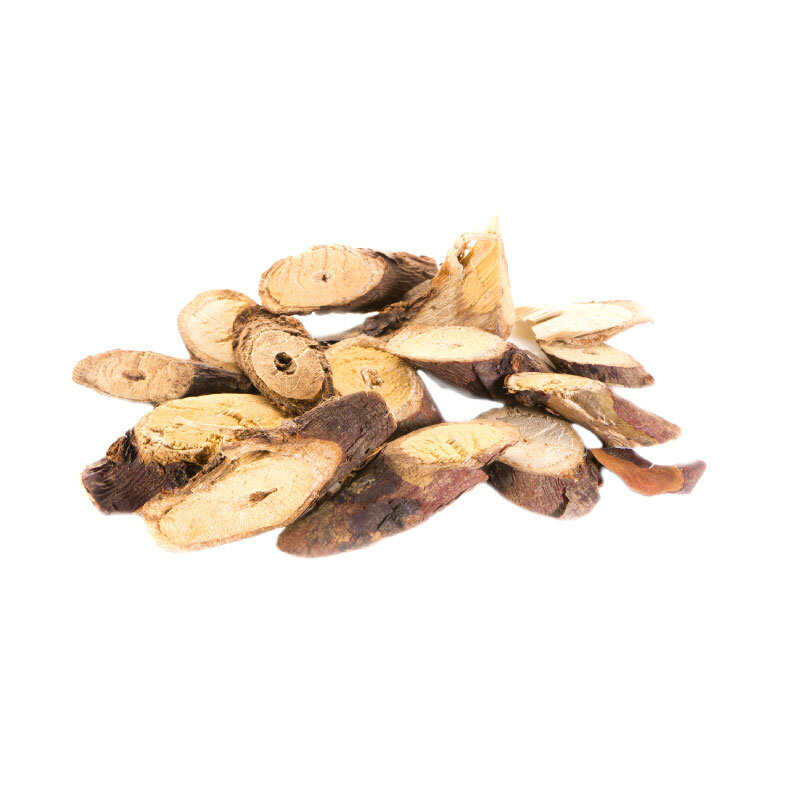
Biscryptolepine is a naturally occurring indoloquinoline alkaloid (dimeric), found in Cryptolepis sanguinolenta and 1 other source. It is flagged as moderately toxic.
Concentration
Content by Source
Concentrations not reported. No percent-dry-weight or mg/g figures have been published for this compound in its source plants.
Biscryptolepine at a Glance
Biscryptolepine is a dimeric indoloquinoline alkaloid — structurally, two cryptolepine-type units joined together — isolated from the root bark of Cryptolepis sanguinolenta, the West African plant known as the yellow-dye root or nibima. It belongs to the same alkaloid family that gives the plant its flagship molecule, cryptolepine, and its siblings neocryptolepine and cryptoquindoline.
Unlike cryptolepine, biscryptolepine is barely studied. Essentially the entire published record for this molecule is its isolation and a single antimicrobial screen, in which it showed modest activity against some Gram-positive bacteria 1Reference 1Antibacterial and antifungal activities of neocryptolepine, biscryptolepine and cryptoquindoline, alkaloids isolated from Cryptolepis sanguinolentaView study →. There are no pharmacokinetic, animal or human data, and its own toxicity has not been directly characterised.
This page is therefore short and deliberately cautious. Where the text below reaches for mechanism or safety context, it borrows from the well-studied monomer cryptolepine — and says so — because those properties have not been demonstrated for biscryptolepine itself.
What It's Used For
The evidence base is a single in-vitro study. Cimanga and colleagues isolated biscryptolepine (alongside neocryptolepine and cryptoquindoline) from C. sanguinolenta root bark and tested the alkaloids for antibacterial and antifungal activity 1Reference 1Antibacterial and antifungal activities of neocryptolepine, biscryptolepine and cryptoquindoline, alkaloids isolated from Cryptolepis sanguinolentaView study →.
Support is an experimental score — weighted by study type (human > animal > in vitro) and volume. A beta, not a validated metric. For biscryptolepine the pool is essentially one in-vitro paper, so the single row below sits low by design.
The only reported bioactivity. In the isolation study, biscryptolepine showed activity against some Gram-positive bacteria, with MICs of about 31 or 62.5 µg/mL, while it and the co-isolated cryptoquindoline were less active than neocryptolepine, and cryptoquindoline was essentially inactive 1Reference 1Antibacterial and antifungal activities of neocryptolepine, biscryptolepine and cryptoquindoline, alkaloids isolated from Cryptolepis sanguinolentaView study →. This is the isolated alkaloid tested against reference strains — not a whole-plant or decoction study, and not an in-vivo infection model.
Gap: the result rests on one paper, at MICs that are moderate at best; there is no confirmation, no spectrum mapping, no mechanism-of-action work, and no in-vivo follow-up for biscryptolepine.
Mechanisms
No mechanistic study has been performed on biscryptolepine. The table below records only what is inferred from its structural class — it is context, not evidence for this molecule.
| Target / pathway | Effect | Relevant to |
|---|---|---|
| Bacterial growth (Gram-positive) | inhibition in vitro (MIC ≈ 31–62.5 µg/mL) — the one measured activity | antibacterial |
| DNA intercalation / topoisomerase II | class-level — demonstrated for the monomer cryptolepine, not tested for biscryptolepine | hypothetical read-across only |
The load-bearing caveat is the second row: DNA intercalation and topoisomerase-II poisoning define cryptolepine, but nothing establishes that the dimer shares them. Do not present class biology as biscryptolepine pharmacology.
Pharmacokinetics
No absorption, distribution, metabolism, half-life or bioavailability data exist for biscryptolepine. As a large, planar, likely DNA-avid dimer it would be expected to have poor oral bioavailability, but this is unmeasured and stated only as an expectation.
Clinical Trials
None. Biscryptolepine has never entered animal efficacy testing, let alone human trials.
| Completed | Planned | Terminated | Preclinical |
|---|---|---|---|
| — | — | — | Single in-vitro antibacterial screen 1Reference 1Antibacterial and antifungal activities of neocryptolepine, biscryptolepine and cryptoquindoline, alkaloids isolated from Cryptolepis sanguinolentaView study → |
Last checked: July 2026.
Isolate vs. Plant Studies
All of the (very limited) evidence is on the isolated alkaloid in vitro 1Reference 1Antibacterial and antifungal activities of neocryptolepine, biscryptolepine and cryptoquindoline, alkaloids isolated from Cryptolepis sanguinolentaView study →. No study has traced biscryptolepine’s contribution to the activity of whole C. sanguinolenta root, its water decoction (the traditional preparation) or its ethanol extract — the plant’s documented antimalarial and antibacterial effects are attributed overwhelmingly to cryptolepine, with biscryptolepine a minor congener of unknown practical contribution.
Prevalence in Nature
Biscryptolepine is reported only from Cryptolepis sanguinolenta (Apocynaceae/Periplocaceae), where it occurs as a minor dimeric alkaloid of the root bark 1Reference 1Antibacterial and antifungal activities of neocryptolepine, biscryptolepine and cryptoquindoline, alkaloids isolated from Cryptolepis sanguinolentaView study →. The roots are the alkaloid-rich part of the plant, and biscryptolepine is a small component of that alkaloid fraction — its actual concentration (% dry weight or mg per g) has not been quantified in the published literature, so no Content-by-Source figure can honestly be given. It has not been reported from the plant’s aerial parts, nor from the Sida species (e.g. Sida acuta/wireweed) that share several of the monomeric indoloquinolines.
Discovery & Synthesis
Biscryptolepine was reported as a new alkaloid by Cimanga and colleagues in 1998, isolated from C. sanguinolenta root bark and characterised by spectral evidence, in the same study that described its antibacterial and antifungal screening alongside neocryptolepine and cryptoquindoline 1Reference 1Antibacterial and antifungal activities of neocryptolepine, biscryptolepine and cryptoquindoline, alkaloids isolated from Cryptolepis sanguinolentaView study →. It is one of the dimeric (“bis”) indoloquinolines that distinguish this plant’s chemistry from the simpler monomeric alkaloids.
No total synthesis of biscryptolepine is documented, and there is no commercial production — it exists only as a research isolate. Manufacture, if ever needed, would presumably start from cryptolepine-type units, but no route has been published.
Patents: not yet researched.
Toxicity & Safety
Biscryptolepine carries a precautionary moderate flag, and it is important to be clear about why: its own toxicity has not been measured. There is no isolate cytotoxicity, genotoxicity, animal or human safety study for biscryptolepine.
The precaution is a class-based read-across, not a finding. The parent monomer, cryptolepine, is potently cytotoxic — the C. sanguinolenta extract and cryptolepine cause dose- and time-dependent loss of cell viability with sub-G1 (apoptotic) accumulation 3Reference 3The popular herbal antimalarial, extract of Cryptolepis sanguinolenta, is potently cytotoxicView study → — and cryptolepine acts as a DNA-intercalating topoisomerase-II poison 2Reference 2The DNA intercalating alkaloid cryptolepine interferes with topoisomerase II and inhibits primarily DNA synthesis in B16 melanoma cellsView study →. A dimer built from two such units is, if anything, structurally more likely to bind DNA avidly, so it would be irresponsible to badge biscryptolepine as low-risk on the strength of an absence of data. Equally, that risk is inferred, not demonstrated.
- The one measured effect is a modest in-vitro antibacterial activity against some Gram-positive bacteria — nothing about it implies a systemic hazard at the exposure levels anyone actually encounters (there are none).
- Toxicity is not established for biscryptolepine. The moderate grading is precautionary, driven by the potent cytotoxicity and DNA-intercalating topoisomerase-II activity of its monomer cryptolepine 2,
3Reference 2The DNA intercalating alkaloid cryptolepine interferes with topoisomerase II and inhibits primarily DNA synthesis in B16 melanoma cellsView study →Reference 3The popular herbal antimalarial, extract of Cryptolepis sanguinolenta, is potently cytotoxicView study → — properties not tested for the dimer. - No safety characterisation of any kind: no genotoxicity, reproductive, repeat-dose or interaction data. Never read the silence as reassurance.
Dosage
There is no human dose for biscryptolepine — it has never been developed, dosed or tested in people or animals. The only quantitative figures in the literature are in-vitro minimum inhibitory concentrations of about 31–62.5 µg/mL against some Gram-positive bacteria 1Reference 1Antibacterial and antifungal activities of neocryptolepine, biscryptolepine and cryptoquindoline, alkaloids isolated from Cryptolepis sanguinolentaView study →, which are laboratory potency measures, not doses. These are research figures and are not a personal recommendation.
References
- Cimanga K, De Bruyne T, Pieters L, Totté J, Tona L, Kambu K, Vanden Berghe D, Vlietinck AJ (1998). Antibacterial and antifungal activities of neocryptolepine, biscryptolepine and cryptoquindoline, alkaloids isolated from Cryptolepis sanguinolenta. Phytomedicine. https://pubmed.ncbi.nlm.nih.gov/23195843/
- Bonjean K, De Pauw-Gillet MC, Defresne MP, Colson P, Houssier C, Dassonneville L, Bailly C, Greimers R, Wright C, Quetin-Leclercq J, Tits M, Angenot L (1998). The DNA intercalating alkaloid cryptolepine interferes with topoisomerase II and inhibits primarily DNA synthesis in B16 melanoma cells. Biochemistry. https://pubmed.ncbi.nlm.nih.gov/9548744/
- Ansah C, Gooderham NJ (2002). The popular herbal antimalarial, extract of Cryptolepis sanguinolenta, is potently cytotoxic. Toxicological Sciences. https://pubmed.ncbi.nlm.nih.gov/12441369/



