
Compound Monograph
Cryptoquindoline
Cryptoquindoline is a minor dimeric indoloquinoline alkaloid of the West African antimalarial root Cryptolepis sanguinolenta, related to the cryptolepine and quindoline series. It is essentially a structural curiosity: when tested it was inactive against bacteria and fungi, and it has no meaningful pharmacology in people or animals.

Sources · 1
Where Does It Come From?
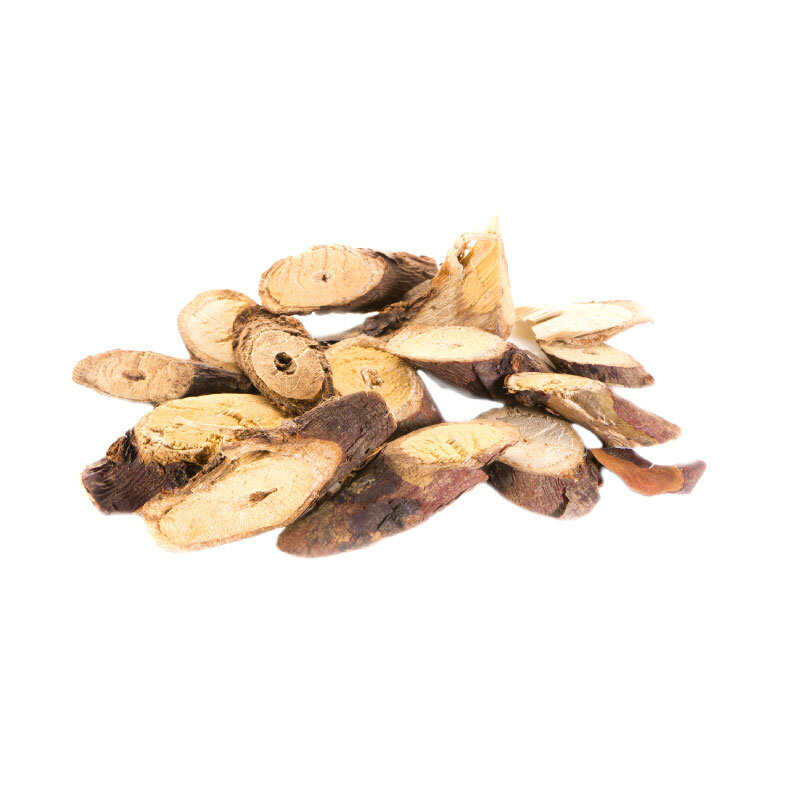
Cryptoquindoline is a naturally occurring dimeric indoloquinoline alkaloid (quindoline series), found in Yellow-dye root. Its toxicity is not yet characterized.
Concentration
Content by Source
Concentrations not reported. No percent-dry-weight or mg/g figures have been published for this compound in its source plants.
Cryptoquindoline at a Glance
Cryptoquindoline is a minor dimeric indoloquinoline alkaloid of Cryptolepis sanguinolenta — the West African “yellow-dye root” whose water decoction is a traditional antimalarial. It belongs to the same chemical family as the plant’s flagship alkaloid, cryptolepine, and its non-methylated relative quindoline, but it is a two-unit (dimeric) member of that series rather than a simple monomer 1,
Unlike its famous siblings, cryptoquindoline has essentially no pharmacology. In the one study that tested it directly, it was inactive against every bacterium and fungus screened 1Reference 1Antibacterial and antifungal activities of neocryptolepine, biscryptolepine and cryptoquindoline, alkaloids isolated from Cryptolepis sanguinolentaView study →; beyond that, the only mention of it in the biomedical literature is a purely computational docking exercise 2Reference 2Alkaloids from Cryptolepis sanguinolenta as potential inhibitors of SARS-CoV-2 viral proteins: an in silico studyView study →. It carries none of cryptolepine’s antimalarial, anticancer or antibacterial activity. This page documents it honestly as a structural constituent, not as a bioactive compound.
A Dimeric Member Of The Quindoline Series
Cryptolepis sanguinolenta produces a whole family of indoloquinoline alkaloids built on the same fused indole–quinoline scaffold. Most are monomers — cryptolepine (the 5-methyl parent), quindoline (its des-N-methyl relative), neocryptolepine and isocryptolepine (positional isomers) — and these carry the plant’s antimalarial and cytotoxic activity.
Cryptoquindoline sits in the plant’s smaller set of dimeric alkaloids: larger molecules formed from two indoloquinoline units, a group that also includes biscryptolepine and the structurally elaborate cryptospirolepine. As a rule, these dimers are isolated in tiny amounts and are far less studied than the monomers — and, in cryptoquindoline’s case, turned out to be pharmacologically inert in the one assay that tested it 1Reference 1Antibacterial and antifungal activities of neocryptolepine, biscryptolepine and cryptoquindoline, alkaloids isolated from Cryptolepis sanguinolentaView study →. Its name reflects this lineage: crypto- (from Cryptolepis) + quindoline (the monomeric building block).
What It's Used For
The evidence base for cryptoquindoline is extremely thin — two references, one of them a negative result and the other a computer simulation. There is no application it can honestly be said to support.
1. Antibacterial & Antifungal Screening (Tested — Inactive)
The only experiment ever run on isolated cryptoquindoline. Cimanga and colleagues isolated it from the root bark of Cryptolepis sanguinolenta alongside neocryptolepine and biscryptolepine and tested all three against a panel of bacteria and fungi. Cryptoquindoline showed no activity against any of the selected microorganisms at the concentrations tested (up to 100 µg/mL), whereas the two co-isolated alkaloids were active 1Reference 1Antibacterial and antifungal activities of neocryptolepine, biscryptolepine and cryptoquindoline, alkaloids isolated from Cryptolepis sanguinolentaView study →.
This is a rare, clean negative isolate result — the compound was purified and directly assayed, and it did nothing.
Gap: only antimicrobial endpoints were tested. No one has assayed cryptoquindoline for the activities that make cryptolepine interesting — antiplasmodial, cytotoxic/anticancer, or DNA-intercalating — so its inactivity is documented only for microbes, not proven across the board.
2. In-Silico SARS-CoV-2 Docking (Computational Only)
The molecule’s only other appearance in the literature. A 2020 molecular-docking and molecular-dynamics study of thirteen Cryptolepis sanguinolenta alkaloids reported that cryptoquindoline — with cryptomisrine, cryptospirolepine and biscryptolepine — bound two SARS-CoV-2 proteins with “very strong” predicted affinity, and proposed the alkaloids as lead compounds worth investigating 2Reference 2Alkaloids from Cryptolepis sanguinolenta as potential inhibitors of SARS-CoV-2 viral proteins: an in silico studyView study →.
Gap: this is entirely computational — a docking prediction with no in-vitro, cell or animal follow-up. Tight predicted binding in a simulation is not antiviral activity, and nothing here has been experimentally confirmed. It should be read as a hypothesis, not a finding.
Mechanisms
No mechanism of action has been established. Cryptoquindoline was inactive in the single antimicrobial assay run on it 1Reference 1Antibacterial and antifungal activities of neocryptolepine, biscryptolepine and cryptoquindoline, alkaloids isolated from Cryptolepis sanguinolentaView study →, and no target, pathway or binding interaction has been experimentally demonstrated. The tight SARS-CoV-2 binding reported for it exists only as an unvalidated docking prediction 2Reference 2Alkaloids from Cryptolepis sanguinolenta as potential inhibitors of SARS-CoV-2 viral proteins: an in silico studyView study →.
Pharmacokinetics
No pharmacokinetic data exist. Absorption, distribution, metabolism, oral bioavailability and half-life are all uncharacterised — unsurprisingly, given the compound has never been administered to an animal or a person.
Clinical Trials
None. Cryptoquindoline has never entered any human study.
| Completed | Planned | Terminated | Preclinical |
|---|---|---|---|
| — | — | — | One in-vitro antimicrobial screen (inactive) + one in-silico docking study 1, |
Last checked: July 2026.
Isolate vs. Plant Studies
What little exists is isolate work: cryptoquindoline was purified from the root bark and tested as a pure compound, where it was inactive 1Reference 1Antibacterial and antifungal activities of neocryptolepine, biscryptolepine and cryptoquindoline, alkaloids isolated from Cryptolepis sanguinolentaView study →. None of the well-documented activity of the whole Cryptolepis sanguinolenta root — the traditional antimalarial decoction, and the antibacterial and cytotoxic effects of its extracts — is attributed to cryptoquindoline. Those effects track the abundant monomer cryptolepine 3Reference 3ReviewPhytochemical and pharmacological review of Cryptolepis sanguinolenta (Lindl.) SchlechterView study →. So there is no isolate-versus-plant tension to resolve here: the isolate does nothing, and the plant’s reputation rests on other molecules.
Prevalence In Nature
Cryptoquindoline is reported only from Cryptolepis sanguinolenta (Lindl.) Schlechter, a scrambling shrub of West and Central Africa whose bright-yellow root is used traditionally to treat malaria and infections. As with the other alkaloids of this plant, it occurs in the root and root bark, where the indoloquinoline alkaloids concentrate 1,
It is a minor/trace constituent. No study has quantified its concentration, and the plant’s alkaloid fraction is dominated by cryptolepine (present at percent-level in the root), so cryptoquindoline is a small side-product of that alkaloid chemistry rather than a major component. Whether it is a genuine plant metabolite or partly an extraction-derived condensation product of the smaller alkaloids has been raised in the phytochemistry literature but is not resolved here.
Discovery & Synthesis
Cryptoquindoline was reported among the indoloquinoline alkaloids of Cryptolepis sanguinolenta root bark characterised in the 1990s wave of work on this plant, and was isolated and tested for antimicrobial activity by Cimanga and colleagues in 1998, alongside neocryptolepine and biscryptolepine 1Reference 1Antibacterial and antifungal activities of neocryptolepine, biscryptolepine and cryptoquindoline, alkaloids isolated from Cryptolepis sanguinolentaView study →. Its name marks its place in the series — a dimeric relative of quindoline, itself the des-N-methyl form of cryptolepine.
No dedicated total synthesis of cryptoquindoline is documented, and given its lack of activity there has been no pharmaceutical incentive to develop one; the synthetic-chemistry interest in this plant’s alkaloids has centred on the bioactive monomers (cryptolepine, quindoline, neocryptolepine, isocryptolepine) instead. Cryptoquindoline exists in the literature essentially as an isolated, structurally characterised natural product and nothing more.
Patents: not yet researched.
Toxicity & Safety
Cryptoquindoline carries an unknown safety flag — not because it is presumed safe, but because no toxicity data of any kind exist for it. It has never been given to an animal or a person, and no genotoxicity, cytotoxicity, reproductive or repeat-dose study has been performed. The one biological test on it measured antimicrobial activity (which was absent), not safety 1Reference 1Antibacterial and antifungal activities of neocryptolepine, biscryptolepine and cryptoquindoline, alkaloids isolated from Cryptolepis sanguinolentaView study →.
Its inactivity in that assay should not be read as evidence of safety, and it should not be assumed to share the well-documented cytotoxic and genotoxic profile of its sibling cryptolepine either — the two are different molecules and cryptoquindoline has simply not been studied. Any exposure in practice is incidental and minute, as a trace alkaloid within Cryptolepis sanguinolenta preparations, whose overall safety is governed by the far more abundant cryptolepine and is discussed on the herb’s own page.
- No safety data exist. Never tested for toxicity, genotoxicity or reproductive effects in any system — “unknown”, not “safe”.
- Do not infer safety from inactivity. Being inactive against microbes says nothing about its toxicology.
- Do not infer cryptolepine’s profile. It is a distinct molecule; the cytotoxic/genotoxic cautions for cryptolepine are not established for cryptoquindoline.
Dosage
There is no dose. Cryptoquindoline is not used therapeutically, is not sold as a supplement, and has no research dosing. Human exposure is limited to whatever trace amount is present in Cryptolepis sanguinolenta root preparations taken for other reasons. Nothing here is a recommendation.
References
- Cimanga K, De Bruyne T, Pieters L, Totté J, Tona L, Kambu K, Vanden Berghe D, Vlietinck AJ (1998). Antibacterial and antifungal activities of neocryptolepine, biscryptolepine and cryptoquindoline, alkaloids isolated from Cryptolepis sanguinolenta. Phytomedicine. https://pubmed.ncbi.nlm.nih.gov/23195843/
- Borquaye LS, Gasu EN, Ampomah GB, Kyei LK, Amarh MA, Mensah CN, Nartey D, Commodore M, Adomako AK, Acheampong P, Mensah JO, Mormor DB, Aboagye CI (2020). Alkaloids from Cryptolepis sanguinolenta as potential inhibitors of SARS-CoV-2 viral proteins: an in silico study. BioMed Research International. https://pubmed.ncbi.nlm.nih.gov/33029513/
- Osafo N, Mensah KB, Yeboah OK (2017). Phytochemical and pharmacological review of Cryptolepis sanguinolenta (Lindl.) Schlechter. Advances in Pharmacological Sciences. https://pubmed.ncbi.nlm.nih.gov/29750083/



