
Compound Monograph
Cascaroside B
Cascaroside B is the C-10 diastereomer of cascaroside A — an O-glycoside of the barbaloin (aloe-emodin) anthrone and one of the four cascarosides that define the stimulant-laxative activity of cascara sagrada bark. It is a colon-activated prodrug, studied only as part of the cascaroside group, and belongs to the hydroxyanthracene class restricted by the FDA and EU on genotoxicity grounds.

Sources · 2
Where Does It Come From?
Cascaroside B is a naturally occurring anthrone o,c-diglycoside (hydroxyanthracene derivative; cascaroside), found in Cascara sagrada and 1 other source. It is flagged as moderately toxic.
Concentration
Content by Source
Concentrations not reported. No percent-dry-weight or mg/g figures have been published for this compound in its source plants.
Cascaroside B at a Glance
Cascaroside B is one of the four cascarosides (A–D) that are the characteristic active glycosides of cascara sagrada (Rhamnus purshiana) bark. Structurally it is an O-glycoside of the barbaloin-type anthrone — the aloe-emodin anthrone carrying a C-linked glucose at C-10 (as in barbaloin) plus an additional O-linked glucose on a phenolic hydroxyl. It is specifically the C-10 diastereomer of cascaroside A: the two molecules are identical apart from the configuration at that anthrone carbon.
Its one genuine, long-established role is collective, not individual — as part of the cascaroside fraction it contributes to cascara’s stimulant-laxative action. Like its relatives it is a prodrug: it passes the upper gut largely intact and is cleaved by colonic bacteria to aloe-emodin anthrone, the compound that actually stimulates colonic motility and secretion 1,
The headline that now dominates the molecule is regulatory. Cascaroside B is a hydroxyanthracene derivative, the class flagged for genotoxicity; the FDA removed cascara OTC laxatives in 2002 and the EU restricted these substances in food 4,
Cascaroside B vs. Cascaroside A
The single most important point about this molecule is that it is a diastereomer of cascaroside A, and the two are almost never separated in practice.
They differ only at C-10. Cascaroside A and cascaroside B share the same connectivity — both are the barbaloin (aloin) anthrone bearing an extra O-linked glucose — and differ solely in the stereochemical configuration at the C-10 anthrone carbon, the same centre that distinguishes aloin A (barbaloin) from aloin B (isobarbaloin) 1Reference 1Isolation of six anthraquinone diglucosides from cascara sagrada bark by high-performance countercurrent chromatographyView study →. Cascaroside A is the O-glucoside of aloin A; cascaroside B is the O-glucoside of aloin B. They are typically reported as a co-eluting or paired set, and modern isolation work resolves them only as members of the wider cascaroside A–F series recovered from the bark by countercurrent chromatography 1Reference 1Isolation of six anthraquinone diglucosides from cascara sagrada bark by high-performance countercurrent chromatographyView study →.
The evidence is collective, not isolate-B. No laxative trial, pharmacokinetic study or toxicology assay has singled out cascaroside B. Everything known about its activity is inferred from (a) the behaviour of the cascaroside fraction as a whole and (b) the well-mapped chemistry of its barbaloin core — the same C-10-glucosyl aloe-emodin anthrone whose colonic activation is documented for barbaloin 2,
The paired relatives round out the family: cascaroside C and D are the corresponding diastereomers built on the chrysophanol anthrone rather than the aloe-emodin one 5Reference 5Safety of hydroxyanthracene derivatives for use in foodView study →.
What It's Used For
Cascaroside B has no evidence base of its own. What can be stated rests on the cascaroside fraction it belongs to and on the chemistry of its barbaloin core — a single, mechanistically understood effect (stimulant laxation) plus a large regulatory/toxicology literature it shares with the whole hydroxyanthracene class.
Support is an experimental score — weighted by study type (human > animal > in vitro) and volume. A beta, not a validated metric. The single row reflects a collective cascara-fraction effect inferred onto cascaroside B, not isolate-B data — read it as class-level, and now a restricted use.
The only application, and it is a class effect rather than a cascaroside-B finding. As one of the cascarosides, cascaroside B is not itself a laxative: its glycoside structure resists upper-GI hydrolysis, so it reaches the colon largely intact, where anaerobic bacteria cleave it to aloe-emodin anthrone, the genuine purgative that stimulates propulsive motility and shifts the mucosa toward net water and electrolyte secretion 2,
The prodrug step is directly documented for the barbaloin core the cascarosides are built on — gnotobiotic rats colonised with a barbaloin-transforming human anaerobe (Eubacterium sp. strain BAR) develop diarrhoea, germ-free ones do not 2Reference 2A purgative action of barbaloin is induced by Eubacterium sp. strain BAR, a human intestinal anaerobe, capable of transforming barbaloin to aloe-emodin anthroneView study →.
In whole cascara the O-glucosylated cascarosides are the milder, aged-bark form of these anthranoids, which is why pharmacopoeias standardise the bark to cascaroside content 5Reference 5Safety of hydroxyanthracene derivatives for use in foodView study →.
Gap: this is inferred from the cascaroside fraction and the barbaloin core, not measured for isolated cascaroside B; the effect also depends on the individual’s colonic flora, and the very mechanism that makes it work — colonic delivery of a reactive anthrone — is what drives the genotoxicity concern (see Regulatory History and Toxicity) 4,
Mechanisms
| Target / pathway | Effect | Relevant to |
|---|---|---|
| Colonic bacterial glycosidases | cleave the cascaroside glycoside → aloe-emodin anthrone (the active purgative) | laxative activation (prodrug step) |
| Colonic enterocytes & myenteric neurons (via the anthrone) | stimulate propulsive motility; net water/electrolyte secretion | stimulant-laxative effect |
| DNA / topoisomerase (via the metabolites aloe-emodin, emodin) | genotoxic signal — the hydroxyanthracene-derivative safety concern | genotoxicity / carcinogenicity |
The load-bearing rows are the top two: cascaroside B does nothing until a colonic bacterium turns it into aloe-emodin anthrone. The same colon-targeted delivery of a reactive anthrone that produces the effect also underlies the harm.
Pharmacokinetics
There are no pharmacokinetic data for isolated cascaroside B. By analogy with its barbaloin core, the expectation is a colon-targeted prodrug: poorly absorbed from the upper gastrointestinal tract, resistant to gastric hydrolysis, reaching the colon largely intact where bacterial glycosidases release aloe-emodin anthrone, which is then oxidised to aloe-emodin 2,
Clinical Trials
There are no clinical trials of isolated cascaroside B, and none are planned. Its human “evidence” is the historical record of cascara-containing stimulant laxatives, which regulators judged to lack adequate safety substantiation — the FDA moved cascara off the OTC market for want of the requested genotoxicity/carcinogenicity data 4Reference 4Status of certain additional over-the-counter drug category II and III active ingredients (aloe & cascara sagrada stimulant laxatives)View study →. The active contemporary literature on the class is toxicological, not therapeutic 5,
| Completed | Planned | Terminated | Preclinical |
|---|---|---|---|
| —(historical cascara laxative use only; no isolate trials) | — | — | Laxative mechanism (barbaloin core); hydroxyanthracene genotoxicity/carcinogenicity (class) |
Last checked: July 2026.
Regulatory History (FDA & EU)
Cascaroside B carries the same regulatory story as the rest of the cascara/aloe anthranoids, because the chemistry that makes them laxatives is the chemistry that carries the genotoxicity signal — the class could not be cleanly split into “useful” and “unsafe.”
United States — FDA, 2002. After reclassifying cascara sagrada from Category I to Category III and requesting mutagenicity, genotoxicity and carcinogenicity data that were not supplied, the FDA ruled in a final rule effective November 5, 2002 that the stimulant-laxative ingredients aloe and cascara sagrada (including casanthranol and the cascara extracts) in OTC products are “not generally recognized as safe and effective”, removing them from the US OTC market 4Reference 4Status of certain additional over-the-counter drug category II and III active ingredients (aloe & cascara sagrada stimulant laxatives)View study →.
European Union — EFSA/EMA and Regulation (EU) 2021/468. In a 2018 scientific opinion, EFSA concluded that hydroxyanthracene derivatives should be regarded as genotoxic and carcinogenic unless data show otherwise, that aloe-emodin and emodin are genotoxic, and that no safe daily intake could be established 5Reference 5Safety of hydroxyanthracene derivatives for use in foodView study →. On that basis Commission Regulation (EU) 2021/468 restricted these substances — and the preparations containing them — in food to trace levels 6Reference 6Amending Annex III to Regulation (EC) No 1925/2006 as regards botanical species containing hydroxyanthracene derivatives (aloin A/B, aloe-emodin, emodin, danthron)View study →. Cascaroside B is inside that class as a barbaloin-derived, aloe-emodin-yielding anthranoid.
Isolate vs. Plant Studies
For cascaroside B the isolate-vs-plant question resolves almost entirely to the plant side. There is no isolate cascaroside-B pharmacology at all — no trial, no toxicology assay, no pharmacokinetic study on the pure diastereomer. The whole evidence base is (a) whole-bark and cascaroside-fraction data used to standardise and regulate cascara, and (b) the isolated barbaloin core whose colonic prodrug activation is documented 2,
Prevalence in Nature
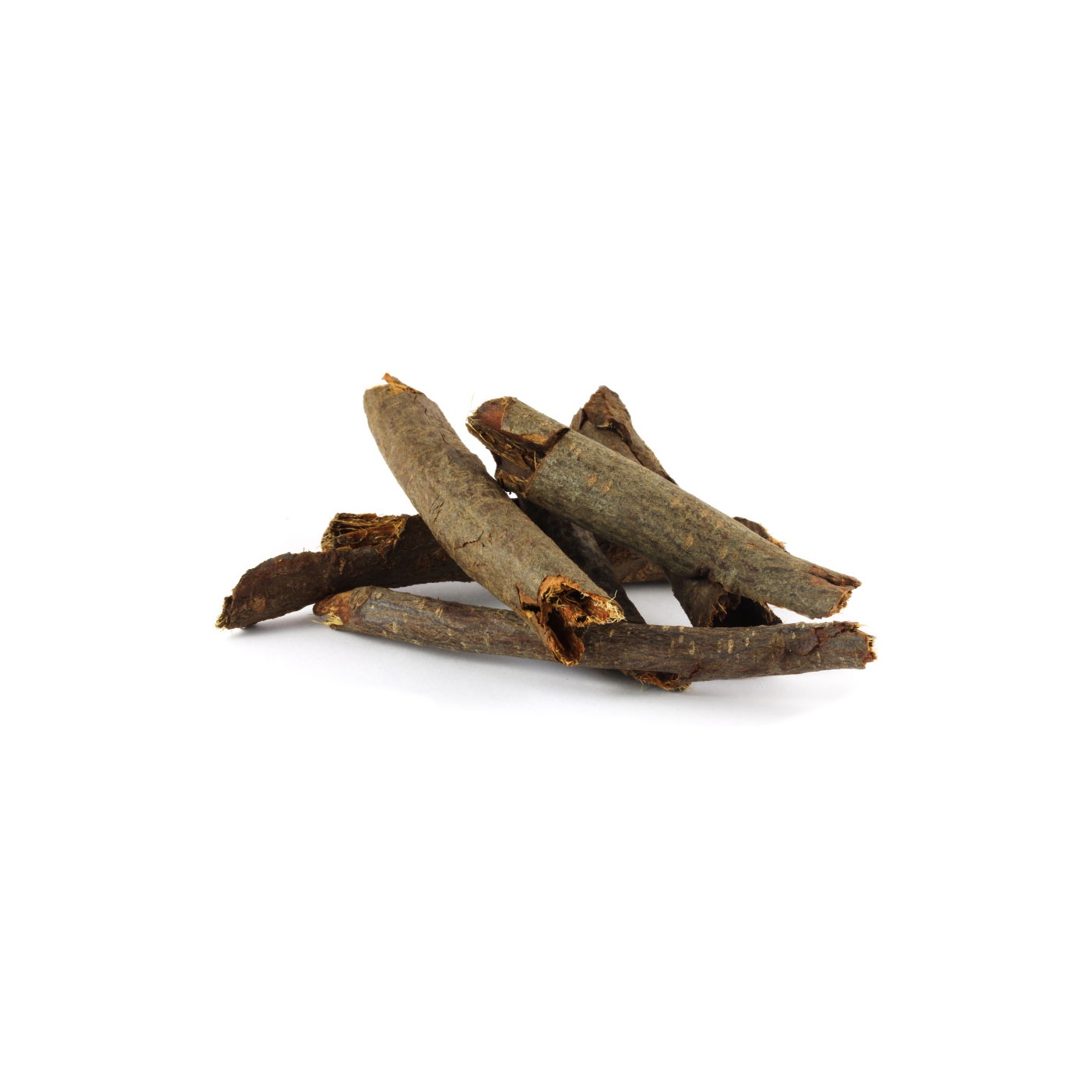
Cascaroside B is, so far as the literature records, essentially specific to cascara sagrada bark — the aged bark of cascara sagrada (Rhamnus purshiana), where the cascarosides are the defining active glycosides. In that bark the cascarosides make up roughly 60–70% of the total anthracene glycosides, with the bark standardised pharmacopoeially to ≥8% total hydroxyanthracenes expressed largely as cascaroside A 5Reference 5Safety of hydroxyanthracene derivatives for use in foodView study →. Cascaroside B is one diastereomer within that cascaroside fraction and is not tabulated as a stand-alone dry-weight figure; modern chromatography recovers it only as one of the cascaroside A–F set isolated from the bark 1Reference 1Isolation of six anthraquinone diglucosides from cascara sagrada bark by high-performance countercurrent chromatographyView study →. The related O,C-glycosyl anthranoids occur across other Rhamnus/Frangula laxative barks, but the specific cascaroside A/B pair is the chemotaxonomic signature of R. purshiana.
Major Natural Sources
| Source (Botanical) | Part | Role / level |
|---|---|---|
| Cascara sagrada (Rhamnus purshiana) | Aged bark | Defining source; one diastereomer of the cascaroside fraction (~60–70% of the glycosides; bark ≥8% total hydroxyanthracenes) 5Reference 5Safety of hydroxyanthracene derivatives for use in foodView study → |
| Other Rhamnus / Frangula laxative barks | Bark | Related O,C-glycosyl anthranoids; the specific cascaroside A/B pair is characteristic of R. purshiana (trace/uncharacterised elsewhere) |
Quantitative cascaroside-B figures on a comparable dry-weight basis do not exist as isolate values — the holes are logged in the compound’s gaps tracker.
Discovery & Synthesis
Cascara bark has been used as a laxative since it entered Western pharmacy in the nineteenth century, but its active glycosides were only characterised much later: the cascarosides were identified as the principal, milder glycosides of aged R. purshiana bark in the mid-twentieth century, and cascaroside B was resolved as the C-10 diastereomer of cascaroside A within the cascaroside series. Modern work has extended the set, isolating six cascaroside diglucosides (A–F) from the bark by high-performance countercurrent chromatography 1Reference 1Isolation of six anthraquinone diglucosides from cascara sagrada bark by high-performance countercurrent chromatographyView study →. Commercially, cascaroside B is obtained by extraction from cascara bark as a reference standard for pharmacopoeial assays, not by total synthesis — the O,C-diglycosyl anthrone is far more practically isolated from the natural source than built.
Patents: not yet researched.
Toxicity & Safety
Cascaroside B carries a moderate flag — heavier than an ordinary plant phenolic, on par with its relatives barbaloin and emodin — because it is a hydroxyanthracene-derivative prodrug that delivers a genotoxic anthrone to the colon. The flag stops short of a carcinogen badge only because the direct two-year cancer data are for aloe whole-leaf extract and for the metabolites, not for cascaroside B itself; the class membership and the regulatory actions are the reasons it is treated as a genuine concern rather than a benign bitter glycoside 4,
Genotoxicity & carcinogenicity (the class hazard). EFSA classifies hydroxyanthracene derivatives — cascaroside B among them — as genotoxic and carcinogenic unless shown otherwise, with aloe-emodin and emodin genotoxic and no safe intake establishable 5Reference 5Safety of hydroxyanthracene derivatives for use in foodView study →. Aloe whole-leaf extract is a clear NTP rodent large-intestine carcinogen 7Reference 7AnimalClear evidence of carcinogenic activity by a whole-leaf extract of Aloe barbadensis miller (aloe vera) in F344/N ratsView study →, and cascaroside B yields the same aloe-emodin metabolite on colonic activation.
GI and functional harms. As part of a stimulant laxative it shares the class harms: cramping, fluid and electrolyte loss (notably potassium), and dependence/atony with chronic use. These are the everyday reasons stimulant anthranoid laxatives are not for long-term use, layered on the genotoxic-class concern.
Pregnancy (prose only). Stimulant anthranoid laxatives are conventionally cautioned in pregnancy (theoretical uterine-stimulant and fluid/electrolyte concerns), and the class genotoxicity signal is an added reason for avoidance. Pregnancy/lactation decisions belong to the herb or product page where intake is actually decided, not to this molecule page — no isolate-specific verdict is issued here.
- Low systemic absorption of the parent. The glycoside structure keeps cascaroside B in the gut lumen; the pharmacology happens locally in the colon after bacterial activation 2,
3Reference 2A purgative action of barbaloin is induced by Eubacterium sp. strain BAR, a human intestinal anaerobe, capable of transforming barbaloin to aloe-emodin anthroneView study →Reference 3Metabolism of barbaloin by intestinal bacteriaView study → . - Hydroxyanthracene-derivative genotoxicity concern. The class is treated as genotoxic/carcinogenic-until-proven-otherwise; cascaroside B yields aloe-emodin on colonic activation, and aloe whole-leaf extract is a clear rodent large-intestine carcinogen 5,
7Reference 5Safety of hydroxyanthracene derivatives for use in foodView study →Reference 7AnimalClear evidence of carcinogenic activity by a whole-leaf extract of Aloe barbadensis miller (aloe vera) in F344/N ratsView study → . - Removed / restricted by regulators. The FDA took cascara stimulant laxatives off the US OTC market (2002); the EU restricts these hydroxyanthracene derivatives in food to trace levels 4,
6Reference 4Status of certain additional over-the-counter drug category II and III active ingredients (aloe & cascara sagrada stimulant laxatives)View study →Reference 6Amending Annex III to Regulation (EC) No 1925/2006 as regards botanical species containing hydroxyanthracene derivatives (aloin A/B, aloe-emodin, emodin, danthron)View study → . - Stimulant-laxative harms. Cramping, electrolyte (potassium) loss, and dependence/atony with chronic use.
- No isolate-specific data. Cascaroside B has never been studied alone — its profile is inferred from the cascaroside fraction and the barbaloin core 1,
2Reference 1Isolation of six anthraquinone diglucosides from cascara sagrada bark by high-performance countercurrent chromatographyView study →Reference 2A purgative action of barbaloin is induced by Eubacterium sp. strain BAR, a human intestinal anaerobe, capable of transforming barbaloin to aloe-emodin anthroneView study → .
Dosage
There is no recommended dose for cascaroside B, and it is never taken as an isolate. Historically, cascara sagrada bark — standardised to its cascaroside content — was dosed as a stimulant (purgative) laxative, but that use has been withdrawn or restricted: the FDA removed cascara stimulant-laxative ingredients from the US OTC market in 2002 4Reference 4Status of certain additional over-the-counter drug category II and III active ingredients (aloe & cascara sagrada stimulant laxatives)View study →, and the EU limits these hydroxyanthracene derivatives in food to trace amounts 6Reference 6Amending Annex III to Regulation (EC) No 1925/2006 as regards botanical species containing hydroxyanthracene derivatives (aloin A/B, aloe-emodin, emodin, danthron)View study →. Any historical cascara “doses” are context, not a personal recommendation, and given the genotoxicity-class concern, self-dosing isolated cascarosides is not advisable.
References
- Rho T, Kil HW, Seo YJ, Shin KJ, Wang D, Yoon KD (2020). Isolation of six anthraquinone diglucosides from cascara sagrada bark by high-performance countercurrent chromatography. Journal of Separation Science. https://pubmed.ncbi.nlm.nih.gov/32876395/
- Akao T, Che QM, Kobashi K, Hattori M, Namba T (1996). A purgative action of barbaloin is induced by Eubacterium sp. strain BAR, a human intestinal anaerobe, capable of transforming barbaloin to aloe-emodin anthrone. Biological & Pharmaceutical Bulletin. https://pubmed.ncbi.nlm.nih.gov/8820926/
- Hattori M, Kanda T, Shu YZ, Akao T, Kobashi K, Namba T (1988). Metabolism of barbaloin by intestinal bacteria. Chemical & Pharmaceutical Bulletin. https://pubmed.ncbi.nlm.nih.gov/3246014/
- Food and Drug Administration (2002). Status of certain additional over-the-counter drug category II and III active ingredients (aloe & cascara sagrada stimulant laxatives). Final rule. Federal Register 67(90):31125-7. https://pubmed.ncbi.nlm.nih.gov/12001972/
- EFSA ANS Panel (2018). Safety of hydroxyanthracene derivatives for use in food. EFSA Journal. https://pubmed.ncbi.nlm.nih.gov/32625659/
- Commission Regulation (EU) 2021/468 (2021). Amending Annex III to Regulation (EC) No 1925/2006 as regards botanical species containing hydroxyanthracene derivatives (aloin A/B, aloe-emodin, emodin, danthron). Official Journal of the European Union. https://eur-lex.europa.eu/legal-content/EN/TXT/?uri=CELEX:32021R0468
- Boudreau MD, Mellick PW, Olson GR, Felton RP, Thorn BT, Beland FA (2013). Clear evidence of carcinogenic activity by a whole-leaf extract of Aloe barbadensis miller (aloe vera) in F344/N rats. Toxicological Sciences. https://pubmed.ncbi.nlm.nih.gov/22968693/



