
Compound Monograph
Caulophyllumine A
Caulophyllumine A is a piperidine-type alkaloid isolated from the roots of blue cohosh (Caulophyllum thalictroides). It sits at the isolation-and-characterisation stage with no pharmacology of its own — distinct from the herb's teratogenic quinolizidine alkaloids and from its CYP-inhibiting companion, caulophyllumine B.

Sources · 1
Where Does It Come From?
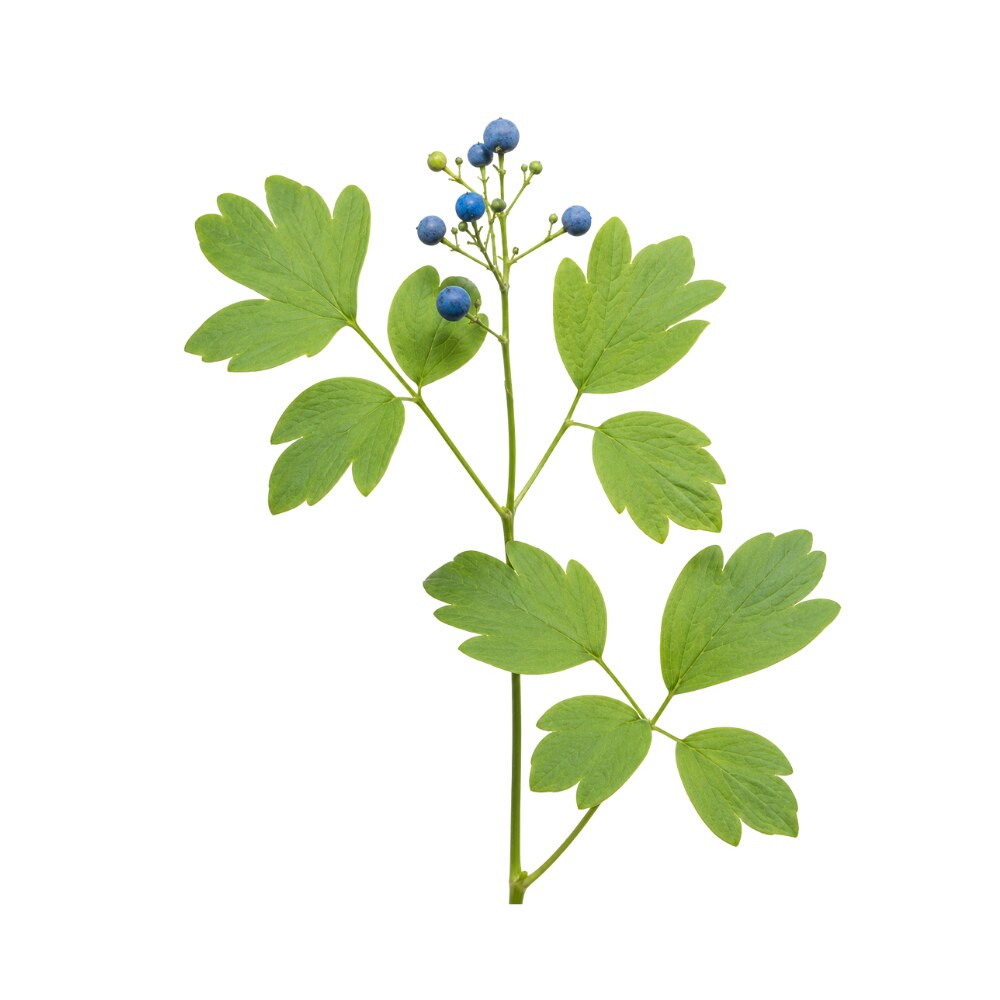
Caulophyllumine A is a naturally occurring piperidine-type alkaloid, found in Blue cohosh. It is well tolerated orally (low toxicity).
Concentration
Content by Source
Concentrations not reported. No percent-dry-weight or mg/g figures have been published for this compound in its source plants.
Caulophyllumine A at a Glance
Caulophyllumine A is a piperidine-type alkaloid first isolated from the roots of blue cohosh (Caulophyllum thalictroides) in 2008 1Reference 1Alkaloids and saponins from blue cohoshView study →. It is one of two structurally novel alkaloids — caulophyllumines A and B — reported together in the same phytochemical study, alongside the previously undescribed saponin cauloside H 1Reference 1Alkaloids and saponins from blue cohoshView study →.
Its evidence base is almost entirely structural. The molecule was isolated, its structure solved by NMR, and then — as far as the published record goes — set aside. No pharmacology, no bioassay, and no human exposure data exist for the isolate itself.
For that reason the entry is deliberately short. What matters most about caulophyllumine A is what it is not: it is chemically distinct from the quinolizidine alkaloids (N-methylcytisine, anagyrine and their relatives) that carry blue cohosh’s nicotinic and teratogenic reputation, and — unlike its companion caulophyllumine B — it has not been shown to inhibit drug-metabolising enzymes 2Reference 2In vitroAlkaloids and saponins as cytochrome P450 inhibitors from blue cohosh (Caulophyllum thalictroides) in an in vitro assayView study →.
A Piperidine Alkaloid of Blue Cohosh
Blue cohosh’s alkaloid complex is dominated by quinolizidine (lupine-type) alkaloids — N-methylcytisine, anagyrine, baptifoline, lupanine and sparteine — plus aporphine alkaloids such as magnoflorine and taspine 1Reference 1Alkaloids and saponins from blue cohoshView study →. The caulophyllumines belong to neither group. They are piperidine-type alkaloids, a distinct scaffold that Ali and Khan resolved from the root’s alkaloidal fraction and characterised by one- and two-dimensional NMR together with chemical analysis 1Reference 1Alkaloids and saponins from blue cohoshView study →.
This structural separation is the single most useful fact about the molecule. The alkaloids that define blue cohosh’s toxicology are the quinolizidines: N-methylcytisine is a nicotinic-receptor agonist and the species’ chemical marker, and both it and anagyrine are teratogenic in embryo-culture models 1Reference 1Alkaloids and saponins from blue cohoshView study →. Caulophyllumine A shares none of that documented activity — but neither has it been tested for it. It is best read as a companion isolate to caulophyllumine B: same paper, same scaffold, described side by side, but with the pharmacology attaching to B rather than A (see below).
What It's Used For
There is effectively no pharmacology of caulophyllumine A to report. The molecule has been isolated and its structure defined, but it has never been run through a bioassay as the isolate. The one nearby activity signal — cytochrome-P450 inhibition — belongs to its companion, caulophyllumine B, not to A 2Reference 2In vitroAlkaloids and saponins as cytochrome P450 inhibitors from blue cohosh (Caulophyllum thalictroides) in an in vitro assayView study →.
Support is an experimental score — weighted by study type (human > animal > in vitro) and volume. A beta, not a validated metric. For caulophyllumine A the honest figure is near-zero: the compound is characterised but never assayed, so both rows below are essentially placeholders that point to the absence of data.
The only primary data on caulophyllumine A is its isolation and structural elucidation. Ali and Khan recovered it from the alkaloidal fraction of blue-cohosh (C. thalictroides) roots as one of fifteen compounds, and determined the structures of the two previously unknown alkaloids — caulophyllumines A and B — by 1- and 2-D NMR and chemical analysis 1Reference 1Alkaloids and saponins from blue cohoshView study →.
This is isolate-level chemistry, not a plant-versus-isolate activity comparison, because no activity was measured.
Gap: no pharmacology of any kind — no receptor, enzyme, cell or animal assay — has been reported for caulophyllumine A. Its biological role, if any, is entirely uncharacterised.
The nearest activity in the molecule’s chemical neighbourhood is CYP450 inhibition by its companion, caulophyllumine B. When the blue-cohosh alkaloidal fraction and its isolated constituents were screened in vitro, the fraction strongly inhibited CYP2C19, 3A4, 2D6 and 1A2; among the isolates, the piperidine-type alkaloid caulophyllumine B — together with O-acetylbaptifoline, anagyrine and lupanine — inhibited these enzymes (IC50 roughly 2.5–50 µM) 2Reference 2In vitroAlkaloids and saponins as cytochrome P450 inhibitors from blue cohosh (Caulophyllum thalictroides) in an in vitro assayView study →.
Caulophyllumine A shares the piperidine scaffold but was not reported among the tested inhibitors.
Gap: whether caulophyllumine A shares B’s CYP-inhibitory behaviour is untested. Treating A as a drug-interaction risk on the strength of B’s data would be an assumption, not a finding.
Mechanisms
| Target / pathway | Effect | Relevant to |
|---|---|---|
| None characterised | No molecular target, receptor or enzyme interaction has been reported for caulophyllumine A | — |
No mechanism table can be populated for this molecule beyond a placeholder: the isolate has never been assayed. The CYP450 inhibition documented for the alkaloidal fraction is attributed to caulophyllumine B and the quinolizidines, not to A 2Reference 2In vitroAlkaloids and saponins as cytochrome P450 inhibitors from blue cohosh (Caulophyllum thalictroides) in an in vitro assayView study →.
Pharmacokinetics
No pharmacokinetic data exist. Absorption, distribution, metabolism, half-life and oral bioavailability for caulophyllumine A are entirely uncharacterised — the molecule has never been dosed in an animal or human, and no analytical method targets it specifically. Human exposure, such as it is, occurs only as a trace alkaloid within whole blue-cohosh root/rhizome preparations, where the quinolizidines and saponins dominate both the measured content and the toxicology 1,
Clinical Trials
There are no clinical trials of caulophyllumine A, and none of the isolate at any preclinical tier either. Its record begins and ends with phytochemical isolation 1Reference 1Alkaloids and saponins from blue cohoshView study →.
| Completed | Planned | Terminated | Preclinical |
|---|---|---|---|
| — | — | — | None(isolation/characterisation only) |
Last checked: July 2026.
Isolate vs. Plant Studies
This molecule has neither isolate nor plant activity data — a rarer state than the usual “isolate under-studied relative to the plant” caveat. Caulophyllumine A exists in the literature purely as a structurally characterised isolate 1Reference 1Alkaloids and saponins from blue cohoshView study →; it has not been tested as the pure compound, and no whole-plant study attributes a specific effect to it. Everything known about blue cohosh’s activity and toxicity is driven by other constituents — the nicotinic/teratogenic quinolizidines N-methylcytisine and anagyrine, the aporphine magnoflorine, and the cauloside saponins 1,
Prevalence in Nature
Caulophyllumine A is reported only from blue cohosh (Caulophyllum thalictroides, Berberidaceae), in the root and rhizome, as a minor component of the plant’s alkaloidal fraction 1Reference 1Alkaloids and saponins from blue cohoshView study →. Its concentration has not been quantified — unlike the marker alkaloids and saponins of the species, which have been measured across commercial supplements and vary more than a hundred-fold between products 3,
Discovery & Synthesis
Caulophyllumine A was first isolated in 2008 by Zulfiqar Ali and Ikhlas A. Khan at the National Center for Natural Products Research, University of Mississippi, during a detailed phytochemical investigation of blue-cohosh roots 1Reference 1Alkaloids and saponins from blue cohoshView study →. That study yielded fifteen compounds spanning the alkaloids and triterpene saponins; three were previously unknown — the two alkaloids caulophyllumines A and B and the saponin cauloside H — and their structures were established by one- and two-dimensional NMR together with chemical analysis 1Reference 1Alkaloids and saponins from blue cohoshView study →. The name derives from the genus Caulophyllum.
No total synthesis of caulophyllumine A has been reported, and no commercial production exists — the compound is obtained, when needed, only by extraction from blue-cohosh material for research purposes. It is not manufactured, sold, or used as a supplement ingredient in isolation.
Patents: not yet researched.
Toxicity & Safety
Caulophyllumine A carries a low flag, but that badge reflects the absence of any reported hazard for the isolate — not a demonstration of safety. No toxicology, genotoxicity, reproductive-toxicity or interaction study has ever been run on the pure molecule. Low here means “nothing on record,” and should not be read as reassurance.
The safety context that does matter is the plant’s, because the only realistic route of exposure to caulophyllumine A is via whole blue-cohosh preparations — where it is a trace constituent riding alongside genuinely hazardous molecules:
- Oxytocic / reproductive-toxic backdrop. Blue cohosh has a long uterine-stimulant (“oxytocic”) reputation and a documented developmental-toxicity signal driven by its quinolizidine alkaloids: N-methylcytisine and anagyrine are teratogenic in in-vitro rat-embryo culture, and N-methylcytisine is a nicotinic-receptor agonist responsible for the herb’s nicotinic toxidrome 1,
3Reference 1Alkaloids and saponins from blue cohoshView study →Reference 3In vitroDetecting potential teratogenic alkaloids from blue cohosh rhizomes using an in vitro rat embryo cultureView study → . This is a property of those alkaloids and the whole herb — not something demonstrated for caulophyllumine A — but it is why blue cohosh is cautioned in pregnancy, and any exposure to caulophyllumine A occurs inside that matrix. - CYP450 / drug-interaction backdrop. The blue-cohosh alkaloidal fraction strongly inhibits several drug-metabolising cytochrome-P450 enzymes (CYP2C19, 3A4, 2D6, 1A2), raising a herb–drug interaction concern for the plant 2Reference 2In vitroAlkaloids and saponins as cytochrome P450 inhibitors from blue cohosh (Caulophyllum thalictroides) in an in vitro assayView study →. Within that fraction, the piperidine-type inhibitor is caulophyllumine B; caulophyllumine A was not among the reported inhibitors, so its own interaction potential is unknown rather than established 2Reference 2In vitroAlkaloids and saponins as cytochrome P450 inhibitors from blue cohosh (Caulophyllum thalictroides) in an in vitro assayView study →.
- No hazard reported for the isolate. No toxicity, genotoxicity or interaction finding has been published for pure caulophyllumine A.
- Absence of data is not safety. The isolate has never been tested; the “low” badge marks an empty file, not a clean bill of health.
- Exposure is via a cautioned herb. Caulophyllumine A occurs only in blue cohosh, whose quinolizidine alkaloids carry oxytocic and teratogenic concerns and whose alkaloid fraction inhibits CYP450 enzymes 1,
2, .3Reference 1Alkaloids and saponins from blue cohoshView study →Reference 2In vitroAlkaloids and saponins as cytochrome P450 inhibitors from blue cohosh (Caulophyllum thalictroides) in an in vitro assayView study →Reference 3In vitroDetecting potential teratogenic alkaloids from blue cohosh rhizomes using an in vitro rat embryo cultureView study → - Interaction potential unknown. Its companion caulophyllumine B inhibits CYP enzymes; whether A does is untested 2Reference 2In vitroAlkaloids and saponins as cytochrome P450 inhibitors from blue cohosh (Caulophyllum thalictroides) in an in vitro assayView study →.
Dosage
There is no dose for caulophyllumine A. It is not a supplement ingredient, is not sold in isolation, and has never been administered in a study. The only human exposure is incidental — as a trace alkaloid within whole blue-cohosh root/rhizome products, whose alkaloid and saponin content varies enormously between preparations and is dominated by other constituents 3,
References
- Ali Z, Khan IA (2008). Alkaloids and saponins from blue cohosh. Phytochemistry. https://pubmed.ncbi.nlm.nih.gov/18048069/
- Madgula VL, Ali Z, Smillie T, Khan IA, Walker LA, Khan SI (2009). Alkaloids and saponins as cytochrome P450 inhibitors from blue cohosh (Caulophyllum thalictroides) in an in vitro assay. Planta Medica. https://pubmed.ncbi.nlm.nih.gov/19137500/
- Kennelly EJ, Flynn TJ, Mazzola EP, et al. (1999). Detecting potential teratogenic alkaloids from blue cohosh rhizomes using an in vitro rat embryo culture. Journal of Natural Products. https://pubmed.ncbi.nlm.nih.gov/10543898/
- Avula B, Wang YH, Ali Z, Smillie TJ, Khan IA (2011). Analytical methods for determination of magnoflorine and saponins from roots of Caulophyllum thalictroides (L.) Michx. using UPLC, HPLC and HPTLC. Journal of Pharmaceutical and Biomedical Analysis. https://pubmed.ncbi.nlm.nih.gov/21872415/
- Ganzera M, Dharmaratne HRW, Nanayakkara NPD, Khan IA (2003). Determination of saponins and alkaloids in Caulophyllum thalictroides (blue cohosh) by high-performance liquid chromatography and evaporative light scattering detection. Phytochemical Analysis. https://pubmed.ncbi.nlm.nih.gov/12597249/



