
Materia Medica
Blue Cohosh
Caulophyllum thalictroides
Blue cohosh is a woodland perennial of eastern North America whose root was a traditional remedy for menstrual pain, childbirth and rheumatism. It contains nicotinic alkaloids, including N-methylcytisine, and is not used in pregnancy.
What Is Blue Cohosh?
Blue cohosh is a woodland perennial of eastern North America whose root and rhizome were a leading traditional remedy for the womb. Native American peoples and later the Eclectic physicians used it for menstrual pain and cramping, to prepare for childbirth, and for rheumatic pain 22,
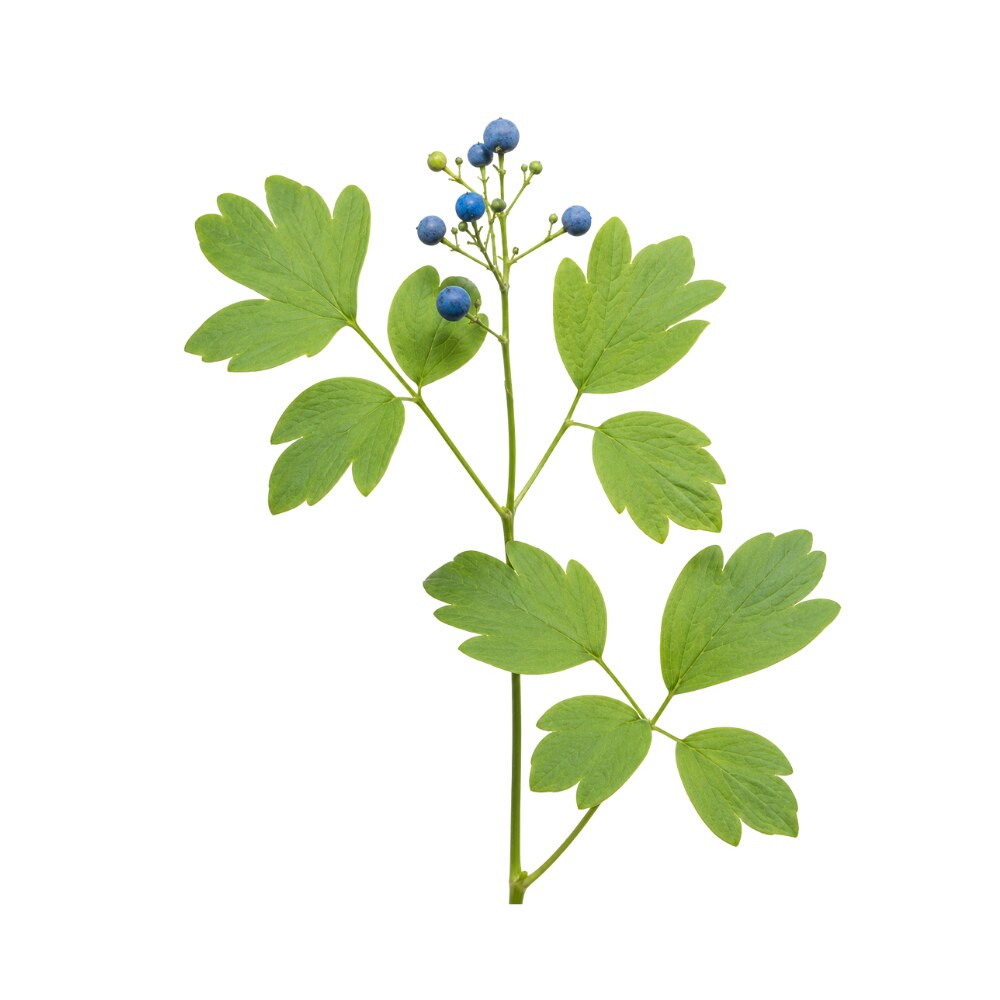
Caulophyllum thalictroides grows 20–90 cm tall in rich, moist forests from Manitoba and New Brunswick south to Georgia and Alabama 22Reference 22Caulophyllum and Caulophyllum thalictroides (Linnaeus) Michaux — genus and species description, habitat, distribution and uses — floraView study →. Its knobby rhizome is the part used, and the plant bears striking clusters of blue seeds in summer and autumn 22,
The root carries nicotinic alkaloids, chiefly N-methylcytisine, and a family of triterpene saponins called caulosides 2,
Blue cohosh is unrelated to black cohosh (Actaea racemosa), a plant of the buttercup family with different chemistry and uses.
How Is Blue Cohosh Used?
- Decoction or tincture — made from the dried root and rhizome, taken in small doses for short periods.
- Compound formulas — combined with other women’s herbs such as black cohosh, cramp bark, motherwort, dong quai and wild yam.
Traditional Uses
Native American Medicine
Native American peoples used preparations of the root for rheumatism, toothache, heavy menstruation, indigestion and stomach cramps, fits, urinary and genital complaints, gallstones and fever, as an aid in childbirth and as a general tonic 22Reference 22Caulophyllum and Caulophyllum thalictroides (Linnaeus) Michaux — genus and species description, habitat, distribution and uses — floraView study →.
Eclectic writers record that a decoction of the root was taken for two or three weeks before labour to ease childbirth. This is the origin of the herb’s later use as a birth preparation 24Reference 24Caulophyllum (U.S.P.) — historical materia medicaView study →.
Eclectic Medicine
Blue cohosh was one of the oldest native remedies of the Eclectic physicians of 19th-century America. They regarded it as an antispasmodic, emmenagogue and parturient 24Reference 24Caulophyllum (U.S.P.) — historical materia medicaView study →.
It was given for painful and absent periods, uterine cramps during menstruation, ovarian pain, chronic inflammation of the uterus, and heavy bleeding from a slow-to-recover uterus after childbirth. As a birth preparation it was taken for several weeks before delivery, and during labour it was used for false pains and weak or poorly coordinated contractions 24Reference 24Caulophyllum (U.S.P.) — historical materia medicaView study →.
Outside gynaecology it was used for rheumatism, especially of the small joints of the fingers and toes, for colicky and crampy pains in the stomach and bowels after eating, and for nervous debility with muscular weakness 24Reference 24Caulophyllum (U.S.P.) — historical materia medicaView study →.
Indications
- Painful periods and menstrual cramps [root and rhizome; Eclectic medicine]
- Absent or irregular periods [root and rhizome; Eclectic medicine]
- Heavy periods [root; Native American and Eclectic medicine]
- Ovarian and uterine pain [root; Eclectic medicine]
- Birth preparation and weak labour contractions [root; Native American and Eclectic medicine] Caution: Case reports link use near term to stroke, heart attack, heart failure and multi-organ injury in newborns, and reviews find little evidence that it helps labour 15,
17, .20 - Rheumatic pain, especially in the small joints of the fingers and toes [root; Native American and Eclectic medicine]
- Colic and stomach cramps [root; Native American and Eclectic medicine]
Botany
Blue cohosh is a hairless, deciduous perennial herb in the barberry family (Berberidaceae). Each year its knobby rhizome sends up a stem 20–90 cm tall carrying two leaves 22Reference 22Caulophyllum and Caulophyllum thalictroides (Linnaeus) Michaux — genus and species description, habitat, distribution and uses — floraView study →.
The leaves are divided two to four times into threes, and the broad leaflets are 3–8 cm long and lobed rather than toothed 22Reference 22Caulophyllum and Caulophyllum thalictroides (Linnaeus) Michaux — genus and species description, habitat, distribution and uses — floraView study →. Young plants have a waxy bloom, and the foliage is blue-green 23Reference 23Caulophyllum thalictroides (blue cohosh) — cultivation referenceView study →.
The small flowers open in late spring, in clusters of 5–70. Their six sepals are yellow, purple or green 22Reference 22Caulophyllum and Caulophyllum thalictroides (Linnaeus) Michaux — genus and species description, habitat, distribution and uses — floraView study →.
The fruit wall splits open early, leaving two seeds on elongating stalks. Each seed has a fleshy, glaucous blue coat and looks like a berry 22Reference 22Caulophyllum and Caulophyllum thalictroides (Linnaeus) Michaux — genus and species description, habitat, distribution and uses — floraView study →. The seeds are poisonous 23Reference 23Caulophyllum thalictroides (blue cohosh) — cultivation referenceView study →.
Flora of North America treats the larger-flowered giant blue cohosh, Caulophyllum giganteum, as a separate species 22Reference 22Caulophyllum and Caulophyllum thalictroides (Linnaeus) Michaux — genus and species description, habitat, distribution and uses — floraView study →.
Distribution
Blue cohosh grows in rich, moist deciduous forests of eastern and central North America, from sea level to 1,200 m 22Reference 22Caulophyllum and Caulophyllum thalictroides (Linnaeus) Michaux — genus and species description, habitat, distribution and uses — floraView study →. Its range runs from Manitoba, Ontario, Quebec and New Brunswick south to Georgia and Alabama, and west to the Dakotas, Nebraska, Kansas and Arkansas 22Reference 22Caulophyllum and Caulophyllum thalictroides (Linnaeus) Michaux — genus and species description, habitat, distribution and uses — floraView study →.
It is slow to spread, and its large seeds are hard to germinate 23Reference 23Caulophyllum thalictroides (blue cohosh) — cultivation referenceView study →. The medicine is the rhizome and root, so harvesting takes the whole plant.
Blue cohosh is on the United Plant Savers At-Risk list, a conservation advocacy list rather than a legal or IUCN status 25Reference 25Species At-Risk List, July 2022 — conservation list. https://unitedplantsavers.org/wp-content/uploads/2022/07/22229-UpS-Species-At-Risk-List-2022-rev-7-22.pdfView study →.
Cultivated and forest-farmed blue cohosh is available. For wild-harvested root, it is worth asking whether the collector rotates harvest sites.
Growing Conditions
Cultivation snapshot for Blue Cohosh
Sundappled or deep shade; a woodland understory plant 23Reference 23Caulophyllum thalictroides (blue cohosh) — cultivation referenceView study →.
Soilrich, loamy, consistently moist soil with plenty of leaf litter, slightly acidic to neutral 23Reference 23Caulophyllum thalictroides (blue cohosh) — cultivation referenceView study →.
Habitlong-lived once established but slow to spread. Divide just after flowering; the seeds are slow to germinate 23Reference 23Caulophyllum thalictroides (blue cohosh) — cultivation referenceView study →.
ZoneUSDA 3–8 23Reference 23Caulophyllum thalictroides (blue cohosh) — cultivation referenceView study →.
Grow it yourself
Farm Wiki is our cultivation-focused sister site, also run by Justin Cooke.
Pharmacology & Research
Research on blue cohosh is mostly chemistry and toxicology. Its alkaloids and triterpene saponins are well characterised 2,
N-methylcytisine was teratogenic in rat embryo culture, and a methanol extract of the root disrupted heart and cartilage development in fish embryos 7,
No human clinical trial has tested blue cohosh for any use.
- Best-supported: an anti-inflammatory action of the saponins, shown in microglial cells and in one mouse study (suppression of iNOS, COX-2 and pro-inflammatory cytokines) 1Reference 1In vitroAnti-inflammatory effect of triterpene saponins isolated from blue cohosh (Caulophyllum thalictroides) — in vitro and mouse animal modelView study →.
- Emerging, worth watching: tumour-cell killing by cauloside A in vitro and in one mouse model, using cauloside A from a different plant 13Reference 13In vitroCauloside A interacts with TLR4 to induce JNK/Caspase-3/GSDME-dependent pyroptosis in non-small cell lung cancer cells — in vitro and mouseView study →.
-
Mechanistically thin: the uterine-stimulant reputation, attributed to the saponins, rests on in vitro evidence 4,
15Reference 4Determination of saponins and alkaloids in Caulophyllum thalictroides (blue cohosh) by HPLC and evaporative light scattering detectionView study →Reference 15Systematic reviewSafety and efficacy of blue cohosh (Caulophyllum thalictroides) during pregnancy and lactation — systematic reviewView study → . Cauloside C showed no oestrogen-receptor activity 12Reference 12In vitroEstrogenic activity of triterpene glycosides in yeast two-hybrid assay (cauloside C showed no estrogenic activity) — in vitroView study →. -
The caveat: the modern literature on blue cohosh is mostly about harm: newborn heart and brain injury, nicotinic poisoning, and CYP450 inhibition by its alkaloids 10,
15, .16, 17Reference 10In vitroAlkaloids and saponins as cytochrome P450 inhibitors from blue cohosh (Caulophyllum thalictroides) in an in vitro assayView study →Reference 15Systematic reviewSafety and efficacy of blue cohosh (Caulophyllum thalictroides) during pregnancy and lactation — systematic reviewView study →Reference 16Case reportNicotinic toxicity from tincture of blue cohosh (Caulophyllum thalictroides) used as an abortifacient — case reportView study →Reference 17Case reportProfound neonatal congestive heart failure caused by maternal consumption of blue cohosh herbal medication — case reportView study →
Products vary widely in content. In one analysis, daily saponin intake from commercial products varied more than 100-fold, while alkaloid content was more uniform. In another, daily saponin intake ranged from 6 to 302 mg 4,
1. Anti-Inflammatory
In lipopolysaccharide-activated microglia, blue cohosh constituents suppressed inducible nitric oxide synthase (iNOS) in a concentration-dependent way, along with the pro-inflammatory cytokines TNF-α, IL-1β and IL-6. In mice, blue cohosh extract lowered COX-2, iNOS and cytokine expression in the adrenal glands 1Reference 1In vitroAnti-inflammatory effect of triterpene saponins isolated from blue cohosh (Caulophyllum thalictroides) — in vitro and mouse animal modelView study →.
The authors link this to the traditional use of the root as an anti-inflammatory and fever remedy 1Reference 1In vitroAnti-inflammatory effect of triterpene saponins isolated from blue cohosh (Caulophyllum thalictroides) — in vitro and mouse animal modelView study →. It is one study from one laboratory, with no human data.
2. Uterine & Smooth-Muscle
Blue cohosh was used historically as a uterine stimulant, emmenagogue and antispasmodic, and its triterpene saponins are considered responsible for the uterine-stimulant effect 4Reference 4Determination of saponins and alkaloids in Caulophyllum thalictroides (blue cohosh) by HPLC and evaporative light scattering detectionView study →. A systematic review cites in vitro evidence of an oxytocic effect 15Reference 15Systematic reviewSafety and efficacy of blue cohosh (Caulophyllum thalictroides) during pregnancy and lactation — systematic reviewView study →. No modern controlled study in animals or people has shown a uterine effect from a defined blue cohosh preparation.
The alkaloids act on nicotinic acetylcholine receptors. N-methylcytisine is a nicotinic agonist 18Reference 18ReviewNicotinic plant poisoning — reviewView study →, and anagyrine activates and then desensitises the fetal-muscle type of the receptor 11Reference 11In vitroActions of piperidine alkaloid teratogens at fetal nicotinic acetylcholine receptors — in vitroView study →. A 21-year-old woman who took blue cohosh to induce an abortion developed a fast heart rate, sweating, abdominal pain, vomiting, muscle weakness and twitching, consistent with nicotinic poisoning. Her symptoms resolved within 24 hours 16Reference 16Case reportNicotinic toxicity from tincture of blue cohosh (Caulophyllum thalictroides) used as an abortifacient — case reportView study →.
Gap: the traditional use has no modern demonstration in a living system. The one clearly mapped receptor action, nicotinic agonism, is also the mechanism of its poisoning.
3. Anticancer / Cytotoxic
Cauloside A, a saponin also found in blue cohosh, interacted with TLR4 and triggered caspase-3/GSDME-dependent pyroptosis in non-small-cell lung cancer cells. It also slowed tumour growth in a mouse allograft model 13Reference 13In vitroCauloside A interacts with TLR4 to induce JNK/Caspase-3/GSDME-dependent pyroptosis in non-small cell lung cancer cells — in vitro and mouseView study →.
Cauloside C acts as a pH-dependent cytotoxin. It makes cell membranes leaky to potassium and calcium, and its effect is stronger in acidic conditions 14Reference 14In vitroThe effect of pH on biological activity of plant cytotoxin cauloside C — in vitroView study →.
Gap: the cauloside A study used material isolated from Fructus Akebiae, a different plant. There is no anticancer evidence for whole blue cohosh root.
Mechanisms
The quinolizidine alkaloids of blue cohosh act on nicotinic acetylcholine receptors. N-methylcytisine is a nicotinic agonist, and anagyrine activates and then desensitises the fetal-muscle receptor 11,
The saponins have been studied for anti-inflammatory activity and for membrane and mitochondrial damage in cells 1,
| Mechanism | Drives | Key compounds |
|---|---|---|
| iNOS ↓, COX-2 ↓, TNF-α/IL-1β/IL-6 ↓ | anti-inflammatory | blue cohosh saponins and extract |
| nAChR agonism → desensitisation (nicotinic) | smooth-muscle activity; toxicity | N-methylcytisine, anagyrine |
| Membrane permeabilisation; mitochondrial disruption | cytotoxicity; organ toxicity | cauloside A, cauloside C |
| CYP450 inhibition (2C19, 3A4, 2D6, 1A2) | drug interactions | caulophyllumine B, anagyrine, lupanine |
Clinical Trials
No registered clinical trial of blue cohosh was identified on ClinicalTrials.gov, and no human efficacy trial exists in the literature. The human data are adverse-event case reports and reviews of them 15,
| Completed | Planned | Terminated | Preclinical |
|---|---|---|---|
| 0 | 0 | 0 | ~20+ |
Last checked: July 2026.
Phytochemistry
The rhizome and root contain quinolizidine and aporphine alkaloids and a family of triterpene saponins 2,
The quinolizidine alkaloids include N-methylcytisine, anagyrine, baptifoline, lupanine, α-isolupanine and sparteine, along with the species’ own alkaloid thalictroidine 7Reference 7In vitroDetecting potential teratogenic alkaloids from blue cohosh rhizomes using an in vitro rat embryo cultureView study →. The aporphine magnoflorine and the alkaloid taspine are also present 7Reference 7In vitroDetecting potential teratogenic alkaloids from blue cohosh rhizomes using an in vitro rat embryo cultureView study →. Two piperidine alkaloids, caulophyllumine A and caulophyllumine B, were first described from blue cohosh in 2008 2Reference 2Alkaloids and saponins from blue cohoshView study →.
N-methylcytisine was found in every blue cohosh supplement analysed, and anagyrine in some 3Reference 3ReviewPrimary constituents of blue cohosh: quantification in dietary supplements and potential for toxicity — reviewView study →. In rat embryo culture, N-methylcytisine was teratogenic, while thalictroidine, anagyrine and α-isolupanine were not, and taspine was toxic to embryos without causing malformations 7Reference 7In vitroDetecting potential teratogenic alkaloids from blue cohosh rhizomes using an in vitro rat embryo cultureView study →. Anagyrine is nonetheless described as a teratogenic alkaloid 3Reference 3ReviewPrimary constituents of blue cohosh: quantification in dietary supplements and potential for toxicity — reviewView study →.
The saponins, historically called caulosaponin, include cauloside A, cauloside B, cauloside C, cauloside D, caulosides G and H, leonticin D and saponin PE 2,
Constituent Summary
Reported from the rhizome and root. Individual alkaloids fall within 0.02–1.1% of the dried root 26Reference 26Analysis of aporphine and quinolizidine alkaloids from Caulophyllum thalictroides by densitometry and HPLC — analyticalView study →; the saponins are not consistently quantified.
Quinolizidine Alkaloid3 compoundsno data
Aporphine Alkaloid1 compoundno data
Dosage
Blue cohosh is taken in small doses of the dried root and rhizome, for short periods only.
Traditional Dosage
| System | Preparation | Dose |
|---|---|---|
| Eclectic (1898) | Specific caulophyllum (concentrated tincture) | 3–10 drops 24Reference 24Caulophyllum (U.S.P.) — historical materia medicaView study → |
| Western herbal | Dried root/rhizome, decoction | 0.3–1 g, up to about 2 g daily |
| Western herbal | Tincture (1:5, about 60% ethanol) | 0.5–2 mL, up to three times daily |
| Western herbal | Liquid extract (1:2) | 10–20 mL per week (about 1.5–3 mL a day) |
Safety & Pregnancy
Blue cohosh is a potentially toxic herb. Its nicotinic alkaloids and saponins act on smooth muscle and the heart, so it is used in small doses, short term, and not in pregnancy or heart disease. A systematic review recommends using it only under the supervision of a medical professional 15Reference 15Systematic reviewSafety and efficacy of blue cohosh (Caulophyllum thalictroides) during pregnancy and lactation — systematic reviewView study →.
- Contraindicated in pregnancy. Use near term to bring on labour is linked in case reports to newborn stroke, heart attack, profound heart failure and multi-organ injury 15,
17Reference 15Systematic reviewSafety and efficacy of blue cohosh (Caulophyllum thalictroides) during pregnancy and lactation — systematic reviewView study →Reference 17Case reportProfound neonatal congestive heart failure caused by maternal consumption of blue cohosh herbal medication — case reportView study → . - Nicotinic poisoning in overdose. Symptoms include abdominal pain, vomiting, a fast heart rate, raised blood pressure, sweating and muscle weakness 16,
18Reference 16Case reportNicotinic toxicity from tincture of blue cohosh (Caulophyllum thalictroides) used as an abortifacient — case reportView study →Reference 18ReviewNicotinic plant poisoning — reviewView study → . - Heart disease and high blood pressure. Blue cohosh is one of a handful of herbs with case reports of heart toxicity 19Reference 19Case reportHeart toxicity related to herbs and dietary supplements: online table of case reportsView study →.
- Drug interactions. Its alkaloid fraction strongly inhibits CYP2C19, CYP3A4, CYP2D6 and CYP1A2 in vitro 10Reference 10In vitroAlkaloids and saponins as cytochrome P450 inhibitors from blue cohosh (Caulophyllum thalictroides) in an in vitro assayView study →.
- Short term only. Its saponins disrupt mitochondria in cell studies, and product content varies widely 4,
5, .9Reference 4Determination of saponins and alkaloids in Caulophyllum thalictroides (blue cohosh) by HPLC and evaporative light scattering detectionView study →Reference 5Analytical methods for determination of magnoflorine and saponins from roots of Caulophyllum thalictroides using UPLC, HPLC and HPTLCView study →Reference 9In vitroToxins in botanical dietary supplements: blue cohosh components disrupt cellular respiration and mitochondrial membrane potential — in vitroView study →
Full Safety & Interactions Detail
Nicotinic poisoning. The alkaloids, notably N-methylcytisine, act on nicotinic acetylcholine receptors. Poisoning begins with abdominal pain, raised blood pressure, a fast heart rate and tremor, and severe cases progress to a low heart rate, low blood pressure and breathing difficulty 18Reference 18ReviewNicotinic plant poisoning — reviewView study →. A woman who took a blue cohosh tincture to induce an abortion developed a fast heart rate, sweating, abdominal pain, vomiting, muscle weakness and twitching, and recovered within 24 hours 16Reference 16Case reportNicotinic toxicity from tincture of blue cohosh (Caulophyllum thalictroides) used as an abortifacient — case reportView study →.
Mitochondrial toxicity. In cell studies, a methanol extract of the root and three of its saponins (cauloside A, cauloside C and saponin PE) disrupted mitochondrial membranes and cellular respiration. The authors propose this as a link to idiosyncratic organ damage 9Reference 9In vitroToxins in botanical dietary supplements: blue cohosh components disrupt cellular respiration and mitochondrial membrane potential — in vitroView study →.
Heart. Blue cohosh is one of about seven herbs with case reports of heart toxicity 19Reference 19Case reportHeart toxicity related to herbs and dietary supplements: online table of case reportsView study →. Avoid it with heart disease or high blood pressure, and use it only short term.
Drug interactions. The alkaloid fraction inhibited CYP2C19, CYP3A4, CYP2D6 and CYP1A2 by more than 80% at 100 µg/mL, while the whole methanol extract of the root had no effect 10Reference 10In vitroAlkaloids and saponins as cytochrome P450 inhibitors from blue cohosh (Caulophyllum thalictroides) in an in vitro assayView study →. No interaction has been studied in people.
Contraindicated. Three case reports link blue cohosh taken near delivery to newborn stroke; to heart attack with profound heart failure and shock; and to severe multi-organ injury from lack of oxygen 15,
N-methylcytisine was teratogenic in rat embryo culture, and a root extract disrupted heart and cartilage development in fish embryos 7,
It has not been studied while breastfeeding. Nicotine-like alkaloids pass freely into breast milk, so avoid it 15,
References
- Lee, Y., Jung, J. C., Ali, Z., Khan, I. A., & Oh, S. (2012). Anti-inflammatory effect of triterpene saponins isolated from blue cohosh (Caulophyllum thalictroides) — in vitro and mouse animal model. Evidence-Based Complementary and Alternative Medicine. https://pubmed.ncbi.nlm.nih.gov/22988475/
- Ali, Z., & Khan, I. A. (2008). Alkaloids and saponins from blue cohosh. Phytochemistry. https://pubmed.ncbi.nlm.nih.gov/18048069/
- Rader, J. I., & Pawar, R. S. (2013). Primary constituents of blue cohosh: quantification in dietary supplements and potential for toxicity — review. Analytical and Bioanalytical Chemistry. https://pubmed.ncbi.nlm.nih.gov/23420136/
- Ganzera, M., Dharmaratne, H. R., Nanayakkara, N. P., & Khan, I. A. (2003). Determination of saponins and alkaloids in Caulophyllum thalictroides (blue cohosh) by HPLC and evaporative light scattering detection. Phytochemical Analysis. https://pubmed.ncbi.nlm.nih.gov/12597249/
- Avula, B., Wang, Y. H., Rumalla, C. S., Ali, Z., Smillie, T. J., & Khan, I. A. (2011). Analytical methods for determination of magnoflorine and saponins from roots of Caulophyllum thalictroides using UPLC, HPLC and HPTLC. Journal of Pharmaceutical and Biomedical Analysis. https://pubmed.ncbi.nlm.nih.gov/21872415/
- Xia, Y. G., Li, G. Y., Liang, J., Yang, B. Y., Lü, S. W., & Kuang, H. X. (2014). Genus Caulophyllum: an overview of chemistry and bioactivity — review. Evidence-Based Complementary and Alternative Medicine. https://pubmed.ncbi.nlm.nih.gov/24876877/
- Kennelly, E. J., Flynn, T. J., Mazzola, E. P., Roach, J. A., McCloud, T. G., Danford, D. E., & Betz, J. M. (1999). Detecting potential teratogenic alkaloids from blue cohosh rhizomes using an in vitro rat embryo culture. Journal of Natural Products. https://pubmed.ncbi.nlm.nih.gov/10543898/
- Wu, M., Hu, Y., Ali, Z., Khan, I. A., Verlangeiri, A. J., & Dasmahapatra, A. K. (2010). Teratogenic effects of blue cohosh (Caulophyllum thalictroides) in Japanese medaka (Oryzias latipes) — animal model. Chemical Research in Toxicology. https://pubmed.ncbi.nlm.nih.gov/20707411/
- Datta, S., Mahdi, F., Ali, Z., Jekabsons, M. B., Khan, I. A., Nagle, D. G., & Zhou, Y. D. (2014). Toxins in botanical dietary supplements: blue cohosh components disrupt cellular respiration and mitochondrial membrane potential — in vitro. Journal of Natural Products. https://pubmed.ncbi.nlm.nih.gov/24328138/
- Madgula, V. L., Ali, Z., Smillie, T., Khan, I. A., Walker, L. A., & Khan, S. I. (2009). Alkaloids and saponins as cytochrome P450 inhibitors from blue cohosh (Caulophyllum thalictroides) in an in vitro assay. Planta Medica. https://pubmed.ncbi.nlm.nih.gov/19137500/
- Green, B. T., Lee, S. T., Panter, K. E., Welch, K. D., Cook, D., Pfister, J. A., & Kem, W. R. (2010). Actions of piperidine alkaloid teratogens at fetal nicotinic acetylcholine receptors — in vitro. Neurotoxicology and Teratology. https://pubmed.ncbi.nlm.nih.gov/20116429/
- Kovalchuk, S. N., Kozhemyako, V. B., Atopkina, L. N., et al. (2006). Estrogenic activity of triterpene glycosides in yeast two-hybrid assay (cauloside C showed no estrogenic activity) — in vitro. Journal of Steroid Biochemistry and Molecular Biology. https://pubmed.ncbi.nlm.nih.gov/16973351/
- Wang, Q. Q., Zhao, W., Liu, L., et al. (2026). Cauloside A interacts with TLR4 to induce JNK/Caspase-3/GSDME-dependent pyroptosis in non-small cell lung cancer cells — in vitro and mouse. International Immunopharmacology. https://pubmed.ncbi.nlm.nih.gov/42085840/
- Aminin, D. L., Agafonova, I. G., Gnedoi, S. N., Strigina, L. I., & Anisimov, M. M. (1999). The effect of pH on biological activity of plant cytotoxin cauloside C — in vitro. Comparative Biochemistry and Physiology Part A. https://pubmed.ncbi.nlm.nih.gov/10216931/
- Dugoua, J. J., Perri, D., Seely, D., Mills, E., & Koren, G. (2008). Safety and efficacy of blue cohosh (Caulophyllum thalictroides) during pregnancy and lactation — systematic review. Canadian Journal of Clinical Pharmacology. https://pubmed.ncbi.nlm.nih.gov/18204101/
- Rao, R. B., & Hoffman, R. S. (2002). Nicotinic toxicity from tincture of blue cohosh (Caulophyllum thalictroides) used as an abortifacient — case report. Veterinary and Human Toxicology. https://pubmed.ncbi.nlm.nih.gov/12136970/
- Jones, T. K., & Lawson, B. M. (1998). Profound neonatal congestive heart failure caused by maternal consumption of blue cohosh herbal medication — case report. Journal of Pediatrics. https://pubmed.ncbi.nlm.nih.gov/9544922/
- Schep, L. J., Slaughter, R. J., & Beasley, D. M. (2009). Nicotinic plant poisoning — review. Clinical Toxicology. https://pubmed.ncbi.nlm.nih.gov/19778187/
- Brown, A. C. (2018). Heart toxicity related to herbs and dietary supplements: online table of case reports. Part 4 of 5 — review of case reports. Journal of Dietary Supplements. https://pubmed.ncbi.nlm.nih.gov/28981338/
- Dante, G., Bellei, G., Neri, I., & Facchinetti, F. (2014). Herbal therapies in pregnancy: what works? — review. Current Opinion in Obstetrics & Gynecology. https://pubmed.ncbi.nlm.nih.gov/24535321/
- Feng, C., Fay, K. E., & Burns, M. M. (2023). Toxicities of herbal abortifacients — review. American Journal of Emergency Medicine. https://pubmed.ncbi.nlm.nih.gov/36924751/
- Loconte, H. Caulophyllum and Caulophyllum thalictroides (Linnaeus) Michaux — genus and species description, habitat, distribution and uses — flora. In Whetstone, R. D., Atkinson, T. A., & Spaulding, D. D. (Berberidaceae), Flora of North America North of Mexico, Vol. 3. http://www.efloras.org/florataxon.aspx?flora_id=1&taxon_id=233500331
- North Carolina Extension Gardener Plant Toolbox. Caulophyllum thalictroides (blue cohosh) — cultivation reference. NC State University. https://plants.ces.ncsu.edu/plants/caulophyllum-thalictroides/
- King’s American Dispensatory (1898). Caulophyllum (U.S.P.) — historical materia medica. Henriette’s Herbal Homepage. https://www.henriettes-herb.com/eclectic/kings/caulophyllum.html
- United Plant Savers (2022). Species At-Risk List, July 2022 — conservation list. https://unitedplantsavers.org/wp-content/uploads/2022/07/22229-UpS-Species-At-Risk-List-2022-rev-7-22.pdf
- Woldemariam, T. Z., Betz, J. M., & Houghton, P. J. (1997). Analysis of aporphine and quinolizidine alkaloids from Caulophyllum thalictroides by densitometry and HPLC — analytical. Journal of Pharmaceutical and Biomedical Analysis. https://pubmed.ncbi.nlm.nih.gov/9172110/



