
Compound Monograph
Cauloside A
Cauloside A is an oleanane-type triterpene saponin of blue cohosh (Caulophyllum thalictroides) — a monodesmosidic hederagenin glycoside whose single defining trait is membrane and mitochondrial disruption. That one property underlies both a recent antitumour signal (TLR4→GSDME pyroptosis in lung-cancer cells) and the herb's saponin-driven cytotoxicity and gut irritancy. It has no human medical use, and is a large, poorly-absorbed saponin.

Sources · 4
Where Does It Come From?
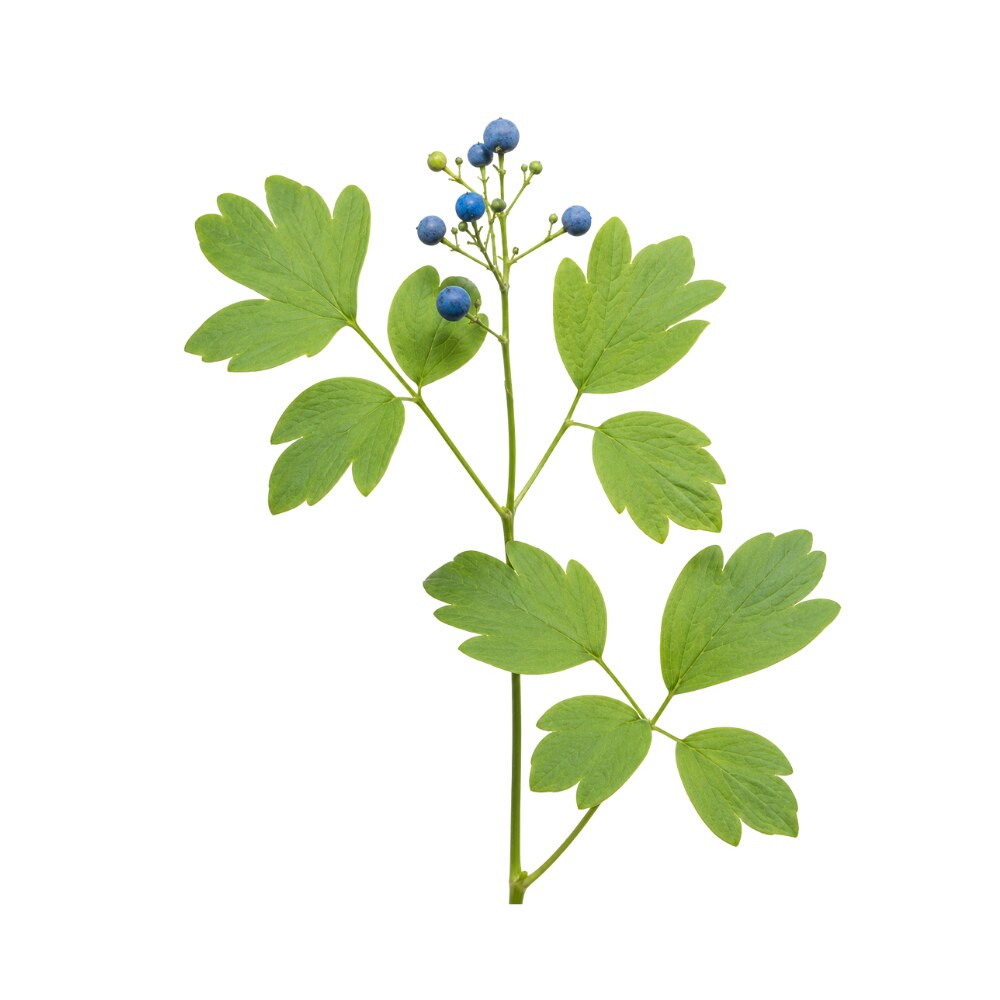
Cauloside A is a naturally occurring triterpenoid saponin (oleanane-type; hederagenin 3-o-monoglycoside), found in Blue cohosh, Caulophyllum robustum, Akebia and 1 other source. It is flagged as moderately toxic.
Concentration
Content by Source
Concentrations not reported. No percent-dry-weight or mg/g figures have been published for this compound in its source plants.
Cauloside A at a Glance
Cauloside A is an oleanane-type triterpene saponin — a molecule of hederagenin carrying a single arabinose sugar at the 3-position (hederagenin 3-O-α-L-arabinopyranoside). It is one of the caulosides, the saponin family named for and characteristic of blue cohosh (Caulophyllum thalictroides) and its Asian relative C. robustum 1Reference 1Cauloside D, a new triterpenoid glycoside from Caulophyllum robustum Maxim: identification of cauloside AView study →.
Almost everything cauloside A does traces to one property: as an amphiphilic monodesmosidic saponin it disrupts sterol-containing membranes. That single mechanism cuts two ways. In cancer-cell work it drives a genuine cytotoxic / antitumour signal — a 2026 study reported that cauloside A engages TLR4 to trigger GSDME-dependent pyroptosis in non-small-cell lung-cancer cells and slowed tumour growth in mice 3Reference 3Cauloside A interacts with TLR4 to induce JNK/Caspase-3/GSDME-dependent pyroptosis in non-small cell lung cancer cellsView study →. In the toxicological setting the same membrane-wrecking behaviour makes it mitochondriotoxic and a contributor to the caulosides’ cytotoxicity and gastrointestinal irritancy 2Reference 2Toxins in botanical dietary supplements: blue cohosh components disrupt cellular respiration and mitochondrial membrane potentialView study →.
It has no established human medical use. It is a large, poorly-absorbed glycoside; the antitumour data are preclinical, and the compound in that study was isolated from Akebia fruit rather than blue cohosh 3Reference 3Cauloside A interacts with TLR4 to induce JNK/Caspase-3/GSDME-dependent pyroptosis in non-small cell lung cancer cellsView study →. This page treats cauloside A as what it is — a membrane-active plant saponin — not as a therapy.
A Hederagenin Saponin: Membrane & Mitochondrial Disruption
The point of the molecule is its surfactant-like, membrane-destabilising action, and it is worth understanding once because it explains both the “good” (antitumour cytotoxicity) and the “bad” (irritancy, mitochondrial poisoning).
Cauloside A is monodesmosidic — it has one sugar chain, attached only at C-3, leaving hederagenin’s free carboxylic acid at C-28. This matters. Among hederagenin saponins, it is the monodesmosides with a free C-28 acid (not the bisdesmosides that also glycosylate C-28) that are the strongly membrane-active, haemolytic and cytotoxic ones; the sugar chain and the state of the aglycone’s carboxyl together set the potency 7Reference 7Structure-activity relationships of some hederagenin diglycosides: haemolysis, cytotoxicity and apoptosis inductionView study →. Cauloside A sits on the active side of that line, whereas its C-28-glycosylated sibling cauloside D is the corresponding bisdesmoside.
Mechanistically these saponins behave as amphiphiles that insert into cholesterol-containing membranes, destabilising the bilayer, permeabilising it and lysing cells (the classic saponin haemolysis) 7Reference 7Structure-activity relationships of some hederagenin diglycosides: haemolysis, cytotoxicity and apoptosis inductionView study →. Applied to mitochondria, that same insertion breaches the inner membrane: in a screen of 352 botanicals, blue-cohosh extract and its purified saponins — cauloside A, saponin PE and cauloside C — caused a fast, concentration- and time-dependent spike in cell respiration followed by collapse, and were shown to impair mitochondrial function by disrupting membrane integrity rather than by inhibiting a specific respiratory complex 2Reference 2Toxins in botanical dietary supplements: blue cohosh components disrupt cellular respiration and mitochondrial membrane potentialView study →. The authors framed this as a plausible link between the caulosides and blue cohosh’s rare but severe idiosyncratic organ toxicity 2Reference 2Toxins in botanical dietary supplements: blue cohosh components disrupt cellular respiration and mitochondrial membrane potentialView study →.
What It's Used For
The research base is small and splits cleanly: one recent antitumour mechanism paper, a toxicological membrane/mitochondrial line, and a traditional herbal attribution that was never pinned to this isolate.
Support is an experimental score — weighted by study type (human > animal > in vitro) and volume. A beta, not a validated metric. Every row here is preclinical (cell/animal or inference); no human data exist, so scores stay low by design.
The one application with a therapeutic framing, and it is isolate work. In A549 and H1299 non-small-cell lung-cancer lines, cauloside A dose-dependently reduced viability and induced pyroptosis (LDH release, characteristic ballooning on electron microscopy, Annexin V/7-AAD), acting through TLR4 binding (confirmed by cellular thermal shift, surface plasmon resonance and docking) to drive JNK phosphorylation → caspase-3 → GSDME cleavage, a GSDME-dependent pyroptotic pathway independent of GSDMD; in a C57BL/6 syngeneic mouse model it suppressed tumour growth dose-dependently with reduced Ki67/PCNA and “no apparent toxicity” reported 3Reference 3Cauloside A interacts with TLR4 to induce JNK/Caspase-3/GSDME-dependent pyroptosis in non-small cell lung cancer cellsView study →.
This is consistent with the broader picture that membrane-active hederagenin saponins are cytotoxic to tumour cells 2,
Gap: a single 2026 study, and — the load-bearing caveat — the cauloside A used was isolated from Fructus Akebiae, not blue cohosh; there are no confirmatory studies, no human data, and the “no apparent toxicity” claim sits awkwardly against the same molecule’s documented mitochondriotoxicity 2Reference 2Toxins in botanical dietary supplements: blue cohosh components disrupt cellular respiration and mitochondrial membrane potentialView study →.
The molecule’s best-characterised behaviour, framed here as a toxicological rather than therapeutic activity. In a screen of 352 authenticated plants, blue-cohosh methanol extract was mitochondriotoxic, and three purified saponins — cauloside A, saponin PE and cauloside C — reproduced it: on exposure, cellular respiration spiked and then collapsed within minutes, and mechanistic work showed the constituents impair mitochondrial function by disrupting membrane integrity 2Reference 2Toxins in botanical dietary supplements: blue cohosh components disrupt cellular respiration and mitochondrial membrane potentialView study →.
This is the expected result for a monodesmosidic hederagenin saponin, whose amphiphilic interaction with membrane cholesterol destabilises bilayers, causing haemolysis and cytotoxicity 7Reference 7Structure-activity relationships of some hederagenin diglycosides: haemolysis, cytotoxicity and apoptosis inductionView study →.
Gap: in-vitro, on isolated cells and mitochondria; it explains a mechanism of harm and a plausible link to blue cohosh’s rare idiosyncratic toxicity, but does not by itself quantify real-world risk from oral herbal use, where saponin absorption is poor 2Reference 2Toxins in botanical dietary supplements: blue cohosh components disrupt cellular respiration and mitochondrial membrane potentialView study →.
Blue cohosh’s historical use to stimulate uterine contractions in childbirth is traditionally credited to its triterpene saponins — the cauloside/caulosaponin fraction — alongside its teratogenic alkaloids 6Reference 6Determination of saponins and alkaloids in Caulophyllum thalictroides (blue cohosh) by high-performance liquid chromatography and evaporative light scattering detectionView study →. Cauloside A is a member of that fraction.
Gap: this is attribution by inference to the whole saponin fraction, not a demonstrated action of isolated cauloside A; there is no controlled pharmacology isolating this molecule’s effect on uterine tissue, and blue cohosh’s documented obstetric harms are driven chiefly by its quinolizidine alkaloids (N-methylcytisine, anagyrine), not the caulosides 6Reference 6Determination of saponins and alkaloids in Caulophyllum thalictroides (blue cohosh) by high-performance liquid chromatography and evaporative light scattering detectionView study →.
Mechanisms
| Target / pathway | Effect | Relevant to |
|---|---|---|
| Membrane sterols (cholesterol) | amphiphilic insertion → bilayer destabilisation, permeabilisation, haemolysis | cytotoxicityGI/haemolytic irritancy |
| Mitochondrial inner membrane | loss of membrane integrity → respiration spikes then collapses (not complex-specific inhibition) | mitochondriotoxicity |
| TLR4 | direct binding/engagement → downstream JNK activation | antitumour pyroptosis (NSCLC) |
| JNK → caspase-3 → GSDME | GSDME cleavage → GSDME-dependent pyroptosis (independent of GSDMD) | antitumour |
| Uterine smooth muscle (herbal) | saponin-fraction uterine-stimulant reputation — by inference, not isolate-proven | traditional herbal use |
The through-line is the first two rows: one membrane-disrupting property that reads as “cytotoxic antitumour agent” in a cancer cell and “mitochondrial toxin / irritant” in a healthy one. The TLR4/GSDME axis is a specific, receptor-level mechanism layered on top, reported in a single study 3Reference 3Cauloside A interacts with TLR4 to induce JNK/Caspase-3/GSDME-dependent pyroptosis in non-small cell lung cancer cellsView study →.
Pharmacokinetics
Cauloside A is a large, polar triterpene monoglycoside, the physicochemical profile that makes saponins poorly absorbed after oral dosing — a first-order caveat on any oral relevance of the in-vitro potency. Where it has been tracked in vivo, it appears as a circulating metabolite of the larger saponin asperosaponin VI: after oral asperosaponin VI, cauloside A was quantified in plasma by LC-MS/MS with a Tmax of about 9.3 h 4Reference 4Pharmacokinetics study of asperosaponin VI and its metabolites cauloside A, HN saponin F and hederageninView study →, consistent with slow appearance via gut/hepatic deglycosylation of a parent saponin rather than direct rapid uptake. Its own further deglycosylation product is the aglycone hederagenin 4Reference 4Pharmacokinetics study of asperosaponin VI and its metabolites cauloside A, HN saponin F and hederageninView study →. No absolute oral bioavailability, Cmax or half-life is established for cauloside A itself, and no human PK data exist.
Clinical Trials
There are no clinical trials of cauloside A — as an isolate or as a defined product. The entire evidence base is preclinical: cell and mouse pharmacology 3Reference 3Cauloside A interacts with TLR4 to induce JNK/Caspase-3/GSDME-dependent pyroptosis in non-small cell lung cancer cellsView study →, in-vitro mitochondrial toxicology 2Reference 2Toxins in botanical dietary supplements: blue cohosh components disrupt cellular respiration and mitochondrial membrane potentialView study →, and analytical/PK characterisation 4Reference 4Pharmacokinetics study of asperosaponin VI and its metabolites cauloside A, HN saponin F and hederageninView study →.
| Completed | Planned | Terminated | Preclinical |
|---|---|---|---|
| — | — | — | Antitumour(TLR4/GSDME) cell + mouse; mitochondrial/membrane toxicology; saponin PK |
Last checked: July 2026.
Isolate vs. Plant Studies
The evidence here is unusually isolate-heavy, but with a twist. The mitochondrial-toxicity work tested the purified blue-cohosh saponin (cauloside A, saponin PE, cauloside C) directly against the parent extract, so that link between molecule and herb is well made 2Reference 2Toxins in botanical dietary supplements: blue cohosh components disrupt cellular respiration and mitochondrial membrane potentialView study →. The antitumour study also used the isolated molecule — a strength for attribution — but the isolate was sourced from Akebia fruit (Fructus Akebiae), not blue cohosh 3Reference 3Cauloside A interacts with TLR4 to induce JNK/Caspase-3/GSDME-dependent pyroptosis in non-small cell lung cancer cellsView study →, so it speaks to the molecule rather than to blue cohosh specifically. The one genuinely plant/fraction-level claim, the uterine-stimulant reputation, was never resolved to this compound and is best read as a property of the whole saponin fraction 6Reference 6Determination of saponins and alkaloids in Caulophyllum thalictroides (blue cohosh) by high-performance liquid chromatography and evaporative light scattering detectionView study →. Net: good molecule-level attribution for the toxicology, a single-study molecule-level antitumour signal from a different plant source, and no isolate-grade evidence for the traditional use.
Prevalence in Nature
Cauloside A is a saponin of the genus Caulophyllum: it was characterised from C. robustum 1Reference 1Cauloside D, a new triterpenoid glycoside from Caulophyllum robustum Maxim: identification of cauloside AView study → and is present, with the other caulosides (B, C, D, G, H, leonticin D, saponin PE), in the roots and rhizome of blue cohosh (Caulophyllum thalictroides) 2,
It is not reliably quantified as a single compound. Analytical methods can separate cauloside A from the other seven blue-cohosh saponins 5Reference 5Analytical methods for determination of magnoflorine and saponins from roots of Caulophyllum thalictroides (L.) Michx. using UPLC, HPLC and HPTLCView study →, but published figures are for total saponins, which vary enormously between products — more than 100-fold across commercial blue-cohosh preparations, with total-saponin intakes estimated from roughly 6 to 300 mg/day depending on the product form and label dose 5,
Discovery & Synthesis
Cauloside A belongs to a set of saponins worked out by Soviet natural-product chemists at the Pacific Institute of Bioorganic Chemistry in Vladivostok — the group of L. I. Strigina and G. B. Elyakov — from Caulophyllum robustum. Its structure, hederagenin 3-O-α-L-arabinopyranoside, was confirmed in the course of characterising the related cauloside D, where cauloside A was shown to be identical to a saponin (“saponin A”) isolated earlier 1Reference 1Cauloside D, a new triterpenoid glycoside from Caulophyllum robustum Maxim: identification of cauloside AView study →. The family name cauloside derives directly from the genus Caulophyllum; cauloside A also appears in the literature under the synonyms Koelreuterii-saponin A and Tauroside B.
There is no commercial manufacture of cauloside A. It is obtained by extraction and chromatographic isolation from Caulophyllum (or Akebia) plant material for research use; there is no established total synthesis, which for a glycosylated triterpene of this size would be a substantial undertaking and is not the route anyone uses to obtain it.
Patents: not yet researched.
Toxicity & Safety
Cauloside A carries a moderate flag. As a purified saponin it is cytotoxic, haemolytic and directly mitochondriotoxic in vitro 2,
- Poorly absorbed after oral intake. As a large, polar triterpene saponin, systemic exposure from ordinary herbal use is limited — the in-vitro potency does not translate directly to an oral dose.
- Membrane-disrupting and mitochondriotoxic in vitro. The purified saponin destabilises cell and mitochondrial membranes (haemolysis, respiration collapse); it is one of the blue-cohosh constituents flagged for mitochondrial toxicity 2,
7Reference 2Toxins in botanical dietary supplements: blue cohosh components disrupt cellular respiration and mitochondrial membrane potentialView study →Reference 7Structure-activity relationships of some hederagenin diglycosides: haemolysis, cytotoxicity and apoptosis inductionView study → . - Saponin-class GI irritancy. Membrane-active saponins irritate the gut lining and contribute to the nausea/cramping associated with the herb’s saponin fraction.
- The herb’s severe risks are largely the alkaloids, not this molecule. Blue cohosh’s teratogenic and perinatal harms track its quinolizidine alkaloids; do not read cauloside A’s cytotoxicity as the source of those specific outcomes 6Reference 6Determination of saponins and alkaloids in Caulophyllum thalictroides (blue cohosh) by high-performance liquid chromatography and evaporative light scattering detectionView study →. Reproductive/pregnancy decisions belong to the herb page, where intake is decided.
Dosage
There is no established or recommended human dose for cauloside A. It is not a supplement and has no clinical use; the antitumour findings are preclinical (cell and mouse), and the effective concentrations in those studies are laboratory exposures, not oral doses 3Reference 3Cauloside A interacts with TLR4 to induce JNK/Caspase-3/GSDME-dependent pyroptosis in non-small cell lung cancer cellsView study →.
The only human-relevant figures are indirect and fraction-level: total triterpene saponins in commercial blue-cohosh products span roughly 6–300 mg/day with more than 100-fold variation between products, of which cauloside A is one minor constituent 5,
References
- Strigina LI, Chetyrina NS, Isakov VV, Elkin YuN, Dzizenko AK, Elyakov GB (1975). Cauloside D, a new triterpenoid glycoside from Caulophyllum robustum Maxim: identification of cauloside A. Phytochemistry. https://doi.org/10.1016/0031-9422(75)85355-6
- Datta S, Mahdi F, Ali Z, Jekabsons MB, Khan IA, Nagle DG, Zhou YD (2014). Toxins in botanical dietary supplements: blue cohosh components disrupt cellular respiration and mitochondrial membrane potential. Journal of Natural Products. https://pubmed.ncbi.nlm.nih.gov/24328138/
- Wang QQ, Zhao W, Liu L, Ni X, Shen Y, Xiao L, Yao X, Feng Y, Yang S, Yuan R, Gao H (2026). Cauloside A interacts with TLR4 to induce JNK/Caspase-3/GSDME-dependent pyroptosis in non-small cell lung cancer cells. International Immunopharmacology. https://pubmed.ncbi.nlm.nih.gov/42085840/
- Liu EW, Wang JL, Han LF, Chang YX, Wang T, Huo Y, Wang L, Gao XM (2014). Pharmacokinetics study of asperosaponin VI and its metabolites cauloside A, HN saponin F and hederagenin. Journal of Natural Medicines. https://pubmed.ncbi.nlm.nih.gov/24615060/
- Avula B, Wang YH, Rumalla CS, Ali Z, Smillie TJ, Khan IA (2011). Analytical methods for determination of magnoflorine and saponins from roots of Caulophyllum thalictroides (L.) Michx. using UPLC, HPLC and HPTLC. Journal of Pharmaceutical and Biomedical Analysis. https://pubmed.ncbi.nlm.nih.gov/21872415/
- Ganzera M, Dharmaratne HR, Nanayakkara NP, Khan IA (2003). Determination of saponins and alkaloids in Caulophyllum thalictroides (blue cohosh) by high-performance liquid chromatography and evaporative light scattering detection. Phytochemical Analysis. https://pubmed.ncbi.nlm.nih.gov/12597249/
- Chwalek M, Lalun N, Bobichon H, Plé K, Voutquenne-Nazabadioko L (2006). Structure-activity relationships of some hederagenin diglycosides: haemolysis, cytotoxicity and apoptosis induction. Biochimica et Biophysica Acta. https://pubmed.ncbi.nlm.nih.gov/16875785/



